Rose Cousins & Band–Catching a Spark at The Living Room
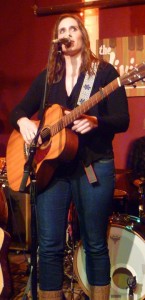
One of the first musical artists I chanced upon when I discovered the terrific Canadian indie music scene on CBC Radio 3 was the spellbinding Maritimes-born singer-songwriter Rose Cousins. I put her classic, “White Daisies,” a poetic tale of love and loss, in one of the first personal playlists I made on the Radio 3 website and have listened to it many times with its great vocal and concluding verse,

“You sent me flowers when you were strong/You were my baby, a whole year long/All you could tell me is how I’d done you wrong/Now I’ve got white daisies and a lonesome song.”

I was excited last month when I heard Rose would be performing in New York City at the Living Room, a great venue to enjoy acoustic and roots music and lightly amplified rock ‘n roll. When I arrived breathless last night, cutting it way too close for the announced 8:00 start time, I saw a very full room, and wondered where or if I might find a seat. When I saw there was no one at the door taking cover charge money, I realized that the gig was actually a release party for Rose’s new album, “We Have Made a Spark.” Someone was already saving the first seat I tried, but on my second attempt found a chair right in front of the low stage, closer to Rose and her mic than anyone else’s in the room. She was only moments from beginning her set when I shrugged off my coat and settled in to my seat.

The stage at the intimate Living Room was crowded with the excellent band she’d gathered around herself in Boston where the new album was recorded–with Charlie Rose on banjo and pedal steel; album producer Zachariah Hickman, plucking and bowing an upright bass and sporting a handlebar moustache; Sean Staples seated, on a battery of acoustic guitars; Billy Beard on drums and other percussion, playing great thumping beats; Austin Nevins on a big, gorgeous hollow body Gretsch electric guitar making tasty licks; Dinty Child, on an eight-string (!) acoustic guitar, banjo, and piano; and Ana Ege singing backup vocals, who was seated at the same table as me when she wasn’t singing. Rose sang beautifully and feelingly, moving between her Martin guitar and the piano tucked in the far corner of the stage. In her songwriting she boldly knits her heart to her sleeve, and in her vulnerability asks her listener to do the same. “Spark’ is a very intimate and personal set of new songs that began growing on me instantly. I had heard Radio 3 hosts Grant Lawrence and Lisa Christiansen say that she also has a great stage presence, often engaging in witty and self-revealing banter. This reputation is deserved, as she introduced virtually every song with a bit of story and a personal truth.

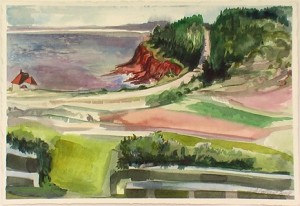
After the gig it was a treat to introduce myself to Rose, and tell her that I love her home province of Prince Edward Island. I mentioned that my wife, artist Kyle Gallup, painted gorgeous watercolors when we vacationed there a few years ago, and she replied that her grandma had also painted PEI’s lovely shores and red sand beaches. One of Kyle’s pieces is below, a PEI scene titled, “Doyle’s Cove, North Rustico, 2008.” 
Men in Trees

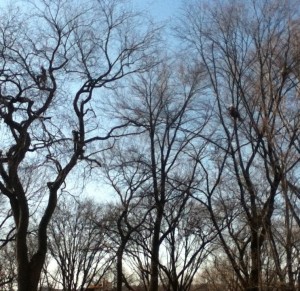
Riding my bicycle uptown on Riverside Drive in Manhattan on Wednesday, parallel to the Hudson River at around 119th Street, I was surprised to see a convoy of vans all parked on the sidewalk adjacent to the road, where one usually sees dog walkers and strollers. I pulled over to ascertain why this posse of vehicles might be there, and then heard voices and shouts from overhead. I looked up and saw men in hard hats with ropes tied around their waists way up in the high limbs of the trees. There must have been ten of these guys, all a good 40 to 50 feet above the ground. They were wielding handsaws and trimming limbs which then fell to the earth below. Over the past couple years, New York City has suffered some tragic incidents where tree limbs have fallen on pedestrians and killed them, so I figured I was witnessing the trimming of dead limbs for public safety. The amazing thing was there was no cherry picker at hand, or FDNY vehicle that had helped them attain those heights–these guys all looked as if they had rappelled up in to the trees, or somehow hauled themselves up to where they could stand on those distant limbs. I took out my IPod Touch and against the backdrop of the late afternoon sky, took a couple pictures, hoping I would be able to view them later and assure myself that I had not just seen a New York apparition. After taking those shots, I got back on my bike, marveling that the New York City I love is always capable of presenting me with another unexpected sight. I never know where the next one might come from, right in front of my eyes, or up above me in the trees.

#Fridayreads/March 2

#FridayReads Misogyny, the late Jack Holland’s modern classic, a thorough study of what he calls “The World’s Oldest Prejudice,” to help me understand current events. Just starting If The Dead Rise Not, an electric Bernie Gunther WWII-era thriller by Philip Kerr.

Lonesome Death of a Teen Actor

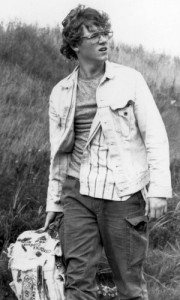
I never watched the Canadian TV show “Degrassi Junior High,” which the CBC broadcast from 1987-91, but I’ve been very touched by two recent articles about the strange, sad death of one of its teenage stars, Neil Hope, who played the character “Wheels.” Hope died alone in a Hamilton, Ontario rooming house in 2007, and was buried in an unmarked grave; surviving family members only recently learned of his lonesome passing at age 35.

In a piece for Newsweek/Daily Beast, Glynnis MacNicol, a Canadian writer living in New York, writes

“It’s painful to imagine anyone’s life ending on such a sad, unobserved note—but doubly so when one considers how deeply Hope’s TV persona resonated with an entire generation of Canadians. . . . Unlike their American counterparts, Degrassi kids were not a pretty or polished group. They looked pretty much like any other group of kids at that age at that time. They looked like the kids you went to school with. And they might have been; for the most part the producers of the show cast regular kids with no acting experience. As one of my Canadian friends put it to me when I broke the news to her, ‘Nobody on Degrassi was perfect. Everyone was ugly, full of embarrassing hair, zits, glasses. The girl in the wheelchair was really in the wheelchair. . . . It was honest.’”

MacNicol explains that the program was a realistic, veritable docudrama, about a group of Toronto adolescents struggling with the rites of passage that young people sometimes experience–substance abuse, pregnancy, and alienation from their families. In a New York Times obituary published this week, five years after the death of its subject, reporter Paul Vitello writes

“‘Wheels’ was a boy who stumbles through misfortunes before drifting into alcoholism, [drawn] broadly on the life of Mr. Hope, who never had formal acting training. . . . After the show’s end in 1991, [he] spoke openly about the wages of alcoholism, revealing that he was the child of alcoholics who had virtually abandoned him and had fed their drinking on his TV earnings. He said he wanted to convey a message to other teenagers whose parents were substance abusers: ‘It’s nothing to be ashamed of. Because it’s not your fault.'”

He was 19 when the program’s run ended.