Tag Archive for: publishing

Looking Back on 2025, Another Productive and Creative Year in Writing, Editing, Consulting, and Agenting

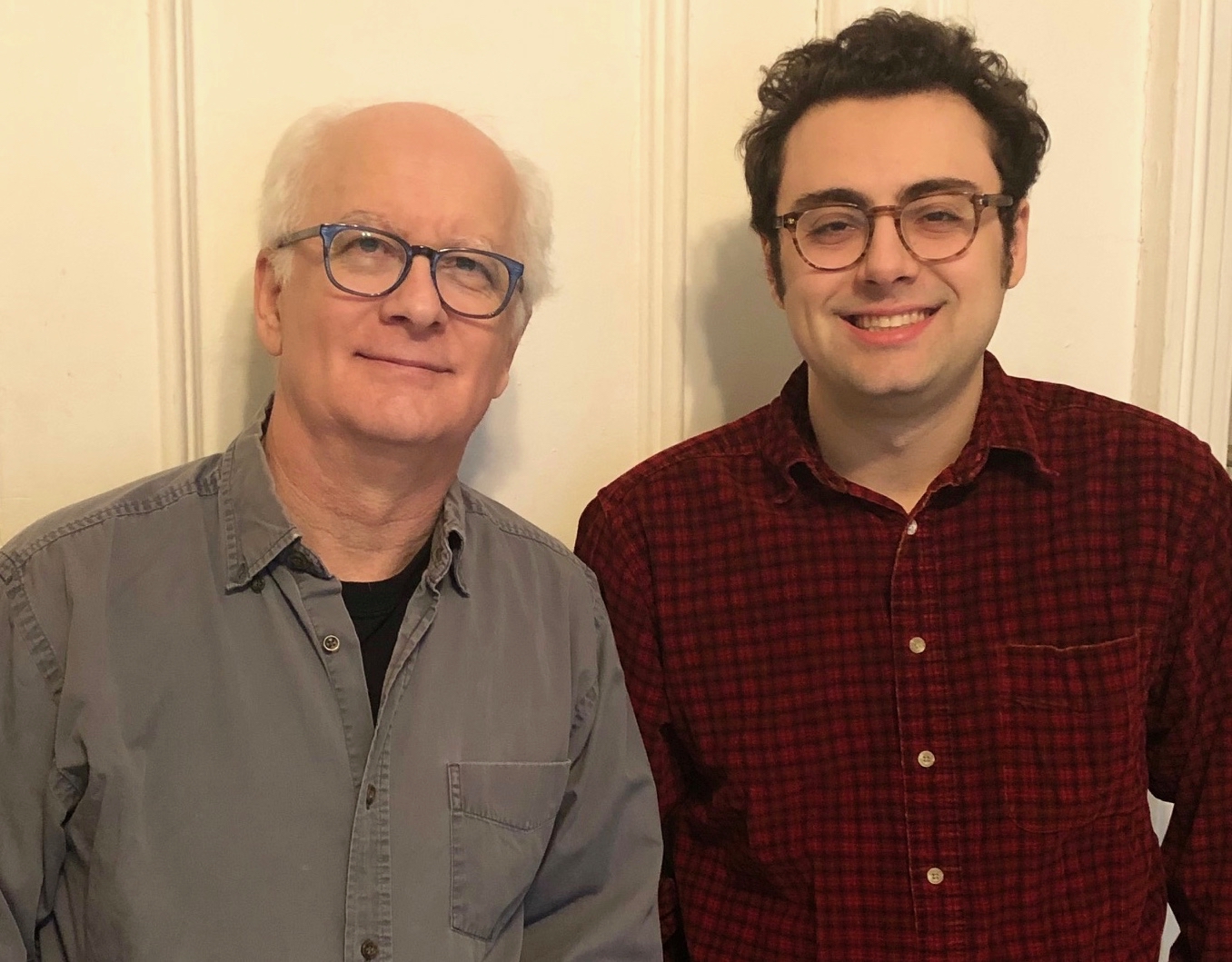
2025 was another banner year for Philip Turner Book Productions, the editorial services consultancy joined to a literary agency that I established in 2009, where I was joined by my adult son Ewan as full business partner in 2020. Before listing the business’s milestones last year, I want first to catalog what Ewan, who publishes as M. G. Turner, accomplished in the past twelve months.

1) I sold his first full length short story collection City of Dark Dreams: Tales from Another New York to DarkWinter Press, a Canadian publisher that specializes in horror and gothic fiction, with great distribution in the U.S. Incorporating the mysterious and the macabre, the 25 tales—selected from a larger body of work M. G. calls the Neighborhood Legendarium—explore life and death, ponder whether mortality can be circumvented, imagine dreams impinging on reality, and find the uncanny in the everyday. Melding the collection into a unified whole is the setting, the Upper West Side of Manhattan and a fictional college, Hudson University, which introduces a dark academia motif. The characters populating this world intersect and influence each other’s lives, akin to the storytelling in David Lynch’s “Twin Peaks.” It will be released in January 2027.

2) M. G. published three chapbooks. Dreams of the Romantics, a story cycle that was inspired by the fateful gathering during the Year Without a Summer at Villa Diodati in 1816, when Lord Byron challenged each of his friends to write a scary story and Mary Shelley began writing the manuscript that would become Frankenstein; Roman Visions, stories inspired in part by The Aeneid, in which M. G. imagines a recovered last chapter of Virgil’s epic; andReader Faustus, a novella-in-verse, which zeroes in on today’s zeitgeist as a young poet exchanges his soul with the devil for the opportunity to read every book ever written; this chapbook includes two other Faustian-themed stories by M. G., and an essay I wrote in my college days, “Faust, Man and Myth,” all of which make this a veritable museum of Faust.

The three chapbooks books range in page count from 96 to 116 pages, and the suggested list price of each is between $18-$20. However, as a New Year’s deal, we’re offering them at a special price of $11 each, or the 3-book bundle for $30. For ordering information, please contact us at ptbookproductions[@]gmail[.]com.

3) The chapbooks were reviewed four times. Two reviews were from the excellent Canadian publication The Seaboard Review of Books, which wrote generously about all three titles. Dreams of the Romantics was also reviewed favorably by Weird Fiction horror critic S. T. Joshi in his periodical Spectral Realms, and by Vermont folklorist Joseph A. Citro in his social networks.

4) Two of the chapbooks, Dreams of the Romantics and Roman Visions, are available in NYC bookstores: Book Culture on Broadway near 114th St and Westsider Books on Broadway near 79th St.

5) Dreams of the Romantics was purchased by Old Dominion University for their book collection, The Perry Library, with the possibility of it being used as teaching material.

6) M. G.’s gothic short story “The Apparatus” was selected for The Promethean Archives an anthology published in July by indie press The Words Faire of Dayton, Ohio.

7) A personal essay by M. G. on movie special effects pioneer Ray Harryhausen was published in the Winter 2025 issue of Videoscope Magazine.

8) M. G.’s successes this year were highlighted in the block association newsletter for our Manhattan neighborhood (page 11).

9) M. G. also completed a novella, his longest individual work to date, along with numerous short stories.

10) To cap off this exciting year, quite by happenstance, on December 30th a candid photograph of M. G. browsing in a Barnes & Noble bookstore was published in the New York Times’ year-end summary of publishing and bookselling.

11) Essays and stories by M. G. can be found via this link on our website.

On the editorial side of our business, we worked with 16 authors, editing their manuscripts and book proposals, and consulting with writers on a number of book ideas. For the Mayo Clinic Press, I was contracted to edit the manuscript of Face in the Mirror: A Surgeon, a Patient, and the Remarkable Story of the First Face Transplant at Mayo Clinic by Jack El-Hai, which was published in 2025; El-Hai’s excellent book The Nazi and the Psychiatrist, was recently adapted into the major movie “Nuremberg.”

On the agency side, in addition to City of Dark Dreams: Tales from Another New York cited above, we made multiple deals with book publishers for titles that will be published in 2026 and beyond; in addition, we received royalty income from past sales for 15 authors, and are currently submitting to publishers several of the book proposals and manuscripts that we edited. These are some of the books we licensed in 2025:

Home equity expert, small business owner, and bank executive Sue Pimento’s Your Retirement Reset: How to Convert Home Equity into Financial Security, giving Canadian seniors and near-seniors the resources and confidence they need to navigate many complex decisions as they plan for and execute a comfortable retirement, to Jennifer Anne Smith at ECW Press, for publication in Fall 2026.

• First Great Sorrow: My Years with Senator Robert Kennedy, a memoir by Donna Chaffee, sold to Usher Morgan of Library Tales, to be published in June 2026.

Deep Story: A Practitioner’s Guide to Creating Transformative Attractions, Destinations, and Guest Experiences—A Guide for Leaders, Creators, and Teachers by Bob Rogers a business book by America’s foremost designer of themed and historical attractions, the manuscript for which we also had a hand in editing; to Peter E. Randall Publishers, for publication in 2026

• John McGraw: The Tumultuous Life and Times of Baseball’s ‘Little Napoleon’ by Daniel R. Levitt. This will be the first full biography of the New York Giants’ legendary player-manager in two decades, sold to University of Nebraska Press for their stellar sports list.

And we are currently submitting a number of proposed books to editors at publishing houses, including a narrative history of surgery going back to the ancient world; a book about the aftermath of the JFK assassination; a natural history book about butterflies and music; and a novel by a Ukrainian emigre writer now living in Ireland.

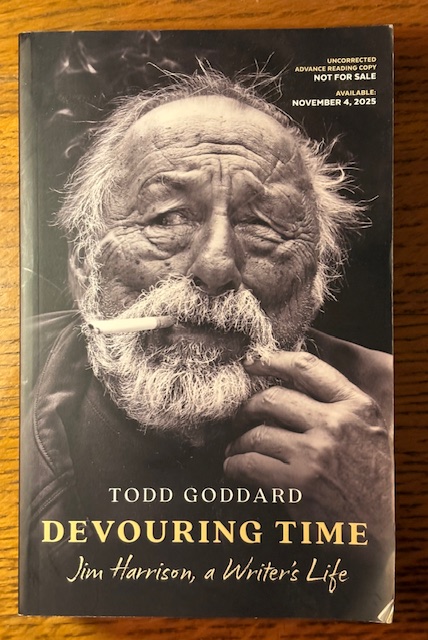
In November 2025, we were thrilled with the publication of our agency client Todd Goddard’s superb biography, Devouring Time: Jim Harrison, a Writer’s Life, published in hardcover, audio, and ebook by Blackstone. The author undertook a vigorous national book tour with numerous stops at bookstores in Montana, Michigan, Mississippi, and Utah, with more appearances coming up in 2026 including Florida and New York City. The book received stellar reviews, including this one from Isaac Randel of Foreword Reviews, who wrote in part, “Drawing on intimate gossip and rigorous critical scholarship…Devouring Time is the first full-scale biography of Jim Harrison, the mold-breaking and large-living man of letters who transformed the literary landscape of his time….A meticulous, loving biography of one of the twentieth century’s most exuberant literary personalities.”

Todd Goddard and I have also licensed the rights for a feature documentary based on Devouring Time to the excellent filmmaker Matthew Miele, who’s made earlier films on Paddy Chavesky and the Carlyle Hotel. Philip Turner Book Productions looks forward to continuing to represent Todd Goddard on future literary projects.

Other books we’d licensed in previous years were published last year, including

• Man in the Iron Mask (Pegasus Books, April 2025), a new translation of Alexandre Dumas by Lawrence Ellsworth. The culmination of Dumas’s swashbuckling saga, set at the glittering court of King Louis XIV, with adventures ranging from the grim fortress of the Bastille to battles on the wild coast of Brittany, in which the Musketeers intrigue, romance, and fight alongside each other. Ellsworth has translated a number of titles in the Musketeers Cycle including The Three Musketeers.

• Shakespeare Theatre Company: The History of a Classical Theatre (September 2025, Peter E. Randall Publisher) by Alexis Greene. A history of one of America’s great classical theaters, the Shakespeare Theatre Company of Washington, D..C., whose roots stretch back to the Folger Shakespeare Library and colonial America. Greene is also author of Emily Mann: Rebel Artist of the American Theater (Applause Books, 2019). To Peter Randall Publishing.

• Scared by the Bible: The Roots of Horror in Scripture (Morehouse Publishing, October 2025) by Brandon Grafius. A practical and spiritual guide to reading the horror stories in the Bible which builds on the author’s illuminating readings of challenging texts from scripture, to Church Publishing, Grafius is also the author of Lurking Under the Surface: Horror, Religion, and the Questions that Haunt Us (Broadleaf Books, 2019).

The Pot Thief Who Studied Calvin, the tenth book in the popular POT THIEF mystery series by J. Michael Orenduff, our longest-tenured agency client who we’ve been representing since 2010, was published by Open Road Media in January 2025. With Open Road, Orenduff, also published his first nonfiction book, The Ten Commandments: Updated, Condensed, and Improved, which provides readers with a fresh look at a familiar text.

Additionally, two audiobooks of books by our authors were published last year:

Our Woman in Havana: A Diplomat’s Chronicle of America’s Long Struggle with Castro’s Cuba, by Vicki Huddleston, which we licensed to Overlook Press in 2018; the audiobook came out from Tantor Media,

The Baby Thief: The Untold Story of Georgia Tann, the Baby Seller Who Corrupted Adoption, a revelatory book by Barbara Bisantz Raymond. Working from her mis-named Tennessee Children’s Home Society, Tann stole, bartered, and brokered more than 5,000 children from unwed mothers and poor Appalachian families from the 1920s through the 1950s, selling them to wealthy clients around the country including in Hollywood, where actors Dick Powell, Lana Turner, and Joan Crawford were among her clients. I edited the manuscript while an editor with Carroll & Graf Publishers in the mid-2000s. It was a Publishers Weekly Best Book in 2007, and changed the face of adoption, leading many states to open their adoption records. The book was awarded an “Angels in Adoption” citation from the US Congress. After Lynn Franklin, the author’s longtime agent, died a few years ago, the author asked Philip Turner Book Productions to be her new agent. We’re also aiming to license a new trade paperback edition in the future.

A number of books we’ve licensed in previous years are set to be published in 2026 or 2027, including

The Ice On The Lake, a debut novel by Alex Messenger, about a late middle-age man haunted by past tragedies, mistakes, and the children he’s pushed away. After a medical diagnosis prompts him to begin making amends with his estranged daughter, he goes missing while ice fishing on Lake Superior; a story of redemption and survival set in the wild environs of the frozen north, to Blackstone Publishing, by the author of the Wall St Journal bestseller, The Twenty-Ninth Day: Surviving a Grizzly Attack on the Canadian Tundra (Blackstone, 2019). Messenger’s novel has already received this enthusiastic endorsement:

“Alex Messenger is a sensational writer, and The Ice on the Lake is a mesmerizing tale of loss, love, and redemption. Equal parts survival story and psychological reckoning, this book manages to thrill even as it gets to the heart of what it means to be alive. It’s also a magnificent portrait of Lake Superior and all her many moods and depths. I couldn’t put it down, and I already can’t wait to read whatever Alex writes next.”—Peter Geye, author of A Lesser Light

• Feeling Our Way Through the Bible: Interpreting Scripture with Emotions (Baker Academics) by Brandon Grafius, author of the above-named Scared by the Bible. This book for students and scholars will demonstrate how emotional responses to a biblical text can help readers understand difficult passages in the Bible.

• Versions and Subversions: The Cover Songs That Changed Music by Nate Patrin (University of Minnesota Press). A wide-ranging examination of the place the cover version holds in popular music. Starting from the premise that the rise of the singer-songwriter in 1960s pop music put a renewed emphasis on the potentially transformative relationships between a song’s author and its performer(s), Patrin’s new book takes a kaleidoscopic and unpredictable view of the way musicians both renowned and obscure have found new means of expression through the works of others. Examples include Aretha Franklin’s cover of Otis Redding’s “Respect”; Run-D.M.C.’s genre-bending revival of Aerosmith’s “Walk This Way”; and Johnny Cash’s world-weary cover of Nine Inch Nails’ “Hurt.” Patrin is previously author of Bring That Beat Back: How Sampling Built Hip-Hop and The Needle and the Lens: Pop Goes to the Movies from Rock’n’Roll to Synthwave, published by UMP in 2019 and 2022, so the new book should be seen as the third in a trilogy of books by Patrin about the surprising ways in which songs are given additional life through new contexts.

• “I’ve Got the Shakes”: Performing Richard Foreman by Shauna Kelly (Applause Books). A sparkling curation of interviews and writings from cast and crew discussing their experiences working with Richard Foreman (1937-2025), who wrote and directed award-winning plays for forty-five years at the Ontological-Hysteric Theater (OHT) in SoHo, the East Village, at the Public Theater, and around the world, exploring Foreman’s philosophy, legacy, creative methods, and artistic values, and providing insight about the careers of theater artists such as Willem Dafoe with roots in off-off Broadway. The Foreword to the book is by Helen Shaw, recently named Theater Critic of the New York Times.

•  Wallace Terry: A Reporter’s Journey from Selma to Saigon toBloods (High Road Books, University of New Mexico Press) by Ray E. Boomhower, out in October 2026. The first-ever biography of Terry (1938-2003), who spent his life smashing barriers as a Black journalist, first in his hometown of Indianapolis, all the way to the nation’s capital at the Washington Post and Time magazine (becoming the first Black correspondent working for a major U.S. news magazine) and then overseas during the Vietnam War, where he chronicled Black service members as no one ever had before him.  With University of New Mexico Press Boomhower is also author of Richard Tregaskis: Reporting Under Fire from Guadalcanal to Vietnam and The Ultimate Protest: Malcolm Browne, Thich Quang Duc and the News Photograph that Stunned the World.

Who’s To Blame for Putin? Reassessing Russia’s Lost Chance for Democracy (Reaktion Books, London) by Amy Knight. Thirty-five years ago many in the West hoped that Russia was embarking on a future of unprecedented political freedom. Today the countries of Eastern European that were under the Soviet yoke are democracies and members of NATO and the EU, while Russia has retreated to a form of governance that echoes the Stalin era. Knight’s new book will examine how this occurred. Amy Knight is also author of Orders to Kill: The Putin Regime and Political Murder (St Martin’s Press, 2017) and The Kremlin’s Noose: Putin’s Bitter Feud with the Oligarch Who Made Him Ruler of Russia (Cornell/Northern Illinois University Press, 2024).

And the above-mentioned City of Dark Dreams: Tales from Another New York by M. G. Turner, which DarkWinter Press of Ontario, Canada, will publish in January 2027. We’ve already received this endorsement of the collection:
“Anyone who enjoys Poe, Robert Chambers, M.R. James, and other 19th-century writers will enjoy this collection; those who have been put off by the sometimes archaic language of some gothic writers will find M. G. Turner’s work more accessible. Don’t look for splatter, though, as these tales aim to disturb the mind and the heart rather than the stomach. American horror fiction would be immeasurably better off, in my opinion, if more writer’s followed Turner’s example.”—Graeme Davis, editor Colonial Horrors: Sleepy Hollow and Beyond (Pegasus Books, 2017, an anthology we licensed to the publisher on behalf of the editor)

I want to also note with sadness the passing in September of my longtime author and good friend, Elaine Dewar, age 77. Elaine was a very accomplished journalist and author who specialized in reporting on and writing about challenging subjects, especially cutting-edge science as it intersected with culture, business, and society. I had the privilege of working with her on four of her seven books. Beyond our strong professional links, she was a tremendously steadfast friend—having my wife and I stay in a comfortable bedroom in her home numerous times when visiting Toronto, always reminding us that it was there for a getaway when needed. She also had my back after 2009, the year that I became an independent editorial provider in the book business, with me no longer holding an in-house publishing position. I will always think fondly of Elaine, and her husband Stephen Dewar (d. 2019), seated at the breakfast table in their cozy kitchen, CBC Radio program Metro Morning on the dial, newspapers open, when I came down for a morning meal, and they each greeted us with humor and charm.

I also note the passing last year of my longtime close colleague Herman Graf (1933-2025), who founded the publishing company Caroll & Graf, where I worked with him from 2000-07. As he was remembered in the NY Times, Herman was “A raconteur with a booming voice [and] a bibliophile who loved the works of Stendhal and Thomas Mann. His apartment in Queens was filled with books, many of them first editions. And he was a relentless, and boisterous, salesman for Grove Press, where he spent the better part of two decades.”

Last, among people I admired who passed last year, I want to note David Pryce-Jones (1936-2025), a true person of letters, the like of which there are few examples today. Foreign correspondent, memoirist, essayist, novelist, devoted letter writer, and biographer of Unity Mitford, one of the five Mitford sisters, who had a notorious romance w/ Adolf Hitler in the 1930s. For writing about her life some members of the Mitford family sued Pryce-Jones for libel, intent on suppressing the book, while some upper crust Brits inveighed against Pryce-Jones for spotlighting deep currents of anti-semitism in British society; he was Jewish, and as a three-year old had been evacuated from France when WWII began. Pryce-Jones was faced with a decision to halt publication, or go forward, despite the threat of significant money damages if he lost in court. He didn’t back down, and was vindicated; the book is still in print today. I eulogized him a post last month: A True Man of Letters Whose Work Revealed Anti-Semitism in the UK.

Please be in touch if you want to discuss your book ideas! Contact us at ptbookproductions[@]gmail[.]com.

Powerful Endorsements for “Devouring Time: Jim Harrison, a Writer’s Life” by Todd Goddard

September 15, 2025 update:

Along with all the terrific endorsements the author and publisher have received for Devouring Time: Jim Harrison, a Writer’s Life by our agency client Todd Goddard (shown below), we now also have an enthusiastic Publishers Weekly review (“A perceptive account of a prolific and celebrated artist.”), which was quickly shared by the proprietor of the popular Jim Harrison Author Page on Facebook**, where it’s generating more enthusiasm and pre-orders ahead of the book’s launch on November 4.
—-

As announced previously on this website, Devouring Time: Jim Harrison, a Writer’s Life by our agency client Todd Goddard, the first biography of the notable American author, will be published on November 4, 2025, in hardcover, audiobook, and ebook by Blackstone Publishing. The book has garnered powerful endorsements so far, from writers Gretel Ehrlich, Rebecca Solnit, Colum McCann, Carl Hiassen, John Matteson, William Souder, and Jim Fergus, as shown below.

If you’re interested in pre-ordering the book, here are links for doing so:

Bookshop.org (Bookshop is an online bookseller whose sales support  independent bookstores), 2) Barnes & Noble, 3) Books-A-Million, and 4) Amazon.

Advance Praise for Devouring Time: Jim Harrison, a Writer’s Life by Todd Goddard

Devouring Time is a massive achievement, a deep plunge into the life of Jim Harrison whose 40 books of fiction, nonfiction, and poetry line our shelves. Atavistic, inspired, despairing, gluttonous, turbo-charged, and broken-hearted, the gut strings of what drove Harrison are plucked, page by page until his high-wire obsessions, his “beggar’s banquets” of eating, drinking, traveling, and writing finally recede. What lasts are the words.”—Gretel Ehrlich, author of The Solace of Open Spaces and Unsolaced: Along the Way to All That Is

“Jim Harrison was a mustang that never got corralled, or at least broke out of all the paddocks he found himself in, and Todd Goddard tells the story of this bon vivant, outdoorsman, hellion, and great poet from his ancestors to his end with grace, momentum, generosity, and insight. I was more than glad to go on the journey that was Harrison’s life in Devouring Time’s narrative, and what a great American life it was, wreckage, glory, gifts, and all.”—Rebecca Solnit, author of Orwell’s Roses

“Jim Harrison is and always will be one of my great heroes. He emerges from Todd Goddard’s splendid Devouring Time in vivid technicolor, and indeed shadow, as if he could walk off the page at any moment, sounding out his American yawp. Gracefully rendered and impeccably researched, Goddard intimately charts the free-flowing river that was Harrison’s life, its headwaters and tributaries, the glistening shallows and eddies, and the dark charging currents that carved channels through the literary landscape. His timeless poetry and fiction, singular joie de vivre, boundless appetites and intellect, as well as his unerring commitment to wisdom and wildness, resound on every page. One of our most cherished writers, Jim Harrison has landed in the hands of a worthy biographer. An absolute pleasure to read, Devouring Time resonates with me still.”—Colum McCann, author of Let the Great World Spin and Apeirogon

“My friend Jim Harrison always seemed a fiercely untameable subject for a biographer, but I think Devouring Time will stand as a complete and moving portrait. Jim was one of those rare writers whose private life was as adventurous as their works, but only a dogged journalist could have tracked down all the tales. Todd Goddard tells the whole story in a way that Jim would have admired – raw and revealing, yet with a sensitive eye for both the pain and the talent that made Jim one of modern America’s most intriguing poets and novelists.”—Carl Hiaasen, author of Bad Monkey and Fever Beach

[caption id="attachment_18927" align="alignright" width="202"] Jim Harrison, Paris, 1971. Credit: Dan Gerber[/caption]

“Jim Harrison lived a big life, and he has long deserved a gargantuan biography, both in size and spirit. And this is what Todd Goddard has given us. All by itself, the meticulously rendered story of how Harrison’s prose masterpiece Legends of the Fall came into being would be ample reward for the curious reader. But Goddard has given us immeasurably more. Impeccably researched, sensitively written, Devouring Time gives us a man — one who experienced the very depths of pain but found there the building blocks of enduring art. Cruelly battered by adversity, Harrison nevertheless infused his world with transcendent song. Read in conjunction with his own work, Devouring Time completes his testament.”—John Matteson, Pulitzer-Prize-winning author of Eden’s Outcasts: The Story of Louisa May Alcott and Her Father

“A feast of a biography that does full justice to a writer whose vast appetites…for books, food, sex, success, and a life in the wild…fueled a prodigious and prolific talent. Sweeping yet judicious, written with grace and restraint, Devouring Time deftly captures a life that veered between exhilaration and despair, impoverishment and acclaim. A keen-eyed and sensitive interpreter of Harrison’s writing, especially his poetry, Todd Goddard also grapples with his subject’s manifold excesses and insecurities. Harrison’s long marriage to his wife Linda, to whom he was serially unfaithful but never faithless, anchored his tempestuous personality. Their often-challenged devotion to each other is the beating heart of this moving portrayal of an artist who craved domesticity but could never live entirely within its boundaries. An exquisite, indelible book.”—William Souder, author of Mad at the World: A Life of John Steinbeck

“Let me just say upfront that any other writers who are working on, and/or planning to write a biography about the life and times of poet/novelist Jim Harrison, I would suggest that you hang up your pens and pencils, fold up your laptops, and turn your literary attentions elsewhere. Todd Goddard here delivers the most definitive possible such work, a book brilliantly constructed, comprehensive and artfully written.

I was a close friend of Jim Harrison’s for thirty-seven years (among, of course, many others) right up until the evening of his death. I thought in that time (as many of us did) that I had heard virtually all of Jim’s stories, some more than once, for he was a consummate storyteller, frequently with alternate versions of his tales, and never too shy to talk about himself.

Herein are the rich details of the life and career of one of America’s sometimes overlooked literary geniuses, a man devoted to his art, who pushed his talents, and body, to the limit, from the rarefied world of poetry, to fiction and novels, to screenplays on the other end of the spectrum. Along the way, the reader will learn a great deal about the complicated and sometimes cutthroat literary and film businesses, as well as meet a vast array of friends, family members and colleagues who peopled Jim’s world.

There are no punches pulled here; like so many creative geniuses, Jim Harrison had his dark side, fueled by alcoholism of which he himself was more than well aware. This is a big book, and not just in size, that tells the story of an extraordinary character unlike any other, a man so totally out of the ordinary, that those of us who knew him personally, forgive him all his excesses, remember his humor and generosity, and will miss his presence on earth until the day we die.”—Jim Fergus, author of One Thousand White Women: The Journals of May Dodd

**

Looking Back on 2024, Another Productive and Creative Year in Editing, Consulting, and Agenting

This week I began totaling up the volume of business for Philip Turner Book Productions in 2024, to prepare to send agency clients a full accounting of monies we received from publishers for them in the past year, and to write this annual year-end blog post. I’m pleased to note the figures confirm how it felt while we were working all year—2024 was another very productive year for the company that I founded in 2009, which I began operating with my adult son Ewan five years ago.

It’s fun and rewarding to work with Ewan, a knowledgeable colleague and partner whose instincts and judgment I trust completely. He began as Managing Editor, and then in 2022 was promoted to Executive Editor and Co-Literary Agent. The dual role is emblematic of our makeup as a joint editorial services consultancy and literary agency.

Ewan is also a very talented creative writer who publishes his own fiction under the pen name M. G. Turner. His personal essay, “Ray Harryhausen: A Remembrance,” on the movie special effects pioneer, along with his review of Harryhausen’s classic movie “Jason and the Argonauts,” will be published in the Winter 2025 issue of Videoscope Magazine. All his writings on this website—personal essays and short stories—can be viewed via this link.

In January, Ewan will also be publishing a book of his own, Dreams of the Romantics, a story cycle about Lord Byron, Mary and Percey Bysshe Shelley, and their poetic circle. It’s an interconnected series of tales written in a gothic vein. It will come out under the rubric of Riverside Press, a new book imprint devoted to publishing belles-lettres titles of Ewan’s work and other writers. If you’d like to have a copy of ordering info for Dreams of the Romantics, we’ll be sharing ordering information in a few weeks.

A creative highlight of the past year for me was the opportunity I had to interview Canadian historian  Ken McGoogan at the Explorer’s Club in Manhattan for his latest polar book Searching for Franklin: New Answers to the Great Arctic Mystery. I posted an essay about the event for this blog, “In Conversation w/Canadian Author Ken McGoogan at The Explorer’s Club in NYC.” Our conversation can also be viewed on youtube. My writings on this website can be viewed via this link.

Looking back on the year that ends next week, Ewan and I note that,

  • On the editorial side, we worked with a total of nineteen authors, editing manuscripts and book proposals, and consulting with writers on a number of different book ideas;
  • On the agency side, we made ten new deals with book publishers and audiobook publishers for titles that will be published in 2025 and beyond; in addition, we are currently submitting a number of the above book proposals to publishers—such as a narrative nonfiction about domestic violence, a biography of one of Major League Baseball’s greatest player-managers, a memoir about Senator Robert F. Kennedy, and a novel in stories set in a surreal New York City by Ewan, writing as M. G. Turner;
  •  With a backlist of author clients whose books we began licensing over a decade and a half ago, we also paid out advances and ongoing royalties from various publishers to seventeen different authors and rights holders.

The books we licensed in 2024, to be published in 2025 unless otherwise noted:

  • Black Witness: Journalist Wallace Terry, the Civil Rights Crusade, Vietnam, and Bloods by Ray E. Boomhower. The first-ever biography of  Terry (1938-2003), who spent his life smashing barriers as a Black journalist, first in his hometown of Indianapolis, all the way to the nation’s capital at the Washington Post and Time magazine (becoming the first Black correspondent working for a major U.S. news magazine) and then overseas during the Vietnam War, where he chronicled Black service members as no one ever had before him. To High Road Books, University of New Mexico Press (UNMP) for publication in 2026; for more on Boomhower’s books with UNMP please see below under the rubric of books published in 2023-24.
  • Who’s To Blame for Putin? Reassessing Russia’s Lost Chance for Democracy by Amy Knight. Thirty-five years ago many in the West hoped that Russia was embarking on a future of unprecedented political freedom. Today the countries of Eastern European that were under the Soviet yoke are democracies and members of NATO and the EU, while Russia has retreated to a form of governance that echoes the Stalin era. Knight’s new book will examine how this occurred. To Reaktion Books in London, for publication in 2026; for more on Knight’s books see below under the rubric of books published in 2023-24.
  • The Ice On The Lake, a debut novel by Alex Messenger, about a late middle-age man haunted by past tragedies, mistakes, and the children he’s pushed away. After a medical diagnosis prompts him to begin making amends with his estranged daughter, he goes missing while ice fishing on Lake Superior; a story of redemption and survival set in the wild environs of the frozen north, to Blackstone Publishing, by the author of the Wall St Journal bestseller, The Twenty-Ninth Day: Surviving a Grizzly Attack on the Canadian Tundra (Blackstone, 2019).
  • “I’ve Got the Shakes”: Performing Richard Foreman by Shauna Kelly. A sparkling curation of interviews and writings from cast and crew discussing their experiences working with Richard Foreman, who wrote and directed award-winning plays for forty-five years at the Ontological-Hysteric Theater (OHT) in SoHo, the East Village, at the Public Theater, and around the world, exploring Foreman’s philosophy, legacy, creative methods, and artistic values, and providing insight about the careers of theater artists such as Willem Dafoe with roots in off-off Broadway. A new play by Foreman, now eighty-seven, was recently reviewed by Ben Brantley, NY Times Theater Critic. To Applause Theater and Cinema Books.
  • Shakespeare Theatre Company:  An Illustrated Biography of a Classical Theatre by Alexis Greene. A history of one of America’s great classical theaters, the Shakespeare Theatre Company of Washington, D..C., whose roots stretch back to the Folger Shakespeare Library and colonial America. Greene is also author of Emily Mann: Rebel Artist of the American Theater (Applause Books, 2019). To Peter Randall Publishing.
  • Man in the Iron Mask, a new translation by Lawrence Ellsworth. The culmination of Dumas’s swashbuckling saga, set at the glittering court of King Louis XIV, with adventures ranging from the grim fortress of the Bastille to battles on the wild coast of Brittany, in which the Musketeers intrigue, romance, and fight alongside each other. To Pegasus Books; for more on Ellsworth’s books see below under the rubric of books published in 2023-24
  • Versions and Subversions: The Cover Songs That Changed Music by Nate Patrin. A wide-ranging examination of the place the cover version holds in popular music. Starting from the premise that the rise of the singer-songwriter in 1960s pop music put a renewed emphasis on the potentially transformative relationships between a song’s author and its performer(s), this book takes a kaleidoscopic and unpredictable view of the way musicians both renowned and obscure have found new means of expression through the works of others. Examples include Aretha Franklin’s cover of Otis Redding’s “Respect”; Run-D.M.C.’s genre-bending revival of Aerosmith’s “Walk This Way”; and Johnny Cash world-weary cover of Nine Inch Nails’ “Hurt.” To University of Minnesota Press (UMP) for publication in 2026. Patrin is previously author of Bring That Beat Back: How Sampling Built Hip-Hop and The Needle and the Lens: Pop Goes to the Movies from Rock’n’Roll to Synthwave, published by UMP in 2019 and 2022, so the new book should be seen as the third in a trilogy of books by Patrin about the surprising ways in which songs are given additional life through new contexts.
  • Scared by the Bible: A New Hermeneutics of Horror by Brandon Grafius. A practical and spiritual guide to reading the horror stories in the Bible which builds on the author’s illuminating readings of challenging texts from scripture, to Church Publishing, Grafius is also the author of Lurking Under the Surface: Horror, Religion, and the Questions that Haunt Us (Broadleaf Books, 2019)
  • Feeling Our Way Through the Bible: Interpreting Scripture with Emotions by Brandon Grafius. This book for students and scholars will demonstrate how our emotional responses to a biblical text can help us to understand difficult passages in the Bible, to Baker Academic, for publication in 2026
  • The Baby Thief: The Untold Story of Georgia Tann, the Baby Seller Who Corrupted Adoption by Barbara Bisantz Raymond. Audio rights licensed to Tantor Media. Working from her mis-named Tennessee Children’s Home Society, Tann stole, bartered, and brokered more than 5,000 children from unwed mothers and poor Appalachian families from the 1920s through the 1950s, selling them to wealthy clients around the country including in Hollywood, where actors Dick Powell, Lana Turner, and Joan Crawford were among her clients, prominent names she would cite in marketing to future customers. I edited the manuscript while an editor with Carroll & Graf Publishers in the mid-2000s. It was a Publishers Weekly Best Book in 2007, and changed the face of adoption, leading many states to open their adoption records. The book was awarded an “Angels in Adoption” citation from the US Congress. After Lynn Franklin, the author’s longtime agent, died a few years ago, Barbara Raymond asked Philip Turner Book Productions to be her new agent. We’re also aiming to license a new trade paperback edition in 2025.
  • Our Woman in Havana: A Diplomat’s Chronicle of America’s Long Struggle with Castro’s Cuba, by Vicki Huddleston, which we licensed to Overlook Press in 2018, will also be an audiobook in 2025 from Tantor Media.
  • In the popular Pot Thief mystery series—whose author J. Michael Orenduff we’ve been representing since 2010—we placed his tenth title, The Pot Thief Who Studied Calvin, to be published by Open Road Media in January 2025. With Open Road, in March 2025 Orenduff will also be publishing The Ten Commandments: Updated, Condensed, and Improved, providing readers with a fresh look at a familiar text and offering readers a new understanding of what they can mean in our time.
  • Also coming in 2025, is Devouring Time: Jim Harrison, a Writer’s Life by Todd Goddard (Blackstone Publishing), the first biography of the great American poet, fiction writer, outdoorsman, and gourmand, Jim Harrison. We’re getting a great response to Blackstone’s cover.   

In our book development role—in which we begin working with authors even before they’ve begun writing their book—we are editing proposals and consulting with authors for books on:

  • The history of surgery going back to the Greco-Roman world;
  • How people can assemble adequate wealth to assure a prosperous retirement;
  • The latest techniques to bring equity and inclusion to organizations and institutions;
  • The island of Cyprus, and its long history from antiquity to the present;
  • A knowledgeable commentator on Russia with a popular youtube channel;
  • An anthology with essays by trans athletes about their lives and sports careers.

For the record, projects we currently have on submission to publishers include

  • a memoir by the frontwoman of a popular Canadian grunge rock duo;
  • a business book by America’s foremost designer of themed and historical attractions, the manuscript for which we also edited;
  • an epistolary novel about Elvis;
  • a memoir by the first Arab jurist to serve on the Israeli Supreme Court;
    and the aforementioned:
  • narrative nonfiction about domestic violence;
  • biography of Major League Baseball’s greatest player-manager;
  • memoir about Senator Robert F. Kennedy;
  • and novel in stories set in a surreal New York City by Ewan, writing under his pen name, M. G. Turner.

For the Mayo Clinic Press, I also edited the manuscript of Face in the Mirror: A Surgeon, a Patient, and the Remarkable Story of the First Face Transplant at Mayo Clinic by Jack El-Hai, which will be published in 2025.

In 2024, I also served as a judge in the Public Scholars program of the National Endowment for Humanities (NEH), for which I served on a four-person panel reviewing applications from authors seeking grant support for their projects in American history. Prior to that, I was a juror for the Works-in-Progress Award from the Lukas Prize, sponsored by the Columbia Journalism Graduate School. In these two roles, I reviewed more than 125 nonfiction works-in-progress, many stellar projects, giving me the widest view of quality nonfiction publishing I’ve ever had.

In addition, please see books published by our clients in 2023-2024:

  • Cinema of Swords: A History and Guide to Movies about Knights, Pirates, Barbarians, and Vikings [And Samurai and Musketeers and Gladiators and Outlaw Heroes] by Lawrence Ellsworth, acclaimed translator of classic works of Alexandre Dumas including The Three Musketeers and The Red Sphinx.
  • The Needle and the Lens: Pop Goes to the Movies from Rock’n’Roll to Synthwave by Nate Patrin, Book II in Patrin’s nonfiction trilogy on the creative repurposing of popular songs, University of Minnesota Press;
  • Molyvos: A Greek Village’s Heroic Response to the Global Refugee Crisis by John Webb, Potomac Books, University of Nebraska Press;
  • Public/Private: My Life with Joe Papp at the Public Theater by Gaill Merrifield Papp, Applause Theater and CinemaBooks;
  • The Ultimate Protest: Malcolm W. Browne, Thich Quang Duc, and the News Photograph That Stunned the World by Ray E. Boomhower, High Road Books, UNMP, which also brought out his Richard Tregaskis: Reporting Under Fire from Guadalcanal to Vietnam in trade paperback, first published in hardcover in 2022;
  • How Midsummer Night: A Memoir of Friendship and Loss by Janet Somerville, Open Road Media, lauded by Stephen King as “A wonderful memoir.” Somerville was previously author of Yours, for Probably Always:
Martha Gellhorn’s Letters of Love and War 1930–1949 (Firefly Books, 2019), which we licensed to Penguin Random House audio in 2021.
  • The Kremlin’s Noose: Vladimir Putin’s Blood Feud with the Oligarch Who Made Him Ruler of Russia by Amy Knight; in addition, for Knight, with independent subsidiary rights representative Linda Biagi, we licensed The Kremlin’s Noose to publishers in Brazil and the UK, and the audiobook rights were sold to Tantor Media. In addition, Knight’s 2017 book Orders to Kill: The Putin Regime and Political Murder (St Martin’s Press, 2017) came out in trade paperback.
[gallery link="file" ids="18683,18684,18685"]


A Dispatch From the End of January

I established my company, Philip Turner Book Productions, in January 2009, fifteen years ago this month. It was the nadir of the Great Recession, only weeks after I’d been laid off in a big publisher’s downsizing; it turned out to be the last corporate house I would work for, an experience I wrote about in 2012. With that founding period in mind, I like to use the first month of each new year to take stock of the annum just ended, and try to set a course for the new one. In 2020, my adult son Ewan Turner began working in the business with me, and we had lots of new activity, so I had occasion to write full-length summaries of 2021 and 2022 which I published on this website and shared in my social networks.

This year, however, I’ve reached the end of  January without having prepared a similar summary. I just haven’t been inclined to go through the strenuous effort of a full-form look-back at 2023, not with the future rushing in. And the new year in business has gotten off a flying start, so I’ve had little time to blog. In addition to new work quickly cropping up, I’ve undertaken an interesting assignment. I’m serving as a juror for the 2024 J. Anthony Lukas Prize Project Awards, sponsored by the Columbia Graduate Journalism School. Our shortlists will be announced in late February, and a public event for finalists and awardees will be held later, in the spring. At the moment, I’m reading intensively back and forth among approximately 100 projects that are candidates for recognition. The Lukas Prize has three categories, all in nonfiction, as you can see on their website. It’s a very rewarding experience so far, and I’m enjoying working with some new colleagues.

I’ll close this post by sharing the covers of current books by authors we represent in the literary agency portion of our business, either recently published, or soon to be out in 2024. Ewan and I are hoping to do more good work this year.

Excited to Receive My Copy of “AMONG FRIENDS: An Illustrated Oral History of American Book Publishing in the 20th Century”

The Story Behind a Handsome New Book on Books

One bright spot during the dark first year of COVID came on October 10, 2020, almost three years ago. I was invited by Buz Teacher to write an essay for a book he was assembling, an oral history of bookselling and publishing in the last century. Buz had asked my publishing friend Mildred Marmur for a contribution to the forthcoming book and she advised him to ask me, too. Given that I’d been writing about writing about both subjects for more than a decade it didn’t take me long say yes.

Fortunately, I had about six months before I would have to deliver my essay. As is my wont when I have a writing assignment that I’m obliged to deliver—this is true for  writing pitch letters as an agent, or when I was an in-house editor in publishing companies and I had dust jacket copy and catalog copy to write—I fretted about it for some time without actually writing anything. I couldn’t think how I might start it. Eventually I did quit procrastinating and found a place to begin.

I handed the essay in, in June 2021, under the title “The Education of a Bookselling Editor,” clocking in at approximately 4100 words. I welcomed the opportunity to write longer than usual; personal essays on this site, like one I published here—about working with William Styron on an Introduction he wrote for Dead Run, a nonfiction narrative I edited about an innocent man on Death Row—tend to less than 2500 words.

I also handed into Buz, and his co-editor, his wife Janet Bukovinsky Teacher, about half a dozen photos and illustrations from Undercover Books, the bookstores I ran with my siblings and our parents at the start of my career,  and from some of the titles I’ve brought out as editor, which they said they hoped to use as they laid the book out. For more than two years, I’ve been wondering which ones they might use. Much time passed, but Buz kept in touch, and I had faith that the design and production of the book, and all that was necessary to make what would ultimately be a 576-page tome—the impressive volume is 9 inches wide, 11 inches tall, with a 3-inch thick spine, and weighs about nine pounds, with dozens of photos and illustrations and essays by more than 100 contributors (many of whom are bookpeople I know)—was well in hand. My confidence wasn’t misplaced—after all, Buz and his late brother Lawrence had co-founded the indie publisher Running Press back in the day.

Contributors were not being offered money as payment, but Buz promised us all a finished copy of the book, which I’m thrilled to say arrived today. This is the book’s website, where there’s a two-minute video trailer. The official publication date is in two days, September 23rd. They edited my piece lightly**, and split it into into two sections; one, headed Independent Booksellers: All in the Family, is devoted to my years as a bookseller with Undercover Books, the bookstore I founded and ran in Cleveland from 1978-85 with my siblings Joel and Pamela, and our parents, Sylvia and Earl; the second, called Literary Independents: Making a Difference, covers roughly my first two decades as an in-house editor and publisher.

As the book copy puts it,

In lively personal essays about the people, companies, and books that helped shape our culture, more than 100 prominent figures and publishing and bookselling recall their careers during a time of extraordinary growth, from the postwar period through the revolutions of the 1960s and ’70s to the new millennium. Illustrated with original photography of vintage book jackets, period graphics form Publishers Weekly and archival photos, Among Friends reveals how the book industry both reflected and responded to societal changes. This deluxe limited edition pays homage to the creative and entrepreneurial spirt of that time.”

If you’re a bibliophile or if you have a book collector on your holiday gift list, I suggest you consider buying this very special book for them. They only printed around 1600 copies, so if this is a book for you, or someone you love, I suggest you not wait to buy it, because it could sell out, and the price of it in future resale is in my opinion likely to rise in years to come beyond it’s published list price of $200.

Below is the complete essay I wrote in 2021, and below it are photos of the handsome book and the hinged box and my contributions to it. It is really a stunning book.

The Education of a Bookselling Editor

Founding Undercover Books

In 1977, while finishing my last year as an undergraduate at Franconia College, an experimental institution in the White Mountains of New Hampshire, I had intended with my bachelor’s degree in history of religion and philosophy of education, to seek a professional niche for myself promoting interfaith dialogue among Jews and gentiles. I hoped to work for an organization with a mission to combat bigotry, anti-Semitism, injustice, and intolerance. After returning to Cleveland, my hometown, I began looking in this direction, but quickly learned that, lacking an advanced degree, I was unlikely to have a chance of getting anywhere in the field. What’s more, as an émigré from traditional education—I had also attended an alternative high school, my first happy immersion in the educational ferment of the times—graduate school was the last thing I wanted to do! I may have only known it inchoately, but I sought a field in which my nontraditional education and interests would not hold me back, and might even propel me forward.

At roughly the same time, my elder siblings, out in the work world longer than I, were already plotting exits of their own from any chance they’d be relegated to humdrum working lives.

Pamela, the eldest of us three, had worked in Cleveland’s grand department stores, which had bustling book departments, and middle sibling Joel (d. 2009) had worked at Kay’s Bookstore, in downtown Cleveland, a venerable book emporium whose truculent owner Rachel Kowan kept her employees on their toes by challenging them to answer exactly where certain titles in the rambling three-floor store were shelved, along with other tests of arcane bookselling knowledge, such as which edition of Goethe’s Faust contained Parts I and II of the frequently abridged work.

Pam and Joel’s smart idea was to open, with our book-loving parents Earl and Sylvia, a new bookstore in Shaker Heights, the suburb where we’d grown up. I quickly tossed my lot in with them, at least to get the store opened, then soon found myself more involved and engaged by bookselling and the book business than I’d anticipated. We chose the name Undercover Books—invoking our passion for reading under the covers as kids, and for mystery fiction—and on May 4, 1978 opened the first of what would ultimately be three locations.

In this collection of essays about bookselling and publishing in the second half of the twentieth century, it is noteworthy that Undercover Books joined the wave of a building trend in the 1970s-80s in which retail bookselling was migrating from department stores and big downtown bookstores to indie bookstores in the suburbs of a number of cities—Pittsburgh, Detroit, Atlanta, St. Louis, Kansas City, as well as in our own downtown, where many local readers had long shopped at Publix Book Mart, run for decades by the eminent Anne and Bob Levine. However, suburbanites with readerly interests not inclined to visit downtown were under-booked, it could be said.

The space we leased in an outdoor strip shopping center—deliberately not an indoor mall—had formerly housed a shoe store where we’d shopped as kids, and was large at 2700 square feet, but the shape itself was that of a shoebox, and could’ve made for a very dull bookstore layout. Smartly though, a store designer showed us how to address this problem: beyond the front section of the store, where the cash counter and walls of bookcases displaying lots of frontlist fiction and nonfiction were displayed face-out, we could cut into the rectangular space with wooden bookcases built at 30-degree angles, lending an intimate, library-like feel to the store. With that, the Travel, Reference, Literature, Poetry, Art & Photography, Children’s, Health & Parenting, and Cookbook sections became their own quiet spaces. The opening of this attractively designed bookstore, in a suburb with a well-educated populace that had never had a bookstore within its city limits, quickly attracted the trade and appreciation of lots and lots of people locally and in the city more widely.

I enjoyed working on in-store displays, and grew adept at fashioning arrangements of books that encouraged browsers to make connections among titles, subjects, authors, and ideas, while also managing to shelve the greatest number of titles possible in finite spaces. As adult book buyer, I ordered books that led to annual sales exceeding $1,000,000, at a time when that level of sales was not common among independent bookstores. Regularly called upon by sales reps, and pitched specific titles by sales management, Undercover Books became a go-to store for publishers eager to break out books nationally. Notable fiction writers who launched books with us included Mark Helprin (A Dove of the East, and Other Stories, Seymour Lawrence/Delacorte Press), Richard North Patterson (The Lasko Tangent, W.W. Norton), and Walter Tevis (Queen’s Gambit, Random House). We also held salon-like evenings, as when George Gibson of David R. Godine, Publisher, discussed the Godine list and fine printing with our customers.

We’d look for books we had already read and enjoyed, new or backlist, on which we would take aggressive ordering positions, then sell 300-400 copies of these titles in a two- or three-month stretch. This happened with Simon & Schuster’s trade paperback reissue of Jack Finney’s classic time travel novel Time & Again, as it did with the travelogue Blue Highways, when author William Least Moon was brought in by our Little, Brown rep to meet us and sign stacks of the hardcover we had ordered. Our parents were also avid readers, Sylvia of commercial fiction and cookbooks, Earl of biography, sports and business, and their enthusiasms meant our in-store selection appealed to a wide age range of readers. Our parents also opened their home for meals and convivial time with sales reps and authors.

Cleveland was the home of many Fortune 500 companies, and most had corporate libraries in their home offices, where professional books were often required, likewise true of partners in remote offices who also needed books for their work. We worked with staff librarians who got requests for books for the home office and from distant branches, all of which business we’d fulfill. We made rapid delivery of special orders and prompt service on bulk orders of business books, reference titles, and professional manuals a priority. Innovations we made in book ordering and inventory management, in conjunction with book industry expert Leonard Shatzkin and his son Mike, a publishing consultant, made Undercover Books the subject of a chapter in Leonard’s diagnosis of the book business, In Cold Type: Overcoming the Book Crisis (Houghton Mifflin, 1982) and of articles in Publishers Weekly.

In this period, Joel became a board member of the American Booksellers Association (ABA), which gave us a voice in independent bookselling’s response to the growing influence of corporate chain bookselling. Able to start a conversation with just about anyone, Joel enjoyed public organizing and in 2000 ran for the House of Representatives in Ohio’s 11th congressional district. That same year, Pamela was hired by Overdrive, an early distributor of ebooks. With responsibility to uphold copyright, publishers wanted assurance that their titles would be secure on the emerging platforms. As director of content, she worked to gain the confidence of sales and marketing departments, holding that position till 2004, a key period in the digital transition.

During my time in bookselling I read avidly in all genres of fiction, especially many detective series and spy fiction, enjoying and recommending books by George Chesbro, James Crumley, Earl W. Emerson, Dorothy Hughes, Margaret Millar, Russell Greenan, John Le Carré, Tony Hillerman, Ross Macdonald and John D. Macdonald. We also had great clientele for new literary fiction, selling many copies of books by Robert Stone, Brian Moore, Peter De Vries, Anne Tyler, Barbara Pym, Margery Sharp, Margaret Atwood, Laurie Colwin, Howard Frank Mosher, Ernest Hebert, and Susan Richards Shreve.

It should be noted too that we opened just as a new generation of Canadian authors was bursting in to print, and I had an instant affinity for Canadian literature. Though trade rules at the time discouraged importation of Canadian titles, I found a way to work around them. Seal Books was Bantam Books’ Canadian division; their titles resided ostensibly off-limits to us on an out-of-the-way corner of the Bantam order form. Our Bantam rep instructed me if I ordered any Seal Books titles the order wouldn’t be filled, but I penciled in some quantities to see what would happen, and they were shipped to us! We began introducing our customers to books by Margaret Atwood, Mordecai Richler, Margaret Laurence, Marian Engel, Antonine Maillet, Alice Munro, Guy Vanderhaeghe, Timothy Findley, Farley Mowat, Pierre Berton, the longtime CBC broadcaster Patrick Watson, who visited our store to launch his suspense novel, Alter Ego (Viking, 1979), and Robertson Davies.

We were ordering Davies’ Deptford Trilogy (Fifth Business, Manticore, World of Wonders) by the carton from Penguin, stacking them up and selling them in large quantities. In my enthusiasm, I wrote Davies a letter c/o of Penguin to explain this and let him know about our stores. A pleasant correspondence ensued between us, his letters from which are reproduced in facsimile form here.

In 1982 Davies’ editor at Viking, Elisabeth Sifton, invited me to write a letter to U.S. booksellers extolling his work and pitching them on his new novel, The Rebel Angels, which became the Canadian author’s first U.S. hardcover bestseller.

The bookstore was graduate school for me. After seven years, I felt the proverbial itch and decided I’d like to try working in publishing, preferably as an editor. I was keen to originate books, not just sell them as finished products, and with the bookstore experience, I was hopeful I could get a job and do meaningful work. In 1985, I embarked for New York City and bearing in mind E.B. White’s observation in his essay “Here is New York” that, “No one should come to New York to live unless he is willing to be lucky,” I found an apartment in Washington Heights, the hilliest section of Manhattan with its bike-able hills and steep stairways, and the dramatic George Washington Bridge in view from many vantage points, endowing me with a fondness for bridges that lasts to this day as evidenced by the name of my book-focused blog, The Great Gray Bridge, an homage to the 1942 childrens classic The Little Red Lighthouse and The Great Gray Bridge.
Following my departure from Cleveland, the family continued operating from the original location, and then in 1992, to capitalize on the strong B2B elements in the business, Joel re-envisioned the business as Undercover Book Service, supplying books to individuals and corporations all over the country and abroad. With the emergence of the Internet in 1993, the family transformed the stores into an online book-ordering service powered by a website they created some months before Amazon got underway.

Turning 7 Years of Bookstore Experience into a Publishing Career 

One of the first publishing houses I applied to was Charles Scribner’s Sons, as the firm now called Scribner was then known. A contributor to this volume, Mildred Marmur, was its president then, the first female head of a major house. Though we’d never met, she saw me in her office. Intrigued by my background, she explained she had nothing full-time to offer me, but added that the company was sponsoring a first novel contest named after Maxwell Perkins, the legendary Scribner editor who’d nurtured the talents of F. Scott Fitzgerald, Ernest Hemingway, Thomas Wolfe, Marjorie Kinnan Rawlings, and James Jones. She asked if I’d want to work as the contest’s first reader. I told her that at Undercover Books we’d sold A. Scott Berg’s biography, Maxwell Perkins: Editor of Genius (Dutton, 1978), so would be pleased with the opportunity to tap into Perkins’ literary legacy.

More recently, it must be said that as I’ve been preparing this essay for print, I’ve learned about a different legacy of Perkins’ that does not shine favorably on him or Scribner: his shameful elevation of eugenics through their book list, a revelation from author Daniel Okrent that has led to an overdue re-assessment of the Scribner editor’s reputation by many, including the editor of Penguin Random House’s One World book imprint, Chris Jackson, the 2020 recipient of an award formerly given in Perkins’ name. To me, this shows that our business should never be satisfied with its past, but in concert with the wider society, must always work toward a better future for all.

Working three days per week in what ended up as a two-month stint in the winter of 1986, I ensconced myself in Scribner’s conference room with unopened jiffy bags and manuscripts stacked up around me like so much drying cordwood. Think John Updike’s classic sketch “Invasion of the Book Envelopes.” My assignment was to unpack the mailers and read between 5-50 pages of each manuscript of what turned out to be more than 700 contest entries. I also filled out a brief questionnaire, signaling a thumbs-down or -up for a second reading by senior editors. Coincidentally, I recommended seventy entries, or almost exactly 10%, for second readings. There was one entry I really loved, by an E.M. Hunnicutt, which I read avidly beyond the allotted limit. My recommendation of it was more enthusiastic than for any other candidate, but before I’d finished plowing through all the entries, I saw that it wasn’t going to win the prize. I noted the author’s phone number and address and photocopied the manuscript, hoping I might contact “Hunnicutt” soon, once I was hired somewhere as a full-fledged editor.

My good luck held and soon, after a reference from literary agent Ruth Nathan (wife of longtime Publishers Weekly subsidiary rights reporter Paul Nathan), I was offered a job as an acquiring editor at Walker & Company, a somewhat sleepy publisher of young adult non-fiction and genre adult fiction (Westerns, mysteries, Regency romances, etc.), published mostly for libraries. Walker had terraced offices with scenic views twelve storeys above Fifth Avenue at 56th Street; on St. Patrick’s Day the company threw parties as the annual parade streamed past below, attended by house authors such as Isaac Asimov. I was assigned the genre that founder and publisher Sam Walker called “men’s adventure”–thrillers, swashbucklers, seafaring novels, spy books, a genre I still enjoy. Walker had in its early years published books by John Le Carré and Flann O’Brien, so I was hopeful that my mandate might extend to other areas of publishing, even literary fiction. My first week at Walker I called E.M. Hunnicutt—whose initials made me think of E.M. Forster—and learned that E.M.’s first name was “Ellen.” She explained that because she sold many stories to Boys’ Life, the magazine of Boy Scouts of America, she’d long used the initials to disguise her gender,

Ellen and I hit it off beautifully and for an advance of $750 I acquired rights to her novel, the first novel I line-edited. Our relationship established a high benchmark in my relationships with authors that I’ve always sought out since. Ellen and I engaged in a vigorous dialogue about her work and its dominant theme—the creative purposes to which suffering and mourning may be put. The protagonist of the novel was Ada Cunningham a young teenage girl and musical prodigy who’d fled a destructive custody battle that engulfed her family in the wake of her mother’s death. She narrates her story from a safe haven she’s found with a circus troupe that’s wintering over in a quiet Florida camp where she finds solace in composing a requiem for her late mom on the troupe’s calliope.

When Suite for Calliope: A Novel of Music and the Circus, was published in the spring of 1987, it received a starred review in Kirkus, Dell bought paperback rights, and Walker sold out its hardcover first printing. The starred Kirkus happened to land on my desk on May 4, long a fateful date on my personal calendar for the opening of Undercover Books and other milestones. I phoned Ellen to give her the good news and read the review to her, learning only then that that day was her birthday. Suffice it to say, it was one of the happiest birthday calls I’ve ever made. Ellen’s run of good fortune wasn’t finished yet: Before her novel went to the printer, she learned that for her short fiction she’d won the Drue Heinz Literature Prize. This was an award associated with the literary journal Antaeus, which editor Daniel Halpern co-founded with Paul Bowles, a laurel we were able to print on the book jacket; the senior judge of the Heinz Prize that year was Nadine Gordimer. Her winning collection, In the Music Library, was also published in 1987, by Pittsburgh University Press. Quite a year for Ellen. Working with her was a great privilege and cemented my ardent interest in modern nomads and circus stories.

I’ll add that Ellen Hunnicutt’s novel played a role in cementing my relationship with my wife, artist Kyle Gallup, whom I would meet and marry in 1990-91, only a few years after the novel had come out.

Another novelist of Ellen’s period, Mark Dintenfass, praised her novel in a blurb he gave me for the jacket, commenting that the novel “teaches the reader how to read it, with its discussions of art, psychology, and philosophy being clues to its own design.” When Kyle and I met our conversations quickly took on an aesthetic and literary dimension, and I hoped she might appreciate the book as I had. I sent her a copy. When we discussed it she told me that she really liked the narrator Ada—and her friend in the story, a female painter named Kyle—and I knew for sure we could share many things.

Eyewitnesses to History

While Senior Editor and Editor-in-Chief of Kodansha America from 1992-97, I endorsed the recommendation of editorial colleague Deborah Baker who proposed we acquire trade paperback rights from Times Books/Random House to then-Illinois State Senator Barack Obama’s family memoir Dreams From My Father: A Story of Race and Inheritance, which we published in 1996 as a title in the Kodansha Globe series, a nonfiction trade paperback program that paved the way for such successful series as NYRB Classics. At Kodansha I also worked with the prolific diarist and octogenarian Edward Robb Ellis, establishing an affinity in me for editing epistolary works. When his magnum opus, A Diary of the Century: Tales from America’s Greatest Diarist, was published in October 1995, though exclusive arrangements usually applied with the TV network morning shows, Ellis achieved the rare hat trick of being interviewed by Cokie Roberts on ABC, Katie Couric on NBC, and Harry Smith on CBS on their respective morning shows.

By coincidence, my next job was Executive Editor for Times Books/Random House, from 1997-2000. Newly ensconced there, I was submitted a manuscript that I knew would shock the conscience of readers, the true story of an innocent man on Virginia’s Death Row. The heart of the book was the diary of the inmate, which co-authors Joe Jackson and William Burke used skillfully in building their powerful narrative, with first-person diary entries laced through their prose. It was submitted to me during a hot summer, and when the authors chronicled the suffocatingly sultry conditions in the prison, it all but sparked a raging fever in me. With my reaction, it struck me that William Styron, a son of Virginia whose social justice advocacy included vocal opposition to capital punishment, would be outraged at the rank injustice. Through Styron’s Random House editor Robert Loomis, I got the manuscript to “Bill,” as Loomis called him, and began a dialogue with the novelist who offered to write an Introduction to the book, DEAD RUN: The Shocking Story of Dennis Stockton and Life on Death Row in America. 

When I received the draft of his essay, I noted that it revealed the ultimate fate of the inmate Stockton, something I had thought we might not let slip. I called Styron, and suggested that we might refrain from doing this, to which he responded, “The specter of doom hangs over Mr. Stockton from the manuscript’s first page.” I realized he was correct, and forswore my original intention. Styron’s eloquent Introduction shone a bright light on the miscarriage of justice in the book.

As a person, I am not overly concerned about what people seem to think of me, nor do I crave lots of personal validation from others. Yet it’s an occupational hazard of the book business; as an editor and advocate for books, one is invariably focused on what people think of your titles—by publishing house colleagues, and among booksellers, sales reps, agents, foreign scouts, critics, and readers. My aspirations for my books are often sustained by blurbs, reviews, and word-of-mouth, or deflated by the lack of them. In the case of Dead Run, I was blessed by the enthusiasm of Loomis and Styron, which nourished my hopes for the book with such ardency that I was inspired to mint a quip I’m still fond of sharing about my profession: “Being an editor allows me to express my latent religiosity, since I spend so much time praying for my books.”

 At Times Books, I continued working with authors of advanced age, publishing EXODUS 1947: The Ship that Launched a Nation by the trailblazing photojournalist Ruth Gruber (1911-2016), who following the Holocaust had covered the voyage of the real-life Exodus ship and became the foremost chronicler of displaced persons (DPs) in Europe during the postwar years.

As Editor-in-Chief with Carroll & Graf from 2000-2006, I edited and published THE REVENANT, an historical novel and wilderness survival tale that was the first book I acquired after the terrorist attacks of September 11, 2001, when colleagues and I fled from our offices just blocks from the World Trade Center; though novels don’t usually carry subtitles, I suggested to author Michael Punke that he append a tag line to his book which to this day is known as A Novel of Revenge. Other books of mine during this period included national bestseller THE POLITICS OF TRUTH: Inside the Lies that Put the White House on Trial and Betrayed My Wife’s CIA Identity (2004) by Ambassador Joseph Wilson, who upon his death in 2019 was still a hero to many for his vocal opposition to the 2003 invasion of Iraq; THE BABY THIEF: The Untold Story of Georgia Tann, the Baby Seller Who Corrupted Adoption (2007) by Barbara Bisantz Raymond, an exposé of a nefarious baby broker, a Publishers Weekly Best Book of the Year; and the cri-de-coeur SHAKE HANDS WITH THE DEVIL: The Failure of Humanity in Rwanda by Lt. Gen. Roméo Dallaire, commander of the U.N. peacekeeping force during the genocide in Rwanda. As Editorial Director of Union Square Press at Sterling Publishing, in 2008 I published COVERT: My Years Infiltrating the Mob by NBA referee Bob Delaney with Dave Scheiber, a USA TODAY Best Book of the Year, a memoir of the author’s three-year high-wire undercover stint investigating organized crime.

The above books all shared a common feature: They were written by and/or about singular witnesses to history–insiders, whistleblowers, truthtellers, muckrakers, revisionist historians–people who’d passed through a crucible of experience that left them with elevated authority in the eyes of the reading public, and the only person who could write the book in question, or about whom it could be written. Whether told in the first person by an author whose personal experience leaves them uniquely qualified to tell the tale, or in the third person by a reporter or scholar who has pursued a story or historical episode with single-minded passion, I remain devoted to working with authors like these, publishing imperative books that really matter in people’s lives.

I am enormously grateful for the opportunity to have worked in my family’s bookstores, and in publishing with eight different in-house jobs, and still be working in the book business, now independently for more than a decade. My experimental education turned out to be no hindrance at all, but an ideal prelude. The work has rarely been humdrum, but instead a continually stimulating, collegial, and rewarding field. While not working in the profession I had in college imagined for myself, many of the books I’ve worked on have been expressions of the search for social justice that fueled my education. I’m happy to close by noting that the familial nature of my endeavors continues with the advent in January 2020 of my adult son Ewan Turner as Executive Editor of the editorial consultancy and literary agency I now operate.

**Alas, the light editing that was done seems to have led to the excision of the lines just above, “I’m happy to close by noting that the familial nature of my endeavors continues with the advent in January 2020 of my adult son Ewan Turner working as Executive Editor of the editorial consultancy and literary agency I now operate.” I suppose this was because it was the last line in the whole piece and the layout was bumping up against the bottom of the page. That’s why I’m happy that I have this website, so I can run every word of the original text here, and with all the Internet links I had included in it, anticipating some day publishing the entire essay on this blog (and in the event there was a digital edition of the book). It’s also given me the opportunity to write the Introduction to it above, and offer all the context that I have above in the “The Story Behind a Handsome New Book on Books.”

[gallery link="file" ids="18170,18171,18172,18173,18174,18175,18176,18177,18178"]


[gallery link="file" ids="18183,18184,18186,18187,18189,18185,18188"]


Listening to and Learning from the Publishing Greats—”A Constant Education”

June 17 update: The organization that sponsored the event below, NY Book Forum, has posted a video of the May 24th program on youtube, linked to here.
—-

Listening to tales of the career experiences of successful professionals in publishing is always inspiring, and I felt that in spades about last night’s event put on by the New York Book Forum, held in Hachette’s sleek offices in Midtown Manhattan. The event was a shared conversation between two major figures in the book business, Victoria Wilson, an editor at Knopf for five decades, and Jane Friedman, publishing and marketing maestra who was with Knopf for twenty-nine years, then CEO of HarperCollins, and was more recently the founder of Open Road Media. Between them, they embody a combined century of publishing experience.

The evening got off to a convivial start with an unexpectedly lengthy cocktail hour that nearly stretched to an hour. I had taken a chair, but took part and made the rounds, too. Post-pandemic, I think people are so pleased to be in social settings that no one was in a hurry to start the program, even though we were also all eager for it to begin.

[caption id="attachment_18068" align="alignright" width="200"] Vicky Wilson (l.) and Jane Friedman[/caption]

Once everyone was settled, Vicky Wilson began by talking about her father, who was a writer, and she said among her family’s circle of acquaintances were family names like Boni and Liveright who operated the Boni & Liveright company, a publisher of some distinction. She was hired at Knopf in 1972 or ’73, in the editorial department, soon became a full-fledged editor, and never went elsewhere. At one point, she sought permission from her boss, Bob Gottlieb, to attend a writer’s conference out west in Squaw Valley, Idaho. Gottlieb agreed, though he told her he doubted she’d find any writers there to publish. In fact, that’s where she met Anne Rice, whose debut novel, Interview With A Vampire, she would then edit and publish. Among other things, the book became a bestseller in hardcover, and the paperback rights were sold in an auction among mass-market publishers for more money than any novel to that point. Wilson recounted sitting on a couch in Gottlieb’s office as the paperback bids ascended, astonished at all that was happening. Among Wilson’s authors is one we have in common, humanitarian and photojournalist Ruth Gruber  (1911-2016). Wilson described her career as “a constant education” in life and in business. Life, because as an editor you’re always encountering some new thing you were not apt to have known about before, and business, because you need to have at least a modicum of business sense, even though you may be more passionately interested in content and writing than the nuts & bolts of the operation.

Jane Friedman related how she came to Random House for an interview with the personnel director where, without blushing, she stated that she wanted to be in charge of something at the company.  She started working with the longtime head of Publicity, Bill Loverd, and not too long after that became head of what was then known as the Promotion department. In that role, she inaugurated—with Julia Child as the author—the first city-to-city author tour to promote a new book. The tour for Mastering the Art of French Cooking visited many major cities, supported by local morning show TV spots and well-attended signings in the book departments of major department stores, where the inimitable Julia would do a cooking demonstration. Friedman later started Random House Audio, the first audio division at a major book publisher.

Their personal monologues very quickly evolved into a stimulating back & forth, with some ribbing and joking about each other’s exploits, achievements, and work styles. It made for a delightful conversation. And everyone who came to see and hear them had a chance to engage and ask questions. I was especially pleased that many Knopf veterans were on hand, including Kathy Hourigan, Martha Kaplan, Andy Hughes, Vicky Wilson’s assistant Melinda, and Nicholas Latimer, who is Knopf’s head of publicity.

During the extended cocktail hour that kicked off the event, I was excited to learn from Latimer that Knopf is bringing out a memoir by Rose Styron, pub date June 13. Nodding toward the front of the conference room, he added that in fact Jane introduced Rose Styron to Vicky, who acquired the rights and edited the manuscript. I am eager to read it, as she has been involved throughout her life with many important humanitarian causes and human rights issues, advocating for social justice with her husband the late novelist William Styron (1925-2006). I see now that the new book is titled Beyond the Harbor: Adventurous Tales of the Heart. Almost twenty-five years ago, I had a meaningful professional encounter with her husband, and later had occasion to meet Rose, too.

It all began when I read in a biography of William Styron that the first piece of nonfiction he ever published was a critique of capitol punishment in Esquire magazine. I was working as an editor at Times Books/Random House, where I had just acquired a powerful nonfiction book about an innocent man on Death Row in Virginia. With that in mind I contacted him through his editor at Random House, and asked if he would write an Introduction to the book. It was titled Dead Run: The Shocking Story of Dennis Stockton and Life on Death Row. As a son of Virginia himself, it roused him to write a powerful essay that opened the book. After his death, I attended the public memorial held for him at a Manhattan cathedral. Afterward, I introduced myself to Rose Styron, expressed my condolences, and explained my connection to her husband, whereupon she embraced me spontaneously and said, “Oh, Bill loved that Death Row book!” I write more about Dead Run and William Styron in an essay that ran in the BN Review some years ago.

For readers of this blog who may be interested, Bob Gottlieb, head of Knopf for many of the years that Wilson and Friedman, is the author of a delightful memoir chronicling his years in publishing, a Avid Reader. Last fall, before Lizzie Gottlieb’s documentary Turn Every Page was released, about her father and Robert Caro, I wrote an appreciative essay about the memoir, published here on The Great Gray Bridge, “Avidly Reading Bob Gottlieb’s Avid Reader.”

I’ll watch for other events put on by New York Book Forum, whose president, Peggy Samedi, spoke at the beginning of the program. She said they want to bring back events like this for publishing people to take part in, now that we’ve finally all emerged from Covid isolation. I say, three cheers for that!