Tag Archive for: bookselling

Remembering Years of Enjoying Radio and Recommending Three Favorite Book-Oriented Podcasts

Raised on Radio

I became a devoted listener to radio starting about age nine, when I got my first in a series of transistor and tabletop radios. While an interested reader from my early years, taking in information with my eyes, I was also an ardent listener and enjoyed aural entertainment—music, information, sounds of all kinds. To borrow a memorable line from onetime presidential candidate Ross Perot, you might say I was “all ears.”

Luckily for me, my hometown of Cleveland was a radio capitol, the very birthplace of the term ‘rock ‘n roll’, with local stations playing new music, hits, and oldies throughout the day. What’s more, the proximity of Lake Erie, across which radio waves could travel unimpeded, meant I could listen to CKLW—the hit-making 50,000 watt behemoth from Windsor, Ontario, known as the Powerhouse—even before nightfall, when radio waves are known to travel far from their point of origin. According to a 2022 article in Walrus magazine, CKLW “routinely captured more than 20 percent of the listeners in its market— a figure impossible to imagine in today’s fragmented radio industry. By 1973, with twelve million listeners, it was the third-largest station in North America.”

Cleveland radio stations used to employ DJs with colorful on-air personalities who were fun to tune in to as they rolled through the day, ID’ing songs and bands, mixing the music up with light-hearted announcements and banter. Contests, word puzzles, and trivia games were featured, to which a listener could phone in and give answers to try to win a prize. I recall playing a late-night rhyming word game called “Onesies-Twosies” with host Jay “Jaybird” Lawrence on a local station.

My late father, Earl I. Turner, had a knack for winning contests on the radio, a bit of good luck I seemed at a young age to have inherited from him, as over the years I too won an occasional contest on the radio, though they are rare to extinct these days.

Unfortunately, more recent decades have seen a pronounced dulling of the radio dial, with little personality, and little locality attached to what’s broadcast; much of what airs nowadays sounds like impersonal mass pre-recorded pablum. Talk radio is more live, but it’s also overwhelmingly political, and not my cup of java.

For me, a fortunate exception to the generalized dullness came, again, from Canada, in the form of an Internet radio station, CBC Radio 3, may it rest in peace, that for more than ten years served as a vital outpost for Canadian indie rock ‘n roll, associated with the hashtag #CANRock. They had live hosting helmed by a bevy of talented announcers—Grant Lawrence, Lana Gay, Vish Khanna, Lisa Christiansen, Amanda Putz, and Craig Norris, and guest musician hosts, who formed an extremely enjoyable and listenable lineup—with a communal blog that regularly featured a Question or Topic of the Day, about which listeners would chime in on, with our comments being read out on the air, all of which formed a cohesive community of which I was a part. I also became friendly with Radio 3 producer Pedro Mendes, who I later represented as agent for a book project of his. Unfortunately, in 2015, CBC, the mothership of public broadcasting in Canada, took the retrograde step of shuttering Radio 3.

I want to give credit where it’s due and add that the very first podcast I know of—which was revolutionary for facilitating on-demand listening and time-shifting for listeners—appeared in 2005, The CBC Radio 3 Podcast with Grant Lawrence. When contacted for this essay, Lawrence reminded me that “Doing a music podcast was the idea of our boss Steve Pratt….I had no clue what a podcast was, but it took off very quickly and became the single biggest international success I’ve ever been involved with….It came out every Friday, one hour of music, about ten songs, and one interview or brief feature….It lasted for [about] twelve years. Out of its success came The R330 (thirty top songs) with Craig Norris; Appetite for Distraction with Lisa Christiansen (a way-ahead-of-its time long-form interview podcast—now the norm); Track of the Day, which introduced a new song by a Canadian band each day.” I also enjoyed such programs and on-air features as The Breakfast Club, where Vish Khanna (who’s since gone on to have his own long-running podcast, Kreative Kontrol) ate breakfast with musicians at Canadian diners while they discussed their music; Radio 3 Sessions, where bands were recorded “live off the floor.” CBC Radio 3 was also notable for inviting bands to upload their music to the station’s website, where listeners could find new and favorite music, even when it wasn’t being played at a given moment. At its peak, thousands of musicians and bands uploaded their music to the portal. CBC Radio 3 engendered a strong community spirit that crossed national borders, something we could surely all use more of today.

Meanwhile in the States, though NPR offers much essential programming, relatively little of it is live or interactive, with the exception of two local shows in New York City, on WNYC where I live now. NPR did have a national call-in show, Talk of the Nation, which began in 1991. The first host was John Hockenberry, and later Ray Suarez ably held down the spot. Unfortunately, the network canceled it in 2013, with host Neal Conan (d. 2021) the two-hour program’s last on-air voice.

With radio programming now almost completely relegated to impersonality, my radio listening time is greatly reduced, as it is far less interesting and enjoyable than it used to be. Fortunately, podcasts have emerged to fill the gap, with a kind of personalized listening that I’m still avid for, though they are not live and only occasionally have an interactive component.

Shifting to Podcasts

Nowadays, I regularly listen to a number of different podcasts, on such topics as current affairs (The Daily Blast, an imperative discussion of our parlous politics, hosted by Greg Sargent of The New Republic); sports (Fear the ‘Fro, on the NBA’s Cleveland Cavaliers, hosted by Bob Schmidt, which has interactive elements thanks to a phone-in mailbag and a Discord feed listeners can contribute to); history, culture, and science (In Our Time on BBC 4, hosted for almost thirty years by Melvyn Bragg, who’s now retired from the program and given way to Misha Glenny); and music (Folk-on-Foot, with performances by folk musicians of the British Isles, and interviews of them, by host Matthew Bannister, which I became a fan of during Covid-19).

Additionally, I listen to a number of book-related podcasts, with three that are special favorites, which I’m excited to share word of with book-loving readers of this blog and friends in publishing.

Writerscast with David Wilk

Writerscast is hosted by David Wilk, a publishing veteran, with whom I’ve been friends for many years; he releases new episodes regularly. For more than half of them, he interviews authors of current books, many of them biographies, but also current affairs and fiction. On a program released in March 2025, he interviews Iris Jamahl Dunkle, who wrote Riding Like the Wind: The Life of Sanora Babb (University of California Press, 2024). Babb (1907-2005) was a novelist whose extensive notes for a Dust Bowl epic regrettably became resource material for John Steinbeck when he wrote The Grapes of Wrath, after which Babb’s novel was dropped by major publishers who were considering it. Linked to here, David and Iris have a stimulating 35-minute conversation, during which they discuss Babb’s long persistence as a writer—her lyrical Dust Bowl novel, Whose Names Are Unknown, was finally published by University of Oklahoma Press in 2004—and her many friends, including William Saroyan and Ralph Ellison. I was also intrigued to learn she was married to the pioneering Chinese-American cinematographer James Wong Howe from 1949 till Howe’s death in 1976.

As is the case in the podcast with Dunkle, an occasional theme of Writerscast is authors who’ve uncovered what they believe is a grave injustice, as in a podcast from last June when Wilk talks with Jeff Kisseloff about his book Rewriting Hisstory: A Fifty-Year Journey to Uncover the Truth About Alger Hiss (University of Kansas Press, 2025). Beginning in his college days, Kisseloff was a volunteer on the small staff that worked for Alger Hiss following his release from federal prison after a four-year sentence for a perjury conviction in the notorious case that grew from charges he’d been a Soviet agent, allegations that Hiss (1904-1996) always denied.

NB: I played a role in Kisseloff’s writing of his book when in 2017 he consulted me about the Hiss manuscript, then in development, and I advised him to try writing the narrative in first person, as it was plain to me as an early reader that he’d read the entire complicated and lengthy case record, knew it inside and out, and had been an observer of many relevant events that readers would be more apt to understand if he chronicled his discoveries as a journey, which the reader would be more apt to follow along with and understand better than if a standard third-person approach was taken. He took up my suggestion, and the published book is written in first person, a suggestion for which he expresses his gratitude in the acknowledgments of the printed book.

I want to add that Todd Goddard, author of Devouring Time: Jim Harrison, a Writer’s Life (Blackstone Publishing, November 2025), an agency client of Philip Turner Book Productions, was recently interviewed by David Wilk, and I anticipate that their Writerscast episode will come out sometime in the next few weeks. I will share it in this space when it’s available. In fact, it is now posted, on February 3, 2026, available for folks to listen to, linked to here.

A second portion of Wilk’s podcast is devoted to a series he calls Publishing Talks, where he interviews book business figures, such as last January’s conversation with Jack David, of independent Canadian publisher ECW Press, and an episode last September with Carol Fitzgerald of the Book Reporter, the prominent clearinghouse for book clubs and reading groups.

I’ve really enjoyed these conversations, both Writerscast and Publishing Talks, which usually run a bit longer than a half-hour.

Open Book with David Steinberger

While less than half of Wilk’s podcast episodes are focused on publishing professionals, Open Book hosted by David Steinberger, CEO of Open Road Integrated Media and Chairman of the National Book Foundation, is devoted almost entirely to conversations with publishing insiders, while only a few are with authors. The most recent episode, which I found the most informative and interesting so far among the couple dozen I’ve listened to, is a conversation with Terry Finley, President and CEO of the independently-owned major bookstore chain, Books-a-Million.

Steinberger always asks his guests if they were big readers at a young age, and Finley’s home, where he was one of seven kids, had few books in it—beyond the World Book Encyclopedia, which he and his father read avidly. He did have an eighth grade teacher at a Catholic high school in Birmingham, AL, a nun, who encouraged her students to read and write. “We would go outside and sit under the trees and [Sister Margarita] would read Shelley, Keats, and Byron, and then she would encourage us to write poetry…She was the person who got me interested in reading, books, and literature.”

Finley’s career journey in the book business began when as a student at Auburn University, he worked in the college’s bookstore. His first job after college was at Rich’s Department Store in Atlanta, GA, where he was hired as an assistant buyer by Faith Brunson, a legendary doyenne of bookselling in this era, the late ’70s-early 80s, when department stores had significant clout in the book business; Brunson was even President of the American Booksellers Association, the trade association of booksellers. I’ve written about that period when department stores sold lots of books, in a personal essay on this site titled The Education of a Bookselling Editor.

Next, Finley worked as a sales rep for Crown Publishers, with his first territory Pittsburgh, western PA, and southern Ohio. (With my siblings and our parents, I began operating Undercover Books in suburban Cleveland in 1978, but had a different rep for Crown, and never encountered Terry during this period.) He tells Steinberger that his first day on the road for Crown proved to be a misadventure for the ages. Finley drove his new company car from Pittsburgh to Erie, where upon arrival at the bookstore he learned that the buyer he was supposed to sell to that day had died hours earlier. As he got back on the road, he was sideswiped by a reckless driver; he was alright, but the car was a wreck. Fortunately, things got better from there, and soon after he was able to earn an extra sales commission for his efforts.

After about ten years as a rep, Finley wanted to get off the road, so took a job with a book chain in Knoxville, TN, which was soon acquired by the Anderson family of Birmingham, AL, who operated newsstands and bookstores, known then as Bookland. Finley was given a key role in the newly combined companies, which made up about 120 locations. This, of course, was pre-Internet, prior to the super-store concept that Barnes & Noble and Borders embarked on soon after, and well before before Amazon began operating.

Finley said that around 1989 they opened the first store of theirs with the name Books-a-Million, in an old 45,000-square-foot department store in Huntsville, AL, which they stocked with backlist titles, new releases, and remainders, the latter which he knew well from his days with Crown, which owned Outlet Book Company, the biggest remainder company. Lacking proper shelving at that point, they displayed the merchandise on pool tables, and used jury-rigged sawhorses and plywood. Though it must have had a raw pop-up atmosphere, the store was an immediate success, and offered proof-of-concept for what became a major expansion. The chain, which is still owned by the Anderson family, with Clyde Anderson serving as chairman emeritus of the company, age 91, currently operates 220 stores. They’ve been opportunistic. For instance, they took over forty-five Borders locations after that national chain closed in 2011. Finley told Steinberger that Books-a-Million will open 15 new locations in 2026.

In a small way, I can relate to the growth Books-a-Million underwent, as Undercover Books grew from one location in the Cleveland area to three stores before I moved to New York City in 1985, I hoped, to work in publishing. My family continued to operate Undercover Books after I left, evolving into Undercover Book Service, an online book-ordering operation under the direction of my visionary brother Joel C. Turner, who created an early website and began selling books online in 1993, roughly six months before Amazon hung out its virtual shingle. The company operated until Joel’s unexpected death in 2009.

All in all, in this conversation Terry Finley shows a command of facts and figures that was impressive, with deep knowledge of the demographics of his customers, and insights about aspects of the book business I hadn’t considered or heard before. Because I represent authors in the Horror and Gothic Fiction space I was especially interested in his observation that Horror is currently a burgeoning category for Books-a-Million, starting to supplant Romantasy as that category peaks.

Episodes of Open Book usually run about twenty minutes. Other episodes that I’ve especially enjoyed include the program with Arnaud Norry, Chairman and CEO of Les Nouveaux Éditeurs in France, and the episode with Andy Hunter, founder of Bookshop[.]org, the online book ordering service that shares revenue with hundreds of independent booksellers around the country.

The Lives They’re Living with Ben Yagoda

Finally, as a bonus, I’d like to recommend another podcast, one that I enjoy enormously; the program is partly book-oriented, though not to the same extent as the above programs hosted by David Wilk and David Steinberger. It’s called The Lives They’re Living, and the host is Ben Yagoda, whose writing I first enjoyed in the pages of the terrific magazine from the early 2000s, Lingua Franca. Ben has written fourteen books; his two most recent are Gobsmacked: The British Invasion of American English (Princeton University Press, 2024) and a novel, Alias O’Henry (Paul Dry Books, 2025), a historical what-if about the American author known for his twist endings.  In his podcast, Yagoda focuses his attention and that of listeners on “remarkable people who are a little more under the radar than they deserve to be.” In each episode, he speaks with “someone who is an expert on and fascinated by the subject at hand.”

Over the past two years, there have been twenty-nine episodes, and I’ve listened to about half of them. Checking the website for the podcast, I see that Yagoda has talked with Dave Barry on Roy Blount, Jr.; Elijah Wald on Ramblin’ Jack Elliott; David Bianculli on the TV writer James L. Brooks and the musician Mason Williams; David Remnick on John McPhee; Dwight Garner on Calvin Trillin; Steve Wasserman on Robert Scheer; Glenn Kenny on film editor Thelma Schoonmaker; Steve Soliar on Dick Cavett; Laurie Gwen Shapiro on Abigail Thomas (“Novelist and memoirist, and probably the best writer you’ve never heard of.”); Adrienne LaFrance on Albert Brooks; and Chris Molanphy on Quincy Jones. In a favorite episode of mine, Ben flies solo, talking about the admirable writing career of the protean author Paul Dickson, who’s published more than 60 narrative nonfiction books and reference titles, such as The Bonus Army: An American Epic and The Baseball Dictionary. You’ll find Yagoda’s enjoyable podcasts via this link.

Kudos and props to the two Davids, Wilk and Steinberger, and Ben Yagoda, companionable hosts of their enjoyable programs, each of whom does good work that permits me to indulge my lifelong affinity for aural entertainment, fueling my interest in smart conversations about writing, publishing, culture, and books!

Excited to Receive My Copy of “AMONG FRIENDS: An Illustrated Oral History of American Book Publishing in the 20th Century”

The Story Behind a Handsome New Book on Books

One bright spot during the dark first year of COVID came on October 10, 2020, almost three years ago. I was invited by Buz Teacher to write an essay for a book he was assembling, an oral history of bookselling and publishing in the last century. Buz had asked my publishing friend Mildred Marmur for a contribution to the forthcoming book and she advised him to ask me, too. Given that I’d been writing about writing about both subjects for more than a decade it didn’t take me long say yes.

Fortunately, I had about six months before I would have to deliver my essay. As is my wont when I have a writing assignment that I’m obliged to deliver—this is true for  writing pitch letters as an agent, or when I was an in-house editor in publishing companies and I had dust jacket copy and catalog copy to write—I fretted about it for some time without actually writing anything. I couldn’t think how I might start it. Eventually I did quit procrastinating and found a place to begin.

I handed the essay in, in June 2021, under the title “The Education of a Bookselling Editor,” clocking in at approximately 4100 words. I welcomed the opportunity to write longer than usual; personal essays on this site, like one I published here—about working with William Styron on an Introduction he wrote for Dead Run, a nonfiction narrative I edited about an innocent man on Death Row—tend to less than 2500 words.

I also handed into Buz, and his co-editor, his wife Janet Bukovinsky Teacher, about half a dozen photos and illustrations from Undercover Books, the bookstores I ran with my siblings and our parents at the start of my career,  and from some of the titles I’ve brought out as editor, which they said they hoped to use as they laid the book out. For more than two years, I’ve been wondering which ones they might use. Much time passed, but Buz kept in touch, and I had faith that the design and production of the book, and all that was necessary to make what would ultimately be a 576-page tome—the impressive volume is 9 inches wide, 11 inches tall, with a 3-inch thick spine, and weighs about nine pounds, with dozens of photos and illustrations and essays by more than 100 contributors (many of whom are bookpeople I know)—was well in hand. My confidence wasn’t misplaced—after all, Buz and his late brother Lawrence had co-founded the indie publisher Running Press back in the day.

Contributors were not being offered money as payment, but Buz promised us all a finished copy of the book, which I’m thrilled to say arrived today. This is the book’s website, where there’s a two-minute video trailer. The official publication date is in two days, September 23rd. They edited my piece lightly**, and split it into into two sections; one, headed Independent Booksellers: All in the Family, is devoted to my years as a bookseller with Undercover Books, the bookstore I founded and ran in Cleveland from 1978-85 with my siblings Joel and Pamela, and our parents, Sylvia and Earl; the second, called Literary Independents: Making a Difference, covers roughly my first two decades as an in-house editor and publisher.

As the book copy puts it,

In lively personal essays about the people, companies, and books that helped shape our culture, more than 100 prominent figures and publishing and bookselling recall their careers during a time of extraordinary growth, from the postwar period through the revolutions of the 1960s and ’70s to the new millennium. Illustrated with original photography of vintage book jackets, period graphics form Publishers Weekly and archival photos, Among Friends reveals how the book industry both reflected and responded to societal changes. This deluxe limited edition pays homage to the creative and entrepreneurial spirt of that time.”

If you’re a bibliophile or if you have a book collector on your holiday gift list, I suggest you consider buying this very special book for them. They only printed around 1600 copies, so if this is a book for you, or someone you love, I suggest you not wait to buy it, because it could sell out, and the price of it in future resale is in my opinion likely to rise in years to come beyond it’s published list price of $200.

Below is the complete essay I wrote in 2021, and below it are photos of the handsome book and the hinged box and my contributions to it. It is really a stunning book.

The Education of a Bookselling Editor

Founding Undercover Books

In 1977, while finishing my last year as an undergraduate at Franconia College, an experimental institution in the White Mountains of New Hampshire, I had intended with my bachelor’s degree in history of religion and philosophy of education, to seek a professional niche for myself promoting interfaith dialogue among Jews and gentiles. I hoped to work for an organization with a mission to combat bigotry, anti-Semitism, injustice, and intolerance. After returning to Cleveland, my hometown, I began looking in this direction, but quickly learned that, lacking an advanced degree, I was unlikely to have a chance of getting anywhere in the field. What’s more, as an émigré from traditional education—I had also attended an alternative high school, my first happy immersion in the educational ferment of the times—graduate school was the last thing I wanted to do! I may have only known it inchoately, but I sought a field in which my nontraditional education and interests would not hold me back, and might even propel me forward.

At roughly the same time, my elder siblings, out in the work world longer than I, were already plotting exits of their own from any chance they’d be relegated to humdrum working lives.

Pamela, the eldest of us three, had worked in Cleveland’s grand department stores, which had bustling book departments, and middle sibling Joel (d. 2009) had worked at Kay’s Bookstore, in downtown Cleveland, a venerable book emporium whose truculent owner Rachel Kowan kept her employees on their toes by challenging them to answer exactly where certain titles in the rambling three-floor store were shelved, along with other tests of arcane bookselling knowledge, such as which edition of Goethe’s Faust contained Parts I and II of the frequently abridged work.

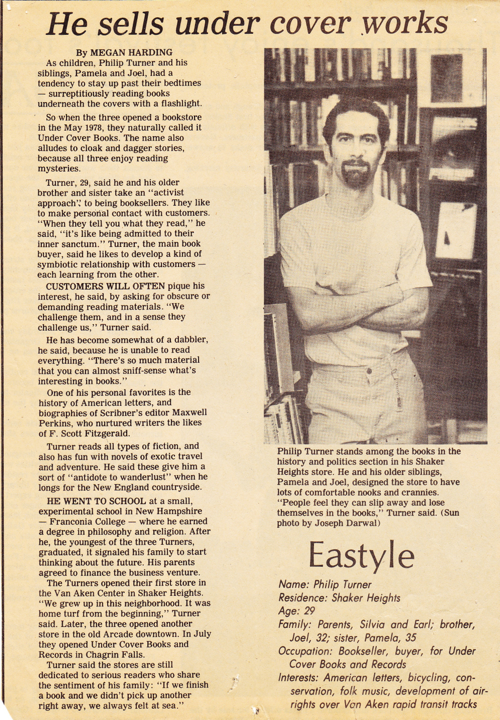
Pam and Joel’s smart idea was to open, with our book-loving parents Earl and Sylvia, a new bookstore in Shaker Heights, the suburb where we’d grown up. I quickly tossed my lot in with them, at least to get the store opened, then soon found myself more involved and engaged by bookselling and the book business than I’d anticipated. We chose the name Undercover Books—invoking our passion for reading under the covers as kids, and for mystery fiction—and on May 4, 1978 opened the first of what would ultimately be three locations.

In this collection of essays about bookselling and publishing in the second half of the twentieth century, it is noteworthy that Undercover Books joined the wave of a building trend in the 1970s-80s in which retail bookselling was migrating from department stores and big downtown bookstores to indie bookstores in the suburbs of a number of cities—Pittsburgh, Detroit, Atlanta, St. Louis, Kansas City, as well as in our own downtown, where many local readers had long shopped at Publix Book Mart, run for decades by the eminent Anne and Bob Levine. However, suburbanites with readerly interests not inclined to visit downtown were under-booked, it could be said.

The space we leased in an outdoor strip shopping center—deliberately not an indoor mall—had formerly housed a shoe store where we’d shopped as kids, and was large at 2700 square feet, but the shape itself was that of a shoebox, and could’ve made for a very dull bookstore layout. Smartly though, a store designer showed us how to address this problem: beyond the front section of the store, where the cash counter and walls of bookcases displaying lots of frontlist fiction and nonfiction were displayed face-out, we could cut into the rectangular space with wooden bookcases built at 30-degree angles, lending an intimate, library-like feel to the store. With that, the Travel, Reference, Literature, Poetry, Art & Photography, Children’s, Health & Parenting, and Cookbook sections became their own quiet spaces. The opening of this attractively designed bookstore, in a suburb with a well-educated populace that had never had a bookstore within its city limits, quickly attracted the trade and appreciation of lots and lots of people locally and in the city more widely.

I enjoyed working on in-store displays, and grew adept at fashioning arrangements of books that encouraged browsers to make connections among titles, subjects, authors, and ideas, while also managing to shelve the greatest number of titles possible in finite spaces. As adult book buyer, I ordered books that led to annual sales exceeding $1,000,000, at a time when that level of sales was not common among independent bookstores. Regularly called upon by sales reps, and pitched specific titles by sales management, Undercover Books became a go-to store for publishers eager to break out books nationally. Notable fiction writers who launched books with us included Mark Helprin (A Dove of the East, and Other Stories, Seymour Lawrence/Delacorte Press), Richard North Patterson (The Lasko Tangent, W.W. Norton), and Walter Tevis (Queen’s Gambit, Random House). We also held salon-like evenings, as when George Gibson of David R. Godine, Publisher, discussed the Godine list and fine printing with our customers.

We’d look for books we had already read and enjoyed, new or backlist, on which we would take aggressive ordering positions, then sell 300-400 copies of these titles in a two- or three-month stretch. This happened with Simon & Schuster’s trade paperback reissue of Jack Finney’s classic time travel novel Time & Again, as it did with the travelogue Blue Highways, when author William Least Moon was brought in by our Little, Brown rep to meet us and sign stacks of the hardcover we had ordered. Our parents were also avid readers, Sylvia of commercial fiction and cookbooks, Earl of biography, sports and business, and their enthusiasms meant our in-store selection appealed to a wide age range of readers. Our parents also opened their home for meals and convivial time with sales reps and authors.

Cleveland was the home of many Fortune 500 companies, and most had corporate libraries in their home offices, where professional books were often required, likewise true of partners in remote offices who also needed books for their work. We worked with staff librarians who got requests for books for the home office and from distant branches, all of which business we’d fulfill. We made rapid delivery of special orders and prompt service on bulk orders of business books, reference titles, and professional manuals a priority. Innovations we made in book ordering and inventory management, in conjunction with book industry expert Leonard Shatzkin and his son Mike, a publishing consultant, made Undercover Books the subject of a chapter in Leonard’s diagnosis of the book business, In Cold Type: Overcoming the Book Crisis (Houghton Mifflin, 1982) and of articles in Publishers Weekly.

In this period, Joel became a board member of the American Booksellers Association (ABA), which gave us a voice in independent bookselling’s response to the growing influence of corporate chain bookselling. Able to start a conversation with just about anyone, Joel enjoyed public organizing and in 2000 ran for the House of Representatives in Ohio’s 11th congressional district. That same year, Pamela was hired by Overdrive, an early distributor of ebooks. With responsibility to uphold copyright, publishers wanted assurance that their titles would be secure on the emerging platforms. As director of content, she worked to gain the confidence of sales and marketing departments, holding that position till 2004, a key period in the digital transition.

During my time in bookselling I read avidly in all genres of fiction, especially many detective series and spy fiction, enjoying and recommending books by George Chesbro, James Crumley, Earl W. Emerson, Dorothy Hughes, Margaret Millar, Russell Greenan, John Le Carré, Tony Hillerman, Ross Macdonald and John D. Macdonald. We also had great clientele for new literary fiction, selling many copies of books by Robert Stone, Brian Moore, Peter De Vries, Anne Tyler, Barbara Pym, Margery Sharp, Margaret Atwood, Laurie Colwin, Howard Frank Mosher, Ernest Hebert, and Susan Richards Shreve.

It should be noted too that we opened just as a new generation of Canadian authors was bursting in to print, and I had an instant affinity for Canadian literature. Though trade rules at the time discouraged importation of Canadian titles, I found a way to work around them. Seal Books was Bantam Books’ Canadian division; their titles resided ostensibly off-limits to us on an out-of-the-way corner of the Bantam order form. Our Bantam rep instructed me if I ordered any Seal Books titles the order wouldn’t be filled, but I penciled in some quantities to see what would happen, and they were shipped to us! We began introducing our customers to books by Margaret Atwood, Mordecai Richler, Margaret Laurence, Marian Engel, Antonine Maillet, Alice Munro, Guy Vanderhaeghe, Timothy Findley, Farley Mowat, Pierre Berton, the longtime CBC broadcaster Patrick Watson, who visited our store to launch his suspense novel, Alter Ego (Viking, 1979), and Robertson Davies.

We were ordering Davies’ Deptford Trilogy (Fifth Business, Manticore, World of Wonders) by the carton from Penguin, stacking them up and selling them in large quantities. In my enthusiasm, I wrote Davies a letter c/o of Penguin to explain this and let him know about our stores. A pleasant correspondence ensued between us, his letters from which are reproduced in facsimile form here.

In 1982 Davies’ editor at Viking, Elisabeth Sifton, invited me to write a letter to U.S. booksellers extolling his work and pitching them on his new novel, The Rebel Angels, which became the Canadian author’s first U.S. hardcover bestseller.

The bookstore was graduate school for me. After seven years, I felt the proverbial itch and decided I’d like to try working in publishing, preferably as an editor. I was keen to originate books, not just sell them as finished products, and with the bookstore experience, I was hopeful I could get a job and do meaningful work. In 1985, I embarked for New York City and bearing in mind E.B. White’s observation in his essay “Here is New York” that, “No one should come to New York to live unless he is willing to be lucky,” I found an apartment in Washington Heights, the hilliest section of Manhattan with its bike-able hills and steep stairways, and the dramatic George Washington Bridge in view from many vantage points, endowing me with a fondness for bridges that lasts to this day as evidenced by the name of my book-focused blog, The Great Gray Bridge, an homage to the 1942 childrens classic The Little Red Lighthouse and The Great Gray Bridge.
Following my departure from Cleveland, the family continued operating from the original location, and then in 1992, to capitalize on the strong B2B elements in the business, Joel re-envisioned the business as Undercover Book Service, supplying books to individuals and corporations all over the country and abroad. With the emergence of the Internet in 1993, the family transformed the stores into an online book-ordering service powered by a website they created some months before Amazon got underway.

Turning 7 Years of Bookstore Experience into a Publishing Career 

One of the first publishing houses I applied to was Charles Scribner’s Sons, as the firm now called Scribner was then known. A contributor to this volume, Mildred Marmur, was its president then, the first female head of a major house. Though we’d never met, she saw me in her office. Intrigued by my background, she explained she had nothing full-time to offer me, but added that the company was sponsoring a first novel contest named after Maxwell Perkins, the legendary Scribner editor who’d nurtured the talents of F. Scott Fitzgerald, Ernest Hemingway, Thomas Wolfe, Marjorie Kinnan Rawlings, and James Jones. She asked if I’d want to work as the contest’s first reader. I told her that at Undercover Books we’d sold A. Scott Berg’s biography, Maxwell Perkins: Editor of Genius (Dutton, 1978), so would be pleased with the opportunity to tap into Perkins’ literary legacy.

More recently, it must be said that as I’ve been preparing this essay for print, I’ve learned about a different legacy of Perkins’ that does not shine favorably on him or Scribner: his shameful elevation of eugenics through their book list, a revelation from author Daniel Okrent that has led to an overdue re-assessment of the Scribner editor’s reputation by many, including the editor of Penguin Random House’s One World book imprint, Chris Jackson, the 2020 recipient of an award formerly given in Perkins’ name. To me, this shows that our business should never be satisfied with its past, but in concert with the wider society, must always work toward a better future for all.

Working three days per week in what ended up as a two-month stint in the winter of 1986, I ensconced myself in Scribner’s conference room with unopened jiffy bags and manuscripts stacked up around me like so much drying cordwood. Think John Updike’s classic sketch “Invasion of the Book Envelopes.” My assignment was to unpack the mailers and read between 5-50 pages of each manuscript of what turned out to be more than 700 contest entries. I also filled out a brief questionnaire, signaling a thumbs-down or -up for a second reading by senior editors. Coincidentally, I recommended seventy entries, or almost exactly 10%, for second readings. There was one entry I really loved, by an E.M. Hunnicutt, which I read avidly beyond the allotted limit. My recommendation of it was more enthusiastic than for any other candidate, but before I’d finished plowing through all the entries, I saw that it wasn’t going to win the prize. I noted the author’s phone number and address and photocopied the manuscript, hoping I might contact “Hunnicutt” soon, once I was hired somewhere as a full-fledged editor.

My good luck held and soon, after a reference from literary agent Ruth Nathan (wife of longtime Publishers Weekly subsidiary rights reporter Paul Nathan), I was offered a job as an acquiring editor at Walker & Company, a somewhat sleepy publisher of young adult non-fiction and genre adult fiction (Westerns, mysteries, Regency romances, etc.), published mostly for libraries. Walker had terraced offices with scenic views twelve storeys above Fifth Avenue at 56th Street; on St. Patrick’s Day the company threw parties as the annual parade streamed past below, attended by house authors such as Isaac Asimov. I was assigned the genre that founder and publisher Sam Walker called “men’s adventure”–thrillers, swashbucklers, seafaring novels, spy books, a genre I still enjoy. Walker had in its early years published books by John Le Carré and Flann O’Brien, so I was hopeful that my mandate might extend to other areas of publishing, even literary fiction. My first week at Walker I called E.M. Hunnicutt—whose initials made me think of E.M. Forster—and learned that E.M.’s first name was “Ellen.” She explained that because she sold many stories to Boys’ Life, the magazine of Boy Scouts of America, she’d long used the initials to disguise her gender,

Ellen and I hit it off beautifully and for an advance of $750 I acquired rights to her novel, the first novel I line-edited. Our relationship established a high benchmark in my relationships with authors that I’ve always sought out since. Ellen and I engaged in a vigorous dialogue about her work and its dominant theme—the creative purposes to which suffering and mourning may be put. The protagonist of the novel was Ada Cunningham a young teenage girl and musical prodigy who’d fled a destructive custody battle that engulfed her family in the wake of her mother’s death. She narrates her story from a safe haven she’s found with a circus troupe that’s wintering over in a quiet Florida camp where she finds solace in composing a requiem for her late mom on the troupe’s calliope.

When Suite for Calliope: A Novel of Music and the Circus, was published in the spring of 1987, it received a starred review in Kirkus, Dell bought paperback rights, and Walker sold out its hardcover first printing. The starred Kirkus happened to land on my desk on May 4, long a fateful date on my personal calendar for the opening of Undercover Books and other milestones. I phoned Ellen to give her the good news and read the review to her, learning only then that that day was her birthday. Suffice it to say, it was one of the happiest birthday calls I’ve ever made. Ellen’s run of good fortune wasn’t finished yet: Before her novel went to the printer, she learned that for her short fiction she’d won the Drue Heinz Literature Prize. This was an award associated with the literary journal Antaeus, which editor Daniel Halpern co-founded with Paul Bowles, a laurel we were able to print on the book jacket; the senior judge of the Heinz Prize that year was Nadine Gordimer. Her winning collection, In the Music Library, was also published in 1987, by Pittsburgh University Press. Quite a year for Ellen. Working with her was a great privilege and cemented my ardent interest in modern nomads and circus stories.

I’ll add that Ellen Hunnicutt’s novel played a role in cementing my relationship with my wife, artist Kyle Gallup, whom I would meet and marry in 1990-91, only a few years after the novel had come out.

Another novelist of Ellen’s period, Mark Dintenfass, praised her novel in a blurb he gave me for the jacket, commenting that the novel “teaches the reader how to read it, with its discussions of art, psychology, and philosophy being clues to its own design.” When Kyle and I met our conversations quickly took on an aesthetic and literary dimension, and I hoped she might appreciate the book as I had. I sent her a copy. When we discussed it she told me that she really liked the narrator Ada—and her friend in the story, a female painter named Kyle—and I knew for sure we could share many things.

Eyewitnesses to History

While Senior Editor and Editor-in-Chief of Kodansha America from 1992-97, I endorsed the recommendation of editorial colleague Deborah Baker who proposed we acquire trade paperback rights from Times Books/Random House to then-Illinois State Senator Barack Obama’s family memoir Dreams From My Father: A Story of Race and Inheritance, which we published in 1996 as a title in the Kodansha Globe series, a nonfiction trade paperback program that paved the way for such successful series as NYRB Classics. At Kodansha I also worked with the prolific diarist and octogenarian Edward Robb Ellis, establishing an affinity in me for editing epistolary works. When his magnum opus, A Diary of the Century: Tales from America’s Greatest Diarist, was published in October 1995, though exclusive arrangements usually applied with the TV network morning shows, Ellis achieved the rare hat trick of being interviewed by Cokie Roberts on ABC, Katie Couric on NBC, and Harry Smith on CBS on their respective morning shows.

By coincidence, my next job was Executive Editor for Times Books/Random House, from 1997-2000. Newly ensconced there, I was submitted a manuscript that I knew would shock the conscience of readers, the true story of an innocent man on Virginia’s Death Row. The heart of the book was the diary of the inmate, which co-authors Joe Jackson and William Burke used skillfully in building their powerful narrative, with first-person diary entries laced through their prose. It was submitted to me during a hot summer, and when the authors chronicled the suffocatingly sultry conditions in the prison, it all but sparked a raging fever in me. With my reaction, it struck me that William Styron, a son of Virginia whose social justice advocacy included vocal opposition to capital punishment, would be outraged at the rank injustice. Through Styron’s Random House editor Robert Loomis, I got the manuscript to “Bill,” as Loomis called him, and began a dialogue with the novelist who offered to write an Introduction to the book, DEAD RUN: The Shocking Story of Dennis Stockton and Life on Death Row in America. 

When I received the draft of his essay, I noted that it revealed the ultimate fate of the inmate Stockton, something I had thought we might not let slip. I called Styron, and suggested that we might refrain from doing this, to which he responded, “The specter of doom hangs over Mr. Stockton from the manuscript’s first page.” I realized he was correct, and forswore my original intention. Styron’s eloquent Introduction shone a bright light on the miscarriage of justice in the book.

As a person, I am not overly concerned about what people seem to think of me, nor do I crave lots of personal validation from others. Yet it’s an occupational hazard of the book business; as an editor and advocate for books, one is invariably focused on what people think of your titles—by publishing house colleagues, and among booksellers, sales reps, agents, foreign scouts, critics, and readers. My aspirations for my books are often sustained by blurbs, reviews, and word-of-mouth, or deflated by the lack of them. In the case of Dead Run, I was blessed by the enthusiasm of Loomis and Styron, which nourished my hopes for the book with such ardency that I was inspired to mint a quip I’m still fond of sharing about my profession: “Being an editor allows me to express my latent religiosity, since I spend so much time praying for my books.”

 At Times Books, I continued working with authors of advanced age, publishing EXODUS 1947: The Ship that Launched a Nation by the trailblazing photojournalist Ruth Gruber (1911-2016), who following the Holocaust had covered the voyage of the real-life Exodus ship and became the foremost chronicler of displaced persons (DPs) in Europe during the postwar years.

As Editor-in-Chief with Carroll & Graf from 2000-2006, I edited and published THE REVENANT, an historical novel and wilderness survival tale that was the first book I acquired after the terrorist attacks of September 11, 2001, when colleagues and I fled from our offices just blocks from the World Trade Center; though novels don’t usually carry subtitles, I suggested to author Michael Punke that he append a tag line to his book which to this day is known as A Novel of Revenge. Other books of mine during this period included national bestseller THE POLITICS OF TRUTH: Inside the Lies that Put the White House on Trial and Betrayed My Wife’s CIA Identity (2004) by Ambassador Joseph Wilson, who upon his death in 2019 was still a hero to many for his vocal opposition to the 2003 invasion of Iraq; THE BABY THIEF: The Untold Story of Georgia Tann, the Baby Seller Who Corrupted Adoption (2007) by Barbara Bisantz Raymond, an exposé of a nefarious baby broker, a Publishers Weekly Best Book of the Year; and the cri-de-coeur SHAKE HANDS WITH THE DEVIL: The Failure of Humanity in Rwanda by Lt. Gen. Roméo Dallaire, commander of the U.N. peacekeeping force during the genocide in Rwanda. As Editorial Director of Union Square Press at Sterling Publishing, in 2008 I published COVERT: My Years Infiltrating the Mob by NBA referee Bob Delaney with Dave Scheiber, a USA TODAY Best Book of the Year, a memoir of the author’s three-year high-wire undercover stint investigating organized crime.

The above books all shared a common feature: They were written by and/or about singular witnesses to history–insiders, whistleblowers, truthtellers, muckrakers, revisionist historians–people who’d passed through a crucible of experience that left them with elevated authority in the eyes of the reading public, and the only person who could write the book in question, or about whom it could be written. Whether told in the first person by an author whose personal experience leaves them uniquely qualified to tell the tale, or in the third person by a reporter or scholar who has pursued a story or historical episode with single-minded passion, I remain devoted to working with authors like these, publishing imperative books that really matter in people’s lives.

I am enormously grateful for the opportunity to have worked in my family’s bookstores, and in publishing with eight different in-house jobs, and still be working in the book business, now independently for more than a decade. My experimental education turned out to be no hindrance at all, but an ideal prelude. The work has rarely been humdrum, but instead a continually stimulating, collegial, and rewarding field. While not working in the profession I had in college imagined for myself, many of the books I’ve worked on have been expressions of the search for social justice that fueled my education. I’m happy to close by noting that the familial nature of my endeavors continues with the advent in January 2020 of my adult son Ewan Turner as Executive Editor of the editorial consultancy and literary agency I now operate.

**Alas, the light editing that was done seems to have led to the excision of the lines just above, “I’m happy to close by noting that the familial nature of my endeavors continues with the advent in January 2020 of my adult son Ewan Turner working as Executive Editor of the editorial consultancy and literary agency I now operate.” I suppose this was because it was the last line in the whole piece and the layout was bumping up against the bottom of the page. That’s why I’m happy that I have this website, so I can run every word of the original text here, and with all the Internet links I had included in it, anticipating some day publishing the entire essay on this blog (and in the event there was a digital edition of the book). It’s also given me the opportunity to write the Introduction to it above, and offer all the context that I have above in the “The Story Behind a Handsome New Book on Books.”

[gallery link="file" ids="18170,18171,18172,18173,18174,18175,18176,18177,18178"]


[gallery link="file" ids="18183,18184,18186,18187,18189,18185,18188"]


Enjoying Many Happy Reunions & First Meetings at Book Expo 2017

I’ve long since quit keeping track of how many annual Book Expo conventions I’ve attended since Undercover Books opened in 1978; over the past 39 years I’d say I haven’t missed more than five of these trade shows. I’ve written about many of them on this blog. Last year was a miss with the show in Chicago, so I was glad that the Javits Center on the west side of Manhattan was the venue once more for the 2017 rendition of the book industry’s annual get-together. Though the show is diminished in attendance and book industry importance since the glory days when it was known as ‘the ABA,’ the period when the American Booksellers Association, the trade association of indie booksellers, owned and ran the convention. It was a great asset, but eventually they sold the show to a company that ran trade shows; currently, it’s owned by Reed Exhibitions. Their management and the choices they make each year about the show is a topic of much discussion and some controversy among booksellers and publishers.

While registering on Wednesday afternoon, May 31, I was startled to see #TrumpRussia figure Carter Page in line after I’d registered, which prompted some quick picture-taking and tweeting from me before my first event. As I was that afternoon, I’m still very curious about what he was doing at the show. Hoping to sell and publish a book? Or, perhaps he already has one in the works? I figure it was one of these—why else would he attend Book Expo? Maybe he hopes to take the same route that the guy who goes by Milo has announced he’ll do: self-publish. And yet, if he’s gonna tell his story, I imagine the congressional committees and Special Counsel Mueller would want to hear it first. That could set up a constitutional struggle: Page’s interest in exercising his free speech rights versus the legislature’s and the law’s interest in exercising their key oversight and criminal prosecution authorities. I love Book Expo for this—you never know who you might see next! One year, I saw former FEMA Commissioner Michael Brown (“Brownie, you’re doing a heckuva job”, courtesy George W. Bush) just a year or two after Hurricane Katrina.just a year or two after Hurricane Katrina.

https://twitter.com/philipsturner/status/869967470739828736

https://twitter.com/philipsturner/status/869969773702123520

The fair’s kickoff event, held before the show floor would open the following morning, was the Editors’ Buzz Panel, where each year six editors are invited to talk about the one book they’re bringing out in the coming months that has them and their publishing house colleagues most excited. In past years, while the lineup always skewed heavily toward fiction—a product, I guess, of the notional that novels lend themselves to hand-selling by booksellers more readily than nonfiction, not an idea I endorse—there would usually be at least one or two nonfiction books among the novels. Not so this year, when it was six novels, one after another, with each editor being introduced at some length by moderator Annie Philbrick, co-owner of Bank Square Books in Mystic, CT, and Savoy Bookshop & Café in Westerly, RI. I’m sure all the novels are worthy, but the program choice led, in my opinion, to an at times leaden and repetitive recitation of plot points, reading of blurbs, and comparisons to other novels, that lasted one hour and fifteen minutes. The other issue I had with the program was the exclusive predominance of big-house publishers, (e.g., three titles from imprints at Penguin Random House, one title from an S & S imprint, one from Hachette, and one from Harper), with no mid-sized majors or indie presses in the mix. Are we supposed to believe there were no worthy titles from among publishers like Grove Atlantic, Norton, Algonquin, Graywolf, Counterpoint, Beacon Press, Other Press, and others of their ilk?

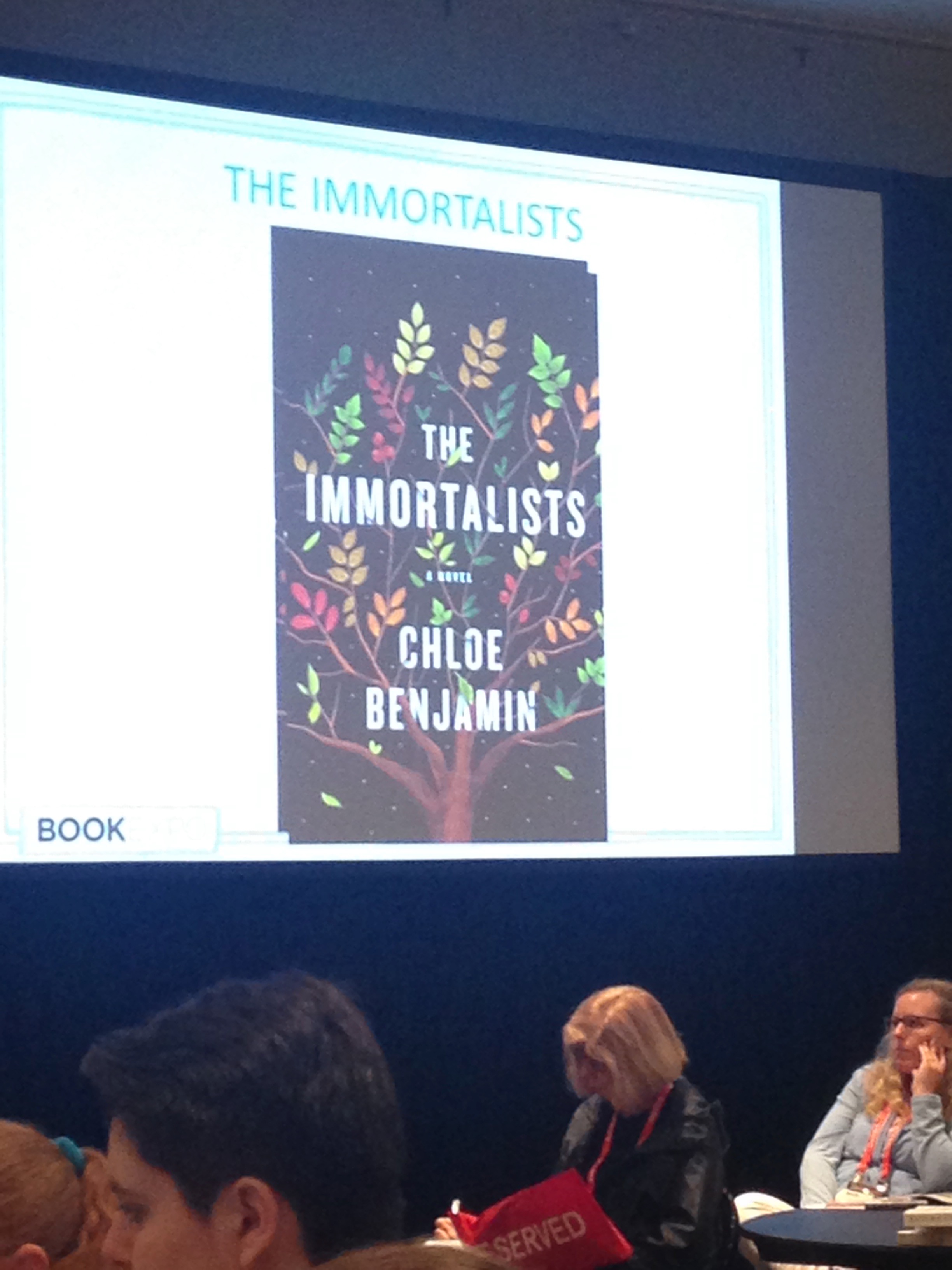
Of the six novels presented (each  mentioned here), I found myself most interested in possibly reading The World of Tomorrow by Brendan Matthews, a first novel set in NYC during the 1939 World’s Fair, and The Immortalists by Chloe Benjamin, the conceit for which is that a fortuneteller can tell characters the very day they’ll die. The whole program would have flowed much better with some adjustments and variation, including briefer presentations by the editors (some seemed stretched to fifteen minutes, which would never be tolerated at a sales conference) and by injecting some narrative nonfiction in to the mix. After the last presenter finished, there was a mad scramble of people rushing to the back of the room to get ARCs of the six books, but it was so intensely crowded, I felt someone could’ve been trampled. Surely, there must be a better way to distribute the reading copies than a mad scrum that has people gasping for air! I hope the Buzz Panel programmers take note of these points for next year’s panel.
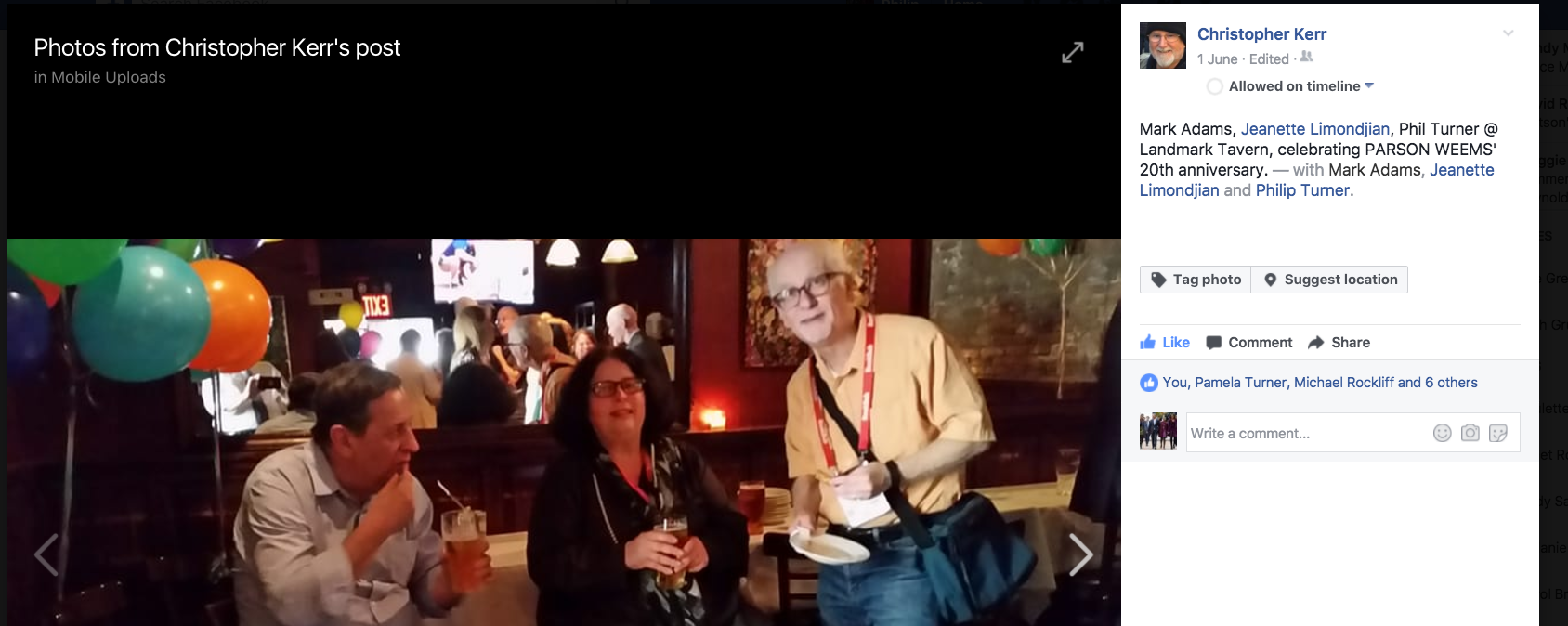
After hours, Book Expo always offers action, and this year was no exception as the sales rep group Parson Weems Publisher Services celebrated its 20th anniversary as a company with a delightful bash at the Landmark Tavern, near the Javits Center. PW sales reps Chris Kerr, Linda Cannon, Eileen Bertelli, and Jason Kincade were great hosts and I enjoyed drinks with many people there in the back room of the tavern, with the late afternoon light fading to early evening as the party unfolded, and the good ale they serve. Glad I could introduce my brother-in-law Ev Taylor to many old friends at the party.
The convention floor opened the next morning, and thanks to the MTA’s new subway stop for the #7 train at Tenth Ave and 34th St (which has the steepest, most vertical escalators I’ve ever seen in NY’s subway), I was right on time for my first meeting of the day. Chance encounters also quickly bloomed, as I bumped in to old and new friends like John Whelan of the superb gift book publisher Cider Mill Press; Tom Nevins, longtime member of the Random House sales force; B.J. Berti, Senior Editor for crafts and illustrated books, St Martin’s Press, to whom I was introduced by another old friend, Mike Shatzkin, one of whose new ventures, OptiQly, was being introduced at Book Expo; Peter Costanzo, digital publishing specialist for the AP; Kevin and Spencer Williams, Talonbooks, Vancouver, BC, who are clients of Consortium, a distributor that’s especially good with literary lines, were excitedly sharing with booksellers copies of one of their lead books, Anima; Rob Sanders, Greystone Books, Vancouver, BC, who had a big hit this year with The Hidden Life of Trees, which he’s following up this fall with The Hidden Life of Animals; and Herb Simon, Chairman Emeritus of the group that owns Kirkus, with whom I discussed the NBA, since he’s principal owner of the Indiana Pacers; George Greenfield, literary and lecture agent, who I chatted with in the crowded aisle in front of Hachette’s stand; Michael Korda, who’s publishing a new book with Liveright, Alone, an historical chronicle on the 1940 evacuation from Dunkirk, which he experienced firsthand as a 6-year old child.

I had prepared a memo that outlined all the current projects I’m agenting, and was pleased in several of my meetings with publishers and editors to register interest for the proposed new titles:

  • The Last Days of Sylvia Plath, a new book about the last months of the poet’s life;
  • Dirty Windshields: A Canadian Rock n’ Roll Band’s Misadventures Across the USA and Beyond, CBC broadcaster Grant Lawrence’s hilarious and heart-tugging book about his years as frontman and lead singer of the breakthrough punk band, The Smugglers
  • The Lust Club: Confessions of a Prada Model, a one-of-a-kind memoir by a male fashion model;
  • The Twenty-Ninth Day: A Dangerous Journey in the Canadian Arctic, a wilderness survival story the center of which was the grievous mauling by a grizzly bear suffered by the author
  • Ten Garments Every Man Should Own, by Toronto writer Pedro Mendes, publisher of The Hogtown Rake menswear blog;
  • A book about the development of Rap music through the history of sampling, Bring That Beat Back, and another music title by a true pioneer of electronic and hip-hop music;
  • How Horses Help us Heal: Reports from the Field, a deeply spiritual book about equine therapy that surveys the many equine therapy centers in the US;
  • Crash Test: How an Automaker Evaded Accountability, a corporate whistleblower’s account of a company’s lethal malfeasance;
  • Macoupin, a novel of the American prairie spanning 1800 to the near-present, by Jack Heinz. “Caste and class are most subtly yet vividly described in prose as spare and suggestive as an Edward Hopper landscape.”—Ward Just

It was exciting to represent these books and authors at Book Expo.

I got in an autograph line to meet Mira Bartok, whose earlier book, a memoir set in Cleveland about her schizophrenic mother, called The Memory Palace, I had found very compassionate. So did the National Book Critics Circle, which gave it their memoir prize in 2011. Her new book is a departure, a YA fantasy novel called The Wonderling. I also stood in line a while to get a book signed by actor William Daniels, who played Dr Craig in “St Elsewhere,” and had a memorable role in “A Thousand Clowns” with Jason Robards, Jr. Little did I know how hugely popular he is, so after some time waiting, I exited the very long line, but first got a picture of him signing his acting memoir, There I Go Again. Later, I did hang on in a shorter line long enough to meet Brooke Gladstone, longtime co-host of one of my favorite public radio programs, “On the Media,” author of The Trouble with Reality: A Rumination on Moral Panic in Our Time, a copy of which she signed for me. I also stood in line for novelist Mark Helprin, who as a younger author back in the day twice traveled to Cleveland for successful events at Undercover Books, for his outstanding early books A Dove of the East and Winter’s Tale (the latter for an event that drew hundreds of people in 1983). On this occasion, I had scrawled my name on a post-it note, as the publisher’s representative asks so an author doesn’t have to guess or hear correctly how your name is spelled; Mark did something of a double-take when he read my name, and looked up at me. We shared a rush of remembered friendship, as Mark and I had exchanged letters years ago about his books and our lives. My sister Pamela had met him once during a visit she made to New York City. He knew my black Lab Noah, who readers of this blog will recall I have written about here. We had a pleasant reunion there on line, even while people behind may’ve been wondering about the hold-up. I look forward to reading his new novel, from Overlook Press, Paris in the Present Tense. I also went out of my way to find Carol Bruneau, whose publisher Nimbus brought her down from Halifax, Nova Scotia to promote her forthcoming short story collection, A Bird on Every Tree. In the early 2000s I published her first novel, A Purple Thread for Sky, about the enduring legacy of an old family quilt. Carol and I had a sweet reunion, talking about Canadian books and writing, and our mixed-up modern world. I’m reading the opening story in the new book, “The Race,” about a long distance swimming competition, and am reminded anew that Carol writes enormously enjoyable sentences. Her new book will officially be available in September, and can already be pre-ordered from the Canadian book chain, Chapters. I know many readers of this blog will savor her writing.

https://twitter.com/carolbruneau/status/871381840090861568

I got a lot of pictures over the three days of the Book Expo. Here are some of my favorites.

Seven Years On, Saying Bye Again to my Brother, Joel Turner

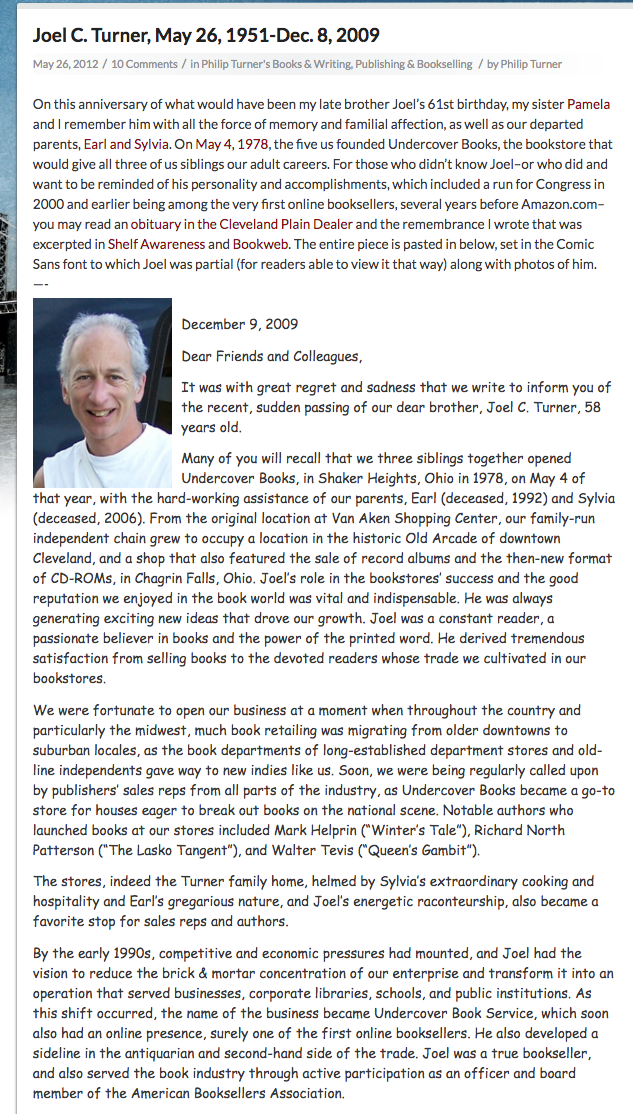
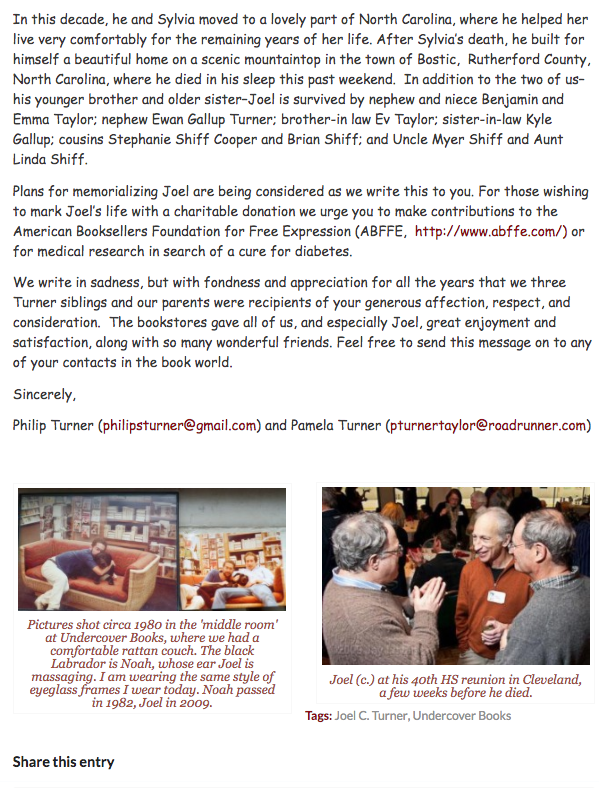
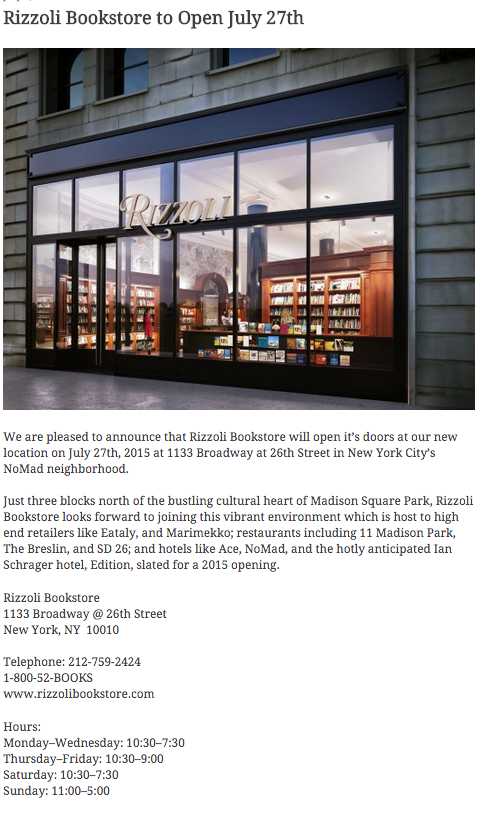
Just before it popped in to my Facebook feed today, this photo of my late brother Joel, a career bookseller—which ran with a Cleveland Plain Dealer obituary of him on this date in 2009—I happened to have only a moment earlier responded to a bookselling-related job posting. Unlike Joel, I branched in to editing and publishing after being in the stores together starting in 1978, but I’ve remained tied to bookselling, too. In 2015, I worked for Rizzoli and helped them reopen in New York City, after the wrecking ball took their midtown store. Undercover Books, the small bookstore chain that Joel and I—and our sister Pamela Turner, and our late parents Earl and Sylvia—founded and ran in Cleveland beginning in 1978 really gave me my career and allowed me, in 1985, to move to NY.
You want to know something kind of amazing? For a long time, the number of years I lived in Cleveland always exceeded my briefer term in NY, but a couple years ago that began to turn over, as I have now lived in NYC more than half my life. Here’s the math: I was born in 1954, and moved from Cleveland to NY when I was 30, in 1985. When the calendar turned to 2015 and 2016, after I’d turned sixty, it occurred to me one day that NY had now been my home for more than half my life. Does that mean I’m not a Clevelander anymore? Sort of, but then there are still my sports team preferences (Go CAVs!). Am I a New Yorker? More and more, but not fully that either (I still can’t believe the way people in the tri-state area drive, like in the Midwest no one will ever drive on the shoulder of a highway amid a long jam and construction backup; here in the NY area, people do it all the time!)  
 The photo of Joel—who died unexpectedly, age 58, on December 8, seven years ago—popped up today in one of Facebook’s memories reminders, a feature which I am of at least two minds about. I don’t like that it tempts me to look to the past too often, but it also reminds me of the precious. Here’s the eulogy that I wrote about him on December 9, 2009, the day after my sister and I learned he’d died, and screenshots of that post as it appears elsewhere on this blog. 

Anticipating a New Way to Sell the Books I Write About to Readers of My Blogs

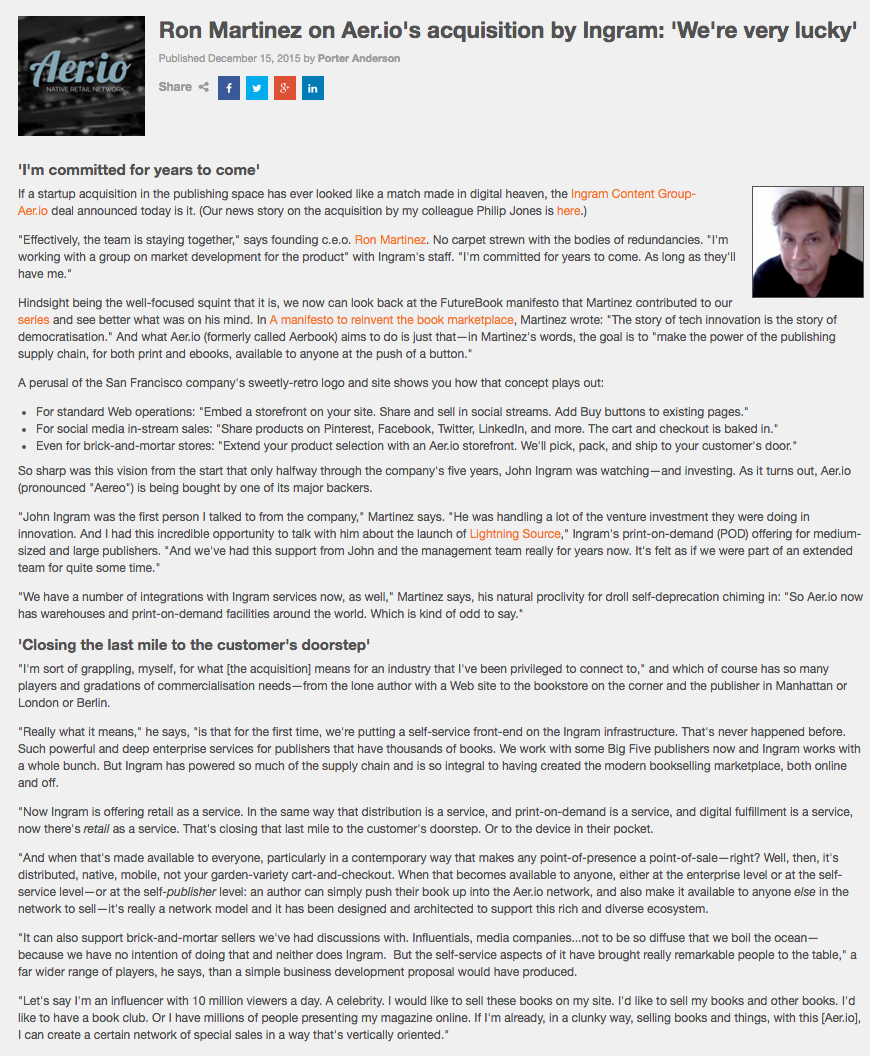
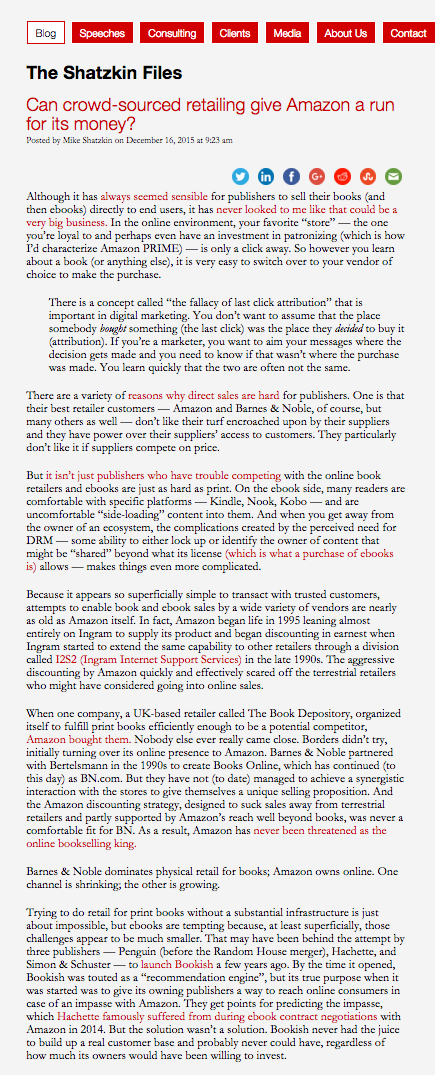
For book industry pals like me, who’d read and wondered this week about the import of national book distributor Ingram’s acquisition of the digital company Aer.io, I was excited tonight to read this analysis by friend and industry observer Mike Shatzkin, which anticipates potentially a very dynamic platform, one that could provide thousands of website managers and Internet publishers tools to help them sell books—print and digital editions—directly to their visitors. For my part, I see that it could provide bloggers who write about books, including me, the ability to sell titles directly from our websites to our readers and visitors. I currently affiliate with Powell’s Books of Portland, OR, but that arrangement has long been limited to print copies, with no prospect for selling ebooks, which is the format more likely to be preferred by blog readers, with rapid availability of digital content, and no shipping involved. As a retail bookseller before I was an editor and blogger, with a career-long penchant for sharing my enthusiasms, I’m eager to learn about these new options, and from an industry perspective, I anticipate significant interest from bloggers like me.
Shatzkin speculates that the new platform, combining Aer.io’s tools with Ingram’s capacity, has the potential to dramatically increase the sheer volume of online bookselling, with the potential to bring along many new types of Web publishers; it could also represent competition for Amazon, hence the title, “Can crowd-sourced retailing give Amazon a run for its money?”
Here you’ll find 1) a screenshot of Ingram’s announcement; 2) a portion of Aer.io founder Ron Martinez’s optimistic interview with The Bookseller, explaining what the platform provides now, and what it may offer in the future; and 3) some paragraphs from Shatzkin’s cogent analysis. You can read these screenshots by clicking Pause at the upper right corner, and read them in their entirety on the respective websites:  1)  /  2)  /  3).  Ron Martinez

Happy to be Back in Bookselling with the New Rizzoli Bookstore

To longtime readers of this blog, and many, many friends in the book business, I’m excited to announce a new venture I’m going to be part of. I’ll be working as a bookseller in the soon-to-be-reopening Rizzoli Bookstore here in New York City. You may recall that last year Rizzoli lost its prior location on W. 57th St when their lease there ended. They’ve found a fabulous new location in the St. James, a landmark building on Broadway between 25th St and 26th St in the booming Manhattan neighborhood of NoMad (north of Madison Park). The Wall St Journal’s Ralph Gardner wrote about Rizzoli’s plans in a story here. Earlier this month, Rizzoli sent out this fact sheet. Decorated handsomely with elegant fixtures in a museum-like setting, the new 5,000 square foot store will offer a stellar inventory of illustrated books in art, photography, architecture, interior design, fashion, film, theater, dance, music, and cooking, along with current releases and classics in fiction and nonfiction, and childrens books. The selection of titles will be fabulous.

The store will have a soft opening, apt for our sultry summer weather, starting July 27. While I’m already spending lots of my time there to help get the store opened and underway, and will continue working many hours in the early weeks once it opens, my longterm schedule will nonetheless permit me to continue operating Philip Turner Book Productions, my editorial service and publishing consultancy, and in fact have completed work on two manuscripts for author clients this month.

I am really excited with this opportunity to be back working on the floor of a well-stocked bookstore, which brings my career full circle. It all began for me with Undercover Books, the three-store indie chain I ran with my family in Cleveland, a business I worked in from 1978 until 1985, when I came to NYC and began working in publishing. I worked for big publishing houses from 1986 until 2009, when I began my consultancy. Now, thirty years after leaving Undercover Books, I’m back as a bookseller. I look forward to seeing NY friends and visitors to the city in the new Rizzoli Bookstore, at 1133 Broadway.