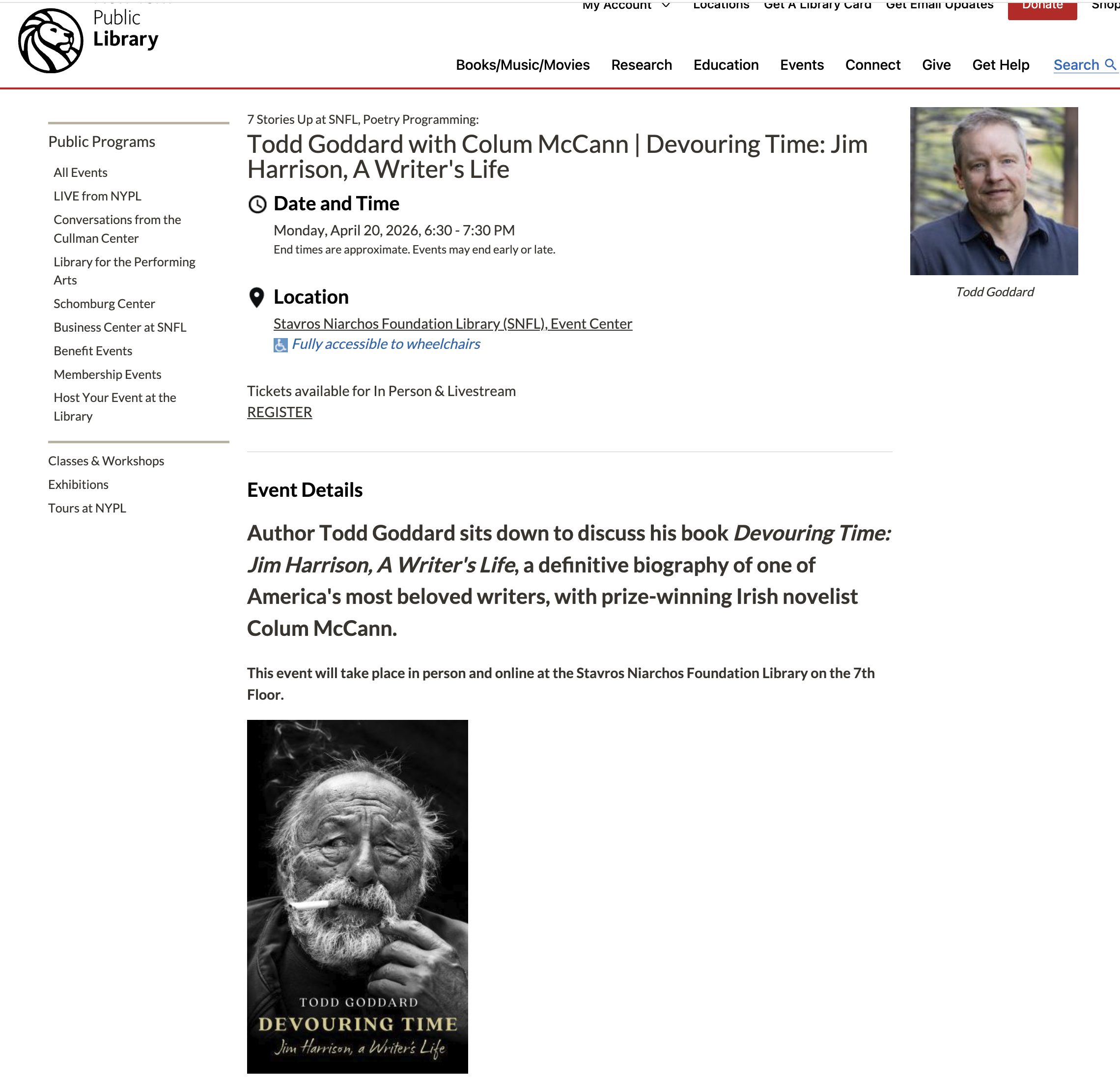
Talking about Jim Harrison, w/Colum McCann and Todd Goddard

An exciting event coming on April 20, for friends interested in Devouring Time, the recently published biography of Jim Harrison. Novelist Colum McCann, author of Let the Great World Spin—who knew Harrison well, and was one of 100 interviewees biographer Todd Goddard talked to for the book—will be in conversation with Todd, who is a client of Philip Turner Book Productions, at the NYPL Library’s Stavros Niarchos building, 455 Fifth Avenue, across the avenue and one block down from the Main Library Building, at 6:30 that evening, a Monday. Registration for the free program has just opened, with in-person attendance—and live streaming, so folks can watch from all over the country—linked to here.

I’m sure it will a great night, so hope to see you there!

“Live Theater—An Incomparable Art Form,” a Guest Essay by Alexis Greene

Live Theater—An Incomparable Art Form by Alexis Greene

I fell in love with theater when I was nine years old. I was growing up in New York City, and in the fall of 1954 friends of my mother took me to see the Broadway musical Peter Pan, starring Mary Martin as Peter and Cyril Ritchard as the villainous Captain Hook. It was the first time I’d ever been inside a theater and I loved where we were sitting: in a box on the right side of the stupendous Winter Garden Theatre. I loved the show, and I especially adored Margalo Gillmore, who played Mrs. Darling, the loving mother of the children whom Peter Pan invites to fly with him to Neverland. I was entranced by the gowns that Mrs. Darling wore: I wanted to be an actress.
*
I acted in productions in high school and college, at Vassar, where I majored in theater. The head of Vassar’s Experimental Theater, William F. Rothwell, Jr., was inspiring, and he believed I was an excellent young character actress. My favorite role was when Rothwell cast me as 13-year-old Willie in This Property Is Condemned, and I remember walking barefoot on the stage, talking to myself and the audience about my deceased older sister. The role was a gift.

After graduating, I was cast in a couple of off-Broadway productions. But the craft of acting did not love me the way I loved it so I went back to school to write my Ph.D. dissertation on Off-Off Broadway theater, and subsequently taught theater at New York University and Hunter College. I became enamored of dramaturgy and cofounded Literary Managers and Dramaturgs of America (now Literary Managers and Dramaturgs of the Americas), and I helped to make live theater as Literary Manager at the George Street Playhouse in New Brunswick, New Jersey. I traveled the Eastern U.S. for the National Endowment for the Arts (NEA), doing site visits.

Eventually I found my true calling: writing and editing books about theater companies and theater artists, especially women. All of these vocations intensified my love for live theater.

When I go to the theater and watch a play or a musical, or simply listen to actors reading a play, I often experience a range of emotions roused by the script and the performances: love and anger; pity and sorrow; desire and pleasure. I learn about myself and I also learn about people who live in the world around me. When I see Shakespeare’s Romeo and Juliet, I relive my own true love. Lorraine Hansberry’s A Raisin in the Sun, in 1959 the first play by a Black woman to be produced on Broadway, taught me about the hatred and fear that African Americans endure in America. For me, it was, and remains, a frightening, and enlightening, revelation.

I imagine that when theater began in the Western world—in ancient Greece—audiences watching the plays of Sophocles and Euripides, Aeschylus and Aristophanes, felt the same emotions and experienced the same kinds of awareness as we do today. Indeed, the mostly male audiences reportedly became so involved that sometimes, if they didn’t like what they saw and heard, they threw things at the stage. Women, unfortunately, were usually excluded from these performances in ancient Greece, from the audiences and as performers.

Live theater continued to grow and thrive in Europe and then in North and South America.

Theater, opera, and dance also came to life in the Far East. Opera emerged in China; Noh and Kyogen plays came about in Japan. Performances, which often merged music and song, dance and mime, sometimes continued for hours, and audiences stayed and watched, munched food, and talked about what they were seeing.

As the world has changed over the centuries, theater has evolved. Slavery was still rampant in America in the nineteenth century, but as the theater historian Oscar G. Brockett writes, in 1821 there arose in New York City the first known company of African American actors in the United States, performing at the African Grove, an outdoor tea garden, and eventually at an indoor theater. Along with Shakespeare’s plays, they performed what was perhaps the first known play written by a Black man in America: The Drama of King Shotaway.

Women also began to receive attention on America’s stages, and in 1840 Anna Cora Mowatt wrote what became a frequently produced comedy of manners: Fashion. As Joel Hirschhorn told Variety in 2008, “She defied male contempt for femme authors, a species Nathaniel Hawthorne defined at the time as a ‘damned mob of scribbling women.’”

During the 19th century, New York City became a theatrical center, with commercial theaters decorating Broadway, and early in the twentieth century Times Square became commercial theater’s most famous location, with a bevy of impressive stages.

But also in the early nineteenth century, here in the USA, the Little Theatre Movement brought to life intimate, independent theaters that in effect challenged Broadway’s commercial devotion and brought forth new playwrights, most notably Eugene O’Neill. Then, in the 1960s, nonprofit regional theaters, funded by the NEA, began to bloom throughout the United States. And as our country passed new laws recognizing and affirming the rights of women and people of color, more and more women and people of color wrote plays and saw them produced: playwrights like Constance Congdon and Eve Ensler, Pearl Cleage and Tina Howe, Lynn Nottage and Emily Mann, Migdalia Cruz and Beth Henley, Rukhsana Ahmad and Diana Son. And directors explored so-called “non-traditional” casting in classical plays.

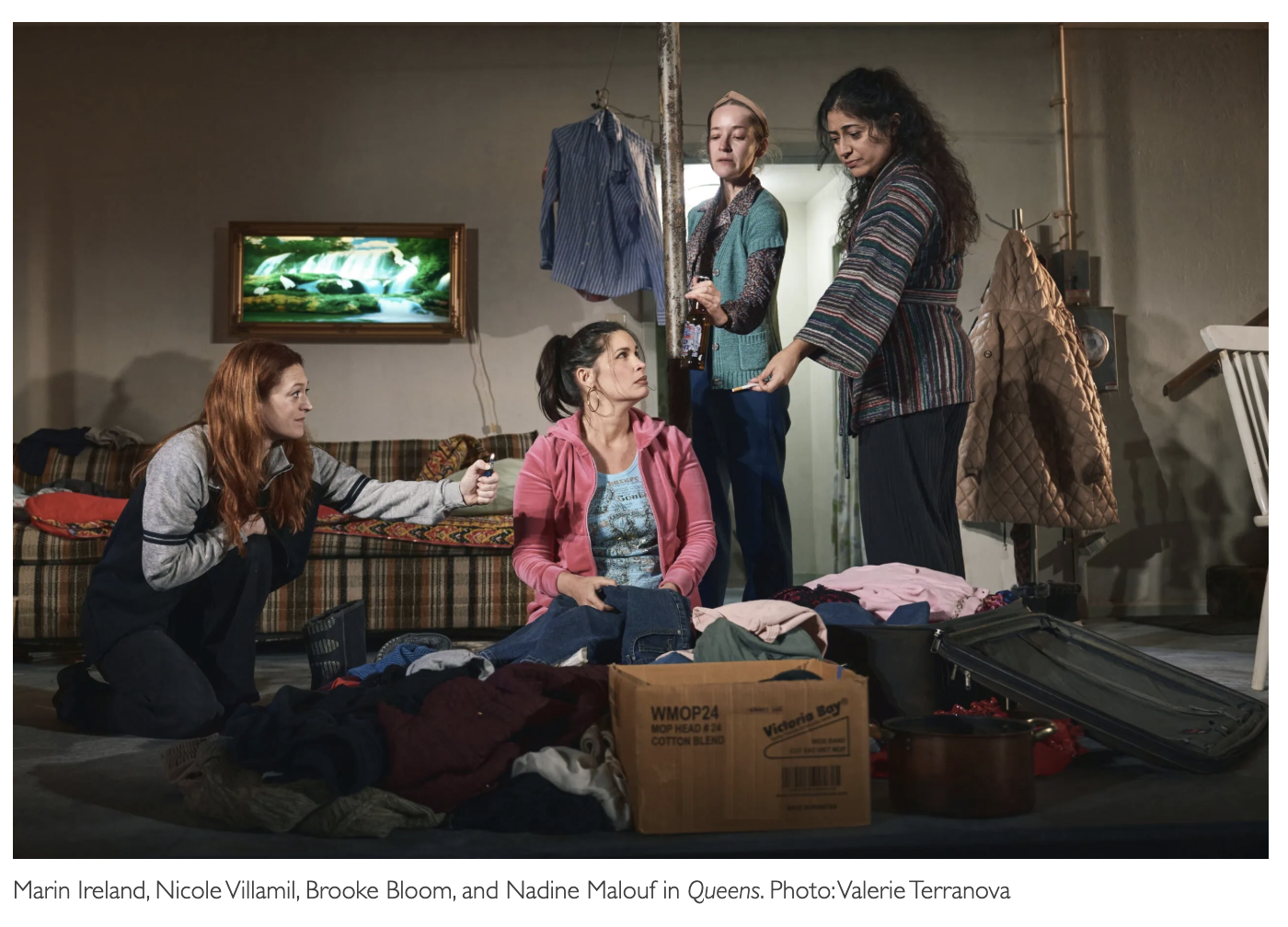
The best plays often reflect the world we are living in. In December 2025, for instance, I saw Martyna Majok’s Queens at Manhattan Theatre Club (MTC). The title might suggest a play that extols women, and the play does do that. But the title actually refers to the borough of Queens in New York City, where a group of immigrant women are living together in a basement apartment. Majok wrote her play in 2018, but she revisited the script for the 2025 production, and we naturally connect the images and the characters and their situations to the issue of immigration that our current President has brought to the fore with calamitous and tragic consequences.

Our country is a country of immigrants, beginning with those who sailed to this land in the sixteenth and seventeenth centuries. And people from practically every country in the world have moved here since. My own grandparents—my mother’s parents–came from Eastern Europe to Dorchester, Massachusetts, in the late nineteenth and early twentieth centuries, and made relatively pleasant and successful lives for themselves there.

The undocumented women in Queens, who live together in an illegal dwelling, are Belarusian, Afghan, Honduran, Polish. The play particularly involves a young Ukrainian woman named Inna (played beautifully at MTC by Julia Lester). She has come to America looking for her mother, who abandoned Inna and came to America when Inna was a child. Indeed, as we watch the production and absorb the play, we realize that the women in Majok’s play have come to America because of the deprivation they faced in their lives in their original countries. But here in America they are striving to find safe, comforting, and sustaining existences.

The play and this production aroused in me what the best of live theater gives us. It stirs our emotions, awakens memories, and leads us to contemplate what the world around us is like. In the case of Queens, of course, I and many others in the audience could not help but connect the play’s content to how America’s current President and administration are treating immigrants: reviling them and deporting them.

Because live theater is such a penetrating and unique experience, those of us who have been following the news are especially disheartened by the threats to the National Endowment for the Arts (NEA), which significantly supports nonprofit theaters like MTC. As Nathan Pugh wrote so aptly in a Fall 2025 essay for American Theatre, “A political takeover of the arts is more than just symbolic; it’s indicative of a very real takeover of American thought and imagination.” Last spring, President Trump recommended eliminating the NEA in the 2026 Federal budget, and in May 2025, the NEA began slashing hundreds of grants that had already been awarded. Among other new reasons for slashing grants were rules against funding a theater company that promoted diversity, equity, and inclusion (DEI).

Anne Hamburger, Founder and Artistic Director of En Garde Arts in New York City, wrote to the En Garde Arts Community soon after the NEA revoked a $40,000 grant that En Garde Arts had previously been awarded:

“To say we’re disappointed is an understatement. En Garde Arts as an organization will survive. But our artists are at risk. As federal arts funding is slashed, the first to suffer are the bold, untested, and extraordinary new voices….En Garde Arts is launching a campaign to say clearly, loudly, and in no uncertain terms: Art is Not Expendable.”

The NEA was established by Congress in 1965, when Lyndon B. Johnson was President. In addition to Theater, the NEA supports Dance, Music, Visual Arts and Literary Arts and Media Arts, Folk & Traditional Arts, and Design.
President Johnson encouraged the House and the Senate to establish both the National Endowment for the Arts and the National Endowment for the Humanities. And when he signed the NEA into existence, sixty years ago on September 29, 1965, he said, “Art is a nation’s most precious heritage. For it is in our works of art that we reveal to ourselves, and to others, the inner vision which guides us as a nation. And where there is no vision, the people perish.”

The NEA has not been cancelled, but hundreds of grants and offers of grants to arts organizations have been. And on top of that the NEA’s future is uncertain.

Protecting live theater, along with the other arts that the NEA has supported, is urgent, and it begins, as it did with me, by loving theater, either as a regular member of the audience or as someone onstage or behind the scenes. The Los Angeles-based playwright Larissa Fasthorse put it beautifully in the Winter 2025 issue of American Theatre: “You wanna remember why you do theatre? Do a show full of audiences who have never been to theatre before. Hearing gasps and cheers at the magic of theatre—it’s incredible and addictive.”

Those are words I will remember as I go forth contemplating a lifetime of theater experiences I have enjoyed.

#####

ALEXIS GREENE is a writer and editor of numerous books about theater, including The Lion King: Pride Rock on Broadway, written with Julie Taymor (Disney Editions, 1998); Lucille Lortel: The Queen of Off Broadway (Limelight Editions, 2004); Emily Mann: Rebel Artist of the American Theater (Applause Books, 2019); and Shakespeare Theatre Company: The History of a Classical Theater (Peter E. Randall Publishers, 2025). In addition to writing books about theater, Greene’s career spans acting, theater criticism, and teaching (she holds a PhD from the Graduate Center of the City University of New York). She is a member of Biographers International Organization, PEN, the Authors Guild, and League of Professional Theatre Women. She is a client of the literary agency Philip Turner Book Productions. Born and raised in New York City, Greene lives there with her husband, Gordon Hough.

Looking Back on 2025, Another Productive and Creative Year in Writing, Editing, Consulting, and Agenting

2025 was another banner year for Philip Turner Book Productions, the editorial services consultancy joined to a literary agency that I established in 2009, where I was joined by my adult son Ewan as full business partner in 2020. Before listing the business’s milestones last year, I want first to catalog what Ewan, who publishes as M. G. Turner, accomplished in the past twelve months.

1) I sold his first full length short story collection City of Dark Dreams: Tales from Another New York to DarkWinter Press, a Canadian publisher that specializes in horror and gothic fiction, with great distribution in the U.S. Incorporating the mysterious and the macabre, the 25 tales—selected from a larger body of work M. G. calls the Neighborhood Legendarium—explore life and death, ponder whether mortality can be circumvented, imagine dreams impinging on reality, and find the uncanny in the everyday. Melding the collection into a unified whole is the setting, the Upper West Side of Manhattan and a fictional college, Hudson University, which introduces a dark academia motif. The characters populating this world intersect and influence each other’s lives, akin to the storytelling in David Lynch’s “Twin Peaks.” It will be released in January 2027.

2) M. G. published three chapbooks. Dreams of the Romantics, a story cycle that was inspired by the fateful gathering during the Year Without a Summer at Villa Diodati in 1816, when Lord Byron challenged each of his friends to write a scary story and Mary Shelley began writing the manuscript that would become Frankenstein; Roman Visions, stories inspired in part by The Aeneid, in which M. G. imagines a recovered last chapter of Virgil’s epic; andReader Faustus, a novella-in-verse, which zeroes in on today’s zeitgeist as a young poet exchanges his soul with the devil for the opportunity to read every book ever written; this chapbook includes two other Faustian-themed stories by M. G., and an essay I wrote in my college days, “Faust, Man and Myth,” all of which make this a veritable museum of Faust.

The three chapbooks books range in page count from 96 to 116 pages, and the suggested list price of each is between $18-$20. However, as a New Year’s deal, we’re offering them at a special price of $11 each, or the 3-book bundle for $30. For ordering information, please contact us at ptbookproductions[@]gmail[.]com.

3) The chapbooks were reviewed four times. Two reviews were from the excellent Canadian publication The Seaboard Review of Books, which wrote generously about all three titles. Dreams of the Romantics was also reviewed favorably by Weird Fiction horror critic S. T. Joshi in his periodical Spectral Realms, and by Vermont folklorist Joseph A. Citro in his social networks.

4) Two of the chapbooks, Dreams of the Romantics and Roman Visions, are available in NYC bookstores: Book Culture on Broadway near 114th St and Westsider Books on Broadway near 79th St.

5) Dreams of the Romantics was purchased by Old Dominion University for their book collection, The Perry Library, with the possibility of it being used as teaching material.

6) M. G.’s gothic short story “The Apparatus” was selected for The Promethean Archives an anthology published in July by indie press The Words Faire of Dayton, Ohio.

7) A personal essay by M. G. on movie special effects pioneer Ray Harryhausen was published in the Winter 2025 issue of Videoscope Magazine.

8) M. G.’s successes this year were highlighted in the block association newsletter for our Manhattan neighborhood (page 11).

9) M. G. also completed a novella, his longest individual work to date, along with numerous short stories.

10) To cap off this exciting year, quite by happenstance, on December 30th a candid photograph of M. G. browsing in a Barnes & Noble bookstore was published in the New York Times’ year-end summary of publishing and bookselling.

11) Essays and stories by M. G. can be found via this link on our website.

On the editorial side of our business, we worked with 16 authors, editing their manuscripts and book proposals, and consulting with writers on a number of book ideas. For the Mayo Clinic Press, I was contracted to edit the manuscript of Face in the Mirror: A Surgeon, a Patient, and the Remarkable Story of the First Face Transplant at Mayo Clinic by Jack El-Hai, which was published in 2025; El-Hai’s excellent book The Nazi and the Psychiatrist, was recently adapted into the major movie “Nuremberg.”

On the agency side, in addition to City of Dark Dreams: Tales from Another New York cited above, we made multiple deals with book publishers for titles that will be published in 2026 and beyond; in addition, we received royalty income from past sales for 15 authors, and are currently submitting to publishers several of the book proposals and manuscripts that we edited. These are some of the books we licensed in 2025:

Home equity expert, small business owner, and bank executive Sue Pimento’s Your Retirement Reset: How to Convert Home Equity into Financial Security, giving Canadian seniors and near-seniors the resources and confidence they need to navigate many complex decisions as they plan for and execute a comfortable retirement, to Jennifer Anne Smith at ECW Press, for publication in Fall 2026.

• First Great Sorrow: My Years with Senator Robert Kennedy, a memoir by Donna Chaffee, sold to Usher Morgan of Library Tales, to be published in June 2026.

Deep Story: A Practitioner’s Guide to Creating Transformative Attractions, Destinations, and Guest Experiences—A Guide for Leaders, Creators, and Teachers by Bob Rogers a business book by America’s foremost designer of themed and historical attractions, the manuscript for which we also had a hand in editing; to Peter E. Randall Publishers, for publication in 2026

• John McGraw: The Tumultuous Life and Times of Baseball’s ‘Little Napoleon’ by Daniel R. Levitt. This will be the first full biography of the New York Giants’ legendary player-manager in two decades, sold to University of Nebraska Press for their stellar sports list.

And we are currently submitting a number of proposed books to editors at publishing houses, including a narrative history of surgery going back to the ancient world; a book about the aftermath of the JFK assassination; a natural history book about butterflies and music; and a novel by a Ukrainian emigre writer now living in Ireland.

In November 2025, we were thrilled with the publication of our agency client Todd Goddard’s superb biography, Devouring Time: Jim Harrison, a Writer’s Life, published in hardcover, audio, and ebook by Blackstone. The author undertook a vigorous national book tour with numerous stops at bookstores in Montana, Michigan, Mississippi, and Utah, with more appearances coming up in 2026 including Florida and New York City. The book received stellar reviews, including this one from Isaac Randel of Foreword Reviews, who wrote in part, “Drawing on intimate gossip and rigorous critical scholarship…Devouring Time is the first full-scale biography of Jim Harrison, the mold-breaking and large-living man of letters who transformed the literary landscape of his time….A meticulous, loving biography of one of the twentieth century’s most exuberant literary personalities.”

Todd Goddard and I have also licensed the rights for a feature documentary based on Devouring Time to the excellent filmmaker Matthew Miele, who’s made earlier films on Paddy Chavesky and the Carlyle Hotel. Philip Turner Book Productions looks forward to continuing to represent Todd Goddard on future literary projects.

Other books we’d licensed in previous years were published last year, including

• Man in the Iron Mask (Pegasus Books, April 2025), a new translation of Alexandre Dumas by Lawrence Ellsworth. The culmination of Dumas’s swashbuckling saga, set at the glittering court of King Louis XIV, with adventures ranging from the grim fortress of the Bastille to battles on the wild coast of Brittany, in which the Musketeers intrigue, romance, and fight alongside each other. Ellsworth has translated a number of titles in the Musketeers Cycle including The Three Musketeers.

• Shakespeare Theatre Company: The History of a Classical Theatre (September 2025, Peter E. Randall Publisher) by Alexis Greene. A history of one of America’s great classical theaters, the Shakespeare Theatre Company of Washington, D..C., whose roots stretch back to the Folger Shakespeare Library and colonial America. Greene is also author of Emily Mann: Rebel Artist of the American Theater (Applause Books, 2019). To Peter Randall Publishing.

• Scared by the Bible: The Roots of Horror in Scripture (Morehouse Publishing, October 2025) by Brandon Grafius. A practical and spiritual guide to reading the horror stories in the Bible which builds on the author’s illuminating readings of challenging texts from scripture, to Church Publishing, Grafius is also the author of Lurking Under the Surface: Horror, Religion, and the Questions that Haunt Us (Broadleaf Books, 2019).

The Pot Thief Who Studied Calvin, the tenth book in the popular POT THIEF mystery series by J. Michael Orenduff, our longest-tenured agency client who we’ve been representing since 2010, was published by Open Road Media in January 2025. With Open Road, Orenduff, also published his first nonfiction book, The Ten Commandments: Updated, Condensed, and Improved, which provides readers with a fresh look at a familiar text.

Additionally, two audiobooks of books by our authors were published last year:

Our Woman in Havana: A Diplomat’s Chronicle of America’s Long Struggle with Castro’s Cuba, by Vicki Huddleston, which we licensed to Overlook Press in 2018; the audiobook came out from Tantor Media,

The Baby Thief: The Untold Story of Georgia Tann, the Baby Seller Who Corrupted Adoption, a revelatory book by Barbara Bisantz Raymond. Working from her mis-named Tennessee Children’s Home Society, Tann stole, bartered, and brokered more than 5,000 children from unwed mothers and poor Appalachian families from the 1920s through the 1950s, selling them to wealthy clients around the country including in Hollywood, where actors Dick Powell, Lana Turner, and Joan Crawford were among her clients. I edited the manuscript while an editor with Carroll & Graf Publishers in the mid-2000s. It was a Publishers Weekly Best Book in 2007, and changed the face of adoption, leading many states to open their adoption records. The book was awarded an “Angels in Adoption” citation from the US Congress. After Lynn Franklin, the author’s longtime agent, died a few years ago, the author asked Philip Turner Book Productions to be her new agent. We’re also aiming to license a new trade paperback edition in the future.

A number of books we’ve licensed in previous years are set to be published in 2026 or 2027, including

The Ice On The Lake, a debut novel by Alex Messenger, about a late middle-age man haunted by past tragedies, mistakes, and the children he’s pushed away. After a medical diagnosis prompts him to begin making amends with his estranged daughter, he goes missing while ice fishing on Lake Superior; a story of redemption and survival set in the wild environs of the frozen north, to Blackstone Publishing, by the author of the Wall St Journal bestseller, The Twenty-Ninth Day: Surviving a Grizzly Attack on the Canadian Tundra (Blackstone, 2019). Messenger’s novel has already received this enthusiastic endorsement:

“Alex Messenger is a sensational writer, and The Ice on the Lake is a mesmerizing tale of loss, love, and redemption. Equal parts survival story and psychological reckoning, this book manages to thrill even as it gets to the heart of what it means to be alive. It’s also a magnificent portrait of Lake Superior and all her many moods and depths. I couldn’t put it down, and I already can’t wait to read whatever Alex writes next.”—Peter Geye, author of A Lesser Light

• Feeling Our Way Through the Bible: Interpreting Scripture with Emotions (Baker Academics) by Brandon Grafius, author of the above-named Scared by the Bible. This book for students and scholars will demonstrate how emotional responses to a biblical text can help readers understand difficult passages in the Bible.

• Versions and Subversions: The Cover Songs That Changed Music by Nate Patrin (University of Minnesota Press). A wide-ranging examination of the place the cover version holds in popular music. Starting from the premise that the rise of the singer-songwriter in 1960s pop music put a renewed emphasis on the potentially transformative relationships between a song’s author and its performer(s), Patrin’s new book takes a kaleidoscopic and unpredictable view of the way musicians both renowned and obscure have found new means of expression through the works of others. Examples include Aretha Franklin’s cover of Otis Redding’s “Respect”; Run-D.M.C.’s genre-bending revival of Aerosmith’s “Walk This Way”; and Johnny Cash’s world-weary cover of Nine Inch Nails’ “Hurt.” Patrin is previously author of Bring That Beat Back: How Sampling Built Hip-Hop and The Needle and the Lens: Pop Goes to the Movies from Rock’n’Roll to Synthwave, published by UMP in 2019 and 2022, so the new book should be seen as the third in a trilogy of books by Patrin about the surprising ways in which songs are given additional life through new contexts.

• “I’ve Got the Shakes”: Performing Richard Foreman by Shauna Kelly (Applause Books). A sparkling curation of interviews and writings from cast and crew discussing their experiences working with Richard Foreman (1937-2025), who wrote and directed award-winning plays for forty-five years at the Ontological-Hysteric Theater (OHT) in SoHo, the East Village, at the Public Theater, and around the world, exploring Foreman’s philosophy, legacy, creative methods, and artistic values, and providing insight about the careers of theater artists such as Willem Dafoe with roots in off-off Broadway. The Foreword to the book is by Helen Shaw, recently named Theater Critic of the New York Times.

•  Wallace Terry: A Reporter’s Journey from Selma to Saigon toBloods (High Road Books, University of New Mexico Press) by Ray E. Boomhower, out in October 2026. The first-ever biography of Terry (1938-2003), who spent his life smashing barriers as a Black journalist, first in his hometown of Indianapolis, all the way to the nation’s capital at the Washington Post and Time magazine (becoming the first Black correspondent working for a major U.S. news magazine) and then overseas during the Vietnam War, where he chronicled Black service members as no one ever had before him.  With University of New Mexico Press Boomhower is also author of Richard Tregaskis: Reporting Under Fire from Guadalcanal to Vietnam and The Ultimate Protest: Malcolm Browne, Thich Quang Duc and the News Photograph that Stunned the World.

Who’s To Blame for Putin? Reassessing Russia’s Lost Chance for Democracy (Reaktion Books, London) by Amy Knight. Thirty-five years ago many in the West hoped that Russia was embarking on a future of unprecedented political freedom. Today the countries of Eastern European that were under the Soviet yoke are democracies and members of NATO and the EU, while Russia has retreated to a form of governance that echoes the Stalin era. Knight’s new book will examine how this occurred. Amy Knight is also author of Orders to Kill: The Putin Regime and Political Murder (St Martin’s Press, 2017) and The Kremlin’s Noose: Putin’s Bitter Feud with the Oligarch Who Made Him Ruler of Russia (Cornell/Northern Illinois University Press, 2024).

And the above-mentioned City of Dark Dreams: Tales from Another New York by M. G. Turner, which DarkWinter Press of Ontario, Canada, will publish in January 2027. We’ve already received this endorsement of the collection:
“Anyone who enjoys Poe, Robert Chambers, M.R. James, and other 19th-century writers will enjoy this collection; those who have been put off by the sometimes archaic language of some gothic writers will find M. G. Turner’s work more accessible. Don’t look for splatter, though, as these tales aim to disturb the mind and the heart rather than the stomach. American horror fiction would be immeasurably better off, in my opinion, if more writer’s followed Turner’s example.”—Graeme Davis, editor Colonial Horrors: Sleepy Hollow and Beyond (Pegasus Books, 2017, an anthology we licensed to the publisher on behalf of the editor)

I want to also note with sadness the passing in September of my longtime author and good friend, Elaine Dewar, age 77. Elaine was a very accomplished journalist and author who specialized in reporting on and writing about challenging subjects, especially cutting-edge science as it intersected with culture, business, and society. I had the privilege of working with her on four of her seven books. Beyond our strong professional links, she was a tremendously steadfast friend—having my wife and I stay in a comfortable bedroom in her home numerous times when visiting Toronto, always reminding us that it was there for a getaway when needed. She also had my back after 2009, the year that I became an independent editorial provider in the book business, with me no longer holding an in-house publishing position. I will always think fondly of Elaine, and her husband Stephen Dewar (d. 2019), seated at the breakfast table in their cozy kitchen, CBC Radio program Metro Morning on the dial, newspapers open, when I came down for a morning meal, and they each greeted us with humor and charm.

I also note the passing last year of my longtime close colleague Herman Graf (1933-2025), who founded the publishing company Caroll & Graf, where I worked with him from 2000-07. As he was remembered in the NY Times, Herman was “A raconteur with a booming voice [and] a bibliophile who loved the works of Stendhal and Thomas Mann. His apartment in Queens was filled with books, many of them first editions. And he was a relentless, and boisterous, salesman for Grove Press, where he spent the better part of two decades.”

Last, among people I admired who passed last year, I want to note David Pryce-Jones (1936-2025), a true person of letters, the like of which there are few examples today. Foreign correspondent, memoirist, essayist, novelist, devoted letter writer, and biographer of Unity Mitford, one of the five Mitford sisters, who had a notorious romance w/ Adolf Hitler in the 1930s. For writing about her life some members of the Mitford family sued Pryce-Jones for libel, intent on suppressing the book, while some upper crust Brits inveighed against Pryce-Jones for spotlighting deep currents of anti-semitism in British society; he was Jewish, and as a three-year old had been evacuated from France when WWII began. Pryce-Jones was faced with a decision to halt publication, or go forward, despite the threat of significant money damages if he lost in court. He didn’t back down, and was vindicated; the book is still in print today. I eulogized him a post last month: A True Man of Letters Whose Work Revealed Anti-Semitism in the UK.

Please be in touch if you want to discuss your book ideas! Contact us at ptbookproductions[@]gmail[.]com.

RIP David Pryce-Jones (1936-2025), A True Man of Letters Whose Work Revealed Anti-Semitism in the UK

January 11, 2026 Update

As an addenda to the tribute below I published last month about British man-of-letter David Pryce-Jones, in which I mentioned that he and actress Helena Bonham-Carter were cousins, I want now to share an article by Juliet Conway in the Daily Mail that highlights their close relationship:

“Helena has long credited David’s 2015 memoir Fault Lines with helping her understand the dramatic history behind the ‘melting pot’ that is her maternal heritage.

The book recounts life at Royaumont with Helena’s maternal grandparents, Eduardo Propper de Callejon – the Spanish diplomat who saved thousands of Jews by issuing illegal visas – and his wife Helene, known as Bubbles, an Austrian-Jewish heiress from the Springer industrial dynasty.

‘It would make a great sitcom or drama,’ Helena has said of the family’s wartime adventures. ‘There were so many characters, so dramatic and funny and bonkers. And David captured it all.’

His death marks the passing of the last of a generation whose real-life dramas—wartime heroism, family feuds, literary scandals —were as vivid as anything in Netflix’s The Crown, in which the actress played Princess Margaret.

And as Helena once joked: ‘I’d have to approach [Crown writer] Peter Morgan. “I’ve got a whole other family story for you. Forget the fifth, and sixth seasons [of The Crown]. You’re coming with me, mate.”‘

December 17, 2025

I was saddened by the recent passing of David Pryce-Jones (1936-2025), which I read about in a Times of London obituary. (It’s linked to here, though you may hit a paywall, so I’ve also pasted it in below in five sequential screenshots.) We became acquainted via letters and email, beginning in 2023, though never met in person. I had sent him a letter after discovering his books thanks to a biography, The Maverick: George Weidenfeld and the Golden Age of Publishing by Thomas Harding. Harding’s book on the dynamic British publisher Lord Weidenfeld (1919-2016) was not a cradle-to-grave biography, but instead devoted a chapter to a dozen or so of the most important books Weidenfeld published in his prolific career, some of which courted controversy; among them were Saul Bellow’s Herzog, Mary McCarthy’s The Group, Watson and Crick’s The Double Helix, Nabokov’s Lolita, and a writer who was then new to me, David Pryce-Jones and his nonfiction book Unity Mitford, a Quest, published in 1976.

One of the five Mitford sisters, Unity had a notorious romance with Adolf Hitler in the 1930s. For writing about her life some members of the Mitford family sued Pryce-Jones for libel, intent on suppressing the book, while some upper crust Brits inveighed against Pryce-Jones for spotlighting deep currents of anti-semitism in British society; he was Jewish, and as a three-year old had been evacuated from France through Dunkirk where he was when WWII began. Weidenfeld and Pryce-Jones were faced with a decision to halt publication, or go forward, despite the threat of significant monetary damages if they lost in court. They refused to back down, the book was published, and Pryce-Jones was vindicated; it is still in print today.

I found the whole story of his family, told in the memoir Fault Lines, quite inspirational, particularly the actions of his maternal grandfather, a Spanish diplomat named Eduardo Propper de Callejón who during WWII, defied contrary orders from the Franco government and used his diplomatic portfolio to sign visas for refugees; his bravery warrants a place for him alongside the heroic exploits of the American journalist Varian Fry, who helped rescue Jews in France, and the Japanese diplomat Chiune Sugihara, who signed visas for many in Lithuania. Indeed, Propper de Callejón is honored at Yad Vashem. Among David’s relatives was the British actress Helena Bonham-Carter, also a grandchild of the Spanish diplomat. She explores the WWII period in this interview on youtube. Among the people her and David’s grandfather saved was the person who later started Unicef.

The Times of London obit explains that he had a complicated relationship with his father Alan Pryce-Jones, who was editor of the Times Literary Supplement. The elder Pryce-Jones can be seen in a fascinating interview he conducted with W. Somerset Maugham in 1955, also on youtube. The Maugham interview, which my adult son and business partner M. G. Turner discovered during Covid, led to me recognizing the name of David Pryce-Jones when I encountered it in Thomas Harding’s book on Lord Weidenfeld.

David was a true person of letters, the likes of which there are few today, among men or women. He was a foreign correspondent, memoirist, essayist, novelist, biographer, and devoted letter writer. Another book of his that I enjoyed enormously was Signatures, in which he tells the stories behind the many inscribed books that populated the bookshelves in his personal library, chronicling more than ninety literary relationships in his life, among them with W. H. Auden, Beryl Bainbridge, Saul Bellow, Isaiah Berlin, Paul Bowles, Cyril Connolly, Martha Gellhorn, Lawrence Durrell, Robert Graves, Aldous Huxley, Alfred Kazin, Amos Elon, Philip Glazebrook, Arthur Koestler, Jessica Mitford, V. S. Naipaul, Edna O’Brien, Alan Sillitoe, Muriel Spark, J. B. Priestley, Isaac Bashevis Singer, Hugh Nissenson, and Dame Rebecca West, among many others. It is an extraordinarily enjoyable book. Just two pages from the Table of Contents are shown below in blue type. He led an extraordinary life, and was a kind man. RIP. 

Recently Published, Alexis Greene’s “Shakespeare Theatre Company: The History of a Classical Theatre”

A treasured author of Philip Turner Book Productions is Alexis Greene (Emily Mann: Rebel Artist of the American Theater, Applause Books, 2021) who this fall published a fantastic book for which we were proud to arrange publication; it will make an ideal gift for lovers of the Bard, the written word and the theatrical arts. The book is Shakespeare Theatre Company: The History of a Classical Theatre (Peter Randall Publishers, September 2025). It’s a sumptuous, coffee-table book that tells the engaging story of how this nonprofit theatre in Washington, DC, became one of America’s foremost centers for the performing arts. Illustrated with more than 250 dramatic photographs of productions and performers, Greene’s history takes readers from the earliest performances of Shakespeare in America; through the establishment of the Folger Shakespeare Library; the founding of the enthralling Shakespeare Theatre Company (STC); and its current role as a theatre that embraces Shakespeare, as well as other classical playwrights and contemporary dramatists. This unique history was envisioned and commissioned by longtime supporter of the STC, Lawrence Hough to commemorate the 40th anniversary of the company. Ewan Turner and I were honored to edit the text with Alexis Greene, as well.

Shakespeare Theatre Company was recently featured in Washington Unbound, linked to here, and Alexis was interviewed for the same publication in “A Glimpse Behind the Scene of One of Washington’s Finest Theaters.”

Actors and theatre professionals have praised the book, with comments like this:

“I am utterly fascinated by Alexis Greene’s superb account of Washington, D.C. Shakespeare Theatre Company’s existence. She highlights its leadership under five very different artistic directors as well as its operation from small to big physical homes, never failing to convey a vivid personal sense of the actors, directors, and writers that are involved in each decade of its productions. She doesn’t shrink from quoting the good and less-than-good reviews they encountered and gently threads her own feelings about the long-overdue employment of women directors. A volume worthy of a special place on your bookshelf.” Gail Merrifield Papp, author of Public/Private: My Life with Joe Papp at the Public Theater.

For Halloween, “Reader Faustus: A Novella in Verse” by M. G. Turner

My dad and I share an affinity for the legendary literary character Faust, who in various retellings over the centuries has been depicted as selling his soul to the devil in exchange for a number of enticing rewards, including immortal life, admiration from the public, endless amounts of money, and much more. For Philip, this interest goes back to his student days, when with a professor named Donald Sheehan he took a course at Franconia College called “Faust,” and wrote a paper on the topic. Then a few years ago, I undertook the writing of what I call a “novella in verse” which retells the Faust legend for our modern times. With these materials in hand we decided to publish another in the series of chapbooks I’ve brought out this year under our Riverside Press imprint (preceded by Dreams of the Romantics and Roman Visions), using my pen name M. G. Turner. Collected with the narrative poem are two other devilish tales I’ve written, “The Tale of Hanns Drumpf” and “Johann Fust: Patron of Gutenberg,” plus Philip’s essay from 1974, “Faust: Man and Myth.” We believe all this writing goes well together and are now happy to announce publication of Reader Faustus: A Novella in Verse for Halloween. For those who would like to buy a copy from us directly before we begin distributing it online, we are selling them for 13 dollars plus 5 dollars shipping.

To learn a little more about our new title, here is the back cover copy:

The “Faust” legend is as old as time, as is the proverbial “deal with the devil.” In M. G. Turner’s Reader Faustus this idea is brought into a modern context, as a young poet chooses to sell his soul in exchange for the power to read every book ever written. While Turner’s “novella in verse” hearkens back to Marlowe’s The Tragical History of Doctor Faustus (1601), Goethe’s Faust (1808), and Mann’s Doctor Faustus (1947)—Reader Faustus zeroes in on today’s zeitgeist, in which people feel burdened to consume endless content, and who see Faustian bargains all around them, in politics, technology, science, and the arts. Readers of the macabre will surely enjoy this new offering, a veritable museum of Faust, from the author of Dreams of the Romantics.

I’m honored to have received two endorsements in advance of publication:

“The Faust legend is ever regenerative and ever redefined, as seen in M. G. Turner’s beguiling new verse tale Reader Faustus. In elegant, Augustan rhyming couplets, Turner tells the story of the devil’s bargain anew, but with a focus on the wages of modernity, when those who create are cursed by having to consume ever more content. Clever, thoughtful, and fun, Reader Faustus uses classical language to speak to very contemporary problems.”—Ed Simon, author of Devil’s Contract: The History of the Faustian Bargain, Public Humanities Special Faculty in the English Department of Carnegie Mellon University, and Editor of Belt Magazine

“M. G. Turner’s richly imaginative Reader Faustus offers a new twist on the devil’s bargain. In verse both erudite and playful, Turner asks us to reflect on what we might offer in exchange for our pursuit of both knowledge and enjoyment. While Turner takes glee in the use of antique language and form, the poem is also uncannily modern, as it proposes a complex relationship between the ability to consume content and the ability to create content—a relationship that is always under negotiation, and which has become particularly fraught in our digital age. As Turner’s work recognizes, the stakes for this bargain have never been higher.”—Brandon Grafius, author of Scared by the Bible: The Roots of Horror in Scripture 

We hope you find the Faust legend as compelling as we do, and will be interested in visiting, and reading, our “veritable museum of Faust.” Please let us know!

[gallery columns="4" link="file" ids="19012,19013,19014,19011"]