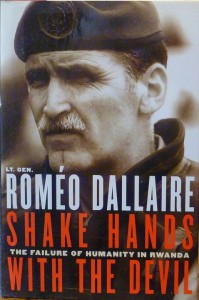
 In 2005 while an editorial executive with Carroll & Graf Publishers of the Avalon Publishing Group, I brought out the U.S. edition of Lt. Gen. Roméo Dallaire’s brave book, Shake Hands with the Devil: The Failure of Humanity in Rwanda. In it he gives an anguished account of the period when, as a member of the Canadian armed forces he served as commander of the UN peacekeeping force in Rwanda. He saved the lives of approximately 30,000 civilians even while 800,000 people died in the genocide. When I acquired U.S. publication rights from Random House Canada, it had already been a huge bestseller up there, where Dallaire was a public figure. He was not yet well known in the States, but publication of the book here coincided with release of the movie, “Hotel Rwanda,” in which Nick Nolte played a Hollywood version of the general. The movie portrayal, though very inaccurate, elevated Dallaire’s notoriety, and enabled us to generate major reviews and book him on shows like Charlie Rose, and many NPR programs. Many U.S. publishers had declined to publish the book here, including Random House in in New York, but when the book came out here–with an added Introduction by Samantha Power, author of the Pulitzer Prize winning, The Problem From Hell: American and the Age of Genocide–it became a Washington Post bestseller and sold very well around the country. It is still very much in print today, from the Basic Books imprint of the Perseus Book Group, which bought Avalon in 2007.
Dallaire had returned home to Canada from the Rwandan mission a nearly broken man, suicidal and afflicted with severe PTSD. Yet he rebuilt his life and psyche and has gone on to do very important work in conflict resolution. I accompanied him to several of the NY interviews in 2005, sitting in the back of taxicabs and in green rooms with him. We became friends. Despite everything he’d endured, he showed a good sense of humor with an often merry glint in his eyes. I mentioned this to him, and he said, “A commander without a sense of humor will not be respected by his troops.” He’s a soldier-humanitarian and an extremely kind and sensitive man, rather Gandhi-like. From the position he holds now as a Canadian Senator he has moved on in his life to advocate for the end of the practice of armies conscripting child soldiers. Yesterday, Huffington Post Canada reported on a new project of his, The Roméo Dallaire Child Soldier Initiative, and an accompanying documentary called “Fight Like Soldiers, Die Like Children,” drawn from the activism that led to his second book, They Fight Like Soldiers, They Die Like Children: The Global Quest to Eradicate the Use of Child Soldiers, published in 2011.
According to Huffington Post Canada’s Ryan Maloney, the movie “captures the innovative way Dallaire’s group is attempting to end this scourge of humanity, not just through research and training, but by staring down and shaming the commanders who put kids on the battlefield in the first place. Dallaire says the use of children in Rwanda was prevalent. He recounts watching packs of ‘wild-eyed, drugged-up’ kids use machetes to slaughter with reckless abandon. ‘It was interesting that the adults always seemed to be more in the back,’ he says.”
The article continues, “Where other programs focus on convincing kids to put down their weapons, the Initiative appeals to militia leaders directly and attempts to convince them it is disadvantageous, from a purely tactical side, to use a child in war. ‘That’s something that nobody else is attempting to do on this issue globally,” says Shelly Whitman, executive director of the Initiative. A key part of that process involves sending Dallaire to challenge these men on a personal level, often by appealing to their very manhood. ‘When another military leader sits down… and says (he) has no respect for you because you use kids, it’s a very macho thing,’ [director of the documentary Patrick] Reed says. Dallaire is confident that speaking with militia leaders directly will ultimately reduce the use of kids as instruments of war. He says his group has already been given the mandate to train the Sierra Leone army and police, as well as write curriculum for the primary school system to show children how to avoid recruitment.”
I’ll be eager to watch “Fight Like Soldiers, Die Like Children” when I can find it. Meantime, below is a trailer for it. The company that made the new film, White Pine Pictures, also made a powerful documentary based on Dallaire’s first book, also called “Shake Hands with the Devil.” I commend this brave and sensitive man to your attention. His important work could lead us to a better world.



