Stay With GoDaddy for Influence, or Ditch ‘Em?

TPM’s IdeaLab has a very thorough analysis covering the controversy buffeting web hoster GoDaddy in the past week. Until today they’d been supporting the controversial SOPA bill that failed as Congress ended its recent session. SOPA (Stop Online Piracy Act) has been criticized by netizens who fear it will just allow large content owners to dominate the streams of […]

Two Great Graphic Novels Coming as Ebooks

I just got an email from Montreal comics publisher Drawn & Quarterly, a company that produces exceptionally fine graphic novels and comic nonfiction, announcing their first entry into the ebooks space with two books by artist/writer Chester Brown. I think their email is worth quoting at length, because this is a fine print publisher stepping in to ebooks and because of their ebook royalty, which they explain will be an equal share with their authors. This is especially topical, in light of Michael Chabon’s new arrangement with Open Road Media, which I’ve discussed in an earlier post today. Bravo to D&Q and Kobo! This is an exciting publishing collaboration. //more

Chabon’s Hyperbole Undermines his Fair Critique

I suggest that the book industry view the cost savings from the diminishment of print as a kind of “peace dividend” for authors and publishers and other stakeholders like retail booksellers. Parties should share fairly in whatever windfall is to come. I would accuse the major publishers of being shortsighted and dumb and in thrall to old ways, but I fear that hyperbole like Chabon’s will only further degrade the debate and discussion that must proceed between publishers and authors, lest Amazon eventually become the monopoly publisher and bookseller many bookpeople nowadays fear is looming in our collective future. //more

Why Vinyl is Today’s Most Dynamic Music Medium

Consider this remark from Dave W. of Wax Tracks Records in Denver: “I have noticed that at least two or three times a week some father or mother comes in saying that their kid asked for a turntable for their birthday or Christmas present. So it’s not a case of the older generation just giving their turntables to their kids and saying ‘Here’s what we used to play music on,’ but rather the kids saying ‘This is what’s cool and happening right now and I want in on it.'”

Literary and Cultural History Preserved in Wood, Paint, Ink & Graphite

Literary, social and cultural history are all fascinatingly preserved in an old wooden door from a 1920s Greenwich Village bookstore. In Frank Shay’s Bookshop at 4 Christopher Street the proprietor was surprised one day in 1921 when writer Hedrik Willem Van Loon, an author with the publishing house of Boni & Liveright, signed his name to the door and for good measure added a little drawing to his contribution. Soon, Shay began routinely asking visiting writers and other cultural notables to sign the door. Ultimately, it would bear hundreds of signatures, including such figures of the day as John Dos Passos, Theodore Dreiser, Sinclair Lewis, Upton Sinclair, Sherwood Anderson, Heywood Broun, Christopher Morley, Edward Arlington Robinson, Frank Conroy, artist John Sloan, explorer Vilhalmur Stefansson, poet Don Marquis (creator of “The Adventures of Archy & Mehitabel”), and Henry Seidel Canby (editor, Saturday Review of Literature).

When the shop closed in 1925, the door was removed from the premises before the contents were auctioned to pay creditors. In subsequent decades its value as a cultural artifact became evident, with this advertisement appearing thirty-five years later:  “Mrs. Frank Leon Smith has a door for sale. On the door are the autographs of about sixty people who in the early Twenties were important, famous, talented, unusual. Im [sic] telling you, this is a fabulous door….Want a door? Ask Mrs. Smith at 321 East 52nd Street, New York 22. —’Trade Winds’ in the Saturday Review, 1960”. Note that money would evidently not have been required to become custodian of the door.

[gallery link="file" ids="877,878"]


Eventually, by steps unknown, the door reached the Ransom Center at the University of Texas in Austin, where it is housed today. Organizers there have created a terrific website devoted to it, to the shop, to Greenwich Village, and the period that produced it. Jennifer Scheussler’s New York Times Book Review article in September, with a neat slideshow, alerted me to the door’s colorful history and I’ve visited the Ransom website many times since. I love that Van Loon’s spontaneous signature became an inspiration for hundreds of contemporaries, all eager to scribble on a plank of wood, leaving a small imprint of their existence. It’s a veritable time capsule, or even better, a time machine taking us back to bookselling and publishing ninety odd years ago.

Lost American Writer Found–Jim Tully

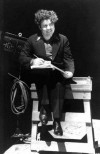
Until recently, I had not read even one of the fourteen books by the early- to mid-twentieth-century American writer Jim Tully (1886-1947) and knew little about him. Given my personal interest in Tully’s subject matter, which included circuses, hoboes, and riding the rails, springing from his twin milieux, rural Ohio and early Hollywood, I’m surprised at myself for having been slow to pick up on him. Now having sampled his work and discovered what an important and successful literary career he made in his life by reading the excellent new biography of him, Jim Tully: American Writer, Irish Rover, Hollywood Brawler, I’m going to do my part here to redress this widespread case of historical amnesia. I believe that now–especially in light of the Occupy movement and the attention it’s drawing to the economic distress afflicting millions in our society–is an ideal time for Jim Tully to be rediscovered. / / more . . .