Tag Archive for: #fridayreads

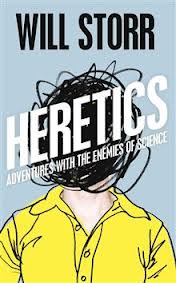
#FridayReads, March 29–‘Heretics: Adventures with the Enemies of Science’

Saturday update–


—
Heretics#FridayReads, March 29—The Heretics: Adventures with the Enemies of Science by British journalist Will Storr. I posted this book as a #FridayReads March 8, so it should be clear it is not a quick read. However, it should also be clear that I’ve stayed with it because reading it is a very rewarding experience. Storr’s investigation blends spot reporting from such locales as a revival meeting in Australia led by a creationist preacher with consideration of the placebo theory and homeopathy and its detractors. Like Jon Ronson, another British author with whom I’ve compared Storr, the author of this book is an affable guide who successfully inveigles his way on to a tour bus of Holocaust deniers led by disgraced former historian David Irving and in to a conversation with the churlish defender of Hitler. I’m reading the last 40 pages now where Storr probes the question of whether James Randi deserves the status he’s widely accorded as the ‘world’s most noble skeptic.’ Storr, shall we say, has some doubts. I recommend this thoughtful and nuanced book most highly. I first read about this book in the Guardian last January and I’m glad I was able to get a copy from Picador, Storr’s obliging UK publisher.

Please note: you may visit a ‘buy page’ for this book at the website of Powell’s Books–the affiliate bookseller for The Great Gray Bridge–by clicking on this book link: The Heretics: Adventures with the Enemies of Science.

#FridayReads, March 22–“Things Fall Apart,” Chinua Achebe

#FridayReads, March 22–Things Fall Apart by Chinua Achebe, who died Thursday at age 82. I read the book in college, the very copy shown here. It’s a classic, richly deserving of its status. Things Fall Apart backThings Fall Apart front cover

#FridayReads, Feb. 22–“Siege 13,” Stories by Tamas Dobozy

siege13-web#FridayReads, Feb. 22–Siege 13: Stories by Tamas Dobozy, an innovative collection of short fiction that oscillates between the Nazi siege of Budapest in 1944 and the present day. I’ve just begun digging in to the book, but find I’m already astonished by the fluency of the writing, and the way the stories pull me right in. I don’t have too much to say about it yet, so I’ll note here the review of it that ran in Quill & Quire, the magazine of the Canadian book industry (Siege 13 was published simultaneously in the US and Canada). The reviewer is writer Robert Wiersema:

The stories are varied in tone: some emphasize the horrors of war, while others–like “The Society of Friends,” about two men in love with the same woman – are darkly humorous. Gripping realism is comfortably juxtaposed with fantasy in stories like “The Ghosts of Budapest and Toronto.” The pieces in Siege 13 are also unified by Dobozy’s skill as a writer. Carefully crafted, but executed with seeming effortlessness, every sentence in this collection, every paragraph, is a thing of beauty, and the stories themselves are without flaws. That said, the combination of the author’s abilities and the book’s subject matter means Siege 13 should come with a warning: take it slow. These are stories that should not be rushed through.

I will definitely take my time. Meantime, if you’d like to know more about the writer, here’s the web page for the book from its US publisher, Milkweed Editions. They sent me a review copy some months ago, I’m glad I’m finally getting to the book. The striking cover was designed by Michel Vrana, a friend who I met at the first Book Camp, an unconference about publishing.

#FridayReads, Feb 15, “Worth Dying For,” a Jack Reacher novel by Lee Child

#FridayReads, Feb 15, “Worth Dying For,” a Jack Reacher novel by Lee Child. I’ve been hearing about Child for quite a while, and now have finally picked up one of his books.  It’s a corker, I can see why they’re so popular. Reacher is a marauding justice-seeker who knows no limits, physical or psychological, in avenging those who’ve been wronged. In this case, it’s about justice for an 8-year old girl who went missing 25 years before the primary events in this story, with her disappearance having gone unsolved all this time. Reacher shows up in a desolate Nebraska county unsuspectingly, and soon gets drawn in to a tangled web with the corrupt Duncan family at the center of it all. The violence–and there’s quite a bit of it with Reacher being one of the toughest badasses I’ve ever come across in suspense fiction–is thick and visceral, and though very realistic, somehow hasn’t made me avert my eyes, figuratively or literally. It’s a bit like the mayhem in a comic book–thunderous and full of punch. Still, unlike the Road Runner, who always gets up again after having an anvil land on him, the blows sustained by Reacher’s opponents leave them down for the count.Reacher backReacher front

As usual, also reading book proposals from prospective author clients, in this case, a manuscript about the recently excavated Richard the III, translated into English from Dutch. Timely, and if good enough, could be something publishable here in North America, and perhaps in other English-speaking countries.

#FridayReads, Jan. 18–“God Save the Mark,” Donald E. Westlake and “Going Clear,” Lawrence Wright

Westlake#FridayReads, Jan. 18–God Save the Mark, a wise-cracking mystery novel by the peerless Donald E. Westlake, featuring a naive young man who inherits a fortune from an uncle he never even knew of, and then tries to keep his hands on it, and away from the lurking no-goodniks who want to fleece him of his windfall. Westlake’s dialogue is street-wise, funny, and real.

Also, just starting to read Going Clear: Scientology, Hollywood & the Prison of Belief,Lawrence Wright’s careful dissection and, as the flap copy reads, “deep penetration” of a modern cult. One case Wright reports on is that of Kyle Brennan, a 20-year old whose tragic suicide may have been preceded by his father’s acquiescence to a Scientologist bigwig’s instruction to withhold from the young man medicine prescribed for him by a psychiatrist. The NY Times has already released a review of the book that will appear in this coming Sunday’s Book Review, by Michael Kinsley, who calls it “essential reading.” Should make for revelatory reading this weekend. Going Clear

#FridayReads, Jan. 11–“Zero” by Collinson Owen & “The Troubled Man” by Henning Mankell

#FridayReads, Jan. 11–“Zero” by Collinson Owen. Enjoyed this engrossing late-Edwardian (1927) potboiler about a novelist who welcomes the opportunity dealt him by a train wreck that leads his wife and friends to believe he’s been killed. Notwithstanding a new life under a nom de plume that shoots his career as a writer to new heights, he discovers a powerful urge to somehow go home again. It has lots of London publishing and theatre world material. According to the inside, Owen wrote at least 5 other books: The Adventure of Antoine; The Rockingham Diamond; The Battle of London (as “Hugh Addison”); C.O’s Cameos; and Salonica and After, a travel narrative. It’s easy to see why this was a popular entertainment in its day. I (gently as possible) reread my 1927 copy (it’s mostly disbound).Zero insideZero

Have moved on to The Troubled Man, another Kurt Wallander police procedural novel in my recent binge of books by Henning Mankell. This is one of the last of his Wallander novels, with the taciturn detective investigating the inexplicable disappearance of his in-laws. This book also features his daughter Linda, a police captain herself. It is the father and mother of her beau that have gone missing. I know from the sequence of these novels that Wallander is going to retire soon, plagued as he is by diabetes and terminal ennui, a fear that he’s wasting his life in futile pursuit of lawbreakers. I love these books for Mankell’s loyalty to his characters.Troubled ManMankell