Saturday Update: Since Friday night when I began tweeting and blogging about the Judge Sentelle-led ruling–that if upheld on appeal could block virtually all recess appointments by President Obama–I’ve seen a lot of coverage. Here’s one the best pieces, a brief one by Scott Lemieux, of the blog, Lawyers, Guns, and Money. It’s called Neoconfederate Judges Rule Recess Appointments Unconstitutional. I recommend it.
Also not to be missed is Charlie Pierce, over at Esquire.com, railing against Judge Sentelle with his typically colorful flair and articulate opprobrium in a post titled simply “David Sentelle is a Hack”.
—-
Thanks to the reporting of Robert Draper and Frontline we know that REPUBs began plotting President Obama’s downfall on the first day of his first term. Well, for a comparable artifact from the Clinton Years, cast your mind back to the early days of Bill Clinton’s first term. Whitewater, little more than an annoyance for the Clinton campaign during the ’92 presidential race–became a nuisance once the new president took office, owing to Republican insistence of corruption or worse, and media enabling. Stupidly, papers like the New York Times, notably under the byline of reporter Jeff Gerth–who weirdly was the grown son of a couple friendly with my parents back in the day in suburban Cleveland’s Jewish community–created a froth of interest and curiosity about the failed real estate deal. To bat back the idea that anything nefarious had happened, the young administration acquiesced to demands for a special prosecutor to investigate the venture, and Robert Fiske was appointed by Attorney General Janet Reno. Reno, who had been Clinton’s third choice for the spot, coming to the fore after two earlier nominations flamed out (remember Zoe Baird and Kimba Wood?). The tall Floridian had little fealty to the Clintons, and had not lacked for independence when she named Fiske, a career attorney, not a partisan. Still, when media began reporting that Fiske was finding little of concern in the land deal, and no wrongdoing by the First Couple, right-wing poobahs claimed Fiske’s selection by Reno had been suspect, and that he was a lackey of the administration.
Senators Jesse Helms and Lauch Faircloth, both from North Carolina, began pulling strings, soon enabling a three-judge panel of the D.C. circuit to remove Fiske. One of those three judges was David Sentelle, also of North Carolina. To the vacated position, the judges appointed Kenneth Starr, a sanctimonious legal prig, who over the next decade would spend more than $100 million on his ever-growing investigation of the Clintons and other DEMs. The rest, unfortunately, became modern history, including ultimately the impeachment and acquittal of President Clinton.
To coerce testimony from Susan MacDougal–former wife of Jim MacDougal, who had in the 80s inveigled the Clintons to buy Whitewater property–Starr charged her with civil contempt and had her jailed for 18 months.* Once it was clear that Starr would never find a smoking gun amid the Whitewater folderol, moved on to place his investigative weight behind the Paula Jones case and the Monica Lewinski affair. At the time Bill Clinton’s second term ended Starr’s investigation was ongoing, even though he had long since stopped looking primarily into Whitewater.
All that is prologue to today, when the NY Times reported along with other news outlets that a three judge panel of the D.C. district court, a body headed up by the same David Sentelle, had ruled that President Obama’s 2012 appointment of three officials to the National Labor Relations Board (NLRB) was unconstitutional. The president had appointed those officials during a 20-day break in the Senate’s business, a hiatus during which he also appointed Richard Cordray to head up the Consumer Financial Protection Bureau. REPUB senators had stalled consideration of these appointments, and scores of others.
The court claims that the Senate was not really in recess, and thus the administration could not make these ‘recess’ appointments. The Times adds,
“Legal specialists said [the ruling’s] reasoning would virtually eliminate the recess appointment power for all future presidents [at a time] when it has become increasingly difficult for presidents to win Senate confirmation for their nominees. . . . ‘If this opinion stands, I think it will fundamentally alter the balance between the Senate and the president by limiting the president’s ability to keep offices filled,’ said John P. Elwood, who handled recess appointment issues for the Justice Department during the Bush administration. ‘This is certainly a red-letter day in presidential appointment power.’ The ruling, if not overturned, could paralyze the NLRB, an independent agency that oversees labor disputes, because it would lack a quorum without the three Obama appointments [made] in January 2012. . . . The ruling also called into question nearly 200 years of previous such appointments by administrations across the political spectrum. The executive branch has been making intrasession appointments since 1867 and has been using recess appointments to fill vacancies that opened before a recess since 1823. Among other things, Mr. Elwood noted, it called into question every ruling made by several federal appeals court judges who were installed by recess power. ‘You know there are people sitting in prisons around the country who will become very excited when they learn of this ruling,’ he said.”
AP reports that Jay Carney, Obama administration press secretary said, “The decision is novel and unprecedented. It contradicts 150 years of practice by Democratic and Republican administrations.”
I don’t pretend to be a lawyer, but I find it hard to believe that this ruling will be upheld. Judge Sentelle and his two cohorts have simply invalidated too much precedent with this radical pronouncement. What interests me more at the moment is how characters like Sentelle–little known outside the halls of government, and not all that well-known even inside them–exert so much authority over our lives and the fate of the nation. The wikipedia page on Sentelle reports that in 1987 to the D.C. District Court, taking the seat just vacated by Antonin Scalia who went on to the Supreme Court. In 1991, Sentelle invalidated the criminal convictions of Oliver North and John Poindexter arising from their illegal conduct in the Iran-Contra scandal. I don’t know the man, so I’d normally be loathe to diagnosis his motives, but it is hard to not see Sentelle as a longstanding and ardent operative promoting right-wing, partisan causes, and doing his utmost to sabotage and confound DEM presidents when he has the opportunity to do so. I must add too that if this decision is upheld, it will become even more difficult for President Obama to run the government in the face of REBUB opposition, particularly that emanating from the Senate. This ruling today makes all the more regrettable the partial measures taken in the Senate yesterday, when DEMs there failed to adequately reform the filibuster. If the Sentelle ruling is not overturned, and soon, Senate REPUBs will have even less reason to work with President Obama. It makes me wonder if Sentelle–a Zelig-like figure on the conservative bench–and his colleagues held the release of their ruling until the day following the announcement of the Senate’s weak measures. lest the urgency of filibuster reform seem truly imperative to wavering DEM senators like Majority Leader Harry Reid.
Here’s an excellent piece by TPM’s Brian Beutler that reports on the constitutional issues at stake.
*In 2000 Susan MacDougal became my author, when I acquired and edited her book The Woman Who Wouldn’t Talk: Why I Wouldn’t Testify Against the Clintons and What I Learned in Jail, with a forceful Introduction by Helen Thomas, a NY Times bestseller. In addition to Susan’s book, recommended reading on this topic is The Hunting of the President by Joe Conason and Gene Lyons.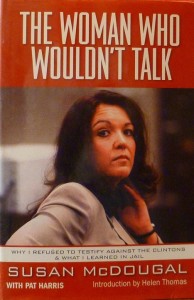

 Readers of this blog may recall earlier posts in which I explained that in the mid-2000s I was a colleague for several years at Avalon Publishing Group with David Wheeler, whose 6-year old son Ben was a first-grade student at Sandy Hook Elementary School, one of the twenty children murdered in Newtown, CT, last Dec. 14. With heavy heart but much pride and encouragement I’ve watched over the past four months as David and his wife Francine, along with other Sandy Hook parents, have become activists for new laws that will diminish the likelihood of other similar tragedies occuring in the future. They and the other parents have met several times with President Obama and this week Francine was invited to deliver the administration’s weekly address. This would be the only time that someone other than the president or vice-president gave the weekly address. Last night NPR reported that Francine wrote the address with the help of David, and together they recorded it in the WH library. The Wheeler’s have vowed that their son’s life and death will have import and meaning, and they are working with great dedication to ensure this. I admire them and their older son Nate, and share their grief for Ben.
 To lend your voice to this effort, here’s the fact page the president mentions in his email.