

Celebrating the Holidays with the Singing Roches
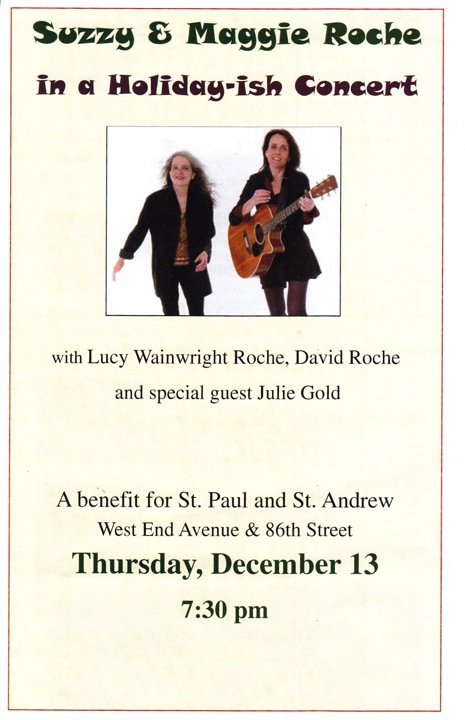 The night before the tragedy in Newtown, CT, I attended a special holiday concert put on by Suzzy and Maggie Roche with their extended musical family. It was a wonderful show, full of humor, uplifting sentiment, and infectious music. Sadly, the next morning as I downloaded photos from my camera and prepared to write a blog post about the show, news of the Newtown shootings began to emerge. I put the idea aside, my heart just wasn’t in it, especially after I learned that a former colleague’s 6-year old son was among the dead. Tonight, with Christmas Eve day ticking on toward midnight, even while another violent outburst of deadly gunfire was reported today, near Rochester, NY, I’ve decided to finally share my pictures and make this into a bit of a Christmas post.
I’ve written about the Roches a number of times over the past several months. First, Kyle and Ewan and I had fun at Terre Roche’s Sunset Singing Circle in Battery Park in June. This public sing-a-long was held at the tip of lower Manhattan, facing New York harbor and the Statue of Liberty. I also wrote about sister Suzzy’s splendid mother-daughter novel, Wayward Saints, a tragi-comic tale of rock n’ roll, family, and second chances in life. I posted next when Terre published a NY Times Op-Ed on what she dubbed the new busking in the music biz, with emerging mechanisms to seek funding for support of recording such as Kickstarter and Indiegogo. Finally, last summer Suzzy led a Bryant Park reading room discussion on Edith Wharton’s House of Mirth, which Kyle and I greatly enjoyed, and which I wrote about, as well.
They are clearly a very talented family, and I’m a fan. What’s more, they don’t just rest on their laurels for things they did back in the day (with Maggie) as The Roches, with such great compositions as “Hammond Song,” with its theremin-like lead instrument and great harmonizing of all three voices. It’s still a beautiful song, and deserves a fresh listen, if you haven’t heard it recently, or ever. That’s why I was eager to attend Suzzy and Maggie’s Dec. 13 program, what they called a “holiday-ish concert,” which was also going to include their brother, David, with his daughter, Oona; Suzzy’s daughter, Lucy Wainwright Roche (whose father is Loudon Wainwright III, composer of the the classic, “Dead Skunk in the Middle of the Road”); and singer songwriter, Julie Gold, best known for her song “From a Distance,” which Bette Midler recorded and made famous as a Grammy Song of the Year in 1991. It promised to be quite a program, and the event didn’t disappoint, at all.
I had never heard Maggie before this occasion, and it was interesting to hear her voice mix with that of Suzzy, with it a bit lower in register by comparison. They did “Hammond Song,” with Lucy taking the part that would’ve earlier been sung by Terre. Lucy also sang the title song from her latest album, “There’s a Last Time for Everything.” That wordplay is found in much of the Roches’ writing, with humor in their lyrics and a kind of plain-spoken matter-of-factness that I found refreshing. It doesn’t at first seem artistic, and the lack of artifice is welcome; what it is, is real. Scan the first verse of their song, “We,” their opening number on this program, credited to all three of the sisters, which they wrote in 1979:
We are Maggie and Terre and Suzzy/Maggie and Terre and Suzzy Roche/we don’t give out our ages/and we don’t give out our phone numbers/give out our phone numbers/sometimes our voices give out/but not our ages and our phone numbers
The night ended with them inviting anyone in the audience who wanted to sing in the last few carols to join them at the front of the church. A lively group assembled around them and the evening ended with a great, joyous sing-a-long. I’m glad I could be there, and finally post this little essay on the concert, notwithstanding the terrible tragedies that have intervened. I hope the photographs below give you a full sense of this special program. Please click here to see all photos.


