“Live Theater—An Incomparable Art Form,” a Guest Essay by Alexis Greene
Live Theater—An Incomparable Art Form by Alexis Greene

I fell in love with theater when I was nine years old. I was growing up in New York City, and in the fall of 1954 friends of my mother took me to see the Broadway musical Peter Pan, starring Mary Martin as Peter and Cyril Ritchard as the villainous Captain Hook. It was the first time I’d ever been inside a theater and I loved where we were sitting: in a box on the right side of the stupendous Winter Garden Theatre. I loved the show, and I especially adored Margalo Gillmore, who played Mrs. Darling, the loving mother of the children whom Peter Pan invites to fly with him to Neverland. I was entranced by the gowns that Mrs. Darling wore: I wanted to be an actress.
*
I acted in productions in high school and college, at Vassar, where I majored in theater. The head of Vassar’s Experimental Theater, William F. Rothwell, Jr., was inspiring, and he believed I was an excellent young character actress. My favorite role was when Rothwell cast me as 13-year-old Willie in This Property Is Condemned, and I remember walking barefoot on the stage, talking to myself and the audience about my deceased older sister. The role was a gift.

After graduating, I was cast in a couple of off-Broadway productions. But the craft of acting did not love me the way I loved it so I went back to school to write my Ph.D. dissertation on Off-Off Broadway theater, and subsequently taught theater at New York University and Hunter College. I became enamored of dramaturgy and cofounded Literary Managers and Dramaturgs of America (now Literary Managers and Dramaturgs of the Americas), and I helped to make live theater as Literary Manager at the George Street Playhouse in New Brunswick, New Jersey. I traveled the Eastern U.S. for the National Endowment for the Arts (NEA), doing site visits.

Eventually I found my true calling: writing and editing books about theater companies and theater artists, especially women. All of these vocations intensified my love for live theater.

When I go to the theater and watch a play or a musical, or simply listen to actors reading a play, I often experience a range of emotions roused by the script and the performances: love and anger; pity and sorrow; desire and pleasure. I learn about myself and I also learn about people who live in the world around me. When I see Shakespeare’s Romeo and Juliet, I relive my own true love. Lorraine Hansberry’s A Raisin in the Sun, in 1959 the first play by a Black woman to be produced on Broadway, taught me about the hatred and fear that African Americans endure in America. For me, it was, and remains, a frightening, and enlightening, revelation.

I imagine that when theater began in the Western world—in ancient Greece—audiences watching the plays of Sophocles and Euripides, Aeschylus and Aristophanes, felt the same emotions and experienced the same kinds of awareness as we do today. Indeed, the mostly male audiences reportedly became so involved that sometimes, if they didn’t like what they saw and heard, they threw things at the stage. Women, unfortunately, were usually excluded from these performances in ancient Greece, from the audiences and as performers.

Live theater continued to grow and thrive in Europe and then in North and South America.

Theater, opera, and dance also came to life in the Far East. Opera emerged in China; Noh and Kyogen plays came about in Japan. Performances, which often merged music and song, dance and mime, sometimes continued for hours, and audiences stayed and watched, munched food, and talked about what they were seeing.

As the world has changed over the centuries, theater has evolved. Slavery was still rampant in America in the nineteenth century, but as the theater historian Oscar G. Brockett writes, in 1821 there arose in New York City the first known company of African American actors in the United States, performing at the African Grove, an outdoor tea garden, and eventually at an indoor theater. Along with Shakespeare’s plays, they performed what was perhaps the first known play written by a Black man in America: The Drama of King Shotaway.

Women also began to receive attention on America’s stages, and in 1840 Anna Cora Mowatt wrote what became a frequently produced comedy of manners: Fashion. As Joel Hirschhorn told Variety in 2008, “She defied male contempt for femme authors, a species Nathaniel Hawthorne defined at the time as a ‘damned mob of scribbling women.’”

During the 19th century, New York City became a theatrical center, with commercial theaters decorating Broadway, and early in the twentieth century Times Square became commercial theater’s most famous location, with a bevy of impressive stages.

But also in the early nineteenth century, here in the USA, the Little Theatre Movement brought to life intimate, independent theaters that in effect challenged Broadway’s commercial devotion and brought forth new playwrights, most notably Eugene O’Neill. Then, in the 1960s, nonprofit regional theaters, funded by the NEA, began to bloom throughout the United States. And as our country passed new laws recognizing and affirming the rights of women and people of color, more and more women and people of color wrote plays and saw them produced: playwrights like Constance Congdon and Eve Ensler, Pearl Cleage and Tina Howe, Lynn Nottage and Emily Mann, Migdalia Cruz and Beth Henley, Rukhsana Ahmad and Diana Son. And directors explored so-called “non-traditional” casting in classical plays.

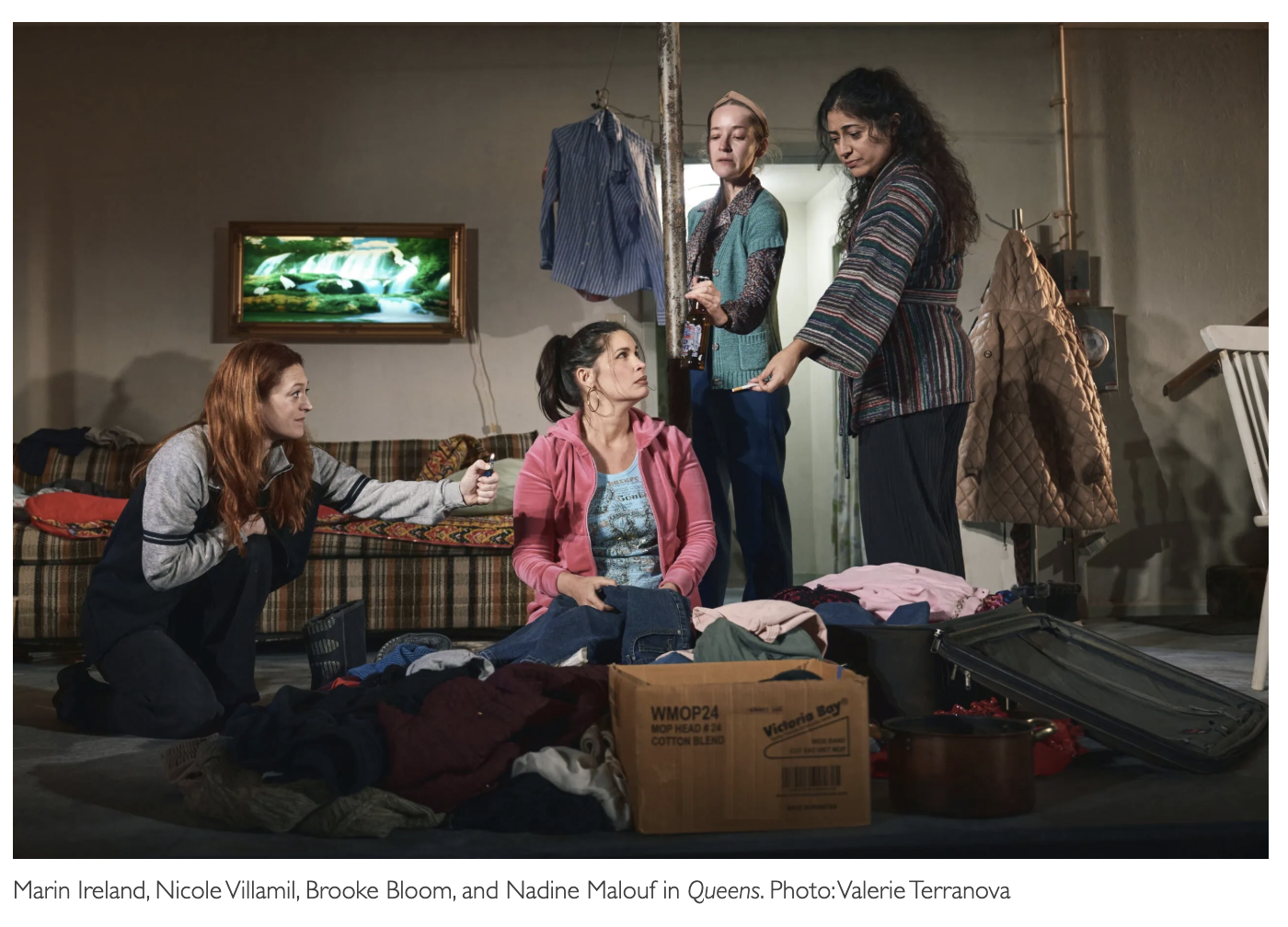
The best plays often reflect the world we are living in. In December 2025, for instance, I saw Martyna Majok’s Queens at Manhattan Theatre Club (MTC). The title might suggest a play that extols women, and the play does do that. But the title actually refers to the borough of Queens in New York City, where a group of immigrant women are living together in a basement apartment. Majok wrote her play in 2018, but she revisited the script for the 2025 production, and we naturally connect the images and the characters and their situations to the issue of immigration that our current President has brought to the fore with calamitous and tragic consequences.
Our country is a country of immigrants, beginning with those who sailed to this land in the sixteenth and seventeenth centuries. And people from practically every country in the world have moved here since. My own grandparents—my mother’s parents–came from Eastern Europe to Dorchester, Massachusetts, in the late nineteenth and early twentieth centuries, and made relatively pleasant and successful lives for themselves there.

The undocumented women in Queens, who live together in an illegal dwelling, are Belarusian, Afghan, Honduran, Polish. The play particularly involves a young Ukrainian woman named Inna (played beautifully at MTC by Julia Lester). She has come to America looking for her mother, who abandoned Inna and came to America when Inna was a child. Indeed, as we watch the production and absorb the play, we realize that the women in Majok’s play have come to America because of the deprivation they faced in their lives in their original countries. But here in America they are striving to find safe, comforting, and sustaining existences.

The play and this production aroused in me what the best of live theater gives us. It stirs our emotions, awakens memories, and leads us to contemplate what the world around us is like. In the case of Queens, of course, I and many others in the audience could not help but connect the play’s content to how America’s current President and administration are treating immigrants: reviling them and deporting them.

Because live theater is such a penetrating and unique experience, those of us who have been following the news are especially disheartened by the threats to the National Endowment for the Arts (NEA), which significantly supports nonprofit theaters like MTC. As Nathan Pugh wrote so aptly in a Fall 2025 essay for American Theatre, “A political takeover of the arts is more than just symbolic; it’s indicative of a very real takeover of American thought and imagination.” Last spring, President Trump recommended eliminating the NEA in the 2026 Federal budget, and in May 2025, the NEA began slashing hundreds of grants that had already been awarded. Among other new reasons for slashing grants were rules against funding a theater company that promoted diversity, equity, and inclusion (DEI).

Anne Hamburger, Founder and Artistic Director of En Garde Arts in New York City, wrote to the En Garde Arts Community soon after the NEA revoked a $40,000 grant that En Garde Arts had previously been awarded:

“To say we’re disappointed is an understatement. En Garde Arts as an organization will survive. But our artists are at risk. As federal arts funding is slashed, the first to suffer are the bold, untested, and extraordinary new voices….En Garde Arts is launching a campaign to say clearly, loudly, and in no uncertain terms: Art is Not Expendable.”

The NEA was established by Congress in 1965, when Lyndon B. Johnson was President. In addition to Theater, the NEA supports Dance, Music, Visual Arts and Literary Arts and Media Arts, Folk & Traditional Arts, and Design.
President Johnson encouraged the House and the Senate to establish both the National Endowment for the Arts and the National Endowment for the Humanities. And when he signed the NEA into existence, sixty years ago on September 29, 1965, he said, “Art is a nation’s most precious heritage. For it is in our works of art that we reveal to ourselves, and to others, the inner vision which guides us as a nation. And where there is no vision, the people perish.”

The NEA has not been cancelled, but hundreds of grants and offers of grants to arts organizations have been. And on top of that the NEA’s future is uncertain.

Protecting live theater, along with the other arts that the NEA has supported, is urgent, and it begins, as it did with me, by loving theater, either as a regular member of the audience or as someone onstage or behind the scenes. The Los Angeles-based playwright Larissa Fasthorse put it beautifully in the Winter 2025 issue of American Theatre: “You wanna remember why you do theatre? Do a show full of audiences who have never been to theatre before. Hearing gasps and cheers at the magic of theatre—it’s incredible and addictive.”

Those are words I will remember as I go forth contemplating a lifetime of theater experiences I have enjoyed.

#####

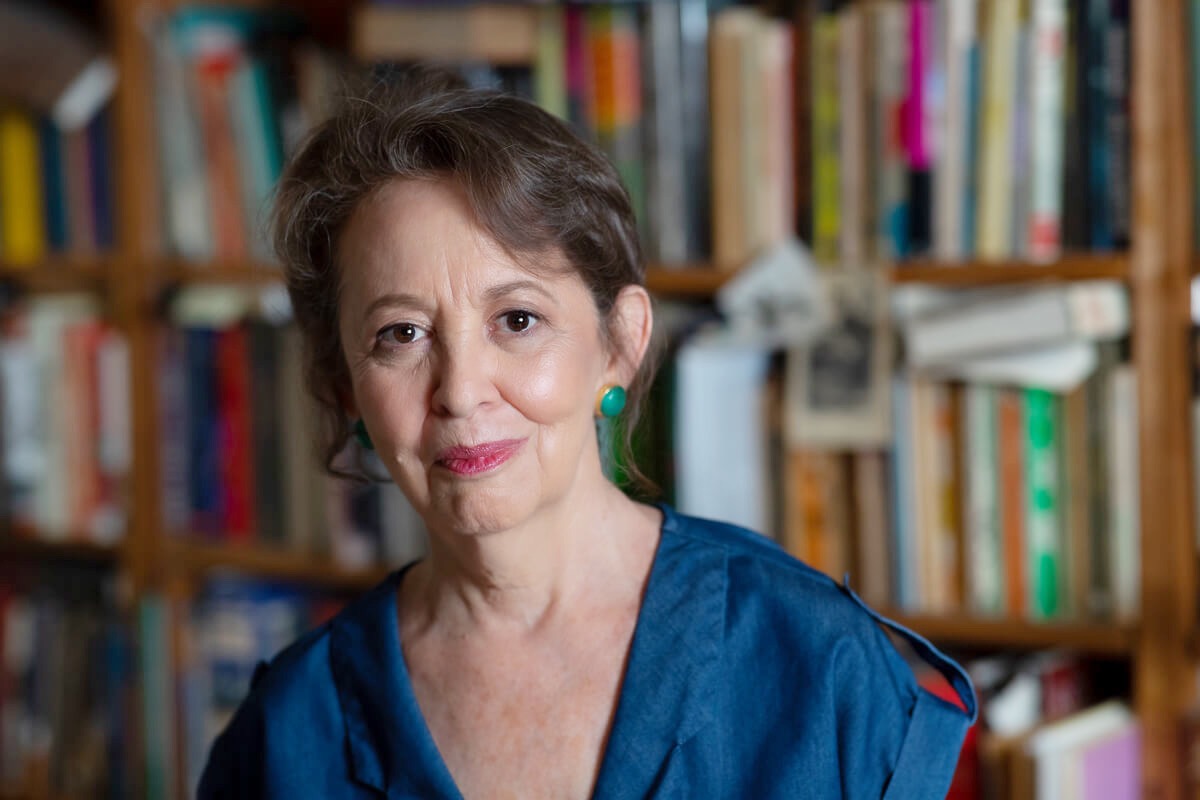
ALEXIS GREENE is a writer and editor of numerous books about theater, including The Lion King: Pride Rock on Broadway, written with Julie Taymor (Disney Editions, 1998); Lucille Lortel: The Queen of Off Broadway (Limelight Editions, 2004); Emily Mann: Rebel Artist of the American Theater (Applause Books, 2019); and Shakespeare Theatre Company: The History of a Classical Theater (Peter E. Randall Publishers, 2025). In addition to writing books about theater, Greene’s career spans acting, theater criticism, and teaching (she holds a PhD from the Graduate Center of the City University of New York). She is a member of Biographers International Organization, PEN, the Authors Guild, and League of Professional Theatre Women. She is a client of the literary agency Philip Turner Book Productions. Born and raised in New York City, Greene lives there with her husband, Gordon Hough.

Excited about “Deep Inside the Blues: Photographs and Interviews” by Margo Cooper

As readers of this blog may recall, I’ve been a fan of blues music since my teens in Cleveland, when I began listening to the local legend Mr Stress, whose eponymous band played at area venues for many years. I contributed an essay about him to the Cleveland Anthology from Belt Publishing in 2011, “Remembering Mr Stress, Live at the Euclid Tavern.”  I was excited recently to hear about the new book, Deep Inside the Blues: Photographs and Interviews by Margo Cooper, a historian and photographer who’s contributed to the NY Times Lens blog, and to receive a copy of her new book from the University Press of Mississippi.  

In a lengthy Foreword, William Ferris, former chair of the National Endowment for the Humanities, writes “These interviews deftly unlock and reveal the soul of a people and their music. These voices have hypnotic powers as they speak. Cooper focused on their rich language in her interviews and tried to capture “not only the exact content of what the musicians had to say, but the way they said it, their emotions, the rhythm of their speech, which was its own music. I began to see the possibilities of a deeper kind of blues story.”

I’ve only just begun to dig into this exceptional book, and know I’ll get a lot of enjoyment it in the weeks and months to come. Below is a gallery of some more shots of the book, the back cover, and interior shots of Earnest Roy, Jr. and Anthony Sherrod; Billy Boy Arnold; Bo Diddley, Arnold’s mentor; and Pinetop Perkins, who played with Muddy Waters; and the author/photographer, Margo Cooper.

[gallery link="file" ids="18297,18298,18299,18300,18301,18302"]


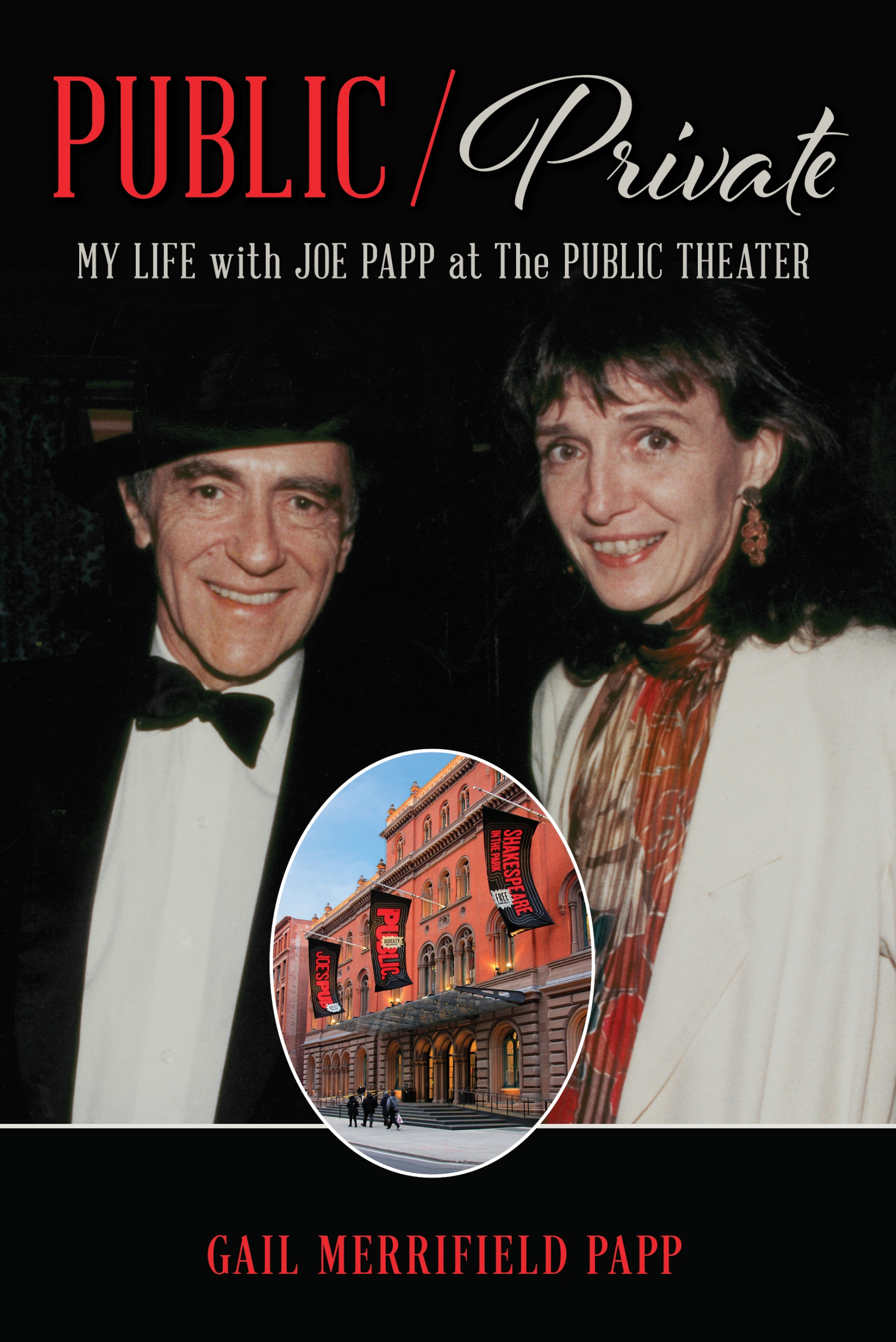
Sold—Public/Private: My Life with Joe Papp at the Public Theater
by Gail Merrifield Papp

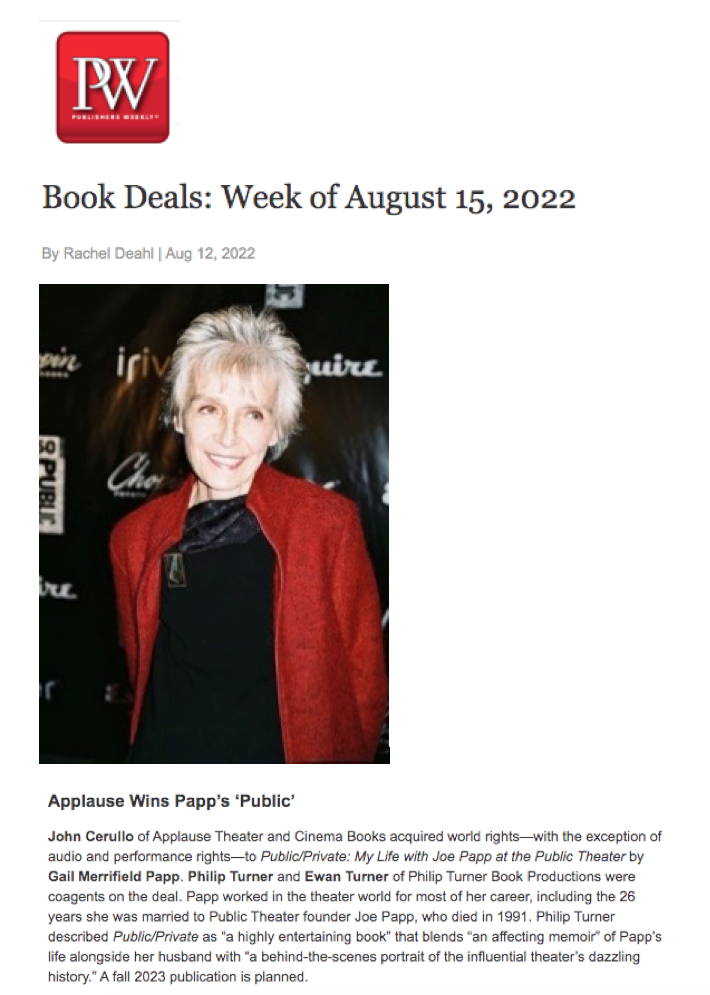
Delighted to announce that our literary agency Philip Turner Book Productions has sold PUBLIC/PRIVATE: My Life with Joe Papp at the Public Theater by Gail Merrifield Papp to Applause Theater and Cinema Books. News of the deal appeared first in Publishers Weekly’s Deals column today.

The author has worked in the theater world for most of her career, starting at the Repertory Theater of Lincoln Center, and then at producer Joe Papp’s New York Shakespeare Festival/Public Theater from 1965-1991. As Director of New Plays and Musicals Development, she was responsible for some of the Public’s best-remembered productions. Gail Merrifield and Joe Papp married in 1976 and were together until his death in 1991. She lives in New York City.

To offer readers of this blog a sense of the book, below is a portion of the pitch letter I sent to publishers.

Gail Merrifield Papp has written an engrossing and highly entertaining book that blends an affecting memoir of her life alongside the founder of the Public Theater Joe Papp with a behind-the-scenes portrait of the influential theater’s dazzling history. She opens with the Public Theater’s beginnings more than a half-century ago in a narrative that spans the decades-long association the couple enjoyed until Joe’s death in 1991. During that span, the Public mounted hundreds of productions, from Shakespeare in the Park to such plays as for colored girls who have considered suicide/when the rainbow is enuf and Sticks and Bones, to the musicals Hair and A Chorus Line—with many actors whose careers were launched at the Public, including James Earl Jones, Meryl Streep, Kevin Kline, Colleen Dewhurst, Martin Sheen, Gloria Foster, George C. Scott, Diane Venora, Morgan Freeman, and dozens of others.*

In a witty conversational style, the author paints a comprehensive portrait of the creative process of one of America’s most acclaimed theater artists, highlighting the innovative ways the Public operated, driven by Joe’s ambition to create a year-round producing home focused on original plays and musicals from new voices, while employing non-traditional casting which made it a home for scores of the most creative people in American pop culture. In  Public/Private she traces the founding of the Shakespeare Festival, when its role was for a time limited to small venues around New York City, later moving into Central Park where its Shakespeare renditions became an indelible feature of summer in the city, and the Public’s evolution toward cultural renown and national significance, a beacon for social change.

New aspects of Joe Papp’s many battles with the establishment are also highlighted, from tilts with Robert Moses to theater critics to conservative poohbahs in the US Congress. The scourge of AIDs is also documented, in the form of people close to Joe and Gail, Larry Kramer’s play The Normal Heart, and in the toll it exacted on Joe’s son, Tony.

Her touching remembrances lend the narrative a keen, emotional edge, which will captivate readers and bring a human side to the legendary figure whose theater continues to thrive today, operating at both the Delacorte Theater in Central Park, in the theaters on Astor Place and at Joe’s Pub, a live music venue dedicated in his honor.

At a time when America remains divided over issues of race, identity, and sexual orientation, Public/Private reminds us that theater is a powerful force for social change and community-building, a place for people to gather.

*A marvel of the book will be its impressive appendices of more than thirty pages appearing under the headings: Featured Actors, Choreographers, Composers, Directors, and Playwrights.

To read more about Gail Merrifield Papp and what you can expect to discover in her upcoming book, visit GailPapp.com.


Manhattan’s Metro Theater, Reopening at Last

In 2012, I was excited I could report this on my blog, some good news for denizens of my Manhattan neighborhood, and other New Yorkers.

https://philipsturner.com/2012/07/15/alamo-drafthouse-cinema-coming-nyc/

Following Sept 11, 2001, which hit NY’s infrastructure and economy so hard, and Superstorm Sandy in 2012, which added to the damage, it would have been a real shot in the arm for the city to have the renovated movie theater open just four blocks from my apartment, but alas, in 2015, this was the outcome to Alamo’s interest.

https://philipsturner.com/2013/12/08/alamo-drafthouse-cinema-abandons-renovation-metro-theater-nyc/

Last week with my wife—artist Kyle Gallup, who made a collage of the Metro marquee seen below—we were walking up Broadway at 98th Street in front of the old Metro, where we were surprised to see the building’s omnipresent steel doors had been raised and people were working inside. Kyle took a picture:

Now this week comes the welcome news, first in via Westside Rag, and then today in Gothamist that the Metro will finally be reopening. Manhattan Borough President Mark Levine told Gothamist reporter Ben Yakas that though he himself had been skeptical himself—due to the past abandonment by Alamo—he’d spoken to the CEO of the as-yet unnamed exhibitor, who told him that the company has actually signed a lease. Renovations will begin soon to turn it into a cinema complex with multiple screens and an event space, to reopen in 2023.

Celebrating Maurice Sendak at the Society of Illustrators

[caption id="attachment_17163" align="alignright" width="300"] A Thurber drawing in the permanent collection at the Society of Illustrators.[/caption]

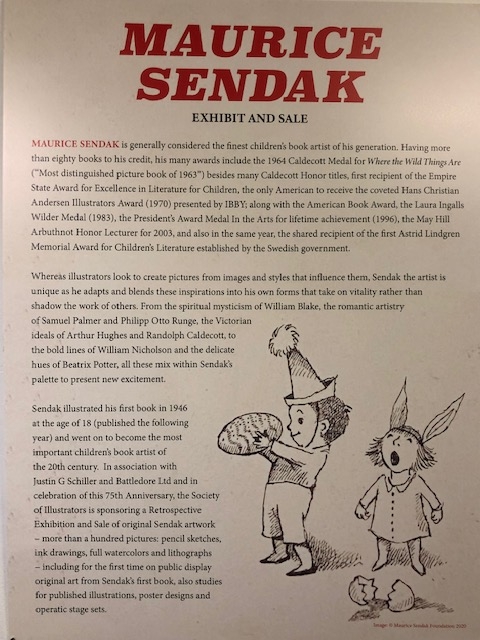
Ewan and I had fun yesterday with children’s book scholar Michael Patrick Hearn at the Society of Illustrators on E. 63rd St in Manhattan for an exhibit and sale of paintings, drawings, etchings, and posters by Maurice Sendak. Lovely work by a true master artist. The Society was founded in 1901, and their narrow townhouse building is beautifully kept up, with a handsome cafe bar and patio on the third floor. It’ll be fun to go back for a drink later this summer. The permanent collection at the Society is also excellent, including works by Norman Rockwell, James Thurber (see picture here, two figures and a dog, in his signature style). In 2012, as a tribute to Sendak, I wrote about a censorious customer in my bookstore, Undercover Books, who vehemently demanded we stop selling his book In the Night Kitchen, which you can read about here. Michael Patrick Hearn wrote an even more personal eulogy to Sendak in 2012. It was a treat to spend the afternoon appreciating the art of Maurice Sendak in this exhibit put on by Battledore Ltd. #childrensbooks #art #NYC #MauriceSendak #SocietyofIllustrators

For more images from the exhibit, click here.
 

Q&A with Paulette Myers Rich—Photographer, Printer, and Curator of No. 3 Reading Room & Photo Book Works

I’m handing over the blog today to my wife, artist Kyle Gallup, for a guest post in the first of what will be a series of interviews by her with artists and writers. Kyle last wrote for The Great Gray Bridge with a post on the painter J.M.W. Turner. I am really excited to publish this post, because it draws on the rich literary tradition of Minnesota, such a vital place in America for book arts and fine printing. —PT
—-

[caption id="attachment_17036" align="alignleft" width="198"] Paulette Myers Rich. Photo credit: Donna Turner[/caption]

Paulette Myers Rich is a photographer, artist, fine art printer, maker and collector of artists’ books. She is also the curator of the exhibition space, No. 3 Reading Room & Photo Book Works in Beacon, New York. With Covid restrictions she has reoriented her space to show art in the front windows of her gallery. It seemed to me like a good time to check in with her and see how her own work’s going and what she sees for the future of her gallery space.

You moved from Minnesota to New York City and now upstate, to Beacon, New York. Can you tell me a little bit about what led you from the Midwest to the East Coast, and how this has influenced your work as a photographer and artist?

I was teaching and working in Minneapolis/St. Paul for many years, but major life changes prompted us to take time off to decide what would come next. My husband David Rich is a painter and educator who has deep roots in NYC and in 2012 we decided to spend a year there to immerse ourselves in our work and consider our next steps. The year turned into five before we completely relocated from Minnesota.

We had a live/work loft in lower Manhattan that gave us each a small studio space, but I was going back and forth from NYC to my letterpress studio in St. Paul for months at a time. Finding the right kind of space for my equipment in NYC was tough because so many larger studios have been chopped up into tiny spaces with high rent. I began looking north for a place on the train line and in 2015, finally found a derelict commercial building for sale on Beacon’s Main Street where we could live and work, although I wasn’t looking forward to yet another gut renovation. This became our fourth such project. We sold our St. Paul building, moved everything into storage until the renovation was done a year later, then moved from our loft in the city up to Beacon. I got very good at logistics.

The move to Beacon allowed me to open No.3 Reading Room & Photo Book Works in the storefront adjoining my letterpress studio. It’s an extension of my studio practice, designed for viewing artists’ books, photobooks and small press poetry from my collection along with work on paper and photography by guest artists. Exhibitions of artists’ books tend to show the work in a vitrine out of reach with only a page spread on view, which was frustrating for me as an artist as my work is intended to be interactive. I decided to make a space where readers’ copies of my artists’ books are accessible to viewers. Books are meant to be handled and read and the experience is incomplete without this. No.3 offers visitors access to experience the entire book at their own pace in a context with related work. I also make myself available for conversation or questions as viewing books tends to generate a response and many times, looking at one book leads to another. It’s a form of engagement that’s rare in viewing art.

I also invite exhibiting artists to include personal copies of books that informed their practice, or alternatively, a reading list. The artists I show are readers and they’re generous in their sharing. Some of these books have traveled with them or were gifts from loved ones, many have marginalia and tabs that reveal what’s important to them. But if the artist needs to hold onto their books, I’ll acquire a reader’s copy to share. This hybrid approach to showing artwork opens up conversations in a meaningful way that doesn’t often happen in a commercial gallery.

I read that your photographs are about landscape, place, and time. How does your locale influence what you photograph?

My current locale in Beacon and the Hudson Valley is new to me and I’m still exploring it. I’m surrounded by wilderness and mountains, which is very different from the urban post-industrial landscapes I’ve been living in and photographing for the past forty years. However, it’s the remove from familiarity that’s been most influential in my current practice. I returned to the studio about ten years ago, spending more time in what I see as a necessary and compelling phase of my landscape work, which means delving into my photo archives, revisiting these sites and reconfiguring them through collage and new juxtapositions. I’m also photographing constructed spaces that explore the metaphysical, mathematical and spiritual dimensions of place once again. There’s a quietude here that I’ve never had elsewhere that I find I need in this time.

Are there particular subjects and themes that you most gravitate or return to?

Most sites I photographed were once active industries on acres of land that were abandoned and left vacant in the midst of working class neighborhoods or along the Mississippi River, and there were many of them. It was hard for me to fathom how a company could just shut down, throw so many people out of work and walk away from such a massive property, usually very polluted, that we as residents had to deal with in the aftermath before gentrification. However, aside from the social indifference and environmental impacts that I contended with as a citizen at City Hall, as an artist, it was the mysteries of the site that I sought out; the lingering energies, the aftereffects of abandonment, evidence of the former life of the place, the encroachment of nature, and the momentary landscapes that emerged from the demolition process that combined to make strange, poetic juxtapositions and layers. I’m striving for that kind of mystery and energy in my current work in the studio through combinations of ephemeral installations and constructions set up for the camera, as well as in the reworking and reconfiguring of my Work Sites series photographs.

Your artistic practice is wide ranging, from photography, to fine art printing, to handmade book-making, to being a collector of artists’ books, and director of No. 3 Reading Room & Photo Book Works. How have these different aspects come about and how have they evolved?

I came to my photo-based artist book practice through experimental films I was making in the early 1970’s as a youth, at a media arts center called Film in the Cities, where I was immersed in contemporary alternative and experimental media projects. I was especially interested in film-as-film, where the material qualities of light, emulsion, grain and surface are a part of the content. But to continue making this work as a working-class mother of two required resources I didn’t have, so I scaled back to still photography, working experimentally, abstractly and sequentially to simulate the pacing of film. I exhibited this work as sequential stills but wasn’t satisfied with this form of presentation. It felt static to me.

When the Minnesota Center for Book Arts (MCBA) opened in Minneapolis in 1985, I became an intern in the papermaking studio to study sculptural techniques using handmade paper for still-life constructions, my primary photography subject at the time. Initially, I had no notion of making books, but when I was exposed to contemporary book art practice in MCBA’s studios and gallery, I realized I could reintroduce a sequential and temporal element back into my work, along with the tactility of materials and forms designed to activate the narrative. Eventually though, my industrial landscapes became my primary subject as it came to dominate my life in many ways.

I’ve always been a reader and novice writer and wanted to integrate poetry and text into my work, so I enrolled in the College of St. Catherine’s weekend program to study creative writing and library science, then returned to MCBA in 1990 to intern with Gaylord Schanilec in letterpress printing, entering the world of fine press books. I continued on as a studio assistant on various projects, mentored by master practitioners while taking workshops to acquire the skills I needed, learning a trade in the working-class tradition as an apprentice, which felt comfortable to me. I did this all as a working mother; I wish I still had that kind of stamina.

Eventually I became a master printer-in-residence with assistants of my own, overseeing projects and teaching at MCBA and local art colleges. I acquired my own letterpress equipment and set up Traffic Street Press, named for the street adjoining my studio in the North Warehouse District of Minneapolis. Along with my personal work, I collaborated with poets I admired publishing fine press books in my Trafficking in Poetry series, and also produced a series of contemporary Irish poetry books and broadsides with the Center for Irish Studies at the University of St. Thomas, in St. Paul.

In 1990, I also became a news librarian at the St. Paul Pioneer Press, where I did research for reporters, helped manage the photography collection and cataloged books. It was my dream day job, but soon after, newspaper publishing was hit hard as a business and in time, most of the library staff was eliminated. I then picked up extra teaching in book arts, mentored grad students, and produced and sold my books.

Even before my time at MCBA, I had collected small press poetry chapbooks from a used bookstore in my neighborhood near Macalester College that carried a range of them. St. Paul is a city with a cluster of liberal arts colleges and the used bookstores were goldmines for me. When Allan Kornblum became the first printer-in-residence at MCBA and moved Toothpaste Press from Iowa City to Minneapolis to start Coffee House Press, you could buy his chaps at the Hungry Mind bookstore, so I have a box full of them. There were a variety of small presses, writers, editors and book distributors in the neighborhood. I was in a rich literary environment and took advantage of this.

With Covid-19 restrictions affecting artists around the world, how have you dealt with the quarantine and in what ways has this affected your work, artistic process, and thinking?

I’m trying to remain disciplined, reminding myself that I’ve endured deadly and frightening times in other periods of my life. I looked to women artists who went through difficult times, reading biographies and journals as a guide. As a former Minnesotan, I’m accustomed to hunkering down for long, extreme winters so my home and studio have always been set up for that. I’ve been revisiting photographs from my archives, experimenting with new forms and spending time in No.3 doing research, writing and cataloging new books. I value the quietude and concentrated thought that books provide, but I miss my engagement with artists and the community, so in warmer months I use the display windows of No.3 to install exhibits which works well, and I’ll continue to do that.

But I must say there were times I couldn’t concentrate enough to read or work and instead watched a lot of news keeping up with what was happening back home in Minneapolis/St. Paul after George Floyd was murdered in a neighborhood dear to me, because this could happen to any number of people there that I love. And of course, the 2020 election was stressful. I avoided social media and instead, called friends to talk, which made each of us feel much less isolated. One night during the riots in Minneapolis, while talking to a friend who lives a few blocks from Lake Street, smoke from the fires came into her windows. I had friends on neighborhood watch with their guns and dogs because white extremists had infiltrated the cities, instigating a lot of the destruction. Friends documented cars with Boogaloo Boys logos and out-of-state plates, and they found incendiary devices hidden in their alleys and backyards. People had their garden hoses pulled to the front door and turned on in case they needed to put out a fire. It was traumatizing to see all this unfold on national media and hear even worse news from our friends and family living through it. I’m hoping that Chauvin’s guilty verdict will secure much needed, long overdue police reform and that justice will be served in the ongoing violent episodes that have happened since.

Meanwhile, I’m looking forward to emerging from this strange, isolating time. Initially, No.3 Reading Room will reopen by appointment or invitation, so I can keep it safe for those who visit. I’m going to stay hopeful about reopening more fully as a walk-in space. I really miss that part of my life and I know people need a place to go have some peace and spend time sorting out the last year as well as to plan for the future. Books and the reading room offer that space.

On your blog, you have a new exhibit, Walking the Watershed, Photographs by Ronnie Farley, that is part of a larger project and exhibition, Extraction: Art on the Edge of the Abyss. Can you talk about this project and how it relates to your own work and interests?

Extraction: Art on the Edge of the Abyss, was initiated by Peter Koch, a fine press book artist, writer, educator and co-founder of the CODEX Foundation, a non-profit devoted to fine press and artist book practice. Peter is from Montana and experienced the impact mining has made on the environment and people there. In 2015 he produced a book called Liber Ignis; “…a collaborative project of appropriations, inventions, and constructs documenting the ongoing war against nature in the American West…”

When Peter encountered the book Black Diamond Dust in the Dia Beacon museum bookstore about a year later, he was inspired by this multi-site arts action about the impact of the extractive industries in Vancouver Island, B.C., and decided to initiate something similar in Montana about the mining industry there, but it expanded to a much larger scale and became what he calls a “global Art Ruckus.” I was supportive of this project early on, having photographed, lived near and worked in industrial landscapes set in big nature for many years, so I’m well aware of the impact these industries have on our environment. I’m honored that No.3 Reading Room & Photo Book Works is included as a site for exhibiting artists who focus on these environmental issues in their work as a part of the Extraction project.

Ronnie Farley is a photographer and writer I admire very much. Her work is deeply concerned with the environment and the Indigenous women who have been fighting polluters for decades. Her recent Walking the Watershed project features photographs from her 150-mile trek from the Schoharie Reservoir, following the path of the aqueduct that delivers water to NYC. She made it in stages, carrying a bucket of water from the reservoir and giving talks in each community she passed through. When she arrived in NYC at the end of her journey, she poured the water into the Jacqueline Kennedy Onassis Reservoir in Central Park, “returning the water to itself.” Ronnie lived in NYC for many years but is from upstate and wants New Yorkers to know what a long distance their drinking water travels and how fragile and precious it is. She has a companion book and film that will be completed soon that I’ll also feature.

Throughout 2021, I’ll be showing the work of painters, sculptors, printmakers and filmmakers, alongside books relating to their specific topics, including Black Diamond Dust. The Extraction project has produced a comprehensive catalog called the Megazine (pictured above), featuring writing and images by participants. I’ll be giving away 100 copies throughout the summer to visitors.

 What have you been reading over the last year?

I’ve been reading across disciplines, but the books that stand out for me are the biography and poems of Paul Celan, essays by Audre Lourde, and the new anthology Women in Concrete Poetry, 1959-1979. I’m also reading Ninth Street Women, by Mary Gabriel; Square Haunting: Five Writers in London Between the Wars by Francesca Wade, and Frantumaglia: A Writers’ Journey by Elena Ferrante. I’m always looking at new photography books, but Alessandra Sanguinetti’s The Illusion of an Everlasting Summer is a favorite, but there are too many more to mention; my research covers everything from industrial handbooks of the late 19th century to theory. One thing leads to another when you read.

[caption id="attachment_17072" align="alignleft" width="300"] No. 3 Reading Room & Photo Book Works, Beacon, NY[/caption] [caption id="attachment_17074" align="alignleft" width="277"] Ghost Poems for the Living, Traffic St Press, Paulette Myers Rich[/caption] [caption id="attachment_17075" align="alignleft" width="300"] Ghost Poems, interior, Paulette Myers Rich[/caption] [caption id="attachment_17076" align="alignleft" width="207"] Ghost Poems, interior, Paulette Myers Rich[/caption] [caption id="attachment_17077" align="alignleft" width="300"] Work Site Series, Paulette Myers Rich[/caption] [caption id="attachment_17078" align="alignleft" width="236"] No. 3 Reading Room & Photo Book Works[/caption] [caption id="attachment_17079" align="alignleft" width="217"] No. 3 Reading Room & Photo Book Works[/caption]