Entries by Philip Turner

#FridayReads, Aug. 23, John W. Pilley’s “Chaser: Unlocking the Genius of the Dog Who Knows 1000 Words”


#FridayReads, Aug. 23, John W. Pilley’s Chaser: Unlocking the Genius of the Dog Who Knows a Thousand Words I’m really enjoying dog owner and psychologist Pilley’s engaging book on his remarkable Border collie, Chaser. It could have also been subtitled, “Unlocking the Genius of a Dog Who Knows 1000 Words,” so smart is this dog. I’m reading a galley I got at Book Expo last June. The book will be published October 29th, according to the promotional copy on the back of the advance reader’Chaser back covers copy.

Fun Friday in Coney Island


RosettesKyle and I had a great time in Coney Island today. In addition to the photo I sent out with the above tweet, here are more highlights from my camera roll with about 20 shots of this supremely photogenic New York City attraction.

Summer Fun Cruising up the Hudson and Dining in Harlem

As I learned earlier in the summer when a painting of my wife’s was part of the Motown to Def Jam exhibit in Harlem, there’s a lot of exciting cultural activity and economic development taking place in upper Manhattan. The latest venture, which I discovered during a bike ride yesterday, is the West Harlem Gastro Cruise, in which a sunset cruise up the Hudson may be combined with a later stop-off and stroll to any one of ten Harlem-area restaurants. The cruises have been taking place each Monday in August, with one more left this month, on August 26. I learned about all this from two friendly local businesswomen I met, seated under a tent in the West Harlem Piers park at 125th Street.

Branded with the logo of Amalgamated Bank, under the red canopy were Bethlehem B. Belatchew–an Amalgamated VP and manager of their 564 W. 125th Street branch–and Savona Bailey-McClain, Curator of the West Harlem Food & Beverage Association, and former chair of Community Board 9’s Economic Development Committee. She explained to me that the association is a trade group focused on food, beverage, and nightlife in West Harlem. The cruises actually begin downtown at the World Financial Center Ferry Terminal, on the ship, Marco Polo, making a stop at the West Harlem Piers and then sailing up to the George Washington Bridge, aka the Great Gray Bridge, the namesake of this blog. Prices are quite reasonable: a $45 package price for the cruise and dinner at any of the participating restaurants; $20 per person for the cruise alone. Both options have reduced prices for children. More pricing info and sailing times are in the scanned brochure below with web link here, too.

Though I wasn’t able to join the cruise last night, I’m hoping I will have the chance next Monday night. It would be a great send-off to August! Here also are links to their Facebook and Twitter pages. Hudson cruise 1Hudson Cruise insideHudson Cruise back

“In Search of Blind Joe Death,” New Documentary on John Fahey

After hearing filmmaker James Cullingham interviewed on WNYC last Friday I was glad I could make it to Cinema Village that night for the first Gotham screening of “In Search of Blind Joe Death,” Cullingham’s new film on John Fahey, the idiosyncratic instrumental musician, fabulist, record label founder, album hunter, turtle venerator, musicologist, and writer who pioneered a genre dubbed around 1960 as “American primitive guitar.” John Fahey docuAlong with the poster for the film, also shown here is a shot (courtesy of docnorthfestival.ca) showing Cullingham (r.) with Pete Townsend of The Who. Ever a literary-minded sort, Townsend, a former book editor, says in “Joe Death” that for him Fahey occupied a role like that played by William Burroughs or Charles Bukowski in modern American literature.jamesandpete
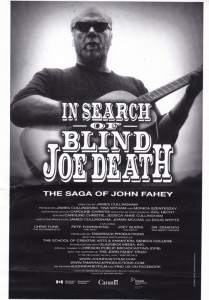

As suggested by Townsend’s reference to the Beats, Fahey drank and over-used prescription meds. Sadly, he also suffered with diabetes and other chronic ailments. His life journey was at times lugubrious and he was living quite squalidly when died at age 61, but the film does a very good job of spotlighting his considerable talents and singular accomplishments for which we should be grateful. He developed a prodigiously creative vernacular guitar and compositional style that reflected blues, folk, and traditional American sources while also drawing on Charles Ives, Bela Bartok, Gregorian chant, and world music, before that term had any currency. As a facilitator and label owner, he would do things like send a postcard cold to a black bluesmen c/o General Delivery at a Mississippi delta town post office where he hoped the man still lived, asking: “Would you like to record for the Takoma Records label?”; thus, did he bring to public awareness the music of Booker (later known as ‘Bukka’) White. He was also involved in rediscovering Charley Patton, Skip James and more guys with “Blind” as part of their name than I’d ever known of.

Before his death in 2001, Fahey would himself be rediscovered by grunge bands, including Sonic Youth and Cul de Sac. Along with Townsend, Cullingham also interviewed Chris Funk of The Decemberists and Joey Burns of Calexico, both of whom testify to Fahey’s influence on their music. I met the filmmaker briefly before the screening and I learned he worked for a time at the CBC. He lives in Toronto, and is associated with Seneca College there. In his interview on the Leonard Lopate Show  he said that he met Fahey three or four times when he performed in Toronto. Although the guitarist had a deserved reputation for making up stories about himself and his origins, with flights of fancy that were expressed in colorful titling of his compositions and prolific self-mythologizing, the director said he always found Fahey straightforward and direct. Blind Joe Death, borrowed by Cullingham for his title, was one of Fahey’s album names and one of the aliases he adopted as a creative alter-ego, mordantly observing that if a musician had “blind” and “death” in his name he would surely be successful.

Lots of archival sequences of Fahey talking and playing are punctuated by the interview segments with a total of about eight music industry figures (including Townsend, et al). There’s also conspicuous use of animation in the film, with many of the graphics arriving on-screen in sequentially hand-lettered script. This was used to best effect when the filmmaker’s voiceover reads the contents of Fahey’s postcard to Booker White in Mississippi. The audience chuckled at that on-screen animation as it unfolded for all to read along with the voiceover. According to the wikipedia article on Fahey, the White album then released on Takoma became the label’s first non-Fahey release.

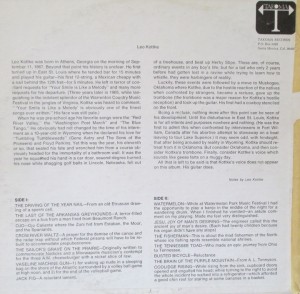
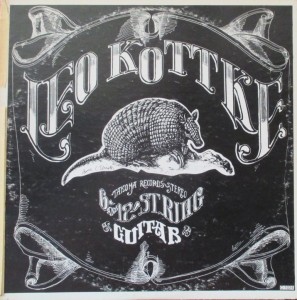
Takoma was far from a vanity enterprise. Among the artists and acts Fahey championed on the label were guitarist Mike Bloomfield and Canned Heat, both of whom I recently saw on-screen in the blues documentary “Born in Chicago“, and Leo Kottke, whose first album “6 and 12-String Guitar,” released in 1969, is still a treasured part of my record collection. It became Takoma’s single bestselling release. From the armadillo on the cover (not a turtle, but here you might say a hard-shelled repti-mammal stands in for the standard reptile), through Kottke’s liner notes and the song names on the back of the album below, you can see that he had fun borrowing Fahey’s grandiloquent style and self-mythologizing. (“All that is left to be said is that Kottke’s voice does not appear on this album. His guitar does.”)

Though Fahey’s life took downward turns in later decades, he nonetheless managed to start a second label, Revenant Records; in 2003 their Charley Patton CD collection won three Grammys. The name revenant could not have been accidentally chosen, suggesting an unkillable being who returns from beyond to seek revenge against his tormentors; perhaps Fahey saw himself in pitched battle against dumbing-down influences and the homogenization of indigenous cultures. There is no readily distilled or uplifting message in Fahey’s life, yet I recommend the film for showing how a determinedly idiosyncratic and protean artist may make a musical mark and leave behind a rich legacy of inspired experimentation and curation. To learn more about “In Search of Blind of Joe Death,” I suggest you listen to Leonard Lopate’s interview with James Cullingham from August 16 and visit the film’s website to learn about future opportunities to see it.
IMG_1233IMG_1234

#FridayReads, August 16–Mike Sowell’s “The Pitch That Killed” & Jayne Anne Phillips’ “Quiet Dell”

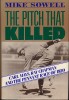
Sowell-front-cover-69x100#FridayReads, August 16–Mike Sowell’s The Pitch That Killed: The Story of Carl Mays, Ray Chapman, and the Pennant Race of 1920 is one of the best baseball books I’ve ever read, or been involved with publishing. It chronicles the only fatality ever caused by injury to a player during a pro baseball game. Ray Chapman was a terrific Cleveland Indians shortstop who died after being struck in the head with a pitch thrown by NY Yankee Carl Mays. The tragedy occurred in the same season that the Tribe won their first World Series, somehow overcoming the mid-season loss of one of their most valuable players. I’m glad that Cleveland Plain Dealer sports writer Bill Livingston, @LivyPDchose to write about it recently, reminding me of the time I worked at Macmillan Publishing when an editorial colleague and friend, Rick Wolff, brought out the book. Livingston reports that a film based on the book, “Deadball,” is in the works.

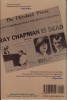
Sowell-back-cover-67x100 Today is the 93rd anniversary of the day of the day of the beaning. Chapman never regained consciousness, lingering in a coma and dying two days later. I have read the book several times and feel privileged to make it part of my #FridayReads today.

Quiet Dell coverI am also happy to say that I am continuing to read and savor Jayne Anne Phillips’ Quiet Dell, a mesmerizing novel drawn from the annals of a notorious true crime. It’s set in 1931, when a West Virginia killer who operated under several aliases lured a Chicago-area widow and her three children in to his fatal embrace. He tried to dispose of his victims but failed at that; his crimes were discovered and he was arrested by authorities in the hamlet of Quiet Dell, WV, near the city of Clarksburg. Into this true-life set-up, Jayne Anne Phillips has found it necessary to insert only four fictional characters, alongside the more numerous figures filling the narrative from the historical record. Fictional or once among the living, she renders the actions and motivations of her characters with vivid and imaginative power. One of her fictional characters is female journalist, Emily Thornhill, who becomes the readers’ eyes and ears on the case, which she’s covering for the Chicago Tribune. Emily has had thrust upon her the adoption of the dead family’s orphaned dog–a real-life bull terrier with the Victorian-tinged name of Duty–earlier the target of a vicious kick by the malefactor, now playing a valuable canine role in the investigation with his compelling identification of the killer. Phillips grew up in West Virginia and on her website she includes an Author’s Note that chronicles her personal connections to the story. I urge you to watch for the book which will be published October 15, and which has already received a starred review from Kirkus: “Phillips’ prose is as haunting as the questions she raises about the natures of sin, evil and grace.” I am deliberately not rushing through Quiet Dell and will write more on the book when I’ve finished reading it.Quiet Dell back

Mike Sowell’s fine book is still in print today, in a trade paperback edition from Ivan R. Dee, independent publisher in Chicago. It can be purchased from Powell’s Books in Portland, Oregon via this link: The Pitch That Killed. You may also pre-order Quiet Dell from Powell’s. They are the bookselling partner for this site, returning a percentage of your purchase price to aid me in its upkeep.

Some New Music from Ewan Munro

Ewan in parkMy 17-year old son Ewan has been writing and performing songs of his own the past year and he just posted a few on Soundcloud.com at this embedded link under ‘Ewan M Turner’. The first two are songs he wrote himself, “Faded Glory,” and “Out to Brooklyn.” The third is a cover of Bob Dylan’s “Sara.” Below is a screenshot of what the page for Ewan’s music looks like, again listenable via this link.Ewan's Soundcloud