Sold: “PICTURE SHOW PLAYLIST: Pop Music in Film from the Crystals to Rihanna” by Nate Patrin

Delighted to announce our sale of the second book by my agency client, music writer Nate Patrin. As a follow-up to his stellar debut, BRING THAT BEAT BACK: How Sampling Built Hip-Hop, a Rolling Stone best music book of 2020, published by the University of Minnesota Press, Nate will be writing about music in film in a series of linked essays on eighteen movies for the PICTURE SHOW PLAYLIST: Pop Music in Film from the Crystals to Rihanna. In addition to the music and movie pairings noted in the adjacent Deal Report that’s running today in PublishersMarketplace, he’ll also be  covering these examples of pop music in movies:

  • John Coltrane, “A Love Supreme” — Mo’ Better Blues
  • The Delfonics, “Didn’t I Blow Your Mind This Time” — Jackie Brown
  • Talking Heads, “The Big Country” — 20th Century Women
  • Simon & Garfunkel, “The Sounds of Silence” — The Graduate
  • The Doors, “The End” — Apocalypse Now
  • Steppenwolf, “The Pusher”—Easy Rider
  • Jimmy Cliff, “Many Rivers to Cross” — The Harder They Come

    I’m excited for Nate, whose first book received splendid reviews like this one: “A deeply informed, eminently readable account of a facet of pop music as complex as it is commonly underestimated.”—Music Books of 2020, on the Rough Trade music store blog.

The cover of Nate Patrin’s first book Bring that Beat Back: How Sampling Built Hip-Hop (University of Minnesota Press, 2020)

Sold: “The Ultimate Protest: Malcolm W. Browne, Vietnam, and the Photo that Stunned the World” by Ray E. Boomhower

One of the pleasures of having been an active literary agent for several years now is the satisfaction I get from selling a subsequent book by an author whose earlier book that I sold is already on the way to being published. This is the case with Ray E. Boomhower, whose biography of combat reporter, Richard Tregaskis: Reporting Under Fire From Guadalcanal to Vietnam will be published this November under the High Road Books imprint of the University of New Mexico Press. Yesterday we announced that Boomhower’s next book, The Ultimate Protest: Malcolm W. Browne, Vietnam, and the Photo that Stunned the World, has also been acquired by University of New Mexico Press. The book will detail how Browne—a most unlikely war correspondent who switched from life as a chemist to a journalist, and became the Associated Press’s bureau chief in Saigon at age 32—was the only Western reporter on June 11, 1963, to capture, with a cheap Japanese Petri brand camera, the image of Thich Quảng Đức, the Buddhist monk who immolated himself to protest the Catholic-dominated administration of South Vietnamese president Ngo Dinh Diem.

Boomhower, who began publishing books long before we began working together (in fact, The Ultimate Protest will be his nineteenth title), has made a speciality of tracking the work of journalists at war, with earlier books on Ernie Pyle and Robert Sherrod, and the forthcoming book on Tregaskis, best known for publishing Guadalcanal Diary, the 1943 bestseller that was the first book in the US to emerge from the Pacific theater.

Chronicling the impact of the gruesome photo inside the Kennedy administration, from the draft manuscript:

“Jesus Christ!”

The sharp expletive uttered by President John F. Kennedy interrupted the telephone conversation he had begun early on the morning of Tuesday, June 11, 1963. The president was talking with his brother, Robert Kennedy, the Attorney General of the United States, who had called to discuss what to do if Alabama governor George Wallace made good on his promise to deny the entry of two African American students, Vivian Malone and James Hood, into the University of Alabama.

The impetus for the president’s exclamation had not been Wallace’s intransigence, but a photograph he saw splashed on the front pages of newspapers delivered to him that morning. Since May 8, 1963, when a company of Civil Guards had killed Vietnamese civilians protesting a new governmental decree outlawing the flying of the Buddhist flag on Buddah’s birthday in Hue, South Vietnam had been wracked by demonstrations. The awful image that had so startled the president showed a man—a seventy-three-year-old Buddhist monk named Thich Quảng Đức—engulfed in flames while calmly, it seemed, sitting in the lotus posture on a street in Saigon, South Vietnam.

Browne, who had been tipped off about the demonstration the evening before, was the only Western reporter on the scene to photograph the horrific event. Although the monk, as he burned, uttered no sound nor changed his position, Browne could see that his “features were contorted with agony” and could hear moans from the crowd that had gathered, as well as the ragged chanting from the approximately 300 yellow-robed monks and gray-robed Buddhist nuns who had joined the protest.

“Numb with shock I shot roll after roll of [35mm] film, focusing and adjusting exposures mechanically and unconsciously,” Browne recalled. “Trying hard not to perceive what I was witnessing I found myself thinking: ‘The sun is bright and the subject is self-illuminated, so f16 at 125th of a second should be right.’ But I couldn’t close out the smell.” The AP correspondent was almost overwhelmed by the smells of joss sticks—incense burned for religious rituals—mixed with burning gasoline and diesel fuel and the odor of burning flesh.


Sold: “Cinema of Swords: A Popular Guide to Movies & TV Shows About Knights, Pirates, and Vikings (Plus Samurai and Musketeers)”

Proud to announce the latest book by our agency client Lawrence Ellsworth, Cinema of Swords: A Popular Guide to Movies & TV Shows About Knights, Pirates, and Vikings (Plus Samurai and Musketeers), a popular reference tome containing hundreds of reviews of action movies and programs. It will be published in 2023 by Applause Theater and Cinema Books*.

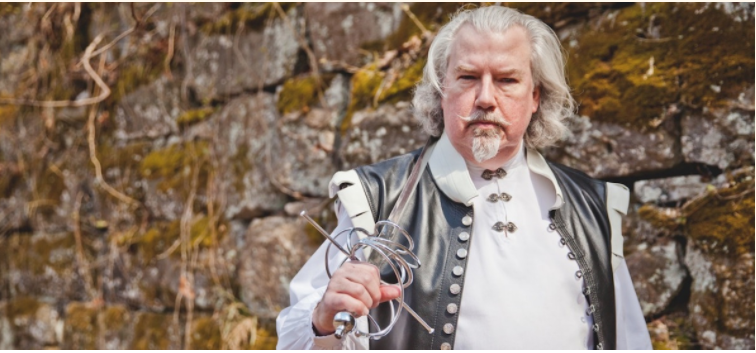
Ellsworth is the pen name of Lawrence Schick (seen below), who is also translator of Alexandre Dumas’s  Musketeers Cycle from Pegasus Books. Early in his career, Schick was a writer on the team at TSR Hobbies that developed Dungeons & Dragons. He’s something of a role-playing game legend. An impetus for the new book is his popular web feature, Cinema of Swords, on his site, and on Black Gate: Adventures in Fantasy Literature.

Shots from videos below: 1) Toshiro Mifune as a crafty ronin in Kurosawa’s “Yojimbo” (released in 1961); 2) Basil Rathbone ready to skewer Errol Flynn in “The Adventures of Robin Hood” (1938), and 3) “Jason and the Argonauts” (1963), with stop-motion animation pioneer Ray Harryhausen’s ingeniously conceived skeletons clashing with Todd Armstrong as the seeker of the Golden Fleece.


*We earlier sold Applause Books Emily Mann: Rebel Artist of the American Theater by Alexis Greene to be published in October 2021.

“J.M.W. Turner: The Majesty of Vision” by Kyle Gallup

[caption id="attachment_16308" align="alignleft" width="225"] “J.M.W. Turner: Watercolors from Tate at the Mystic Seaport Museum” through Feb 23, 2020[/caption]
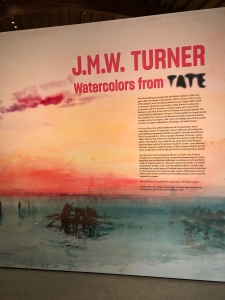
“J.M.W. Turner: Watercolors from Tate at the Mystic Seaport Museum”

Painting as an Aide-Memoire

Stormy seas as atmospheric notations; sheer, floating sunsets; a bright-white moonrise over a glassy body of water; imaginary, architectural views of early nineteenth-century buildings; and a pastoral River Thames on a cloudy summer day. These paintings comprise five of the ninety-two watercolors, four oil paintings, and one of Joseph Mallord William Turner’s last sketchbooks that are on view in a current exhibition, “J.M.W. Turner: Watercolors from Tate,” at the Mystic Seaport Museum, Mystic, Connecticut, through February 23, 2020.

The watercolors are thoughtfully selected from the Turner Bequest, which contains 30,000 works on paper left to Great Britain and housed by the Tate since 1856, five years after the artist’s death. The show is curated by Dr. David Blayney Brown,Tate’s Manton Senior Curator of Nineteenth Century British Art, and organized chronologically with informative title cards that provide important context for these visionary works within the larger arc of Turner’s long public career.

As you enter the gallery, the first dark, silvery watercolors were done when Turner (1775-1851) was in his early twenties and one, “View in the Avon Gorge,” was painted when Turner was only a precocious sixteen-year-old. In it we see a gorge and river view with an overhanging tree, rock cliffs in powdery blues, and silvery-green leafed trees, delicately painted and already masterfully detailed. These early works, along with the thousands of others on paper, filled his residence after his death. The majority of the bequest was part of Turner’s private collection, made for himself, and not intended for public viewing.

Watercolors—a fragile, fugitive medium—are seldom displayed in public. They are loaned, transported, and exhibited even less often, so it’s very special to have the works on display in the United States at all, and an opportunity to see Turner in an intimate light, not as Royal Academician and renowned artist of dramatic oil paintings, but as a far-seeing, romantic, and hard working painter.

The exhibition has many watercolors with atmospheric notes; dashes and washes of buoyant color; sight and thought as one. I can imagine that Turner used these simple landscapes for reference, and as aide-mémoire when painting other works.

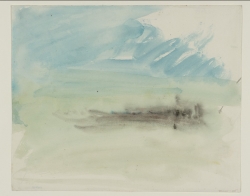
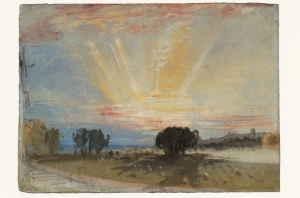
“A Wreck Possibly Related to ‘Longships Lighthouse, Land’s End’ (1834),” “Sunset Across from the Terrace of Petworth House (1827),” and “Coastal Terrain (1830-45),” give the viewer a sense of the weather conditions, movement, and hour of the day. They are Turner’s visual shorthand—pared down, yet still encompassing a larger sense of what Turner was looking at and thinking about at particular moments in time.

For the full essay with all illustrations, please click here.

[caption id="attachment_16309" align="alignleft" width="190"] “A Wreck, Possibly Related to ‘Longships Lighthouse, Land’s End (1834)”. Turner Bequest 1856 © Tate 2019[/caption] [caption id="attachment_16310" align="alignleft" width="183"] “Coastal Terrain (1830-45)”. Turner Bequest 1856 © Tate 2019[/caption] [caption id="attachment_16311" align="alignleft" width="190"] “Sunset Across from the Terrace of Petworth House (1827)”. Turner Bequest 1856 © Tate 2019[/caption]


Bonnard at the Tate in London