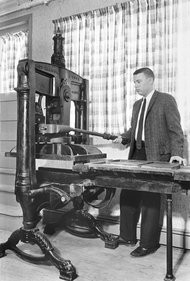
 On December 5 New York Times reporter David Dunlap published a fascinating article about the forthcoming sale at Christie’s auction house of the illustrious printing press that under William Morris’s cultivated hand and eye printed the Kelmscott Chaucer, with illustrations by pre-Raphaelite painter Edward Burne-Jones. Completed between 1894-96, it is among the most important modern fine press books ever printed and published. I’ve always enjoyed Dunlap’s reporting, in which he usually covers architecture. He brought the right sensibility to this article, which I loved for it being stuffed with factual nuggets like these:
“The instrument on which this artwork [the Kelmscott Chaucer] was composed was the Improved Albion Press No. 6551, a hand press almost seven feet high, weighing 2,000 to 3,000 pounds, that was made in 1891 by Hopkinson & Cope in England. It is to be auctioned on Friday by Christie’s [in New York]. The estimate is $100,000 to $150,000.”
I’ve been waiting to blog about Dunlap’s article, because I wanted to report the auction result, if I could. And from a report I just found today, I’ve got that now, and also great detail on the provenance of the press. For instance, I’d been wondering:
How did the Albion Press No. 6551 even get to North America?
Turns out, in 1924, noted type designer Frederick Goudy shipped the Albion across the Atlantic to his print shop in Marlborough, NY. I’m glad it wasn’t wartime, when the ship could’ve been the target of a U-Boat crew. In a real sense, the precious Albion carried the legacy of Morris’s elevated enterprise, so devoted–all-in, as we say now– to cultivating the art of the book. In 1960 the press was acquired by J. Ben and Elizabeth Lieberman of White Plains, NY. Under their ownership it was moved on three occasions, the last time when they moved house to Ardsley, NY. Though the family had long been active in fine printing circles, they came to find day-to-day operation and maintenance of the press beyond their capacities. Current owners, Jethro K. Lieberman and his wife Jo Shiffrin, told Dunlap, “It’s time for someone who will put it back into service.”
Dunlap reports that over two years in the last decade of the 19th century, 438 copies of the Kelmscott Chaucer were printed by Morris and his pressmen on the Albion, and that every copy is accounted for, whether in institutions, libraries or private hands. He writes,
“Four belong to the Morgan Library & Museum. John Bidwell, its curator of printed books and bindings, permitted this reporter to examine a volume bound in white pigskin.The sheer amount of ink on paper is breathtaking. The decorated pages are blacker than they are white. Yet the printing is so exact that there is not so much as a stray smudge in this jungle of leaves, vines, berries and flowers.”
The report on the auction, running at What They Think, a site devoted to news of the commercial printing industry, reports that the Albion N. 6551 will now be housed at the Rochester Institute of Technology (RIT) in upstate NY in the Cary Graphic Arts Collection. It was bought for RIT by the “Brooks Bower family. Bower, a 1974 graduate of the School of Print Media, is an RIT trustee and chairman and chief executive officer of Papercone Corp., an envelope-manufacturing firm in Louisville, KY.” The auction price was $233,000, well above the estimate. It will be put in to regular use by RIT students. I was pleased to read this thorough provenance of the press, which includes a lovely bit of history provided in part by Steven Galbraith, curator of the Cary Collection:
“’From 1932 to 1941, Albion No. 6551 was owned by the Cary Collection’s namesake, Melbert B. Cary Jr., director of Continental Type Founders Association and proprietor of the private Press of the Woolly Whale. . . .Cary bequeathed the press to his pressman George Van Vechten, and in 1960, J. Ben and Elizabeth Lieberman acquired Albion No. 6551 for their Herity Press. They topped the press with a Liberty Bell, a reminder of the vital role that private presses play in the freedom of the press.’ Albion No. 6551 will join the Cary Collection’s Arthur M Lowenthal Memorial Pressroom, a working collection of 15 historical printing presses and more than 1,500 fonts of metal and wood type. Supporting study of the press is a collection of Kelmscott Press publications and archives of material related to Frederic Goudy and Cary’s Press of the Woolly Whale. The Cary Graphic Arts Collection is located on the second floor of The Wallace Center at RIT. Hours are from 9 a.m. to noon and 1 to 5 p.m. Monday through Friday. For information, call 585-475-3961 or go http://cary.rit.edu.”
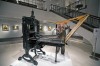
It’s been a good week for the art of the book, as last Friday I saw gorgeous printed materials at the Center for Book Arts’ holiday open house, and now this news about the outcome of the Christie’s auction. I hope to see the Cary Collection and the Albion No. 6551 someday. The photo at the top of this informational post and those borrowed below for it I happily credit to Eddie Hausner and Marilynn K. Yee, photographers of The New York Times, and thank them for this fair use.

 Had fun seeing art last night with Kyle, and the city was surprisingly quiet, especially for a Friday. The subways, sidewalks, and galleries were not so crowded, which made getting around in the cold and ice almost a piece o’ cake.