March 6 Update: Pleased to see that the NBCC blog Critical Mass has included my coverage of their annual awards in their latest news round-up.
—
 After the superb readings from 21 finalists on Wednesday night, the NBCC awards ceremony Thursday night was an inspiring close to the week of literary observances. On the earlier evening, more than 2/3 of the thirty nominated books were represented, while oddly, it turned out last night that of the six final recipients, only two of the authors were in the house to acknowledge the recognition. It was just the luck of the draw that four of the winners were unable to attend. Most of the audience, myself included, had read less than a handful of the finalists, whereas the NBCC critics, amazingly, read all the finalists. Each year that I attend their events I am struck again by their industry and their devotion to the critical enterprise.
The first two awards were announced prior to the ceremony. These were:
Nona Balakian Citation for Excellence in Reviewing: Recipient William Deresiewicz gave a lovely acceptance speech about criticism. He observed that critics have always drawn the enmity of artists and that criticism seems always called upon to justify its existence. He invoked Waiting for Godot, where the worst insult that Estragon can fling at Vladimir is “critic.” He quoted Stravinsky’s turnabout of Voltaire’s ode to free speech, “What a reviewer said may be inconsequential, what I protest is his right to say it.” Throughout his talk, Deresiewicz reflected on the seclusion of writing about books, which nonetheless contrasts with the mutuality of reading them, in which we animate or re-animate the author’s work. Citing the New Yorker‘s Arlene Croce, his most affecting line was, “If art gives voice to our experience of life, criticism gives voice to our experience of art.”
Ivan Sandrof Lifetime Achievement Award: Sandra Gilbert and Susan Gubar, authors of The Madwoman in the Attic: The Woman Writer and the Nineteenth-Century Literary Imagination (1979) and editors of the Norton Anthology of Literature by Women, and a host of other trailblazing books. Gilbert and Gubar, though unable to attend, had each filmed splendid presentations that were screened for the audience at the New School, and can be viewed via this youtube link.
These were the awards in the NBCC’s six book categories:
Poetry: At the reading on Night One, of the three poets who read I had particularly enjoyed David Ferry’s reading from Bewilderment and A.E. Stallings’ rhymed poems from Olives. On Thursday night we learned from chair of the poetry panel David Biespiel that D.A. Powell’s Useless Landscape, or A Guide for Boys, published by Graywolf Press, was the top choice. Powell was not present, so his editor Jeffrey Shotts went to the podium and read a brief statement from the poet. It happened that Shotts and I had met the night before over drinks at Cafe Loup, and so were seated together in a row near the front of the auditorium as the awards began. Just before the event kicked off, Jeff told me that he might need to sneak past me if his author won. When the moment came, I clapped him on the back and let him out of our row.
Criticism: Like all the categories, this one was filled with standout titles. At the reading, Paul Elie, (Reinventing Bach), had read a fascinating passage about the blockbuster album of 1968, “Switched-on Bach,” for which Walter Carlos had played Bach on the recently invented moog synthesizer. Elie quoted Glenn Gould on the fusion of Bach and the new electronic instrument, where the Canadian pianist heard an ideal match. Gould relished the moog’s absence of vibrato and inflection, which I imagine probably had an aural quality for him akin to a harpsichord. Kevin Young (The Grey Album: On the Blackness of Blackness) read a passage about rappers and love songs, which fascinatingly play against type. The winner was Stranger Magic: Charmed States and the Arabian Nights by Marina Warner who was at home in England. Unfortunately, no one was present from her publisher Harvard University Press to accept the award.
Autobiography: On Wednesday night finalists Rena Grande (The Distance Between Us, a memoir of her Mexican family’s passage in to the United States) and Maureen N. McLane (My Poets, on the role of Gertrude Stein and Elizabeth Bishop in her reading life) had each read brilliantly. Likewise, an emotional moment came when George Hodgman, longtime editor for the late journalist Anthony Shadid read a moving passage from House of Stone: A Memoir of Home, Family, and a Lost Middle East. The panel for this prize gave their nod to Swimming Studies by Leanne Shapton, who we learned has recently had a baby. Her publisher, David Rosenthal of Blue Rider Press, accepted in her place.
Biography: Wednesday night I had been enchanted by finalist Tom Reiss’s reading from The Black Count: Glory, Revolution, Betrayal, and the Real Count of Monte Cristo, a biography of novelist Alexander Dumas’ father. I had not known of the fascinating life led by Dumas pere, and I very much enjoyed later meeting and talking with him. And yet, it was hardly a surprise that the award was bestowed on Robert Caro for The Passage of Power: The Years of Lyndon Johnson, the fourth volume in his epic work on the 36th president. Kathy Hourigan of Knopf, accepted for Caro who had been prevented from attending because of an earlier scheduled speech.
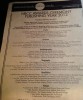
Nonfiction: While all the categories were filled with extremely strong books, this category took the ribbon for some of the most amazing books of all, as a glance at the program below will confirm for you, too. Seated near me were Andrew Solomon, author Far From the Tree: Parents, Children, and the Search for Identity, and his editor Nan Graham of Scribner. It was a pretty electric moment when Andrew’s book was given the award. He got a big laugh when reaching the podium he remarked with wit worthy of Oscar Wilde, “It’s obviously very unfashionable to show up. I hope you won’t think less of me for actually being here.” The audience was plainly very glad for him, as was I.
Fiction: In this category, everyone who came for the readings the night before had been wowed by the regal Zadie Smith’s inspired animation of her own work, when like a ventriloquist she had given voice to her array of characters in a gritty scene from a London park. The recipient of the award turned out to be Ben Fountain for Billy Lynn’s Long Halftime Walk. Fountain gave a moving talk. Along with thanking his agent Heather Schroeder of ICM, and staff at Ecco Books, his publisher, he acknowledged all the writers who’d been finalists, observing that “We’re all on the same team . . on the team of beauty, truth, justice, love–all the corny reasons why we got in to this line of work. Let’s just keep remembering that.” He closed by thanking his family for their love and commented starkly “without that love I’d be lying in a ditch somewhere.”
With that the program ended, and many in the audience walked a block uptown to continue their conversations and celebrate at a jubilant reception benefiting the NBCC. You can view the program hear on my site in the window below. You may also view and listen to interviews that were done with all the finalists by students at the New School Graduate Writing Program, hosted at this site and co-sponsored by the NBCC and the New School. To begin, just click on one of the NBCC’s six nomination categories. I will add that if you love books and criticism, you can become a friend of the NBCC by joining the organization as an associate (non-voting) member. I relish my status as a friend of the NBCC. Likewise, if you live in NYC, or will be here visiting next year when they hold their annual readings and awards ceremony, I urge you to attend. Remarkably, the events are free of charge and open to the public. The only event for which there’s a cost is the benefit reception. You can find more information at the NBCC website, bookcritics.org. I invite you also to view the pictures I took, below the video window, and read about the night of readings, at this link, where I’ve posted another 20 photos.
Please click here to see photos from the awards ceremony.