Tosca, a San Francisco Retreat, Facing Eviction

When I worked for Carroll & Graf Publishers from 2000-2007 I used to travel 2-3 times a year to the Bay Area for sales conference with our parent company Avalon Publishing Group. Though Avalon was based in Berkeley, I learned from my senior colleague Herman Graf that it was far more interesting to stay in San Francisco, and drive over the Bay Bridge to the East Bay in the morning for our meetings. Years earlier Herman–who I recently helped fete to mark his 51 years in publishing–had years before I joined the company staked out a motel that suited his needs perfectly, and mine too once I became semi-frequent on the Jet Blue flights from JFK to SFO.

This establishment was the Royal Pacific Motor Inn, and I see from the Web that it’s still thriving. The Royal Pacific had everything we wanted–perfectly adequate and clean motel rooms; free guest parking, which Herman appreciated since he was the one of us who rented a car (never mind that driving with him was often a hilarious if not nerve-wracking adventure); and great restaurants and nightlife all around us in the Chinatown/North Beach neighborhood. The motels current reviews on yelp.com make clear that, depending on your personal preferences, it can be an ideal and reasonably priced place to stay when you’re in the Bay Area.

The nearby streets offered innumerable Italian and Chinese restaurants (I still recall and savor the fresh whole Dungeness crab cooked Szechuan-style I ate one night at a Chinese place less than a 100 steps from the motel); coffee bars; City Lights Bookstore and Black Oak Books; and Tosca Cafe, an after-hours bar and hang-out that was a pleasant cave-like retreat from the busy sidewalks outside. Its soft lighting showed red booths, eye-catching murals on dark walls, and a long bar to stand at or park a stool in front of. Back in the day, Enrico Caruso frequented Tosca, so the excellent jukebox sported not only rock n’ roll, but opera. Whatever the musical genre, it was never up too loud. There was also a back room with a pool table, where I once shot a game or two with astronomer and author Timothy Ferris. Over the years Tosca’s clientele has been reported to include Sam Shepard, Gov. Jerry Brown, and Francis Ford Coppola, who with Tosca’s owner Jeannette Etheredge, started an initiative for homeless denizens of North Beach, according to C.W. Nevius of the San Francisco Chronicle. Like such legendary watering holes as Greenwich Village’s White Horse Tavern, remembered fondly in Pete Hamill’s memoir, A Drinking Life, and Elaine’s Restaurant on Manhattan’s Upper East Side, Tosca always seemed like a place that didn’t try to do too much for its customers, but what it did do, it did very well.

These recollections of the Royal Pacific, North Beach, and Tosca are prompted by a column by reporter Nevius in last Saturday’s Chronicle. He reports that Toscas’s landlord, a strip club owner named Roger Forbes, is seeking a substantial rent increase that Etheredge says she she simply cannot afford to pay. If the two are unable to reach a settlement, Tosca may be evicted. Etheredge laments the situation, telling Nevius, “Look at the place. It’s out of an Edward Hopper painting.” Like the late Elaine Kaufman of Elaine’s, who was known to sometimes treat customers with disdain, Etheredge is also no shrinking violet. Nevius writes,

Etheredge has a long history in North Beach. Her family owned Bali’s, a restaurant there, and she purchased Tosca in April 1980. However, it is probably too much to expect that she would polish a few of her rough edges. One of her endearing traits is that she treats famous actors just like everyone else–she yells at them, too.”Everybody knows she’s a pain in the ass,” said [her attorney] Keker. “And everyone loves her.”

Well, maybe not Roger Forbes. For his part, Nevius adds,

That’s why, although Forbes may have all that strip club cash, I don’t like his chances. It is possible that he could evict Tosca and put in another generic stripper revue in its place. He might even make a little more money. People are reportedly warning Forbes not to mess with Tosca. Putting in a strip club is one thing. Evicting an institution is another. You’ll still get a nice sum in rent and you won’t incur the wrath of the city’s famously combative true believers. That’s good advice.

Urban homogenization is increasing everywhere these days, whether banks and chain drugstores taking over the commercial blocks on the upper west side of Manhattan, or North Beach submitting to the siren song of tourist-friendly peep shows. As a New Yorker who’s seen favorite businesses lose their lease or disappear overnight  (farewell Calcutta Cafe on Broadway at 104th St.), I hope Tosca can hang on. After reading about Tosca’s troubles, I called Herman Graf to let him know and share some old North Beach memories. He reminded me that during sales conference week, other Avalon Publishing Group clients, such as Morgan Entrekin of Grove Atlantic, would end up at Tosca in the wee hours, one of the very best times to hang out there. To get a sense of the bar’s splendid interior and rich history, I urge you to view the rest of photographer Carlos Avila Gonzalez’s excellent slideshow and read Nevius’s entire column via this link.

Suzzy Roche’s Sensitive Reading of Edith Wharton

Kyle and I took the bus to Bryant Park yesterday to hear singer, musician and novelist Suzzy Roche* lead a discussion of Edith Wharton’s House of Mirth in the Park’s long-running Reading Room series. We arrived just in time to corral two chairs near the front of the outdoor space and settled in as Suzzy was tuning her guitar for what would later be an original song to close the program. Suzzy began by sharing some notes and interesting facts she had learned about Wharton.

She said that 2012 marks the 150th year since Wharton’s birth in to a wealthy family in New York City. The family name was Jones, and some believe their conspicuous upper-class status may be the origin of the phrase “keeping up with the Joneses.” Early on, Edith’s mother forbade her from reading novels, lest her daughter’s intellect expand in ways that would make it harder to ensure a proper marriage for her. Suzzy reminded everyone how fitting it was to be in Bryant Park with a view of the main branch of the New York Public Library, since the novel we were discussing includes a scene set in the lovely park. From her youthful days, Wharton exhibited a high degree of sensitivity, and Suzzy read a quote she found in Wharton’s autobiography: “The owning of my first dog woke in me the long ache of pity for animals and for all inarticulate beings which nothing has ever stilled.”

Wharton’s first full-length piece of fiction, a novella finished at age 18, was accompanied by several passages of self-criticism where she assessed what she judged to be the weaknesses of her own work. Suzzy quoted this early comment of Wharton’s on the subject of criticism: “After all, one knows one’s weak points so well it’s rather bewildering to have the critics overlook them and invent others.”

With these details of Wharton’s life in our minds, Suzzy turned the discussion to the novel itself. After reviewing contemporary critical reaction to the book, which often emphasized Wharton’s gender, she asked “Does this book have something to say to us right now about the place of women and money in society? She pointed out that just this year, Jonathan Franzen ignited a controversy when he wrote in the New Yorker about “Edith Wharton’s looks.” Suzzy continued that Franzen wrote “it was hard for him to warm to her novels because she had every advantage of wealth and privilege and was extremely socially conservative. But, he said, ‘she did have one potentially redeeming disadvantage: she wasn’t pretty.’  On the surface, there would seem to be no reason for a reader to sympathize with Lilly; she’s profoundly self-involved and incapable of true charity.  She pridefully contrasts other women’s looks with her own. She has no intellectual life to speak of. She’s put off from pursuing her one kindred spirit because of the modesty of his income. She’s basically the worst sort of party girl, and like Wharton, she didn’t even try to be charming.” There was a gasp among the Bryant Park crowd as Suzzy read the remarks of the award-winning novelist, which whether said about Wharton or Lily Bart, struck many of us as chauvinistic. Please click through for rest of post and all photos

A View From our Train Window

A view of The Great Gray Bridge from the Amtrak train we recently rode from NYC to Cleveland. Photo by Kyle Gallup. Our route took us in to the open air for a few seconds, then back underground and under the bridge, then back out in the open again, north of the bridge, when this picture was shot. The train ride was the first leg of our current midwest road trip, which has continued by car through Ohio, Indiana, and Illinois, and now to St. Louis. On the return leg of our trip, we’ll be dropping our car off in Cleveland and coming back to NYC via Amtrak. Cross-posted at my Great Gray Bridge tumblr.

Alamo Drafthouse Cinema Coming to NYC!

July 17 Update–A Note to Great Gray Bridge Readers: A reader of my blog saw the post below and thought it’s possible that Alamo Drafthouse Cinema may not come to the Metro Theater in NY after all, that it may not happen. I agree there’s certainly been no improvement to the site yet and I concede the news was reported in Huff Post more than 4 months ago. There’s a possibility something could go wrong, but I doubt it. I’ve found the Huff Post story was triggered by a blog post on the Alamo site. I just don’t think they’d have announced the Metro renovation without a proper deal. We shall see soon, if they really are planning to open in 2013.

—-
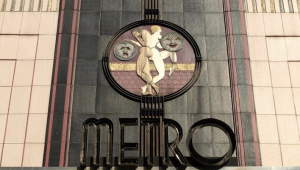
I was excited to discover that Austin, TX–based Alamo Drafthouse Cinema–an innovative chain of movie houses that combines film and food–are going to renovate and reclaim the handsome Metro Theater on Broadway at 100th Street in Manhattan, which has been neglected and empty for nearly a decade. This is great news for the Upper West Side! Coincidentally, the Metro Theater marquee is featured in the series of urban marquees that my wife Kyle Gallup has recently been painting, as seen here. Following Kyle’s piece is shot of the Metro’s Art Deco facade, in a photo borrowed from the Alamo Drafthouse Cinema Facebook page, which you may ‘like.’

Alamo Drafthouse Cinema is also opening a location in Yonkers, just north of New York City, so they’re clearly aiming for a major presence here in the metropolitan area. On the web page for the Yonkers location, they are already soliciting local applicants for positions with the company.

This Week at The Great Gray Bridge

In the past week I’ve blogged about an urban skunk I encountered in Riverside Park;  a great new espionage novel called The Double Game by Dan Fesperman; the shameful lack of recognition for women in tech, as revealed by Change the Ratio’s Rachel Sklar; a well-deserved honor for Jim Tully: American Writer, Hollywood Brawler, Irish Rover, my fave biography of 2011; the lack of public transportation for wage-earners which means they often can’t get to jobs they would otherwise be able to fill; a new genetics study that may shed light on how the Americas were peopled in prehistoric times; a personal essay I’m contributing to a new book called Rust Belt Chic: The Cleveland Anthology; Mitt Romney’s most secret offshore investment, Mitt and Ann’s Jet-Ski vacation, and a NY Times Editorial that hit Mitt. I also put up a guest post by my son Ewan Turner, a blended short story that fuses an actual incident from Bob Dylan’s career with an imagined episode involving the singer.

Over at The Great Gray Bridge tumblr, my site for quick hits and diverting photography, I put up a photo of Donald Trump that the Scots must find hilarious (h/t TPM and Zuma Press/Newscom and a post about the personal effects of lawman Eliot Ness, which have been put for auction.

Contributing an Essay to “Rust Belt Chic: The Cleveland Anthology”

I’m pleased to have been invited to submit a contribution to the upcoming  Rust Belt Chic: The Cleveland Anthology, a book that is being assembled and edited by Anne Trubek and Richey Piiparinen. With several dozen contributors, it will be published in September as a trade paperback and an ebook. I completed my piece and submitted it yesterday, a personal essay titled “Remembering Mr. Stress, Live at the Euclid Tavern,” on a venerable Cleveland bluesman and the venue where he played for many years, which proved personal gateways to my lifelong enjoyment of live music. A bit closer to publication I will cross-post the entire essay here on this blog. For now, here are some lines from it.

“The club included a central music room with a low stage for the band and a dance floor, an outdoor area in back, plus a basement bar. It was a veritable cruise ship of nightlife. During breaks between sets I often made new friends in my ambles around the lively deck. In the room opposite the stage was the main bar, a long hitching post of a drinks station where multiple bartenders pulled beer taps and poured liquor. Behind and above them was a sign that became a watchword in my life: “It’s hard to soar like an eagle when you’re on the ground with the turkeys.”

Clevelander or not, if you’re eager to support this exciting self-publishing initiative in cultural urban renewal, you can pre-order copies of the book via this link. You can also support the effort by

–Following us on twitter at @rust_belt_chic

–Liking the Facebook page: http://www.facebook.com/pages/Rust-Belt-Chic-The-Cleveland-Anthology/385206038193184

–Bookmarking the website: http://www.rustbeltchic.com. The site will be updated frequently.

Please help us spread the word.

In the weeks to come I will post more information and additional links related to the anthology and its contributors. For now, here’s a current photo of the Euclid Tavern taken by my sister Pamela Turner along with shots of the artwork and sleeve from the LP that Mr. Stress released in the early 1980s, the period covered in the piece.