Remembering Earl I. Turner, February 7, 1918-July 8, 1992

Earl I. Turner, Moraigne Lake, Canadian Rockies, July 1982My father Earl I. Turner, about whom I’ve previously written on this blog, died twenty-two years ago today. Recently, my sister Pamela Turner found a letter Earl gave to his three children when we as a family (Pamela; our brother Joel; Earl, mom, Sylvia; and myself) began operating Undercover Books, on May 4, 1978. His letter is kind of an ethical will, full of wisdom, and I invite you to read it for yourself.

Earl Turner letter, May 8, 1978

Slight Sliver of Light in the Aftermath of Teenagers Killing Teenagers in Israel and Palestine

The families and communities grieving the recent kidnapping/killings of Israeli and Palestinian teenagers are trying to console one another. From Times of Israel coverage today:

“The uncle of the slain Israeli teenager Naftali Fraenkel offered his condolences Sunday in a phone call to Hussein Abu Khdeir, whose 16-year-old son was murdered last week in what police believe was a revenge killing by Jewish extremists. Jerusalem Mayor Nir Barkat said he too spoke to Abu Khdeir and, on behalf of the residents of Jerusalem, condemned the killing of his son Muhammad [age 15]. The call came hours after two Palestinians from the Hebron area paid a visit to the grieving Fraenkel family.”

Elsewhere today, Israeli police arrested six Israeli Jewish males, some teenagers, in the murder of the young Abu Khdeir, found dead some hours after passengers in a passing car abducted from an east Jerusalem street.  It was reported by ynetnews.com that Israeli authorities believe that one night before the accused perpetrators grabbed Abu Khdeir, some of them tried and failed to abduct a nine-year old boy who, with his mother, fended off the attempted kidnapping. Finally, in a related development, a clandestine video recording had been made of Israeli soldiers arresting and beating a teenager, Tariq Khderi, who is an American cousin to Muhammad Abu Khdeir, visiting family for the summer. It has been a very terrible month in Israel and the Occupied Territories. When teenagers are torturing other teenagers, something is seriously wrong in a society.3 murdered Israeli teenagersMuhammad Abu Khdeir

The Times of Israel story mentioned above reported at some length on the exchange of sympathies among Jewish and Palestinian civilians, a slight sliver of light amid the bad news:

“One of the [Palestinian] visitors told the Hebrew NRG website that Fraenkel’s statements last week after Abu Khdeir’s murder ‘touched a large portion of the Palestinian people.’

‘I come from a bereaved family, I lost my brother and I have family that were former prisoners, unfortunately we also threw stones at you. What can you do?’ he said.

In a statement last week, the Fraenkels condemned the murder of Abu Khdeir, saying in a statement that ‘There is no difference when it comes to blood. Murder is murder; there is no justification, forgiveness or atonement for any murder.’

‘The moment we learn to deal with each other’s pain and stop the anger against one another, the situation will be better,” the [Palestinian] visitor said. “Our mission is to strengthen the family and also to take a step forward towards the liberation of my people. We believe that only through the hearts of the Jews will our liberation happen.’

He described the warm welcome the Fraenkels gave him, and said: ‘We are sorry for any harm against people, whether Jewish or Muslim. We don’t want anyone to be hurt, and want to reach a political agreement.’

The two Palestinians also described an upcoming initiative called the ‘Hunger Strike Against Violence,’ next Tuesday, on which the Jewish fast of the 17 of Tammuz coincides with the ongoing Muslim Ramadan holiday. ‘Palestinians that I knew wanted to come visit and console the families, so I brought them,” [Fraenkel family friend] Ostroff said. ‘The family welcomed them in a remarkable way. They didn’t even think twice to let them in; it was obvious to them that it was okay.’”

I will close this post by referring to a tweet I sent out last night, regarding a sober analysis of the current situation from a longtime Israeli security official.

Happy in Toronto at NXNE

For the fourth consecutive year I’ve traveled to Toronto for the North by Northeast festival (NXNE); to see my client ExpertFile.com; and hold some publishing meetings. I am having a great week and have been posting frequently on Twitter and Facebook about the great events I’ve attended, and on the sister blog to this one, HonouraryCanadian.com, where I wrote about comedian and podcaster Marc Maron’s rousing keynote remarks.

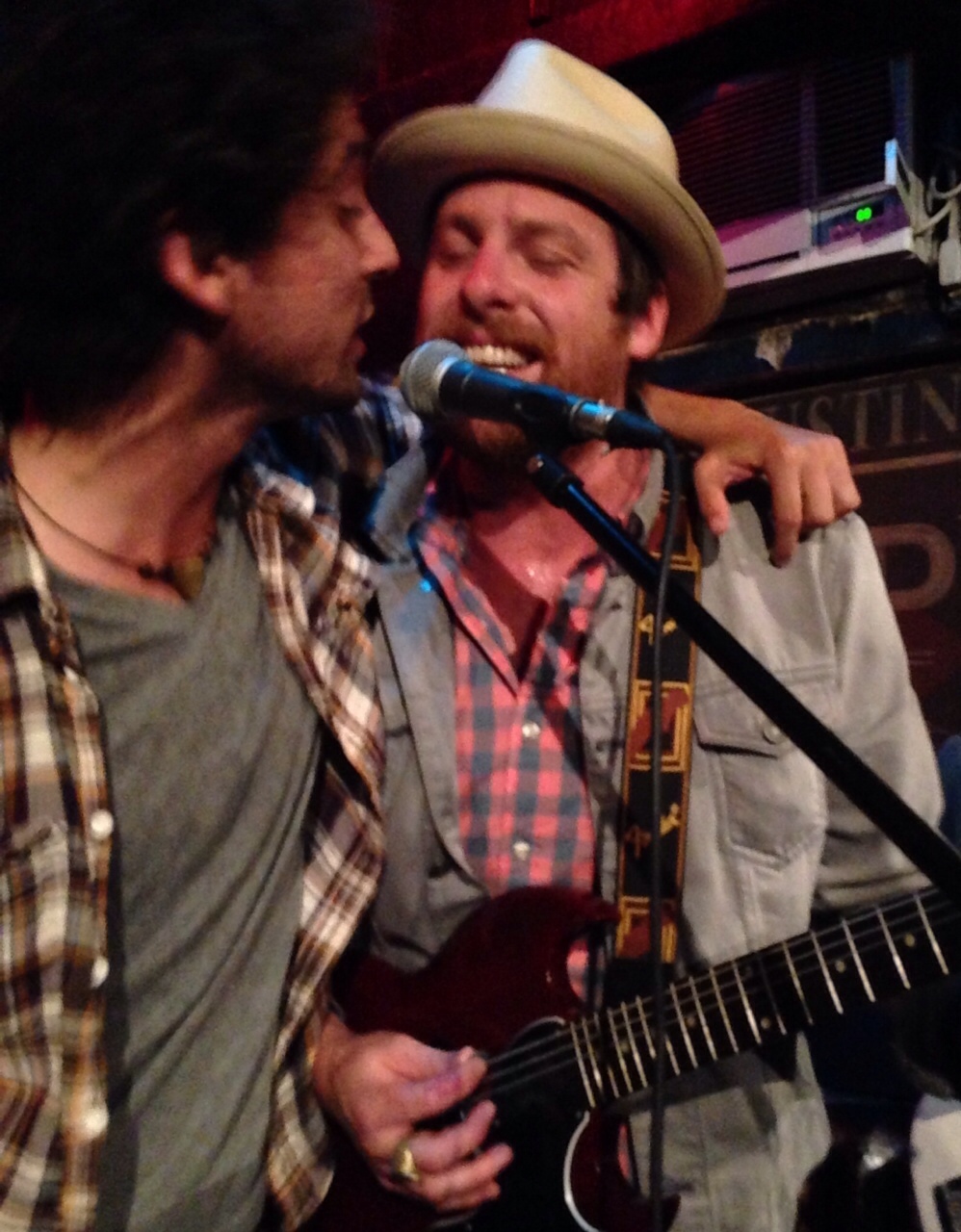
Late last night I lucked in to an impromptu show at the great venue the Cameron House w/one of my musical heroes, Matt Mays. He had been invited by frontman Sam Cash to sit in with his band the Romantic Dogs. Matt began by leading the band, and the audience, in Neil Young’s “Helpless.” Matt and I spoke afterward, exchanging heartfelt appreciations. I conveyed my condolences for the sudden loss last year of his bandmate Jay Smith. He thanked me for remembering his old friend. I told him about Honourary Canadian and he told me he was already a reader of the blog. Thrilled to hear that, I gave him my card for which he thanked me and said it would be going in “a special place.” Here’s a shot of Sam and Matt from last night:

I’ll also be posting more here about NXNE after I return to NYC next week.


Did Allied Bombing of France in WWII Cross an Ethical Line?

Are you aware that during WWII, British, American, and Canadian airplanes bombed Nazi infrastructure and installations in occupied France, or that an estimated 57,000 French civilians died from Allied actions during the war? I was not until last night, when I heard an in-depth report by BBC correspondent John Laurenson that CBC Radio carried on their weekend news program. In Laurenson’s story, the transcript of which can be read here, with several illustrations, he added that Free French forces pleaded for a halt to the raids, to no avail. Meanwhile, the Vichy government—cooperating and collaborating with the Nazis all the while—tried to turn the populace away from any sympathy for the Allied cause by decrying the bombardment.

Laurenson narrates that “According to research carried out by Andrew Knapp, history professor at the UK’s University of Reading, ‘Roughly 75,000 tonnes of bombs were dropped on the UK [including Hitler’s V missiles]. In France, it [was] in the order of 518,000 tonnes.’” Incredible, but apparently accurate. Some of the raids—especially the one pictured here that leveled Le Havre, killing 5,000 inhabitants of the city—would under today’s international agreements, probably be regarded as war crimes. More than 1,500 French towns were hit during the war.

DeGaulle must’ve lobbied Churchill, and FDR, to stop the raids that aimed to hit “marshaling areas,” as the Allies phrased it. But it was the conduct of Marshall Petain and his government that most concerned the Allies,. This topic, and the scale of French casualties, was taboo for many decades, with the moral ambiguity that had shrouded the war years in France. According to this report, many French were conflicted about the bombing campaign. They didn’t ‘support’ it, but many were ashamed of the conduct by the Vichy leaders, and hoped the Allies would prevail. In that context, the deaths of civilians was in some ways as expected, if not excused, as that of combatants. It was total war. Along with the above figure on the French casualties, at least 60,500 British civilians died from the German aerial bombardment. On D-Day itself, in 1944, 2,500 Allied combatants died, while about the same number of French civilians died that day.

Though I don’t excuse certain aspects of the Allied bombing, which has been examined and as far as I can tell, convincingly indicted in A.C. Grayling’s important book, Among the Dead Cities: The History and Moral Legacy of the WWII Bombing of Civilians in Germany and Japan, I think I have a sense of some of the priorities and concerns that may have preoccupied all the Allied heads of state (Churchill and FDR, and also Mackenzie King, Canadian Prime Minister during the war, whose fighter pilots also flew bombing runs over France). They weren’t certain the Allies would win, and so believed in, or rationalized, some bombing that crossed an ethical line.  As for the crews who flew those missions they were lethal for them, too, for Laurenson adds about the British flyers: “Almost half of Bomber Command’s airmen were killed in action. Their missions, their commanders argued, would help win the war more quickly.”

In the case of Churchill, in particular, I don’t mean to cut him any slack he doesn’t deserve. I’ve read Nicholson Baker’s Human Smoke: The Beginnings of World War II, the End of Civilization, where Churchill’s belligerence is on display, and in his own words for it’s a book assembled entirely from original documents. And, yet I must concede that he fought the war like he feared the Nazis might win, a possible outcome that would have been even more detestable than the moral crimes he committed, or may have committed.  I recommend you read Laurenson’s story here.

Taking a Page from Honourary Canadian

As readers of this blog may have noticed, I started a second blog in 2013, called Honourary Canadian: Seeing Canada From Away. After starting this blog in 2011, I was often posting about Canada, and a couple years in, decided to start a second site devoted to Canadian topics, where I’d offer my views of Canada for Canadians and others interested in the country. I aspire to the perspective and the work of Alistair Cooke, who broadcast and wrote knowledgeably and sensitively about America, after moving to the US from England. Like this site, at the new blog I write about Canadian books, publishing, live music, media, and politics, with the cross-cultural perspective of a respectful outsider. I’ve been sharing HC links here from time to time and integrating the two sites one with another, for instance setting up a feed so the latest posts from each site are readily visible and linked to on the other. The two blogs are sort of like siblings, with this one the older brother.

I’m posting here today to let Great Gray Bridge readers know I recently published a new entry at Honourary Canadian called Why I Started This Blog and Call It Honourary Canadian, which explores my lifelong interest in the neighbor to the north. I invite you to read it. It’s a memoiristic piece that chronicles many trips I’ve made in Canada since childhood, beginning with Expo ’67 when I was just twelve years old; authors whose books I’ve read and published; bands I’ve seen live and become friendly with; and reflections on differences between the US and Canada, and the media in both countries. Along with the essay, I’ve included dozens of scenic photographs, book covers, band photos, and scans of letters I received from Canadian novelist Robertson Davies, with whom I had a lengthy correspondence when I ran Undercover Books in the 1980s.

At the top of this entry is a shot of that new post, which will give you a sense of what the new site looks like if you’ve not visited yet. Just as I found a visual touchstone for this blog from a scenic landmark—the George Washington Bridge, aka the Great Gray Bridge, and the little red lighthouse—I found visual inspiration for the new site in a true wonder of the world, the majestic Percé Rock (aka le rocher percé or ‘pierced rock’), a huge rock face on eastern Quebec’s Gaspé Peninsula, a veritable lobster tail jutting in to the Gulf of St. Lawrence where it meets the Atlantic Ocean. Below is a pic of what that post looks like. If you enjoy awe-inspiring scenery, I recommend you check out the whole post, which includes many photos I took during a visit there in 1988. In fact, I invite you to visit Honourary Canadian, and have a look around.