Raised on Radio
I became a devoted listener to radio starting about age nine, when I got my first in a series of transistor and tabletop radios. While an interested reader from my early years, taking in information with my eyes, I was also an ardent listener and enjoyed aural entertainment—music, information, sounds of all kinds. To borrow a memorable line from onetime presidential candidate Ross Perot, you might say I was “all ears.”
Luckily for me, my hometown of Cleveland was a radio capitol, the very birthplace of the term ‘rock ‘n roll’, with local stations playing new music, hits, and oldies throughout the day. What’s more, the proximity of Lake Erie, across which radio waves could travel unimpeded, meant I could listen to CKLW—the hit-making 50,000 watt behemoth from Windsor, Ontario, known as the Powerhouse—even before nightfall, when radio waves are known to travel far from their point of origin. According to a 2022 article in Walrus magazine, CKLW “routinely captured more than 20 percent of the listeners in its market— a figure impossible to imagine in today’s fragmented radio industry. By 1973, with twelve million listeners, it was the third-largest station in North America.”
Cleveland radio stations used to employ DJs with colorful on-air personalities who were fun to tune in to as they rolled through the day, ID’ing songs and bands, mixing the music up with light-hearted announcements and banter. Contests, word puzzles, and trivia games were featured, to which a listener could phone in and give answers to try to win a prize. I recall playing a late-night rhyming word game called “Onesies-Twosies” with host Jay “Jaybird” Lawrence on a local station.
My late father, Earl I. Turner, had a knack for winning contests on the radio, a bit of good luck I seemed at a young age to have inherited from him, as over the years I too won an occasional contest on the radio, though they are rare to extinct these days.
Unfortunately, more recent decades have seen a pronounced dulling of the radio dial, with little personality, and little locality attached to what’s broadcast; much of what airs nowadays sounds like impersonal mass pre-recorded pablum. Talk radio is more live, but it’s also overwhelmingly political, and not my cup of java.
 For me, a fortunate exception to the generalized dullness came, again, from Canada, in the form of an Internet radio station, CBC Radio 3, may it rest in peace, that for more than ten years served as a vital outpost for Canadian indie rock ‘n roll, associated with the hashtag #CANRock. They had live hosting helmed by a bevy of talented announcers—Grant Lawrence, Lana Gay, Vish Khanna, Lisa Christiansen, Amanda Putz, and Craig Norris, and guest musician hosts, who formed an extremely enjoyable and listenable lineup—with a communal blog that regularly featured a Question or Topic of the Day, about which listeners would chime in on, with our comments being read out on the air, all of which formed a cohesive community of which I was a part. I also became friendly with Radio 3 producer Pedro Mendes, who I later represented as agent for a book project of his. Unfortunately, in 2015, CBC, the mothership of public broadcasting in Canada, took the retrograde step of shuttering Radio 3.
I want to give credit where it’s due and add that the very first podcast I know of—which was revolutionary for facilitating on-demand listening and time-shifting for listeners—appeared in 2005, The CBC Radio 3 Podcast with Grant Lawrence. When contacted for this essay, Lawrence reminded me that “Doing a music podcast was the idea of our boss Steve Pratt….I had no clue what a podcast was, but it took off very quickly and became the single biggest international success I’ve ever been involved with….It came out every Friday, one hour of music, about ten songs, and one interview or brief feature….It lasted for [about] twelve years. Out of its success came The R330 (thirty top songs) with Craig Norris; Appetite for Distraction with Lisa Christiansen (a way-ahead-of-its time long-form interview podcast—now the norm); Track of the Day, which introduced a new song by a Canadian band each day.” I also enjoyed such programs and on-air features as The Breakfast Club, where Vish Khanna (who’s since gone on to have his own long-running podcast, Kreative Kontrol) ate breakfast with musicians at Canadian diners while they discussed their music; Radio 3 Sessions, where bands were recorded “live off the floor.” CBC Radio 3 was also notable for inviting bands to upload their music to the station’s website, where listeners could find new and favorite music, even when it wasn’t being played at a given moment. At its peak, thousands of musicians and bands uploaded their music to the portal. CBC Radio 3 engendered a strong community spirit that crossed national borders, something we could surely all use more of today.
Meanwhile in the States, though NPR offers much essential programming, relatively little of it is live or interactive, with the exception of two local shows in New York City, on WNYC where I live now. NPR did have a national call-in show, Talk of the Nation, which began in 1991. The first host was John Hockenberry, and later Ray Suarez ably held down the spot. Unfortunately, the network canceled it in 2013, with host Neal Conan (d. 2021) the two-hour program’s last on-air voice.
With radio programming now almost completely relegated to impersonality, my radio listening time is greatly reduced, as it is far less interesting and enjoyable than it used to be. Fortunately, podcasts have emerged to fill the gap, with a kind of personalized listening that I’m still avid for, though they are not live and only occasionally have an interactive component.
Shifting to Podcasts
Nowadays, I regularly listen to a number of different podcasts, on such topics as current affairs (The Daily Blast, an imperative discussion of our parlous politics, hosted by Greg Sargent of The New Republic); sports (Fear the ‘Fro, on the NBA’s Cleveland Cavaliers, hosted by Bob Schmidt, which has interactive elements thanks to a phone-in mailbag and a Discord feed listeners can contribute to); history, culture, and science (In Our Time on BBC 4, hosted for almost thirty years by Melvyn Bragg, who’s now retired from the program and given way to Misha Glenny); and music (Folk-on-Foot, with performances by folk musicians of the British Isles, and interviews of them, by host Matthew Bannister, which I became a fan of during Covid-19).
Additionally, I listen to a number of book-related podcasts, with three that are special favorites, which I’m excited to share word of with book-loving readers of this blog and friends in publishing.
Writerscast with David Wilk
 Writerscast is hosted by David Wilk, a publishing veteran, with whom I’ve been friends for many years; he releases new episodes regularly. For more than half of them, he interviews authors of current books, many of them biographies, but also current affairs and fiction. On a program released in March 2025, he interviews Iris Jamahl Dunkle, who wrote Riding Like the Wind: The Life of Sanora Babb (University of California Press, 2024). Babb (1907-2005) was a novelist whose extensive notes for a Dust Bowl epic regrettably became resource material for John Steinbeck when he wrote The Grapes of Wrath, after which Babb’s novel was dropped by major publishers who were considering it. Linked to here, David and Iris have a stimulating 35-minute conversation, during which they discuss Babb’s long persistence as a writer—her lyrical Dust Bowl novel, Whose Names Are Unknown, was finally published by University of Oklahoma Press in 2004—and her many friends, including William Saroyan and Ralph Ellison. I was also intrigued to learn she was married to the pioneering Chinese-American cinematographer James Wong Howe from 1949 till Howe’s death in 1976.
As is the case in the podcast with Dunkle, an occasional theme of Writerscast is authors who’ve uncovered what they believe is a grave injustice, as in a podcast from last June when Wilk talks with Jeff Kisseloff about his book Rewriting Hisstory: A Fifty-Year Journey to Uncover the Truth About Alger Hiss (University of Kansas Press, 2025). Beginning in his college days, Kisseloff was a volunteer on the small staff that worked for Alger Hiss following his release from federal prison after a four-year sentence for a perjury conviction in the notorious case that grew from charges he’d been a Soviet agent, allegations that Hiss (1904-1996) always denied.
NB: I played a role in Kisseloff’s writing of his book when in 2017 he consulted me about the Hiss manuscript, then in development, and I advised him to try writing the narrative in first person, as it was plain to me as an early reader that he’d read the entire complicated and lengthy case record, knew it inside and out, and had been an observer of many relevant events that readers would be more apt to understand if he chronicled his discoveries as a journey, which the reader would be more apt to follow along with and understand better than if a standard third-person approach was taken. He took up my suggestion, and the published book is written in first person, a suggestion for which he expresses his gratitude in the acknowledgments of the printed book.
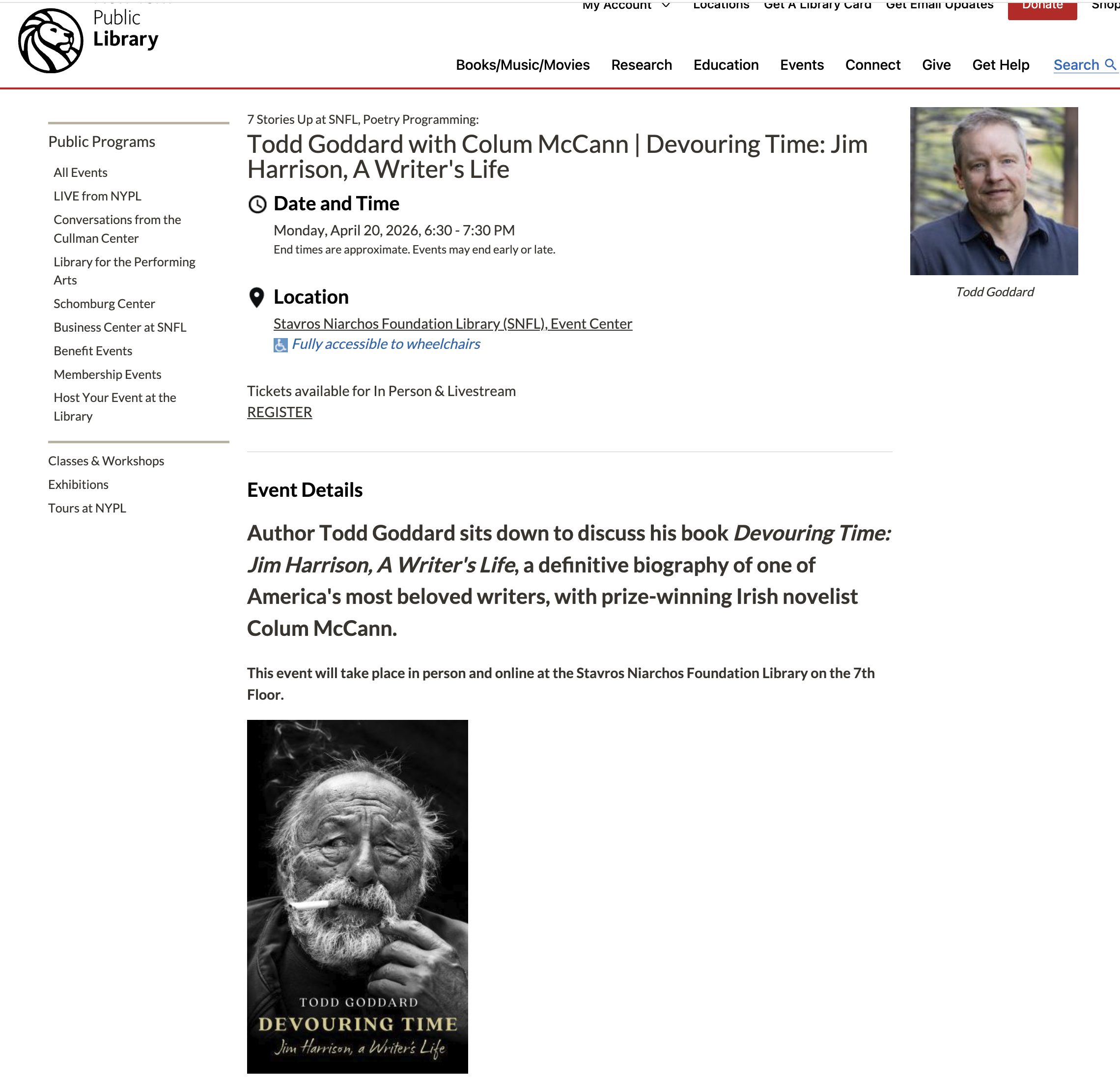
I want to add that Todd Goddard, author of Devouring Time: Jim Harrison, a Writer’s Life (Blackstone Publishing, November 2025), an agency client of Philip Turner Book Productions, was recently interviewed by David Wilk, and I anticipate that their Writerscast episode will come out sometime in the next few weeks. I will share it in this space when it’s available. In fact, it is now posted, on February 3, 2026, available for folks to listen to, linked to here.

A second portion of Wilk’s podcast is devoted to a series he calls Publishing Talks, where he interviews book business figures, such as last January’s conversation with Jack David, of independent Canadian publisher ECW Press, and an episode last September with Carol Fitzgerald of the Book Reporter, the prominent clearinghouse for book clubs and reading groups.
I’ve really enjoyed these conversations, both Writerscast and Publishing Talks, which usually run a bit longer than a half-hour.
Open Book with David Steinberger
While less than half of Wilk’s podcast episodes are focused on publishing professionals, Open Book hosted by David Steinberger, CEO of Open Road Integrated Media and Chairman of the National Book Foundation, is devoted almost entirely to conversations with publishing insiders, while only a few are with authors. The most recent episode, which I found the most informative and interesting so far among the couple dozen I’ve listened to, is a conversation with Terry Finley, President and CEO of the independently-owned major bookstore chain, Books-a-Million.
Steinberger always asks his guests if they were big readers at a young age, and Finley’s home, where he was one of seven kids, had few books in it—beyond the World Book Encyclopedia, which he and his father read avidly. He did have an eighth grade teacher at a Catholic high school in Birmingham, AL, a nun, who encouraged her students to read and write. “We would go outside and sit under the trees and [Sister Margarita] would read Shelley, Keats, and Byron, and then she would encourage us to write poetry…She was the person who got me interested in reading, books, and literature.”
Finley’s career journey in the book business began when as a student at Auburn University, he worked in the college’s bookstore. His first job after college was at Rich’s Department Store in Atlanta, GA, where he was hired as an assistant buyer by Faith Brunson, a legendary doyenne of bookselling in this era, the late ’70s-early 80s, when department stores had significant clout in the book business; Brunson was even President of the American Booksellers Association, the trade association of booksellers. I’ve written about that period when department stores sold lots of books, in a personal essay on this site titled The Education of a Bookselling Editor.
Next, Finley worked as a sales rep for Crown Publishers, with his first territory Pittsburgh, western PA, and southern Ohio. (With my siblings and our parents, I began operating Undercover Books in suburban Cleveland in 1978, but had a different rep for Crown, and never encountered Terry during this period.) He tells Steinberger that his first day on the road for Crown proved to be a misadventure for the ages. Finley drove his new company car from Pittsburgh to Erie, where upon arrival at the bookstore he learned that the buyer he was supposed to sell to that day had died hours earlier. As he got back on the road, he was sideswiped by a reckless driver; he was alright, but the car was a wreck. Fortunately, things got better from there, and soon after he was able to earn an extra sales commission for his efforts.
After about ten years as a rep, Finley wanted to get off the road, so took a job with a book chain in Knoxville, TN, which was soon acquired by the Anderson family of Birmingham, AL, who operated newsstands and bookstores, known then as Bookland. Finley was given a key role in the newly combined companies, which made up about 120 locations. This, of course, was pre-Internet, prior to the super-store concept that Barnes & Noble and Borders embarked on soon after, and well before before Amazon began operating.
Finley said that around 1989 they opened the first store of theirs with the name Books-a-Million, in an old 45,000-square-foot department store in Huntsville, AL, which they stocked with backlist titles, new releases, and remainders, the latter which he knew well from his days with Crown, which owned Outlet Book Company, the biggest remainder company. Lacking proper shelving at that point, they displayed the merchandise on pool tables, and used jury-rigged sawhorses and plywood. Though it must have had a raw pop-up atmosphere, the store was an immediate success, and offered proof-of-concept for what became a major expansion. The chain, which is still owned by the Anderson family, with Clyde Anderson serving as chairman emeritus of the company, age 91, currently operates 220 stores. They’ve been opportunistic. For instance, they took over forty-five Borders locations after that national chain closed in 2011. Finley told Steinberger that Books-a-Million will open 15 new locations in 2026.
In a small way, I can relate to the growth Books-a-Million underwent, as Undercover Books grew from one location in the Cleveland area to three stores before I moved to New York City in 1985, I hoped, to work in publishing. My family continued to operate Undercover Books after I left, evolving into Undercover Book Service, an online book-ordering operation under the direction of my visionary brother Joel C. Turner, who created an early website and began selling books online in 1993, roughly six months before Amazon hung out its virtual shingle. The company operated until Joel’s unexpected death in 2009.
All in all, in this conversation Terry Finley shows a command of facts and figures that was impressive, with deep knowledge of the demographics of his customers, and insights about aspects of the book business I hadn’t considered or heard before. Because I represent authors in the Horror and Gothic Fiction space I was especially interested in his observation that Horror is currently a burgeoning category for Books-a-Million, starting to supplant Romantasy as that category peaks.
Episodes of Open Book usually run about twenty minutes. Other episodes that I’ve especially enjoyed include the program with Arnaud Norry, Chairman and CEO of Les Nouveaux Éditeurs in France, and the episode with Andy Hunter, founder of Bookshop[.]org, the online book ordering service that shares revenue with hundreds of independent booksellers around the country.
The Lives They’re Living with Ben Yagoda
Finally, as a bonus, I’d like to recommend another podcast, one that I enjoy enormously; the program is partly book-oriented, though not to the same extent as the above programs hosted by David Wilk and David Steinberger. It’s called The Lives They’re Living, and the host is Ben Yagoda, whose writing I first enjoyed in the pages of the terrific magazine from the early 2000s, Lingua Franca. Ben has written fourteen books; his two most recent are Gobsmacked: The British Invasion of American English (Princeton University Press, 2024) and a novel, Alias O’Henry (Paul Dry Books, 2025), a historical what-if about the American author known for his twist endings. In his podcast, Yagoda focuses his attention and that of listeners on “remarkable people who are a little more under the radar than they deserve to be.” In each episode, he speaks with “someone who is an expert on and fascinated by the subject at hand.”
Over the past two years, there have been twenty-nine episodes, and I’ve listened to about half of them. Checking the website for the podcast, I see that Yagoda has talked with Dave Barry on Roy Blount, Jr.; Elijah Wald on Ramblin’ Jack Elliott; David Bianculli on the TV writer James L. Brooks and the musician Mason Williams; David Remnick on John McPhee; Dwight Garner on Calvin Trillin; Steve Wasserman on Robert Scheer; Glenn Kenny on film editor Thelma Schoonmaker; Steve Soliar on Dick Cavett; Laurie Gwen Shapiro on Abigail Thomas (“Novelist and memoirist, and probably the best writer you’ve never heard of.”); Adrienne LaFrance on Albert Brooks; and Chris Molanphy on Quincy Jones. In a favorite episode of mine, Ben flies solo, talking about the admirable writing career of the protean author Paul Dickson, who’s published more than 60 narrative nonfiction books and reference titles, such as The Bonus Army: An American Epic and The Baseball Dictionary. You’ll find Yagoda’s enjoyable podcasts via this link.
—
Kudos and props to the two Davids, Wilk and Steinberger, and Ben Yagoda, companionable hosts of their enjoyable programs, each of whom does good work that permits me to indulge my lifelong affinity for aural entertainment, fueling my interest in smart conversations about writing, publishing, culture, and books!

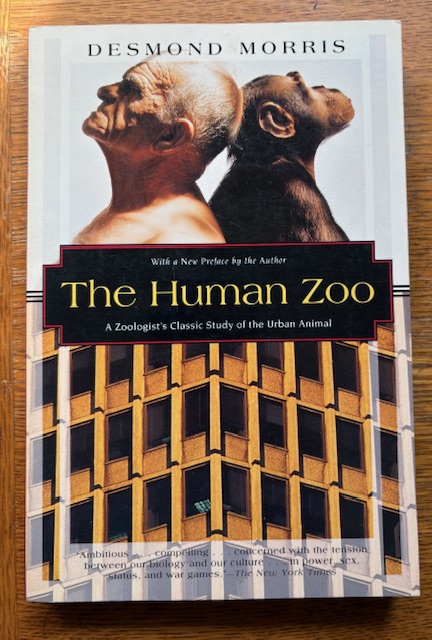 In turning to the NY Times’ Obituary section today, I see that a bestselling author for many decades, Desmond Morris, has died, age 98. Douglas Martin has written an excellent obituary headlined, “Desmond Morris, 98, Dies; Explored Humans’ Animal Instincts in ‘The Naked Ape,’” linked to here (no paywall).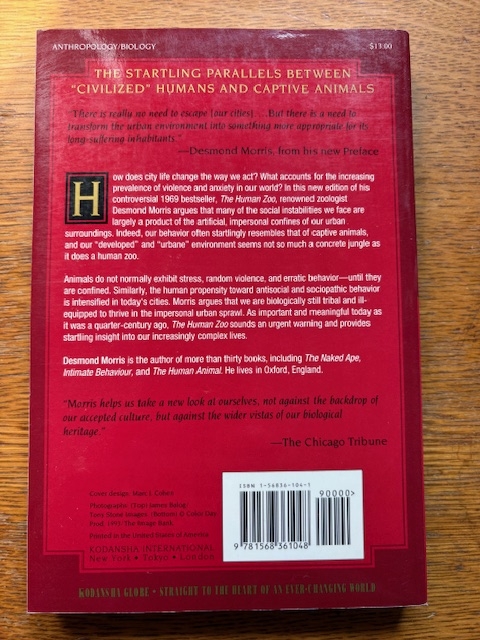
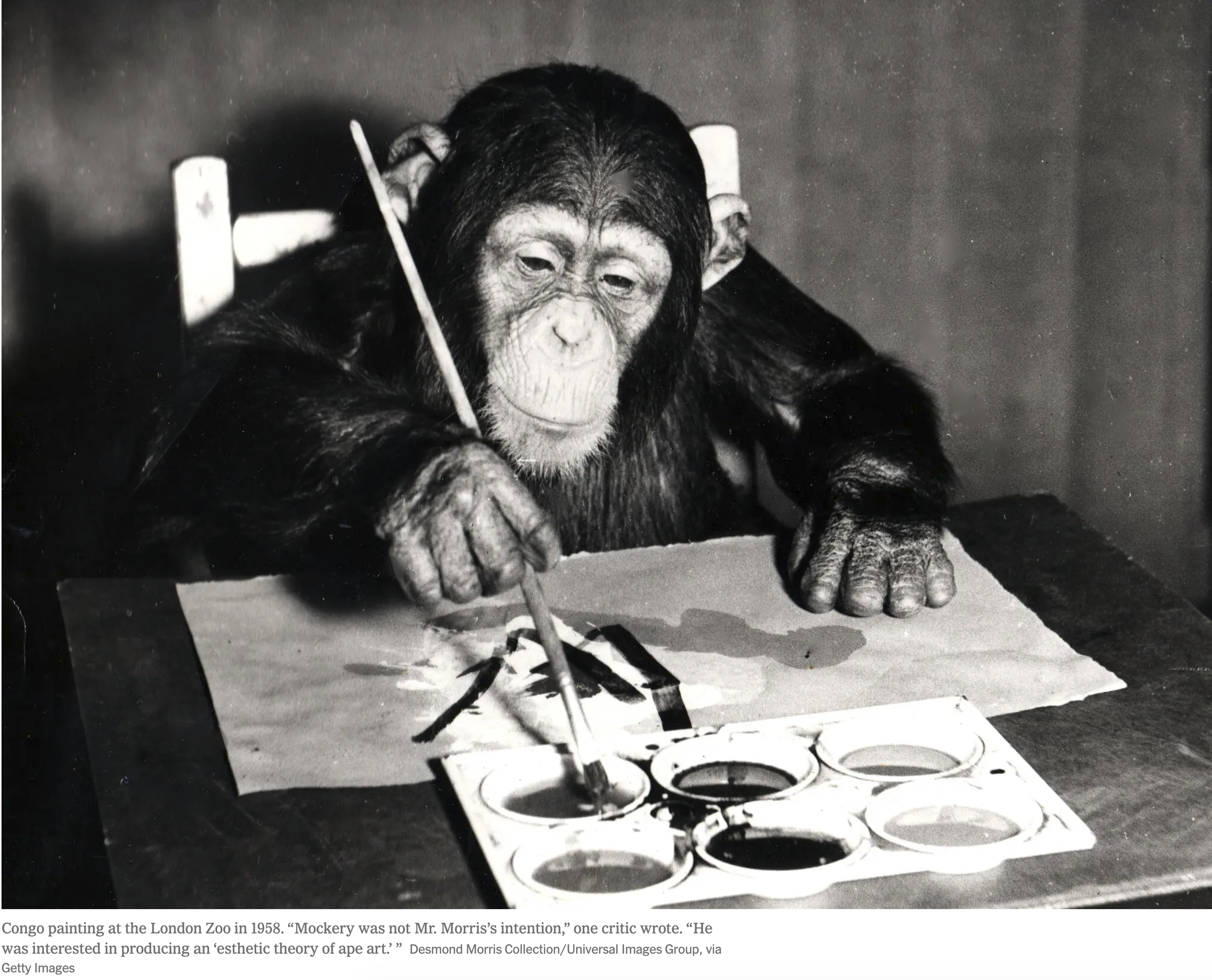 Arguably, his books mainstreamed the study of animal and human behavior like no writer before him had done. As mentioned, he also was a painter and also made a study of the question of possible picture-making among non-human primates. In 2018, he returned to art, publishing a book titled The Lives of the Surrealists. I was privileged to work with him back in the day.