Books I’ve brought out as publisher; essays and reviews I’ve published

Romare Bearden and Albert Murray Enjoying a Harlem Afternoon

The important African-American artist Romare Bearden was at one time good friends with my late author, Edward Robb Ellis, author of A Diary of the Century: Tales from American’s Greatest Diarist (1995). Ellis wrote at length about their friendship in that book, which reflected on Bearden’s upbringing in Pittsburgh, and the life he lived that led to his distinctive style of collage-making and painting. In the years since I worked  with Eddie, whenever I read about Bearden, I feel I almost know him, from Eddie’s fulsome recollections. When the writer and critic Albert Murray died last August, he was eulogized in many venues, most memorably for me by Paul Devlin in Slate, where I was delighted to be reminded that Bearden and Murray had also been very close, as friends, and indeed as frequent collaborators (when Bearden needed something written, Murray often wrote it). Typifying their relationship is the revealing video I tweeted out earlier tonight, and which I’m eager to share here, too.

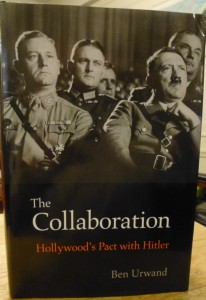
#FridayReads, Oct 11–Ben Urwand’s “The Collaboration: Hollywood’s Pact w/Hitler” & Anne Hillerman’s “Spider Woman’s Daughter”

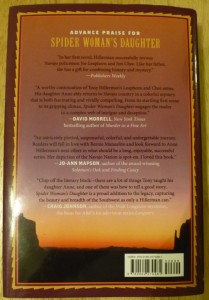
Collaboration#FridayReads, Oct 11–Ben Urwand’s The Collaboration: Hollywood’s Pact with Hitler & Anne Hillerman’s Spider Woman’s Daughter, a new installment in the long-running Joe Leaphorn and Jim Chee mystery series established by her late father, the mystery master Tony Hillerman.

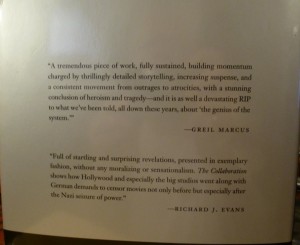
Notwithstanding the controversy I’ve reported on earlier that’s greeted publication of The Collaboration, which I had made part of my #FridayReads a few weeks ago, I have been continuing to methodically read it, even while still reading fiction. It’s ironic about all the hubbub, because I am finding it so far, about 80 pages in, an unsensational, moderately engrossing and well-documented account.

The narrative opens by examining “All Quiet on the Western Front,” the 1930 WWI drama released by Universal Pictures that to German officials, dangerously advocated pacifism while also showing cowardice and dishonorable conduct by their troops. The government, two years before Hitler was to win power, viewed it as a threat to to the nation, and sought to have whole passages of the film cut, scenes changed, and dialogue rewritten.  They threatened to remove it from all German screens, and to make it harder for other American pictures to be exhibited in Germany.

After this key opening example, the book becomes a chronicle of the willing cooperation of some American film industry executives–who along with a number of American functionaries and bureaucrats, and at least one Jewish communal organization, the Los Angeles branch of the Anti-Defamation League–worked to suppress American-made movies being produced about contemporary Germany.  Some of this suppression was triggered by German trade officials who after the Great War’s ignominy zealously attacked films from foreign countries that seemed to hyper-sensitive German governments (even preceding Nazi rule) prejudicial against their country and “damaging to their reputation abroad,” or potentially “demoralizing to morale” at home, as they put it, as with “All Quiet on the Western Front.” Hitler was an enthusiast of cinema and theatrical performances of all kinds, as earlier shown in a book I edited and published,  Ibsen and Hitler: The Playwright, the Plagiarist, and the Plot for the  Third Reich. Once Hitler was in power, with hyper-awareness of both the positive and the damaging  effects of propaganda, he focused his regime on how messages might be spread by movies. With that, the Nazis began even more aggressively lobbying foreign filmmakers to alter the scripts of movies in production, or edit and recut ones already being exhibited on German screens.

For a rundown of the controversy surrounding the book and the overheated things some of its critics have said about it, please see my recent post, Questioning the Critical Reaction to Ben Urwand’s “The Collaboration: Hollywood’s Pact w/Hitler”Collaboration blurbs
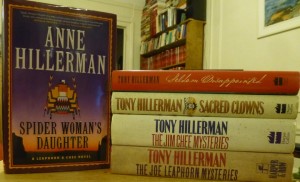
A Second #FridayReads, Spider Woman’s Daughter, Anne Hillerman’s new Joe Leaphorn and Jim Chee Mystery Novel

While reading The Collaboration, I am intercutting it with Anne Hillerman’s Spider Woman’s Daughter. I’ve read and loved the Leaphorn and Chee series for years, and made his 1982 book Dark Wind one of my #FridayReads last year.Hillerman paperbacks
Tony died in 2008. About the revival of the series, Anne has written, “When I emerged from the worst of my grief after Dad’s death, I realized that I was also mourning the end of his mystery series. I missed those detectives [Leaphorn and Chee], and I especially regretted that Bernadette Manuelito would never get a book that put her in the spotlight. And then I thought: I could try writing Bernie’s book myself. . . .In addition to Tony Hillerman’s Landscape, I had written several other books, so I knew part of the challenge that faced me. I jotted down some ideas as a rough outline and got to work.”

I’m loving her new book. The protagonist, Bernadette, is a young police officer in Navajo Country, married to Jim Chee, who learned how to be a cop under the tutelage of Joe Leaphorn, wise man of the tribal police force. She witnesses a startling assault on a fellow cop in the book’s opening chapters, which forces her to the sidelines of an important investigation. Despite her chief’s order to drop any involvement with the case, she continues trying to riddle it out, even while Chee and her fellow officers pursue every lead. Bernie’s unauthorized efforts take her all across the dramatic landscape of Navajo Country, speaking with people who may help her understand what’s really going on. Just as in Tony’s books, the sense of place and people is indelible.

Coincidentally, over the summer, working as literary agent for author J. Michael Orenduff, I licensed his 6-book POT THIEF mystery series to Open Road Integrated Media who will publish them in ebook and print editions in January 2014. The books are are set in and around Albuquerque, New Mexico, and feature dealer in Native American pottery Hubie Schutz. They’re titled The Pot Thief Who Studied PythagorasThe Pot Thief Who Studied PtolemyThe Pot Thief Who Studied EinsteinThe Pot Thief Who Studied EscoffierThe Pot Thief Who Studied D. H. Lawrence, and The Pot Thief Who Studied Billy the Kid.  When not digging in the desert for ancient pots, or crafting copies of artifacts with his own hands, Hubie’s usually absorbed in reading a classic text. In their earlier editions, the POT THIEF books won numerous awards and raves from mystery readers, including this one from Anne Hillerman herself: “I inhaled this book. Witty, well-crafted and filled with unexpected plot turns, The Pot Thief Who Studied Billy the Kid will delight J. Michael Orenduff’s many fans—and win him new ones.”

It’s a small world out there for mystery writers and readers and I’m really excited that Anne Hillerman’s brought back her father’s great characters, and that fans of the Leaphorn and Chee books will soon be able to discover and enjoy the POT THIEF mysteries.Anne HillermanAnne Hillerman back cover
 

GalleyCat’s New Directory of Editorial Professionals

Galleycat.com is the book industry blog for the collection of media blogs that come under the rubric of mediabistro.com. It’s a valuable source of daily information on the book biz. I was glad when I saw galleycat had recently started a Google Docs directory of independent editors. I registered on it this morning. The simple sign-up asked for areas of concentration, notable books I’ve worked on, what kind of editing I do, and the url for the Philip Turner Book Productions page on this website. I’m glad to be part of this directory where authors, agents, and publishers seeking editorial help can learn about my consultancy.

#FridayReads, Oct. 4–Katie Hafner’s Exquisite Memoir “Mother Daughter Me”

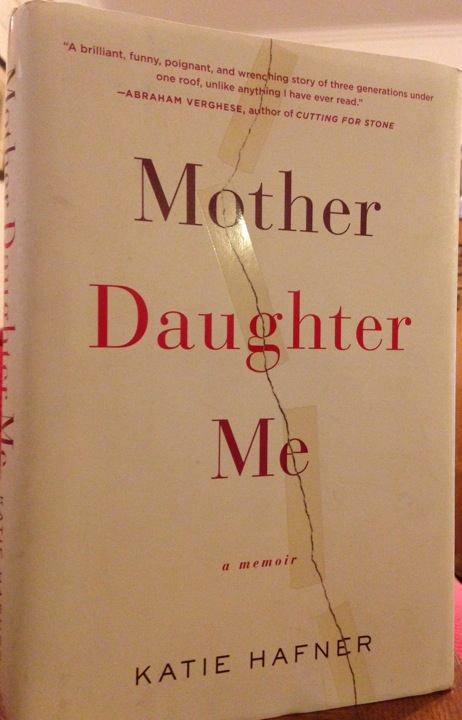
Mother Daughter MeI began reading Katie Hafner’s journalism in the NY Times in the ’90s in what was known as “Circuits,” a section of the Thursday newspaper that covered the era of Web 1.0. Everything about tech was new, to me at least. Katie, and “Circuits,” helped make obscure things clear to me, then a not very tech-oriented book editor. Around 1999 I read a cover story Katie had written for Wired magazine and now I was really smitten by her work. Her story was a long one by magazine standards, about 40,000 words, on The Well, an early online community that emerged in the Bay Area starting around 1984. I was amazed–members of The Well had used a kind of proto-listserv and chat system that allowed them to share cyberspace together in a way no one had done before. But that historical first-ness wasn’t the only reason I wanted to make Katie’s article in to a book if I could. It was because of the extraordinary insight in to people that accompanied her reporting. In its early days, The Well had been a tight world where members supported each other like neighbors in a small town. They abided by founder Stewart Brand’s credo, “You own your own words.” Katie’s narrative, with used long threads of online conversations including multiple characters that the reader came to know and care about, was riveting.

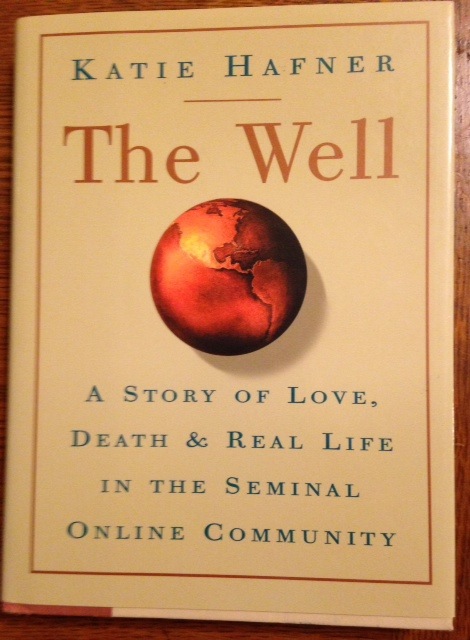
In 2000–after a three-year stint for Random House, where the bulk of the time I worked at Times Books, with a big part of my job liasing with editors at the Times to make books with content from such departments as the Book Review, Real Estate, City, and Dining–I joined Carroll & Graf Publishers and contacted Katie with one of my first new book acquisition ideas. I asked if she’d be interested in turning the Wired article in to a book. I remember one day when she was in NYC from the Bay Area we met for coffee near Times Square. She was petite and had a great smile; I found her immediately likable. She talked like the voice of her journalism: a bit funny, and economical with her words that every so often sported a memorable phrase. Though she had not been trying to turn the Wired reporting in to a book, she was intrigued with my idea, and we made a deal to go ahead with it. I edited it with her revising and expanding the manuscript a bit and in 2001 we brought out The Well: A Story of Love, Death & Real Life in The Seminal Online Community. Among the many superb endorsements we printed on the back cover was this one from the proponent of communitarian philosophy Amitai Etzioni: “The best book ever written about communities and the Internet.” The book didn’t set any records, but it did well enough to justify C&G’s investment in it, and I was quite proud of it, as I believe Katie was, especially once the World Wide Web became such a big part of modern life that it was hard to remember a time before it existed. For anyone who wanted to know the prehistory of online interaction, it was right there in The Well.The Well cover

After the book had run its course, Katie and I stayed in touch, but only occasionally. In 2002 I was startled and saddened when I read that her husband Matthew Lyon had died suddenly while on a visit to Seattle for his job with the University of California. He was 45. Katie and their young daughter survived him. I found something to say and wrote her a card with my condolences, grieving with her from a distance.

Katie HafnerLast year, I read that Katie would be publishing a memoir with Random House. I was excited because I had never read anything by Katie about her own world. Mother Daughter Me came out in July and I was thrilled when I got a copy two weeks ago. After making it my #FridayReads last week, when I was only a little ways in to it, I now can say that it is gripping throughout, and likable, like Katie, even while it chronicles some pretty difficult and sad but ultimately transcendent Hafner family business. It begins with her mother’s move from San Diego to be with Katie and her now-teenaged daughter in San Francisco. I finished it the other day during a break while on a bike ride, and scrawled these words on a piece of scrap paper, anticipating I would use my first impressions in this #FridayReads essay:

“Exquisite, in many senses. Exquisitely painful, as it recounts the failures of her drink-addled mother to provide parental stability for Katie and her older sister when they were young. Exquisitely produced and edited with nary a typo or broken letter in the volume. Exquisitely truthful and unflinching in the way Katie examines her own behavior, no less than that of her mother and her daughter. As good a reporter as Katie is when writing about other people, she is somehow even more insightful and penetrating when the subject is herself, her widowhood, and her own family. I walked with her every step of the way on the difficult journey that she takes with her mother and daughter and am very glad I did. An amazingly honest book.”

I recommend Mother Daughter Me to anyone who’s still trying to riddle out truths about their family; to anyone who’s ever argued with a sibling, child or parent; to anyone with an aging parent who ponders future options for them, from living with you to “aging in place,” a term you will encounter here. I will add that like a particular Vaughan Williams symphony that I love–I believe it’s his 6th–this book winds up with a beautifully orchestrated cascade of multiple endings that transit from tragic to reconciled to fulfilled. If you’re like me, your eyes will be very moist as you finish reading Mother Daughter Me. This is a great book.

Celebrating Photojournalist & Author Ruth Gruber’s 102nd Birthday With Her

LIFE magAs some readers of this blog may know, I’ve had the personal and professional privilege to edit and publish photojournalist and author Ruth Gruber’s books over the years. I’ve done six of her eighteen books. Her first publication was a thesis on Virginia Woolf, written in Cologne, Germany in 1931, while an exchange student there. She was then just 20, a young woman from Brooklyn on the verge of what became an amazing career as a refugee advocate, chronicler of the displaced, humanitarian, and journalist. She met with Woolf in London around 1935, a story she’s told in her book Virginia Woolf: The Will to Create as a Woman, which I wrote about at this link on The Great Gray Bridge.

In the early 1940s, Ruth was a member of the FDR administration, under Interior Secretary Harold Ickes as his special field representative in Alaska. She is doubtless one of the administration’s eldest surviving staffers. To read Ruth Gruber’s work I recommend any of the six books I worked on, five of which are currently available from Open Road Integrated Media. The titles are Haven: The Dramatic Story of 1,000 WWII Refugees and How They Came to America; Ahead of Time: My Early Years as a Foreign Correspondent (also the title of a documentary on Ruth); Inside of Time: My Journey from Alaska to Israel; Raquela: A Woman of Israel; the Virginia Woolf book named above; and Exodus 1947: The Ship that Launched a Nation (the only one of these not available from Open Road, it’s currently published by Union Square Press).

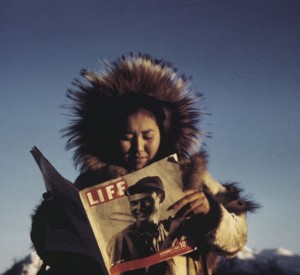
There is also this link to a post I wrote when the International Center of Photography (ICP) gave her their lifetime achievement award in 2012. After a stop in Alaska, the ICP’s exhibit of Ruth’s photojournalism is now traveling the country. The picture above, of an Inuit girl reading LIFE Magazine with Ted Williams on the cover, is part of the ICP exhibit. It is one of her most whimsical; by contrast, she also photographed Holocaust survivors in DP camps after WWII. Those pictures are also part of the ICP exhibit. Here are a dozen pictures from a birthday party that my son Ewan and wife Kyle Gallup attended with me yesterday. (Most pictures by Kyle.) You may click here to see all images.

“Hono(u)rary Canadian”–My New Blog

Perce-Roche-tumbler6Along with The Great Gray Bridge, which is designed and built* upon a Wordpress theme, I maintain a blog–currently on tumblr–where I share briefly written posts with photos and quick hits. It’s often handy when I’m traveling or running around town, away from my desk.** That site was formerly named after this blog, but I’m officially refocusing it–its emphasis will now be on Canadian content and covering Canadian issues. I’m renaming it Hono(u)rary Canadian, in a bid for transnational wit. I make no singular claim to that title, for I know that Canada draws interest and affection from many in the US. I use it though, as kindly Canadians have said it about me, and because I do cherish a near-lifelong deep and personal connection with Canada. In fact, from the time I began The Great Gray in October 2011, Canada has played an important role in my coverage, constituting roughly 20-30% of my writing, links, and sharing. I’ve connected with many Canadian readers over the past two years, and have found there many Facebook friends and Twitter followers. I’m hoping to connect with even more Canadian readers with the newly named site, and more deeply.

Given my interest in Canadian literature, authors, indie music, geography, and politics–and the enjoyment I find in writing about them, this is a natural extension for me. I also plan to write about Canada’s next federal election, which will take place no later than 2015. I’ll also be sharing photos from my many years of travel in Canada, beginning with the image that I’ve chosen as the signature visual for the site. It shows the monumental Roche Percé or ‘pierced rock’ on the Gaspé Peninsula in the most eastern portion of Quebec. I visited the region on a solo vacation in the autumn of 1988. The mighty rock juts in to the Atlantic Ocean with its massive pointed prow facing toward shore. It is a wonder of the world, no kidding. A visitor can only get near it at low tide, as I did on one lucky occasion. I remember spending about 3 hours scampering in and out of the surf and trying to get as close as possible to the pierced opening, with the huge bulk of it towering at least a hundred feet above me. The image at the bottom of the post is a ‘selfie’ I took the same day, long before that term was in the vernacular. It’s a place I hope to see again someday, next time with my family.

I invite you to visit Hono(u)rary Canadian in the days, weeks, and months to come. I’ll post on both sites, share often between them, and do lots of cross-linking. My interest in reading, book culture, live music, city life, media, and current events, and my writing about them–covering New York City, the US, and Canada–is growing so that I need the two sites. Thanks for reading me at one or both of them.

PT & Perce Roche_0001

* My excellent designer, who adapted the Wordpress theme I chose for this site, is Harry Candelario, who when I first met him was known as the Mac Doctor, for his work on Apple products. I frequently suggest him to people when they ask me to recommend a web designer. I should add he also offers helpful advice about Wordpress, various Web platforms, SEO, and generally helps to increases one’s Web savvy.
** Though I may soon convert it from tumblr to Wordpress.