A Heartwarming Tale of Two Very Companionable Horses

I adored this Washington Post story published in their sports section on Christmas Day all about two retired race horses, their affinity for each other, and the apparent joy they derived from the company and proximity of the other, even living in the same stall for a time. I’ve screen-shot the first three paragraphs, and highly recommend you read Chuck Culpepper’s whole story linked to here, which has many surprising twists and turns before you reach the conclusion. 

By a happy coincidence, I have an author/photographer client on the literary agency side of my business who’s doing a book about equine therapy and its benefits for people, to be titled How Horses Help Us Heal, which I am hopeful we will place with a publisher in the new year. This is part of the pitch letter I’ll be sending to editors at publishing houses:

For Karen Tweedy-Holmes’ earlier book, Horse Sanctuary (Rizzoli, 2013), which had a foreword by Temple Grandin, she photographed horses at thirteen equine rescue facilities all over the USA, while also interviewing people who work with the rescued animals. It has wonderful reviews on Amazon and the single printing of the pricey hardcover sold out. In creating that book she discovered that many rescued horses are having renewed lives at equine therapy facilities, where people with vexing physical and mental health conditions find benefit and improvement in being around horses—grooming them, exercising with them, feeding them, sometimes riding them, or walking with them on a light lead. 

Tweedy-Holmes also learned that some of the most sensitive and healing horses are animals that have themselves endured neglect and abandonment and then been rescued, much like the people who often find such great solace in connecting with them. These relationships lead to extremely tight bonds among the horses, the patients, and the skilled therapist facilitators who help direct the interactions, all reflected in her extraordinary photographs and writing. 

Now, Tweedy-Holmes has embarked on How Horses Help us Heal, a wide-ranging overview of more than a dozen equine therapy facilities that treat US military veterans with PTSD; children with learning problems; couples in therapy together; anxiety-plagued teenagers, substance abuse patients, etc.  Tweedy-Holmes intends to focus on the stories of individual horses, adding their stories in to the chapters about patients and caregivers at each therapy center. 

Judging from the story of these two companionable horses and their close bonds, it seems fair to say horses are also very capable of healing each other.

The Indomitable Alexey Navalny, Vladimir Putin’s Most Charismatic Critic

In case you haven’t seen this yet, it’s an important op-ed by my agency client Amy Knight’s in the LA Times today about Alexey Navalny, Vladimir Putin’s popular and charismatic critic. If you don’t know about him yet, you ought to because he’s got a chance to mount a credible challenge to Russia’s political status quo, and is making some headway despite an autocratic environment. The piece reports he has 80 campaign offices and more than 130,000 volunteers. Putin and his government are trying to sideline Navalny and scuttle his candidacy in next year’s presidential election by using the courts to keep him off the ballot. The piece is about 1000 words, so a 5-7 minute read and drawn from reporting for her book Orders to Kill: The Putin Regime & Political Murder. It went on sale this past Tuesday, from St Martin’s Press (ordering info here). I believe it is going to be very widely read and discussed. Thanks for sharing word about it if you have friends keeping any eye Russia’s ongoing politics, not just for what they’ve done in recent years and months, but for what is still to come. The book will help readers understand the Putin system, so necessary for us going forward since his displacement—by Navalny, or anything or anyone else—is unfortunately way more than a long shot. Note that with Russian law mandating 6-year presidential terms, if re-elected, Putin could be Russia’s leader till 2024, a worrying thought for the West. Still, if anyone could do it, Navalny is the one to watch most closely, for his canny maneuvering which includes a fed-up anti-corruption message that could stand alongside Trump’s failed promise to “drain the swamp.” In Russia, with the economy flat, and ordinary people falling behind, and businessmen and bankers cleaning up, Navalny rails against privileged plutocrats and means it. Navalny also bears watching because of the uncomfortable conclusion that his personal security could be at risk. Amy concludes her piece with a quote from the dissident:

“In an interview with the BBC in January, Navalny, who is married with two children, was reminded of what happened to Nemtsov and asked if he realized the danger he faced. Navalny, whose political support far surpasses [the late Boris] Nemtsov’s popularity, assured his interviewer that he was fully aware of the risks of opposing Putin. As to his motivation, he added: ‘This is my country and I am going to fight for my country. I know that I am right.’”

Lawrence Ellsworth, Ushering in a New Heyday for Classic Adventure Fiction

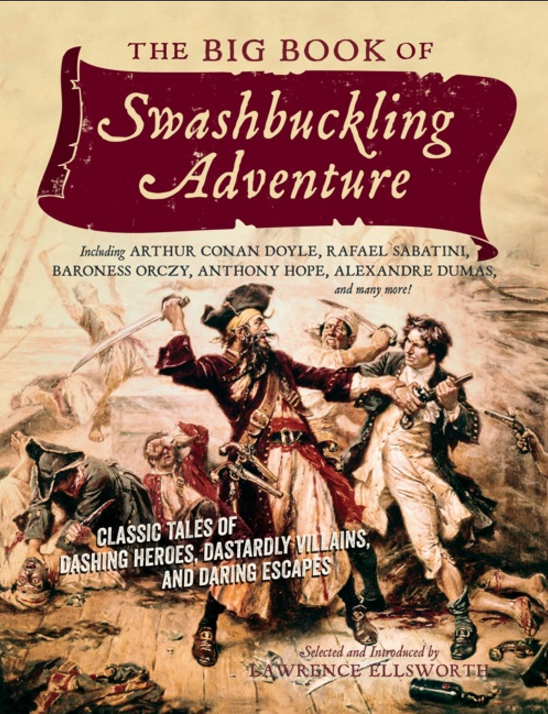
Readers of this blog may recall that one of the authors I represent on the literary agency side of my business is Lawrence Schick, who under the pen name Lawrence Ellsworth has served as anthologist and editor of The Big Book of Swashbuckling Adventure, and translator of Alexandre Dumas’s novel The Red Sphinx, an all but forgotten sequel to The Three Musketeers.

The two books were published by Pegasus Books in 2014 and 2017, respectively. The long-lost novel—which was praised by Washington Post critic Michael Dirda as an “Excellent, compulsively readable translation”—has been so successful that Pegasus later acquired from us the rights to Ellsworth’s new translation of The Three Musketeers, a sparkling, modern translation of Dumas’s classic adventure novel, which they will publish on January 2, 2018. 

With all the praise and interest that Ellsworth’s enterprise of reviving adventure fiction has attracted, Literary Hub assigned journalist Dwyer Murphy to do a profile of him for its readers. The result is a fascinating profile that touches on swords, fencing (author and interviewer visited a fencing academy in Harlem), knights errant, role-playing games (Schick was an original team member of the outfit that created Dungeons & Dragons), and other matters. Linked to here, you can also read the first few paragraphs in the screenshot below. I am delighted to be representing such a talented client as Lawrence. If you or someone you know enjoys adventure fiction, I recommend you check out his outstanding work.

Vicki Huddleston, former top US diplomat on Cuba, on the Letters Page of the NY Times

Very proud of my author client Vicki Huddleston—former head of the United States Interests Section in Havana, Cuba, 1999-2002—who has this letter to the editor running in the NY Times today on the Trump administration’s reversal of President Obama’s Cuba policy. Her book, Our Woman in Havana: A US Diplomat’s Inside Account of America’s Long Struggle With Fidel Castro’s Cuba, will be published by Overlook Press in 2018. Here’s the letter, and you can also find it via this link

An Anthology of 17th Century American Horror Writing

On the literary agency side of my editorial services business, I’m excited to have recently licensed this anthology to Pegasus Books for publication on October 31, 2017, Halloween, as noted in publishersmarketplace.com
COLONIAL HORRORS: Sleepy Hollow and Beyond, a new anthology that shows the roots of American horror writing stretch all the way back to the era when Arthur Miller set “The Crucible,” with little known writings from the seventeenth century by Cotton Mather, Increase Mather, and Richard Chamberlayne, along with selections by Washington Irving, Nathaniel Hawthorne, James Fenimore Cooper, Edgar Allan Poe, John Greenleaf Whittier, Henry James, and H.P. Lovecraft, to Pegasus, in a nice deal, for publication on Halloween this year, by Philip Turner at Philip Turner Book Productions (World).

I put out a tweet about it this week:

Endorsements for “ORDERS TO KILL: The Putin Regime and Political Murder”

As mentioned on the blog last month, on September 19, 2017, St Martin’s Press will publish my agency client Amy Knight’s new book Orders to Kill: The Putin Regime and Political Murder.  To date, we have received these five blurbs

1) “Amy Knight is our foremost expert on Russian spycraft. This incisive, deeply researched account of the Kremlin’s murderous dark arts should
be an electrifying wake-up call to the West about the danger we face from Putin’s gangster state.” —Edward Lucas, Senior editor, The Economist

2) “Amy Knight’s Orders to Kill builds a compelling case against the Putin regime for its complicity in the violent deaths of many of its critics—political opponents, muckraking journalists, and reform advocates. It also destroys the myth that we in the West can appease Putin to get him to behave himself.”—Bill Browder, author of Red Notice: A True Story of High Finance, Murder, and One Man’s Fight for Justice

3) “A brave and important book. Amy Knight has an expert understanding of Russia, its spy agencies, and the dark state created by Vladimir Putin and his KGB cronies. Putin’s critics have an uncanny habit of falling dead and Knight tells this story with rare skill. Compelling.”—Luke Harding, author of A Very Expensive Poison: The Murder of Alexander Litvinenko and Russia’s War with the West 

4) “Putin’s regime kills. It goes after its enemies at home and abroad and has created the environment in which powerful figures close to the Kremlin can also prosecute their own feuds with impunity. In this powerful and detailed account, Amy Knight tackles a series of individual and collective killings and amasses the evidence, some clear, some circumstantial, connecting them with the Kremlin. Whether you agree or disagree with any of the specific findings, having read this book it is impossible to question the extent to which the Kremlin is not just a kleptocracy, it is a ruthless one, at that.”—Mark Galeotti, author of Vory: The Story of Russian Organized Crime 

5) “Orders to Kill focuses unblinkingly on the grim but necessary topic of political murder during the seventeen year Putin period. Amy Knight is a meticulous analyst and is consistently balanced in her judgments. The two chapters on the poisoning through radioactive polonium of former KGB officer Aleksandr Litvinenko in London break significant new ground.  Knight demonstrates that the order to commit a number of the political killings she discusses can, with great likelihood, be traced back to President Putin himself or to his powerful Chechen Gauleiter Ramzan Kadyrov.”—John B. Dunlop, author of The Moscow Bombings of September 1999 

The photo below, with Putin and Chechen president Kadyrov, is one of more than a dozen pictures in the book. Pre-orders for the book can be placed via this link.