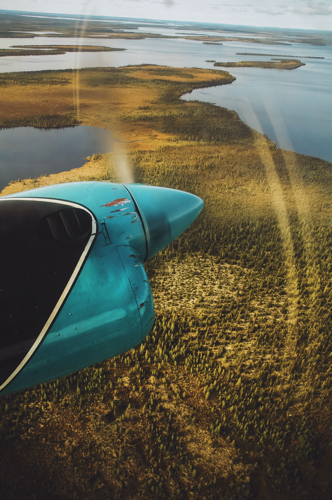
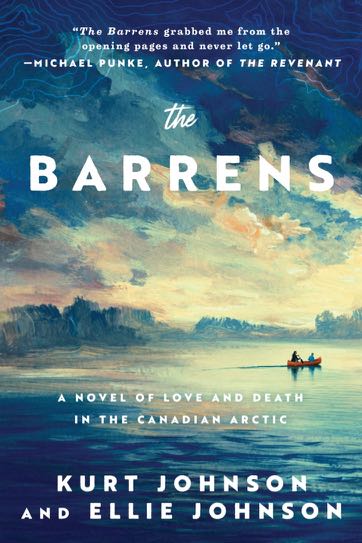
“The Barrens,” Recommended for all Reading Group and Book Clubs


Readers of this blog may recall earlier posts about The Barrens: A Novel of Love and Death in the Canadian Arctic, by the father-daughter team of Kurt Johnson and Ellie Johnson. We just got the fantastic news that the book has been chosen by the Women’s National Book Association for their annual Great Group Reads program. In the WNBA’s announcement they write, “The annual list features 20 books that were chosen by a reading committee of 46 readers out of hundreds of submissions. The books were chosen for literary merit and for their ability to promote meaningful discussions.” The authors and I are thrilled that members of reading groups and book clubs, in particular, will have an opportunity to discover this powerful and entertaining novel.

The Barrens is a gay coming-of-age story that features two college-age women protagonists who set out to canoe the mighty Thelon River. It combines a stirring wilderness tale with an intimate, personal story. Kirkus Reviews loved the book: “Experienced canoeists Kurt Johnson and Ellie Johnson, a father-daughter writing team, present a vibrant, tender novel of love, loss, stamina, and self-discovery….A poignant and engaging thriller with a formidable lead character.” (Full Kirkus review)

Publishers Weekly ran a column by Kurt Johnson chronicling the backstory behind the novel, including Ellie’s own journey through the Canadian Arctic as a teenager.

If you’re a member of a reading group or book club looking for your next great group read, I suggest you check out The Barrens, which was published in May 2022 by Arcade Publishing.

Sold—”The Barrens: A Novel of Love & Death in the Canadian Arctic”

Delighted to announce that in our New Stories initiative Ewan and I have sold a superb debut novel, The Barrens: A Novel of Love & Death in the Canadian Arctic, to Arcade Publishing, who will bring it out in Spring 2022. Here’s a condensed version of the pitch letter I sent to publishers:
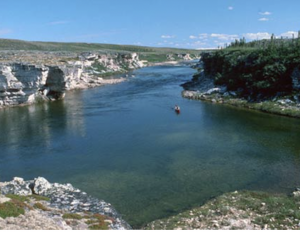
The Barrens: A Novel of Love and Death in the Canadian Arctic by Kurt Johnson and Ellie Johnson is a unique adventure novel that will captivate readers across a wide range of tastes. Written in spare, flowing prose, it tells the story of Holly and Lee, two female wilderness paddlers who face hardship and tragedy along the Thelon River in sub-Arctic Canada, canoeing through the uninhabited tundra of the Barren Lands during their summer break from college. Holly had made this canoe trip in an earlier summer, and wanted to share the experience with her friend and lover Lee.

In their relationship, Holly and Lee have always told each other stories; Holly had even called Lee a “storyist,” an animating idea for them both. Storytelling helps Lee endure, and in turn the reader is brought along on their epic journey. These personal narratives form the backbone of the novel, with Lee chronicling her coming-of-age life off-the-grid in Nebraska with an eco-anarchist father who ends up in prison. The reader also encounters their coming-out stories, peaking when Lee meets Holly’s parents at the end of the trip.

The Barrens explores themes of nature versus humanity, the elements versus civilization, weaving them together in a way that is compelling and engrossing. The word “unique” is applicable when considering this novel, as this is the first wilderness adventure tale I know of that explores themes of gender identity and sexual orientation, juxtaposed with gritty survival and tragedy.

Kurt Johnson wrote the novel with insight and guidance from Ellie, who made the 450-mile-long paddle down the Thelon River and for forty-five days didn’t see a soul apart from her paddling companions. The story is the product of the two working to understand an arduous journey through the Barren Lands, and Ellie’s journey as a young gay woman coming of age.

Kurt completed a year-long novel writing course at the Loft Literary Center in Minneapolis taught by Peter Geye (a Minnesota Book Award winner) who’s said of The Barrens, “I’ve rarely come across a novel that’s simultaneously so economical and fulsome,   that’s as restrained as it is brimming with unspoken wisdom, and that manages all this while also being propulsive in its storytelling. It’s bravura work that demands a wide audience.”

Kurt Johnson lives in St. Paul with his wife Stephanie Hansen, who is writing a cookbook with Minnesota Historical Society Press called True North Cabin Cookbook. Ellie Johnson is a senior at the University of Minnesota in the Twin Cities, and a former canoe counselor at Camp Widjiwagan in Ely, Minnesota.
—-

I’ve never worked on a novel that’s received so many sincere and heartfelt endorsements this far out from publication. Here are all of them, in addition to the one above from Peter Geye.

The Barrens grabbed me from the opening pages and never let go, a riveting adventure story written by a father-daughter team who clearly have wilderness chops.”—Michael Punke, author of The Revenant and Ridgeline

“A deeply compelling tale, told in vivid, elegant but concise prose, The Barrens carried me along, swiftly as the river at the heart of the story. The central character, Lee, will break your heart, although she’ll have none of it. Love, loss, life and death, against a landscape as raw and ancient as the human heart. Most highly recommended.”—Jeffrey Lent, author of In the Fall

“As harrowing as the whitewater adventure it chronicles, The Barrens is an epic tale of wilderness survival and death in the techno age. The writing throbs with presence: the life-force embedded in Canada’s northern frontier landscape and in the life-scape of its queer young heroine as she journeys toward selfhood. Co-authors Kurt and Ellie Johnson reveal the pulse of identity, born of the stories we weave. A mesmerizing, devastating read.”—Carol Bruneau, Canadian author of Brighten the Corner Where You Are: A Novel Inspired by the Life of Maud Lewis

The Barrens is the raw and moving story of two young women paddling by canoe down one of North America’s the most remote rivers—of their coming of age, their love, and terrible loss. I’ve rarely come across a text that is so visual, and so tangible. The Barrens is a vivid portrayal of the Canadian subarctic, and of the human drive to persevere.”—Alex Messenger, author of The Twenty-Ninth Day: Surviving a Grizzly Attack in the Canadian Tundra

 

Sold: “The Twenty-ninth Day: Surviving a Grizzly Attack in the Canadian Tundra” by Alex Messenger

One of the most exciting things in my work as an independent editor and literary agent is when I have the opportunity to work with a new writer on their manuscript, helping them develop it to the point where a publisher later makes an offer to publish it. That is what’s occurred with writer Alex Messenger’s book, The Twenty-ninth Day: Surviving a Grizzly Attack in the Canadian Tundra, which I recently sold to Blackstone Publishing. They’re an Ashland, Oregon-based company that in the past couple years has grown from being a publisher of audio books only (several months ago I sold them audio rights to The Last Days of Sylvia Plath), to now having a full print program, with reissues such as Mr & Mrs Hollywood: Edie and Lew Wasserman and their Entertainment Empire by Kathleen Sharp (by coincidence I edited the original edition for Carroll & Graf Publishers in 2004) and new, never-before-published titles. Below is a lightly edited version of the pitch letter I submitted to editors with the manuscript, prompting the offer from Blackstone. 

A denizen of the wild places and freshwater lakes of northern Minnesota, by his early teens Alex Messenger had already gone on many wilderness and canoeing journeys, sometimes with his family, other times with peers through a local YMCA camp. The summer he was seventeen, a friend encouraged Alex to be a paddler on what would be his most ambitious trip yet: 

“’You should come,’ Mike urged me. Going on the Hommes du Nord expedition would mean spending forty-two days traveling through northern Canada, a near month and a half on trail, of whitewater canoeing, of portaging, of sleeping on a thin mat in a thin tent, forty-two days of dried food, adventure and fresh air.”

For the first twenty-eight days, Alex and his fellow paddlers confronted many difficulties in the Canadian sub-Arctic, including ferocious whitewater rapids that challenged their paddling skills, and an island locked in by shifting ice that barely allowed them to paddle their canoes away from it. The most dangerous animals they encountered were ornery musk-oxen. But on the twenty-ninth day all that changed when on a solitary hike Alex encountered a grizzly bear that attacked him. A life and death struggle ensued as Alex tried to retreat from the bear’s grasp, then bounced his heavy camera case off the bear’s snout, all before slipping in to a state of semi-consciousness. 

When Alex came to, he was alone, wounded and bleeding but somehow still alive. Forcing himself upright, he struggled back to camp in terrible pain from a severe thigh wound, where he was soon being treated by his resourceful companions who sought advice on emergency care from doctors back home via their satellite phone. An immediate evacuation was considered, but in the short term they resumed the canoe journey, hoping to reach the point on the map where the whole expedition was due to conclude at a remote fly-in village. In the days that followed, Alex tried to make himself useful on the water, helping to paddle when he could, though his injuries made the effort excruciating while aggravating the wound.  

A few days later, Alex, his fellow paddlers, and the camp directors back in Minnesota faced a difficult decision: let the party navigate to the village, or have Alex evacuated right then. I will let you discover their decision for yourself. 

The 85,000 word manuscript recounts an unusual coming-of-age story filled with inspiring descriptions of Arctic landscape, thrilling riverine adventures, and high risk adventure, all written more than a decade later from the perspective of a more mature Alex Messenger, who continues to enjoy wilderness camping and works in the outdoors and camping equipment industry with outfitter Frost River, for which he attends many trade shows; these will afford him an excellent opportunity to promote the book. 

Two comparable books that you might look to as models of success would be Between a Rock and a Hard Place by Aron Ralston and The Revenant: A Novel of Revenge, which it so happens I edited and published at Carroll & Graf in 2001. 

Below is an announcement that ran in the book industry newsletter Publishersmarketplace. The photographs illustrating this post are by Alex Messenger, whose Instagram handle is @messengerphoto. If you enjoy adventure and survival narratives such as  Jon Krakauer’s Into the Wild (where by contrast the young protagonist did not survive his wilderness ordeal), Admiral Richard Byrd’s Alone, and Great Heart: The History of a Labrador Adventure by James West Davidson and John Rugge, then you’ll definitely enjoy The Twenty-ninth Day  when it’s published in 2019 or 2020.


A Heartwarming Tale of Two Very Companionable Horses

I adored this Washington Post story published in their sports section on Christmas Day all about two retired race horses, their affinity for each other, and the apparent joy they derived from the company and proximity of the other, even living in the same stall for a time. I’ve screen-shot the first three paragraphs, and highly recommend you read Chuck Culpepper’s whole story linked to here, which has many surprising twists and turns before you reach the conclusion. 

By a happy coincidence, I have an author/photographer client on the literary agency side of my business who’s doing a book about equine therapy and its benefits for people, to be titled How Horses Help Us Heal, which I am hopeful we will place with a publisher in the new year. This is part of the pitch letter I’ll be sending to editors at publishing houses:

For Karen Tweedy-Holmes’ earlier book, Horse Sanctuary (Rizzoli, 2013), which had a foreword by Temple Grandin, she photographed horses at thirteen equine rescue facilities all over the USA, while also interviewing people who work with the rescued animals. It has wonderful reviews on Amazon and the single printing of the pricey hardcover sold out. In creating that book she discovered that many rescued horses are having renewed lives at equine therapy facilities, where people with vexing physical and mental health conditions find benefit and improvement in being around horses—grooming them, exercising with them, feeding them, sometimes riding them, or walking with them on a light lead. 

Tweedy-Holmes also learned that some of the most sensitive and healing horses are animals that have themselves endured neglect and abandonment and then been rescued, much like the people who often find such great solace in connecting with them. These relationships lead to extremely tight bonds among the horses, the patients, and the skilled therapist facilitators who help direct the interactions, all reflected in her extraordinary photographs and writing. 

Now, Tweedy-Holmes has embarked on How Horses Help us Heal, a wide-ranging overview of more than a dozen equine therapy facilities that treat US military veterans with PTSD; children with learning problems; couples in therapy together; anxiety-plagued teenagers, substance abuse patients, etc.  Tweedy-Holmes intends to focus on the stories of individual horses, adding their stories in to the chapters about patients and caregivers at each therapy center. 

Judging from the story of these two companionable horses and their close bonds, it seems fair to say horses are also very capable of healing each other.

Trump’s BLM Wants to Let Wild Horses in the West Die So Cattle, and Cattlemen, Can Flourish

A Welcome Getaway in Rhode Island

After the recent Book Expo in NYC, when I worked about seven days straight before, during, and after the book industry trade show, my wife and I got a nice break from work and the city for a getaway in Rhode Island. This is a charming part of New England, quite accessible to where we live in Manhattan, reachable in about four hours through a stress-free combination of commuter rail to New Haven, CT, where we picked up a rental car, then drove in to the southern corner of the Ocean State. It wasn’t hot yet, not so hot that swimming in the ocean was desirable, but we waded in the surf and took great beach walks. We also encountered freshwater ponds that back up to the edges of the dunes, with the ocean crashing on the other side, both bodies of water separated by fields of fragrant wild rose bushes. We hope to head back for another break later in the summer or fall. More pictures here.