Talking about Jim Harrison, w/Colum McCann and Todd Goddard

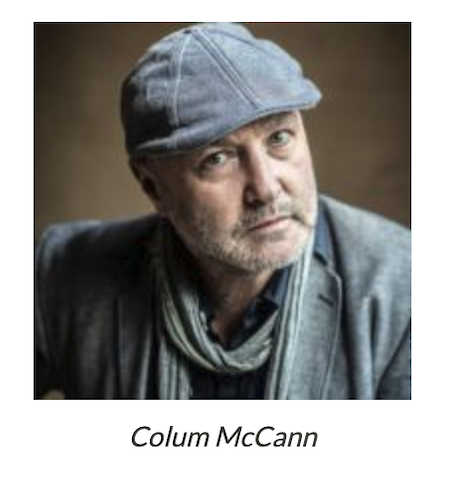
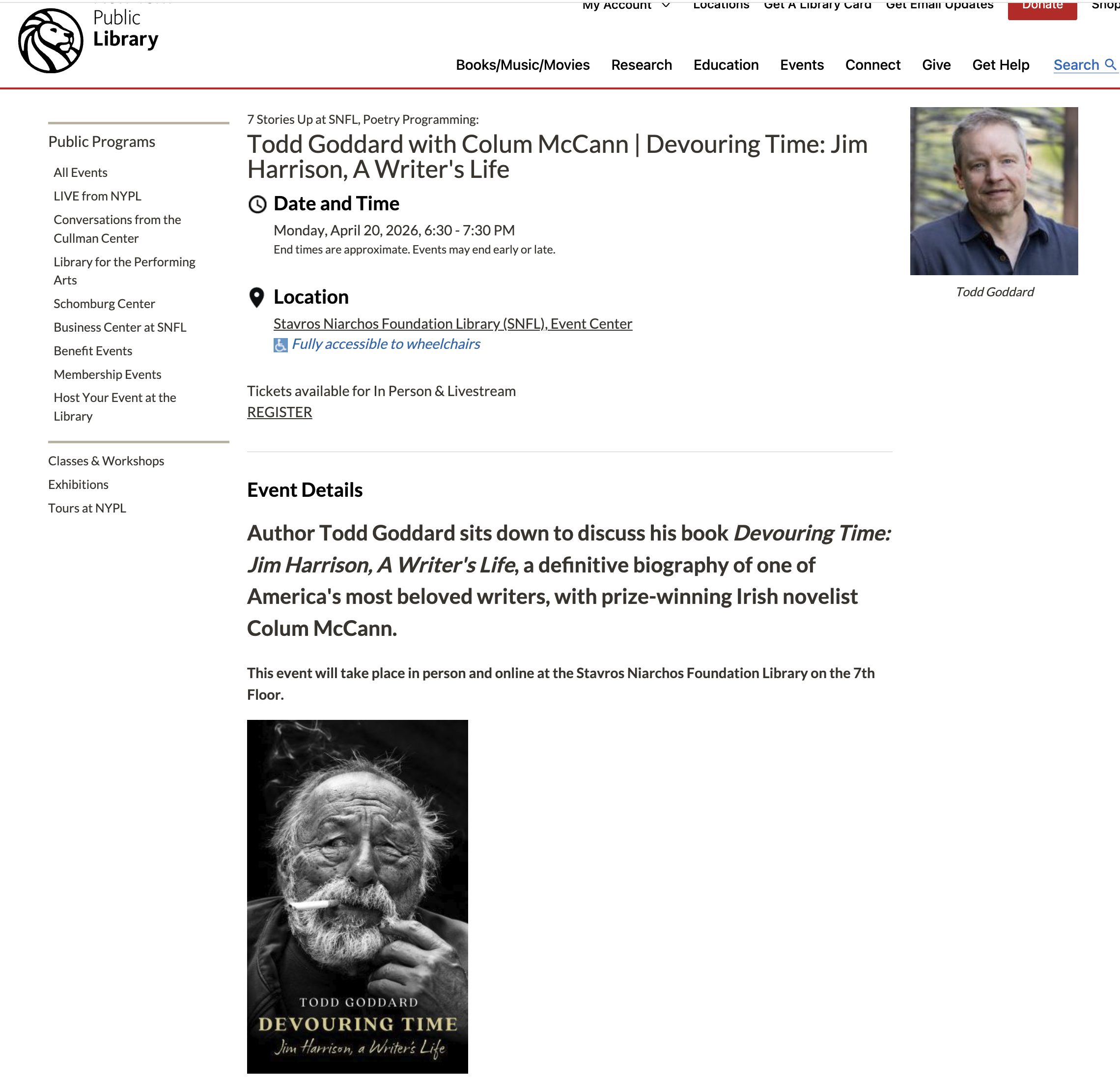
An exciting event coming on April 20, for friends interested in Devouring Time, the recently published biography of Jim Harrison. Novelist Colum McCann, author of Let the Great World Spin—who knew Harrison well, and was one of 100 interviewees biographer Todd Goddard talked to for the book—will be in conversation with Todd, who is a client of Philip Turner Book Productions, at the NYPL Library’s Stavros Niarchos building, 455 Fifth Avenue, across the avenue and one block down from the Main Library Building, at 6:30 that evening, a Monday. Registration for the free program has just opened, with in-person attendance—and live streaming, so folks can watch from all over the country—linked to here.

I’m sure it will a great night, so hope to see you there!

Short Story by M. G. Turner, “The Song of the World,” Published in The Seaboard Review of Books

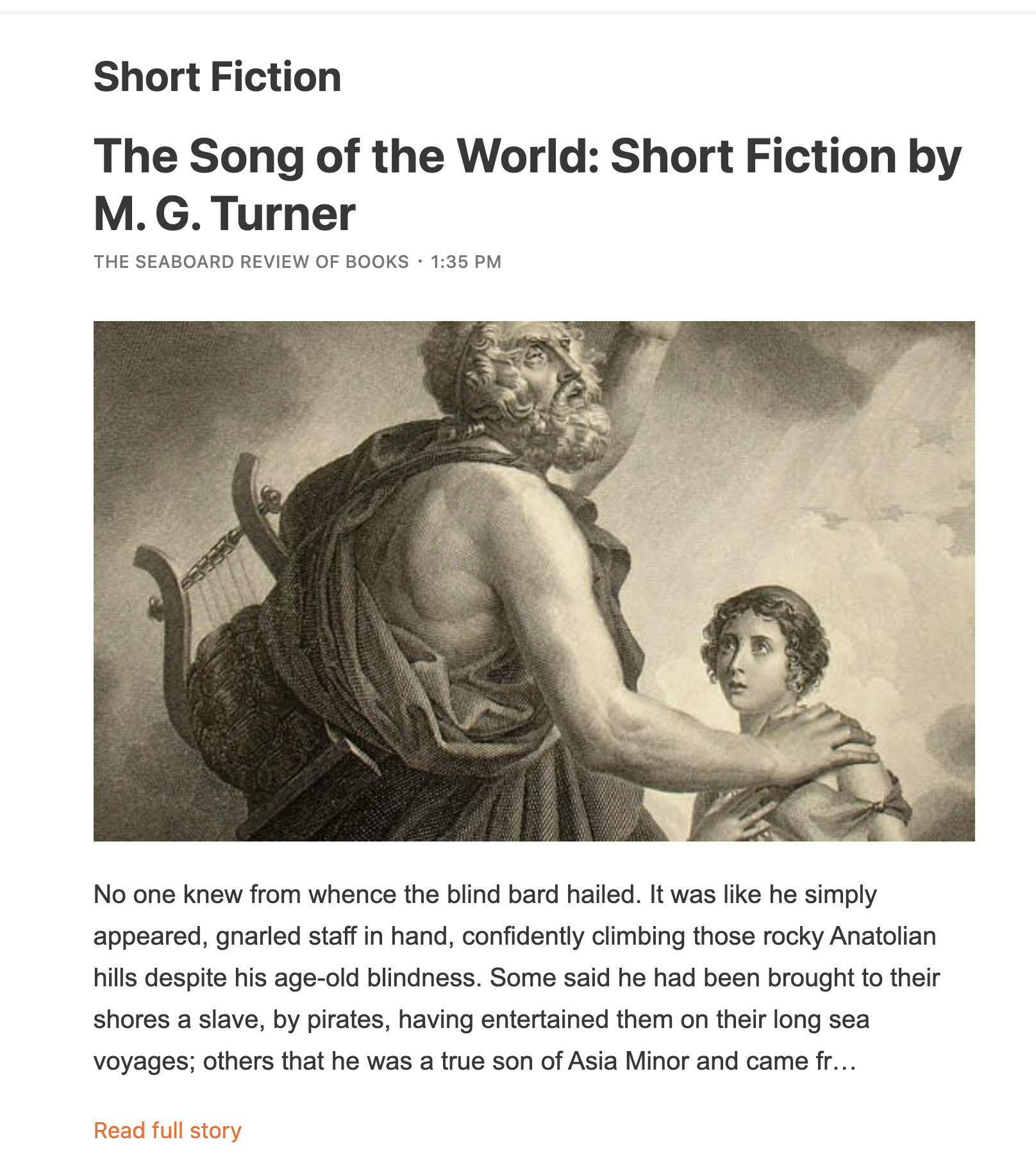
I’m excited to share the word that a new short story by M. G. Turner, “The Song of the World,” is published today in The Seaboard Review of Books. The story is an imagined meditation on the life of Homer, the blind bard, traditionally considered author of The Iliad and The Odyssey. The Seaboard Review of Books is a terrific publication that runs well-written book reviews, and I’m glad to see they’re also starting to publish original fiction, as with this story by M. G., who as some readers of this blog will know, is my adult son and a client of Philip Turner Book Productions, my literary agency.

Also in a classical vein like “The Song of the World,” I want to add that M. G. is also the author of a chapbook Roman Visions: A Story Cycle, which in 2025 was reviewed in The Seaboard Review of Books by its publisher James Fisher. He wrote, “Roman Visions picks up where Virgil’s The Aeneid abruptly ends: that of Aeneas defeating his archenemy Turnus. What became of this famed warrior thereafter? Mr. Turner cleverly takes up the challenge by framing the discovery of “Book 13: The Sorrows of Aeneas” in a late history professor’s desk, not composed by Virgil, but by the professor himself, an expert in the Greek Classics.”

You’ll find “The Song of the World” linked to here. I hope you enjoy reading the story. More of M. G.’s writing can be found here on The Great Gray Bridge.

Reading Homer: A Struggle and an Odyssey by M. G. Turner

Homer’s Iliad is an unforgivingly brutal book. I finished reading it this week, having started it directly after my completion of The Odyssey  which is by contrast a remarkably wonderful book. The latter is filled with mirth and magic and contains valuable and applicable life lessons that anyone may take with them and put toward any situation. On the other hand, the former is a 600-page torrential onslaught of blood, guts, and gore that leaves one with more questions than answers. Also, contrary to popular belief, the three most important events of the Trojan War, that is The Judgement of Paris; Helen’s elopement with Paris back to Troy; and of course the Trojan Horse, are not depicted and whose existence we only know about due to later mythological tracts such as the Posthomerica by Quintus of Smyrna, as well as from brief anecdotes in The Odyssey.

It seems strange to have both loved and loathed two books that are so uniquely intertwined, but this is perhaps not so strange seeing as it is almost unanimously agreed upon by scholars that Homer, whoever he was, wrote one but not the other (indeed, many arguing it was The Iliad and not The Odyssey which bears his signature.) From my standpoint as a writer, I accept the questionable nature of his joint authorship based on the wildly divergent styles of the two epic poems, especially since I read the same translator—Robert Fagles—for both, whose style was identical in each epic, yet whose tone changed to suit what I’d contend were the voices of different storytellers. The Iliad is a linear progression, stultifying in its inchworm progress, and contains few moments of epiphany or release; while The Odyssey is a wildly diverting narrative which contains stories within stories and pleasing digressions and detours; in this way the storyline seems to match the crux of what the hero Odysseus is going through as he journeys home to Ithaca, thus unifying both the message and the action.

Perhaps my distaste for The Iliad is not so much a fault of the work, but its own reluctant triumph. The depiction of war is accurate. Indeed, war is tedious and petty and backbreaking, and progress is made and lost seemingly at the behest of forces on high which do not care for man’s own preferences. Wars are begun for personal reasons, for private enmities, and sometimes spring from rumors, or in our modern parlance “bad intelligence.” This is what the great Simone Weil calls “the wantonness of the conqueror” in her classic essay The Iliad, or The Poem of Force which is a remarkable examination of the poem’s inherent negativity. As she was writing in relation to the Second World War that is also the lens she is choosing to view it through. As a humble reader of the 21st Century it is natural to tie The Iliad to current events. However, one could say, well, Putin isn’t waging his war in Ukraine for the purposes of delivering himself a kidnapped love, he’s simply conducting an outrageous and illegal land-grab. Yet reading about Agamemnon’s motivations one wonders, simply due to her bizarre lack of depiction, if Helen of Troy was simply a pretext for a wider war of aggression, especially as most kings throughout history callously and luridly availed themselves of more than one wife. It is stirring in this way that Helen’s cameo in The Odyssey is so gentle and so moving. This strikes me as another reason why the authors had to be different people, for the treatment of women in both books is remarkably at odds. Odysseus’s wife Penelope is master of her destiny—not to mention the other powerful women of that saga such as Calypso and Circe—while Briseis is a victim, ventriloquized by Homer as hopelessly in love with Achilles, the man who murdered her betrothed, and who would rather be with him than with Agamemnon who treats her as an object. It is certainly unfair to blame Briseis for her depiction, but one can’t help wondering why, amid all this bloodshed, she did not take matters into her own hands and murder the brooding Achilles in his sleep since he left himself so vulnerable to her? Perhaps if Quentin Tarantino had been dressed in Homer’s toga he would have done just that!

Another staggering and disturbing quality in The Iliad which was identified once again by Simone Weil is the way heroes who are murdered on the battlefield become “things.” Their bodies stripped of life they are fodder to be dragged around by horses, eaten by vultures, and whose armor and trinkets are ripe for plunder. Here, it is most tragic that we know next to nothing about Homer, since we do not know what perspective he was writing from, or whether the dramatic irony implicit in his works is intentional. He surely feels enough for the fallen Hector to craft the most redemptive scene in the entire narrative, Book 24, in which King Priam of Troy secretly visits Achilles to beg for the return of his son’s body so that he may be suitably honored, or in our conception buried in consecrated ground. There are several very obvious real-world parallels that could be made here regarding the return of loved ones’ remains, but I will refrain from doing so, as this is a poem that could be applied to almost any conflict, though perhaps fits better with those that are morally ambiguous in nature and which has heroes and villains on both sides.

I want to be clear: I am not writing this piece to disparage The Iliad while concurrently celebrating The Odyssey, but rather to examine whether the poem’s inherent value lies in its irony or its realism. Each gruesome death is realistic given the nature of the time period and the nature of the conflict, but what struck me as so off-putting was the utter lack of breathing room, at least in terms of narrative storytelling. “The heart must pause to breathe,” as Lord Byron wrote, who himself died during a martial folly when he volunteered to fight a war on the shores of Greece and which resulted in his ignoble malarial death. And yet we get few respites during this supposed ten-years war, the decade-long siege of Troy, an Anatolian kingdom that would have had little contact with mainland Greece otherwise.

Another image that strikes me, if you will forgive a final digression, is Dante’s placement of Homer in Hell—or rather in the austere limbo-esque province of the Nobile Castello which rests on the outer levels of the Inferno. Here all the poets, philosophers, and scientists who were born before the coming of Christ live out eternity; they never heard the message of the Son of God and thus are damned to their very own brand of grey non-existence. Yet I can’t help but feel there is a more symbolic reason for their placement here, one that Dante himself may not have been aware of when he was writing his comedia: Homer is in the Nobile Castello because he did not understand mercy. As it is nearing Christmas I feel content as a non-Christian—though one who respects religious art and feels drawn to its own particular themes and thematics—stating the most attractive element of Christianity is its highlighting of mercy as a worthy mind state that may be cultivated and shared. In Homer, both The Iliad and The Odyssey, there is no mercy for any of the characters. The gods have no mercy for mortal men and mortal men have no mercy for each other. Not even the gods treat each other with respect. This is a cosmology of oppression and disdain, a universe where might is right and pride comes before honor. However, some may argue that Achilles’s release of Hector’s body to Priam is a merciful act. Yet I think this is the best that Homer can do. For is it truly mercy when his son is already dead, having been dragged through the dirt by a chariot, his body disfigured and destroyed by his own native soil?

Perhaps Homer belongs in Dante’s Nobile Castello. Though I admit I shudder at the notion of poets being condemned by what they’ve written—or in the case of Homer, sung—there is another view which suggests he was just a mirror for his times, and did not punctuate the dramatic barbarism of The Iliad with release for the mere fact that the concept was unknown to him. Even Odysseus’s journey back to Ithaca is a long and strange one, almost relentless in its misfortunes and mishaps, and its last hopeful notes come only after the brutal and merciless slaughter of Penelope’s former suitors by father and son. I guess it just goes to show that in the ancient world even the poetry ran with blood.

Bust of Homer

Clara Reeve: My New Literary Hero by M. G. Turner

Recently I had the good fortune of making a literary discovery, which was really the discovery of a new literary hero: Clara Reeve. For those who may be unfamiliar with her work, in 1777, Reeve—an Englishwoman born in Ipswich (1729-1807)—wrote a small masterpiece entitled The Old English Baron which is a clever, exciting, and thoroughly captivating retelling of Horace Walpole’s slim novella The Castle of Otranto, written more than a decade prior. Otranto is considered as the first gothic novel and should be thought of as a seminal work. But as is often the plight of anything that is the first it is also flawed, flawed in a way that Reeve took upon herself to openly correct in her own penetrating novel that seamlessly moved the setting from rural and rugged Italy to Medieval England during the time of the crusades. The plot centers around a knight who returns to his friend’s estate after a period of war only to find that it has fallen into a state of dilapidation. It is important to note that this would become a gothic trope, beginning with Otranto and continuing with Daphne du Maurier’s Rebecca—showing how time and neglect can take a piece of property formerly regal and beautiful and obscure its true nature. In this way the gothic writer laments the passage of time and does so by using style as a metaphor and trope as its device. The only difference for Clara Reeve was that she found Walpole’s novel too extreme in its many bold choices and thus tried to rectify them.

Indeed, Reeve’s conceit is one I try to take to heart myself and apply to my own writing. It is simply that when reaching out to portray the supernatural it is important not to go too far, to remain as it were on the “razor’s edge” between unbridled fantasy and stultifying reality. She recognized with the precision of a true artist something that I innately felt about Walpole’s The Castle of Otranto: it was overdone, there was too much mayhem, too much absurdity; why does a giant helmet fall out of the sky and happen to crush the groom? Why are people walking in and out of tapestries as if it were the most natural thing in the world? Why is the father, after the death of his beloved son, so instantly possessed with such lusty rage that he must attempt to marry the young man’s bride? Feeling courageous and sure of herself, Reeve tried her hand at addressing some of what she saw as Walpole’s errors. For my part, I have to admit I like Otranto just fine. But that’s just it: I like it fine. I can distinctly recall rolling my eyes at the exact points Reeve took issue with and felt compelled to explore in her own much more considered way. Reeve is an artist; Walpole is an inventor. He deserves credit for pulling together the disparate strands of style and inventing the gothic genre, but she deserves to be recognized for having written a better book, a work she herself referred to as Otranto’s “literary offspring.”

And it seems she was, in some sense, recognized for this. Though there is not much known about her life and her literary output is small—she did translations, wrote a book of poetry, and penned histories—The Old English Baron deeply offended the man she had written it in emulation of. Walpole was simply aghast than anyone, particularly a woman, would have the temerity to take his form and do something spectacular with it. Of course, both he, and later Walter Scott, claimed that her efforts were not spectacular; they put down The Old English Baron as frivolous, boring, and charmless. Walpole, in a letter to the Reverend William Cole, decreed that Reeve’s novel is: “stripped of the marvelous…, except in one awkward attempt at a ghost or two, that it is the most insipid dull thing you ever saw…” From my own perspective it is hard to see this judgement by Walpole as little more than paternalistic bitterness. Where he failed, she succeeded; where she failed, he succeeded. The two works complement each other and offer something that the other does not have; in the case of Baron a more deft way of deploying the supernatural that does not feel forced or cartoonish but instead makes you shiver with genuine fright due to its well-composed restraint; while Otranto possesses more style than its successor. Either way, these early gothic works led to Mary Shelley, to Bram Stoker, to Edgar Allan Poe, and much later, to Jorge Luis Borges. Here is a continuum that Walpole and Reeve both ushered in, and which matters in the context of our times. For the gothic has been referred to as the most “anxious” of styles and we are now in the most anxious of ages. It recognizes the innate darkness that subsumes so much of our world; estates that were once beautiful and grand can, with the passage of only a few years and within even one generation, fall into decay and utter ruin. The honor of the past is often supplanted by an insipid criminality that is always trying to get away with something. The gothic is not old fashioned, nor is it new-fangled. It is the most present of styles because it acknowledges that change is the most supreme truth of human life. All empires crumble, all families break apart. People fail to live up their promise and due to innate hubris are struck down. These are all themes that filter through both Otranto and Baron and it is our pleasure as readers—and appreciators of style—to debate which one we think did it best.

But there is something even more important in all of this, something even more topical. In this age wherein we are rediscovering voices from the past who were traditionally overlooked, neglected, or wholeheartedly ignored let us not forget the daring Clara Reeve who had the audacity to challenge a powerful man—and carve out her own not insubstantial piece of literary history; for she is the reason for the essay having been written at all! She made Walpole’s rather lurid fantasia something more profound, something that I could recognize as of a kind with greatest works of horror fiction. Because she was a woman writing in an era dominated by men doesn’t mean she should remain unappreciated. And like the ghosts which she deployed with such deftness and alacrity she can rise again, to be known as she should be known: as a pioneer of the macabre and a writer of immense talent, as fearless and brave as the champions of virtue she set down on the page.

M. G. Turner

[gallery columns="4" size="medium" link="file" ids="18558,18559,18560,18561"]

“The Shakespeare Authorship Conundrum Society” by M. G. Turner

The Shakespeare Authorship Conundrum Society met Thursdays at the public mansion on Riverside Drive and 107th street. It was there that Theodore Gurney, Teddy for short, had found his confidantes—a ragtag gang of young and old aesthetes united over the dubious though benign conspiracy theory that the Bard of Avon was not the author of the greatest plays ever written. And in a culture plagued by misinformation of a more destructive sort, their little club wasn’t doing much harm. In fact, it was a delight to meet each week especially on those often rainy April afternoons and discuss, argue, and interpret. Everyone there was well-educated and a lover of the Bard’s work—that is, whoever the Bard actually was.

For some it was Edward de Vere, Earl of Oxford. Several of his close family members had, according to Bennet Leach, a forty-three-year-old professional fact checker, been the supposed Shakespeare’s patrons. He, as well as several others in the group, adhered to the idea that Old Will was indeed a real person, but more of a steward, a frontman for the work of someone else who for reasons of political impropriety could not go public with their quill. How, this particular faction argued, could an uneducated man of humble background, whose father was a mere tanner, have written so penetratingly about kings, queens, and other members of the royal elite? How could he have always had the inside scoop on court intrigue? He couldn’t, they claimed—hence the existence of a secret that, if confirmed, threatened to unseat nearly five hundred years of orthodoxy surrounding the Bard’s majestic output.

But Teddy didn’t fall into this category. Nor did he fall in with the others, some of whom claimed Shakespeare was a Sicilian by the name of Collolanza who’d supposedly been puttering around England at this time, or that he was in fact Christopher Marlowe himself, who’d inexplicably succeeded at faking his infamous barroom death. Nor did Teddy believe he was one of the kings and queens who graced the English, French, or Spanish thrones, whose names over the course of centuries had been tossed into the hat for consideration by amateur critics and armchair scholars.

It is important to note that Teddy’s own belief about the veracity of Shakespeare’s genius lay in a more considered, accurate, though certainly less exciting realm. His own postulation which had come to him after several weeks of attending the Thursday meetings and taking in all the diverse opinions—as well as doing frenzied research of his own—was that Shakespeare was indeed Shakespeare, but that, seeing as he was part of the consummate Elizabethan repertory company at the renowned Globe Theater, many of the plays, including some of the most famous might have been written, or edited, or looked over by actors, namely Richard Burbage, who some scholars had even gone so far as to posit as the unacknowledged co-author of Hamlet.

But amid all the wild theories that dove inside his ears each week Teddy felt reluctant to lay bare this, by comparison, banal theory. To him the very fact of its subdued suggestiveness made it more stirring than say, the unsubstantiated idea that Shakespeare was really Sir Francis Drake, composing plays and sonnets while circling “the whole globe.” Thusly, it wasn’t until the sixth week of his involvement with the Society as he was now thinking of it, that his courage became plucked up enough to share his hypothesis. He decided to begin by validating all the other theories he had heard that day and in subsequent weeks before pouring the proverbial cold water on the wildest of them. “Never in my life,” he began, “have I had occasion to enjoy such compelling and consequential talk. But there is another theory which has gone neglected that I would like to share with you today.”

The faces of his co-conspirators glimmered under the resplendent lights of the Library Room. Several of them smiled, while some looked demonically expectant, as if daring him to outdo their spirited reveries.

“Go ahead, please,” said Margaret Crawley—a sixty-four-year-old librarian who was on the verge of retirement and was herself planning a “truth-seeking trip” to Stratford-upon-Avon, aka “The Birthplace” in the fall. “You have not spoken much in our meetings and we’d all be glad to hear from you.”

“Well,” Teddy cleared his throat. “As I see it, none of us will soon get the validation from academia required for a public acceptance of our theories, but there is one suggestion made by some scholars whose names I can share that seems to me almost indisputable.”

After a shared gasp there was a round of excited voices—some angry and some mortally pleased. Teddy went on:

“It is that, seeing as the Globe was a place of collaboration and collective creativity, portions of the plays—maybe even large portions of them—could have been contributed by the actors. It has even been suggested that the renowned thespian Richard Burbage—and in some ways the Bard’s right hand man—took a leading role in not only the production but in the writing of Hamlet. Who knows how many times an actor would flub a line, but in the process of this divine accident make it sound even better than it had been written on the page and Old Will watching from the back of the theater might have called out: ‘Forsooth, that is better than what I had quilled! Leave as is.’

“And though this line of thinking cannot be expressly proved it cannot be expressly refuted either, which I think lends it a great deal of credence and intellectual power. I would love to know your thoughts.”

As Teddy stopped speaking a great silence filled the Library Room, which was only broken several seconds later by Lloyd Hanger, a fifty-seven-year-old linguistics professor who was the unofficial “heavy” of the group, “THAT IS TREASON!”

“Yes! How absurd!” came another voice, which was met by a second chorus, some in defense, some in derision:

“I think Teddy has a point!”

“What does he know, he hasn’t even spoken until today!”

“But of all the theories his makes the most sense!”

“Don’t forget about Edward de Vere—you can’t explain him away!”

“I think this young man just did.”

“Oh, poppycock.”

“Care to take it outside?”

“I’d like to.”

“SILENCE!” This one word, from the instigator of the unexpected skirmish, quieted the rabble. Especially as Lloyd added: “Do we want to get kicked out of here?”

“He’s right.” Margaret let out a deep, feeling sigh. “This idea you have presented to us, Teddy, has certainly raised the temperature. How curious too, considering it is one of the most moderate we have heard. However, so as not jeopardize our position here, I suggest we move on to other business.”

With that mild word the war had been put down and Teddy sat in silence, unsure if another contribution of his was apt to be considered. But truthfully he didn’t have one and when he walked out that April day, after saying goodbye to his co-conspirators he made a silent vow to not return. For as the rain pattered down upon the earth and misted the Westside in its dew he felt as if he could, like Schrodinger, see all the possible identities of Shakespeare both having existed and not. He was simultaneously a great naval-man, a great earl, a great king, and a great scholar. He was a Sicilian wanderer and Miguel de Cervantes. But something all these theories seemed to reject, and something all the theorists seemed allergic to was that someone of so humble a background could be imbued with genius. Like most conspiracy theories, it neglected to consider a bare, and perhaps humdrum truth—in this case, that the embers of creativity can spark anywhere resulting in a blaze so tall and great we remain in awe for hundreds of literarily blessed years after.

And some five hundred years prior, in a green corner of jolly old England a bard was brought into the world—though in the minds of the most benignly credulous, who he truly was we’ll never know.

M. G. Turner
New York City
December 2023

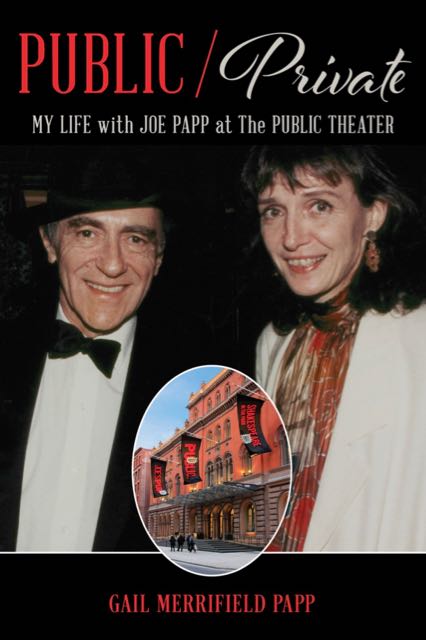
Book Cover for “Public/Private: My Life with Joe Papp at the Public Theater”

Thrilled to see that Applause Theater and Cinema Books now has the cover and the book catalog page up for Public/Private: My Life with Joe Papp at the Public Theater live on their website. The cover—and a full listing with price, pub date, and ordering info—is also now posted on major book retailing websites—Bookshop.org, BN.com, and Amazon—with many more booksellers to come. Gail Merrifield Papp’s memoir, with many photographs, will be published October 17, 2023.

I first wrote about the project when we sold it to Applause last summer and it was announced in Publishers Weekly. To offer readers of this blog a sense of the book, I’ll quote here from the pitch letter we sent to publishers.


Gail Papp has written an engrossing and highly entertaining book that blends an affecting memoir of her life alongside the founder of the Public Theater Joe Papp with a behind-the-scenes portrait of the influential theater’s dazzling history. She opens with the Public Theater’s beginnings more than a half-century ago in a narrative that spans the decades-long association the couple enjoyed until Joe’s death in 1991. During that span, the Public mounted hundreds of productions, from Shakespeare in the Park to such plays as for colored girls who have considered suicide/when the rainbow is enuf and Sticks and Bones, to the musicals Hair and A Chorus Line—with many actors whose careers were launched at the Public, including James Earl Jones, Meryl Streep, Kevin Kline, Colleen Dewhurst, Martin Sheen, Gloria Foster, George C. Scott, Diane Venora, Morgan Freeman, and dozens of others.*

In a witty conversational style, the author paints a comprehensive portrait of the creative process of one of America’s most acclaimed theater artists, highlighting the innovative ways the Public operated, driven by Joe’s ambition to create a year-round producing home focused on original plays and musicals from new voices, while employing non-traditional casting which made it a home for scores of the most creative people in American pop culture. In Public/Private she traces the founding of the Shakespeare Festival, when its role was for a time limited to small venues around New York City, later moving into Central Park where its Shakespeare renditions became an indelible feature of summer in the city, and the Public’s evolution toward cultural renown and national significance, a beacon for social change.

New aspects of Joe Papp’s many battles with the establishment are also highlighted, from tilts with Robert Moses to theater critics to conservative poohbahs in the US Congress. The scourge of AIDs is also documented, in the form of people close to Joe and Gail, Larry Kramer’s play The Normal Heart, and in the toll it exacted on Joe’s son, Tony.

Her touching remembrances lend the narrative a keen, emotional edge, which will captivate readers and bring a human side to the legendary figure whose theater continues to thrive today, operating at both the Delacorte Theater in Central Park, in the theaters on Astor Place and at Joe’s Pub, a live music venue dedicated in his honor.

At a time when America remains divided over issues of race, identity, and sexual orientation, Public/Private reminds us that theater is a powerful force for social change and community-building, a place for people to gather.

*A marvel of the book will be its impressive appendices of more than thirty pages appearing under the headings: Featured Actors, Choreographers, Composers, Directors, and Playwrights.