Reading Homer: A Struggle and an Odyssey by M. G. Turner

Homer’s Iliad is an unforgivingly brutal book. I finished reading it this week, having started it directly after my completion of The Odyssey  which is by contrast a remarkably wonderful book. The latter is filled with mirth and magic and contains valuable and applicable life lessons that anyone may take with them and put toward any situation. On the other hand, the former is a 600-page torrential onslaught of blood, guts, and gore that leaves one with more questions than answers. Also, contrary to popular belief, the three most important events of the Trojan War, that is The Judgement of Paris; Helen’s elopement with Paris back to Troy; and of course the Trojan Horse, are not depicted and whose existence we only know about due to later mythological tracts such as the Posthomerica by Quintus of Smyrna, as well as from brief anecdotes in The Odyssey.

It seems strange to have both loved and loathed two books that are so uniquely intertwined, but this is perhaps not so strange seeing as it is almost unanimously agreed upon by scholars that Homer, whoever he was, wrote one but not the other (indeed, many arguing it was The Iliad and not The Odyssey which bears his signature.) From my standpoint as a writer, I accept the questionable nature of his joint authorship based on the wildly divergent styles of the two epic poems, especially since I read the same translator—Robert Fagles—for both, whose style was identical in each epic, yet whose tone changed to suit what I’d contend were the voices of different storytellers. The Iliad is a linear progression, stultifying in its inchworm progress, and contains few moments of epiphany or release; while The Odyssey is a wildly diverting narrative which contains stories within stories and pleasing digressions and detours; in this way the storyline seems to match the crux of what the hero Odysseus is going through as he journeys home to Ithaca, thus unifying both the message and the action.

Perhaps my distaste for The Iliad is not so much a fault of the work, but its own reluctant triumph. The depiction of war is accurate. Indeed, war is tedious and petty and backbreaking, and progress is made and lost seemingly at the behest of forces on high which do not care for man’s own preferences. Wars are begun for personal reasons, for private enmities, and sometimes spring from rumors, or in our modern parlance “bad intelligence.” This is what the great Simone Weil calls “the wantonness of the conqueror” in her classic essay The Iliad, or The Poem of Force which is a remarkable examination of the poem’s inherent negativity. As she was writing in relation to the Second World War that is also the lens she is choosing to view it through. As a humble reader of the 21st Century it is natural to tie The Iliad to current events. However, one could say, well, Putin isn’t waging his war in Ukraine for the purposes of delivering himself a kidnapped love, he’s simply conducting an outrageous and illegal land-grab. Yet reading about Agamemnon’s motivations one wonders, simply due to her bizarre lack of depiction, if Helen of Troy was simply a pretext for a wider war of aggression, especially as most kings throughout history callously and luridly availed themselves of more than one wife. It is stirring in this way that Helen’s cameo in The Odyssey is so gentle and so moving. This strikes me as another reason why the authors had to be different people, for the treatment of women in both books is remarkably at odds. Odysseus’s wife Penelope is master of her destiny—not to mention the other powerful women of that saga such as Calypso and Circe—while Briseis is a victim, ventriloquized by Homer as hopelessly in love with Achilles, the man who murdered her betrothed, and who would rather be with him than with Agamemnon who treats her as an object. It is certainly unfair to blame Briseis for her depiction, but one can’t help wondering why, amid all this bloodshed, she did not take matters into her own hands and murder the brooding Achilles in his sleep since he left himself so vulnerable to her? Perhaps if Quentin Tarantino had been dressed in Homer’s toga he would have done just that!

Another staggering and disturbing quality in The Iliad which was identified once again by Simone Weil is the way heroes who are murdered on the battlefield become “things.” Their bodies stripped of life they are fodder to be dragged around by horses, eaten by vultures, and whose armor and trinkets are ripe for plunder. Here, it is most tragic that we know next to nothing about Homer, since we do not know what perspective he was writing from, or whether the dramatic irony implicit in his works is intentional. He surely feels enough for the fallen Hector to craft the most redemptive scene in the entire narrative, Book 24, in which King Priam of Troy secretly visits Achilles to beg for the return of his son’s body so that he may be suitably honored, or in our conception buried in consecrated ground. There are several very obvious real-world parallels that could be made here regarding the return of loved ones’ remains, but I will refrain from doing so, as this is a poem that could be applied to almost any conflict, though perhaps fits better with those that are morally ambiguous in nature and which has heroes and villains on both sides.

I want to be clear: I am not writing this piece to disparage The Iliad while concurrently celebrating The Odyssey, but rather to examine whether the poem’s inherent value lies in its irony or its realism. Each gruesome death is realistic given the nature of the time period and the nature of the conflict, but what struck me as so off-putting was the utter lack of breathing room, at least in terms of narrative storytelling. “The heart must pause to breathe,” as Lord Byron wrote, who himself died during a martial folly when he volunteered to fight a war on the shores of Greece and which resulted in his ignoble malarial death. And yet we get few respites during this supposed ten-years war, the decade-long siege of Troy, an Anatolian kingdom that would have had little contact with mainland Greece otherwise.

Another image that strikes me, if you will forgive a final digression, is Dante’s placement of Homer in Hell—or rather in the austere limbo-esque province of the Nobile Castello which rests on the outer levels of the Inferno. Here all the poets, philosophers, and scientists who were born before the coming of Christ live out eternity; they never heard the message of the Son of God and thus are damned to their very own brand of grey non-existence. Yet I can’t help but feel there is a more symbolic reason for their placement here, one that Dante himself may not have been aware of when he was writing his comedia: Homer is in the Nobile Castello because he did not understand mercy. As it is nearing Christmas I feel content as a non-Christian—though one who respects religious art and feels drawn to its own particular themes and thematics—stating the most attractive element of Christianity is its highlighting of mercy as a worthy mind state that may be cultivated and shared. In Homer, both The Iliad and The Odyssey, there is no mercy for any of the characters. The gods have no mercy for mortal men and mortal men have no mercy for each other. Not even the gods treat each other with respect. This is a cosmology of oppression and disdain, a universe where might is right and pride comes before honor. However, some may argue that Achilles’s release of Hector’s body to Priam is a merciful act. Yet I think this is the best that Homer can do. For is it truly mercy when his son is already dead, having been dragged through the dirt by a chariot, his body disfigured and destroyed by his own native soil?

Perhaps Homer belongs in Dante’s Nobile Castello. Though I admit I shudder at the notion of poets being condemned by what they’ve written—or in the case of Homer, sung—there is another view which suggests he was just a mirror for his times, and did not punctuate the dramatic barbarism of The Iliad with release for the mere fact that the concept was unknown to him. Even Odysseus’s journey back to Ithaca is a long and strange one, almost relentless in its misfortunes and mishaps, and its last hopeful notes come only after the brutal and merciless slaughter of Penelope’s former suitors by father and son. I guess it just goes to show that in the ancient world even the poetry ran with blood.

Bust of Homer

Sold: “City of Dark Dreams: Tales from Another New York” by M. G. Turner

Postcard showing what New Yorkers in the past imagined the future metropolis would look like.

Great news about my adult son M. G. Turner and his writing! As his literary agent, I’ve sold what will be his first full-length commercially published book, City of Dark Dreams: Tales from Another New York, to be published in January 2027 by DarkWinter Press.

Incorporating the mysterious and the macabre, the 25 tales—selected from a larger body of work the author has dubbed the Neighborhood Legendarium—explore life and death, ask whether mortality can be circumvented, imagine dreams impinging on reality, and find the uncanny in the everyday. Melding the collection into a unified whole is the setting, the Upper West Side of Manhattan and a fictional college, Hudson University, which introduces a dark academia motif. The characters populating this world intersect and influence each other’s lives, akin to the storytelling in David Lynch’s “Twin Peaks.” We’ll have more information about the book in the future, including how to pre-order copies.

And, while we have your attention, if you’re starting to think about books you may want to give as presents to friends and family for the holidays this year, here’s something to consider:

We are pleased to offer a bundle of three small chapbooks M. G. Turner’s published this year under our Riverside Press imprint. They are 1) Dreams of the Romantics, a story cycle inspired by the Romantic Poets, Lord Byron, Mary and Percy Shelley, etc.; 2) Roman Visions, a story cycle inspired by Virgil and The Aeneid; and 3) Reader Faustus, a novella-in-verse in which a young man—possessed by the desire to read every book ever written—makes a pact with a demon. These three books, each between 96-116 pages, may be enjoyed in single sittings, or savored over time. To relieve what would be the cost of shipping three separate books we’ve decided to package them as a bundle. The suggested list price of each is between $18-$20. However, the special price including shipping for the 3-book bundle is $30. If you’d like to know more about the three chapbooks, we invite you to read reviews of them, including in The Seaboard Review of Books, where editor of the publication James Fisher wrote, “Dreams of the Romantics was a beautiful read. Turner’s use of language reflects the period, and I read through the book several times, picking up on different metaphors from the lives of all those in attendance at Lord Byron’s dinner party. I also found it educational, as I had only a passing knowledge of the Shelleys, little of Byron and none of Doctor John Polidori. Invariably, I was sent scrambling to the Internet for answers to my questions, as well as the biographies of the participants.” You may read more here and here. For ordering information for the bundle, please contact us at ptbookproductions[@]gmail[.]com.

For Halloween, “Reader Faustus: A Novella in Verse” by M. G. Turner

My dad and I share an affinity for the legendary literary character Faust, who in various retellings over the centuries has been depicted as selling his soul to the devil in exchange for a number of enticing rewards, including immortal life, admiration from the public, endless amounts of money, and much more. For Philip, this interest goes back to his student days, when with a professor named Donald Sheehan he took a course at Franconia College called “Faust,” and wrote a paper on the topic. Then a few years ago, I undertook the writing of what I call a “novella in verse” which retells the Faust legend for our modern times. With these materials in hand we decided to publish another in the series of chapbooks I’ve brought out this year under our Riverside Press imprint (preceded by Dreams of the Romantics and Roman Visions), using my pen name M. G. Turner. Collected with the narrative poem are two other devilish tales I’ve written, “The Tale of Hanns Drumpf” and “Johann Fust: Patron of Gutenberg,” plus Philip’s essay from 1974, “Faust: Man and Myth.” We believe all this writing goes well together and are now happy to announce publication of Reader Faustus: A Novella in Verse for Halloween. For those who would like to buy a copy from us directly before we begin distributing it online, we are selling them for 13 dollars plus 5 dollars shipping.

To learn a little more about our new title, here is the back cover copy:

The “Faust” legend is as old as time, as is the proverbial “deal with the devil.” In M. G. Turner’s Reader Faustus this idea is brought into a modern context, as a young poet chooses to sell his soul in exchange for the power to read every book ever written. While Turner’s “novella in verse” hearkens back to Marlowe’s The Tragical History of Doctor Faustus (1601), Goethe’s Faust (1808), and Mann’s Doctor Faustus (1947)—Reader Faustus zeroes in on today’s zeitgeist, in which people feel burdened to consume endless content, and who see Faustian bargains all around them, in politics, technology, science, and the arts. Readers of the macabre will surely enjoy this new offering, a veritable museum of Faust, from the author of Dreams of the Romantics.

I’m honored to have received two endorsements in advance of publication:

“The Faust legend is ever regenerative and ever redefined, as seen in M. G. Turner’s beguiling new verse tale Reader Faustus. In elegant, Augustan rhyming couplets, Turner tells the story of the devil’s bargain anew, but with a focus on the wages of modernity, when those who create are cursed by having to consume ever more content. Clever, thoughtful, and fun, Reader Faustus uses classical language to speak to very contemporary problems.”—Ed Simon, author of Devil’s Contract: The History of the Faustian Bargain, Public Humanities Special Faculty in the English Department of Carnegie Mellon University, and Editor of Belt Magazine

“M. G. Turner’s richly imaginative Reader Faustus offers a new twist on the devil’s bargain. In verse both erudite and playful, Turner asks us to reflect on what we might offer in exchange for our pursuit of both knowledge and enjoyment. While Turner takes glee in the use of antique language and form, the poem is also uncannily modern, as it proposes a complex relationship between the ability to consume content and the ability to create content—a relationship that is always under negotiation, and which has become particularly fraught in our digital age. As Turner’s work recognizes, the stakes for this bargain have never been higher.”—Brandon Grafius, author of Scared by the Bible: The Roots of Horror in Scripture 

We hope you find the Faust legend as compelling as we do, and will be interested in visiting, and reading, our “veritable museum of Faust.” Please let us know!

[gallery columns="4" link="file" ids="19012,19013,19014,19011"]

Stellar Reviews of “Dreams of the Romantics,” a Story Cycle by M. G. Turner

September 9, 2025, latest update re: Dreams of the Romantics

Dreams of the Romantics by M. G. Turner is available through online booksellers, such as Amazon.com, BN.com, and Bookshop.org, whose sales support independent bookstores.

A very keen reader, the horror writer Joseph Citro, author of such novels as The Gore—who is described on Wikipedia as a “Vermont author and folklorist who has extensively researched and documented the folklore, hauntings, ghost stories, paranormal activity and occult happenings of New England”—loved Dreams of the Romantics and posted a very favorable review of it on the book’s Amazon page and on his own Facebook page. His full comment is below, and he concludes with this:

“The prose is poetic, the themes philosophical, and the tales range from contemplative to supernatural. (See especially Dr. Polidori’s installment!) Just when you’re feeling comfortably immersed in early 19th-century prose, the author inserts an anachronistic word or turn of phrase that reminds you the issues explored are as relevant today as they were during that unforgettable Year Without a Summer. Overall, this is an original, thought-provoking, and fascinating read, something [Lord] Byron might have called a “ripping yarn!”
Two thumbs up; three if I had an extra!👍👍+👍


May 15, 2025, an update regarding Dreams of the Romantics:

The prominent editor of weird fiction, and critic, S. T. Joshi (known for American Supernatural Tales, Penguin Classics, and The Theory of the Weird Tale, Sarnath Press) reviewed the book and recommended it to his audience, writing:

“The occasion for this story cycle is the most famous literary contest in the history of weird fiction….Turner engages in the fantasy of being himself a member of the literary circle at the Villa Diodati, recounting his own Gothic tale….The final story in the book, “The Last Voyage,” is a gripping modern recreation of the fateful boat trip that led to Shelley’s drowning in the Bay of Spezia in 1822….Dreams of the Romantics is a vivid and engrossing little book….well worth reading by those many devotees of the weird who find themselves drawn back to that day, more than two centuries ago, when several towering literary figures sought to enshrine the weird into the corpus of English literature.”—S. T. Joshi, Spectral Realms No. 23 (Summer 2025)

Post originally published April 8, 2025

Among the fortunate discoveries I made during COVID was that of a book reviewer in New Brunswick, Canada, James Fisher, who edits a book review journal called The Seaboard Review of Books, which can be found on Substack. Having long been interested in Canadian literature, and the curator of a blog I call Honourary Canadian, I appreciated that he and his team of critics focus on Canadian authors and small presses, and noticed that they also cover “international” titles. With that in mind, I contacted James and asked if he’d be interested in receiving a copy of Dreams of the Romantics, the chapbook inspired by the Romantic poets that Ewan Turner, my adult son and business partner, recently published under his pen name M. G. Turner. James was intrigued, so we shipped him a copy.

Yesterday, he published a lovely, thoughtful review of the book which I’m pleased to share here. Below are the closing paragraphs:

Dreams of the Romantics  was a beautiful read. Turner’s use of language reflects the period, and I read through the book several times, picking up on different metaphors from the lives of all those in attendance at Lord Byron’s dinner party. I also found it educational, as I had only a passing knowledge of the Shelleys, little of Byron and none of Doctor John Polidori. Invariably, I was sent scrambling to the Internet for answers to my questions, as well as the biographies of the participants.

I certainly anticipate hearing more from the pen of M. G. Turner, as Dreams of the Romantics certainly demonstrated his potential as a writer.”

I invite you to read it in full by clicking on this link, or by opening the screenshots below.

Dreams of the Romantics is now available on Bookshop.org, Barnes and Noble, and Amazon.


“On Browsing in Bookstores, a Pastime” by M. G. Turner

There is something uniquely magical about walking inside a bookstore, preparing to browse: you cross the threshold and suddenly you have been transported, quite literally, to a world of books. As the atmosphere settles, you notice there is a quiet here that reigns supreme, a quiet comparable perhaps only to that of a library; a pregnant hush fills the air and instills a state of calm that you would be unlikely to find elsewhere. Especially in New York City where the aggressive frenzy of life never ceases, the bookstore—and its ill-treated cousin, the library—can be an oasis, a place of refuge, a second home that can be utilized when other options of play or fun or drink have been depleted or appear uninviting.

When times are tough the world of books calls to us, and if we’re lucky we heed that call—the call of what we must do and not what we ought to. There is no greater pleasure than going to a bookstore with an objective in mind, say to purchase some work or other by Balzac and leaving inexplicably with a Faulkner. Bookstores divert our expectations. The shelves in many of New York’s finest are crammed high to the ceiling with both old and new tomes that at first speak to us in voices we may only hear subliminally. Thus visuals are our calling card, our way in. Often it is the seductive glint of a spine or the flicker of a cover that catches our eye, and as we pull the book off the shelf, and stare at it, a love affair begins. The eye tries to comprehend what the soul sees clearer. We know there is some future here for us, our paths will diverge together, we will save that spark and let it grow—that is, if we are lucky and decide not to put whatever work we have found back on the shelf where it will be consigned to wait a while longer for the coming of its true owner.

But if we hold in our hands the book we are meant to read, then we are giving ourselves over to something unconscious and in some ways very powerful. What we are giving ourselves over to is Fate. For reading books, and at the outset, buying books, is very much like making friends. The object itself transcends the lucid boundaries of paper and ink; it is so much more, and because of that the weight of a decision rests heavily on our shoulders. Do you buy another Nabokov? No, you’ve already read four of him. Another Tolstoy? You haven’t even finished Anna Karenina. A new edition of Ulysses? You have two already, dog-eared and disgruntled and waiting to be finished. You walk on aimlessly, through the aisles, dodging people taking on a similar pursuit: beautiful girls in faded jean jackets and sunglasses on their foreheads, old men stooping over dangerously to get a look at some old and beaten Melville, and the others like yourself trying to work themselves up into a state of rapt determination, studying the walls, trying to discern the titles of famous works, squinting as if at the hieroglyphics of Luxor.

The weight of a book in hand is equivalent to the weight of gold. You measure it, test it, consider whether you can withstand the flurry of its pages, the emotional impact of its premise. Stories are contained within stories, characters within characters, subtlety gives way to novelty, novelty to extremity, enjoyment to a cessation of pain. For that is what all the browsers, including yourself are looking for: a place to stop and sit awhile, to direct thought consciously toward a more righteous purpose, feeding the imagination a meal it cannot make on its own.

The shelves are calling to you. You know not to make a mistake. Occasionally you do make one and you are back at the register the next day making the same hurried, nervous claim: “I bought this for my friend but it turns out he already had it.” Several Hemingways have found their way back to this bardo. Tolstoy’s What is Art? was too polemical for your taste. A copy of the Master and Margherita whose translation you utterly hated was happily parted with. Silently, the cashier, gives you store credit and with this slip, handed over with a subdued frown—half-judgement, half-dismay—you are now able to go back to the walls, back to the drawing board as it were, to feast your eyes over the multitude of possibilities, the bold, broad scope of world literature staring you so determinedly in the face.

And finally you find what you’re looking for. And that pain does cease. Until of course you finish the book at a remarkable clip and opt to do it all again. The energy to read recycles, reincarnates, reinvigorates, and you hope never to give up the journey; even after you have lined up your finished books like the proud trophies they are, there is always a little more room, another book case to fill, another story to sink into. Finished Mann’s Buddenbrooks, well there’s always The Magic Mountain or Doctor Faustus. You’ve read those two Flauberts but there’s more Proust to dig into, a seemingly endless supply of it. Turgenev always wins over the other, more popular Russians, but there is not much of him along the walls, save the obvious in Fathers and Sons. You’d read more Dostoyevsky if you didn’t hate his guts and think he was an anti-semite and in many ways a difficult and stifling writer. You need to read more women, it’s a fault of the whole system, the whole structure, but for your part you do love Woolf, Chopin, Cather, Stein; Wharton is an undeniable great but her meanness never ceases and it’s not clear she even likes her characters.

But no matter who you choose—or rather who chooses you—the point is never to give up on books or decline what they have to offer. The point is to never cease searching for some little taste of paradise that we had previously lacked, to find the good in the bad, the large in the small, the mediocre in the great. You can see in three dimension and you can read in four. To live other lives is to live your own more fully. You can’t believe it sometimes, the depth, the brevity, the longevity, the incalculable gifts given to us by people who worked sitting down. It is connection that we are looking for when we pace like ghosts up the hallways of some magnificent temple of literature, filled to bursting with every voice; male, female, Black, white, and all varieties of humanity. Nothing can touch us, and by the same token, everything can. For we want it to. We will it to. For if Fate has deemed it, we go home happy—and if we’re lucky, stay that way.
M. G. Turner

Ernest Hemingway and the Agony of Inspiration by M. G. Turner

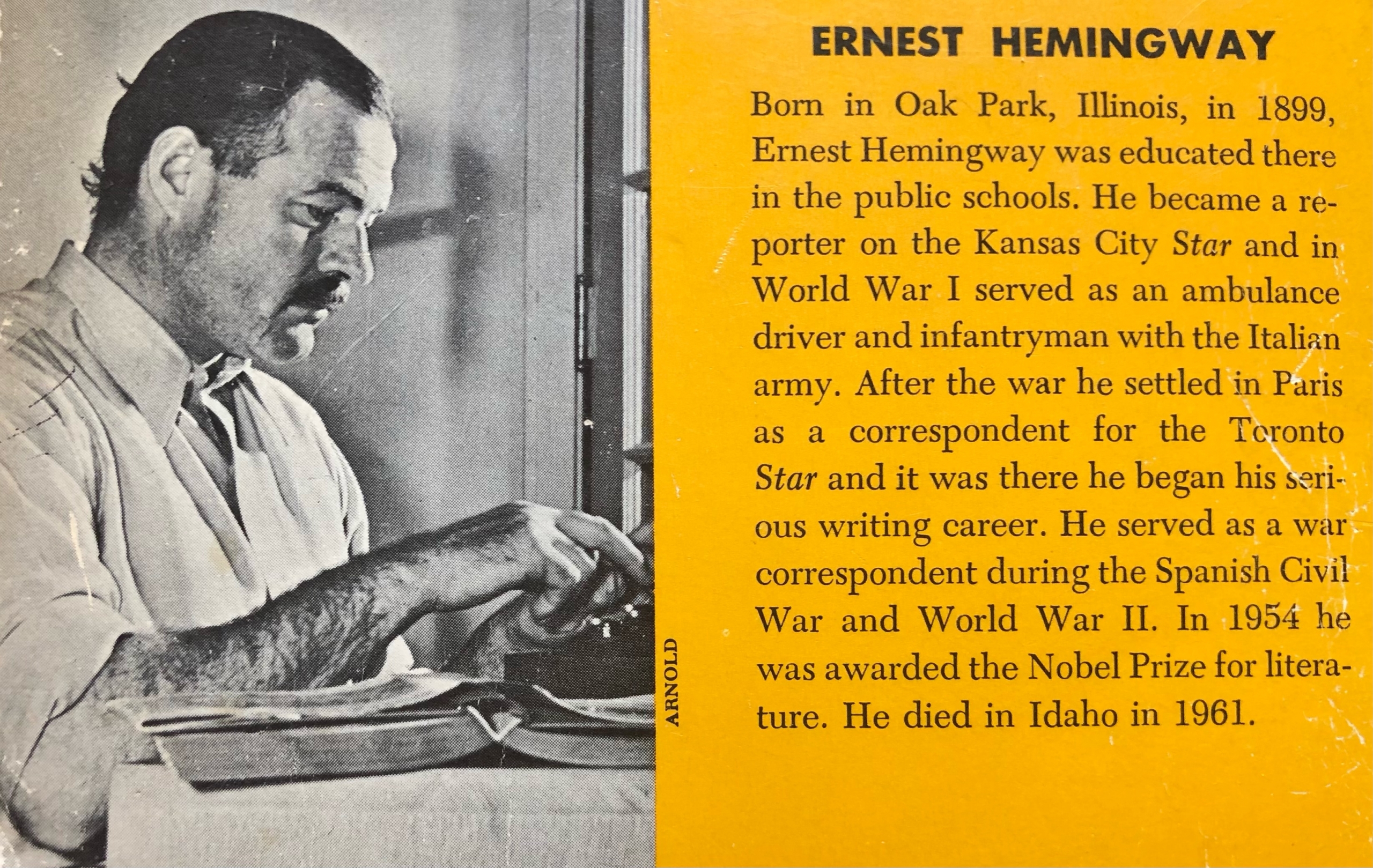
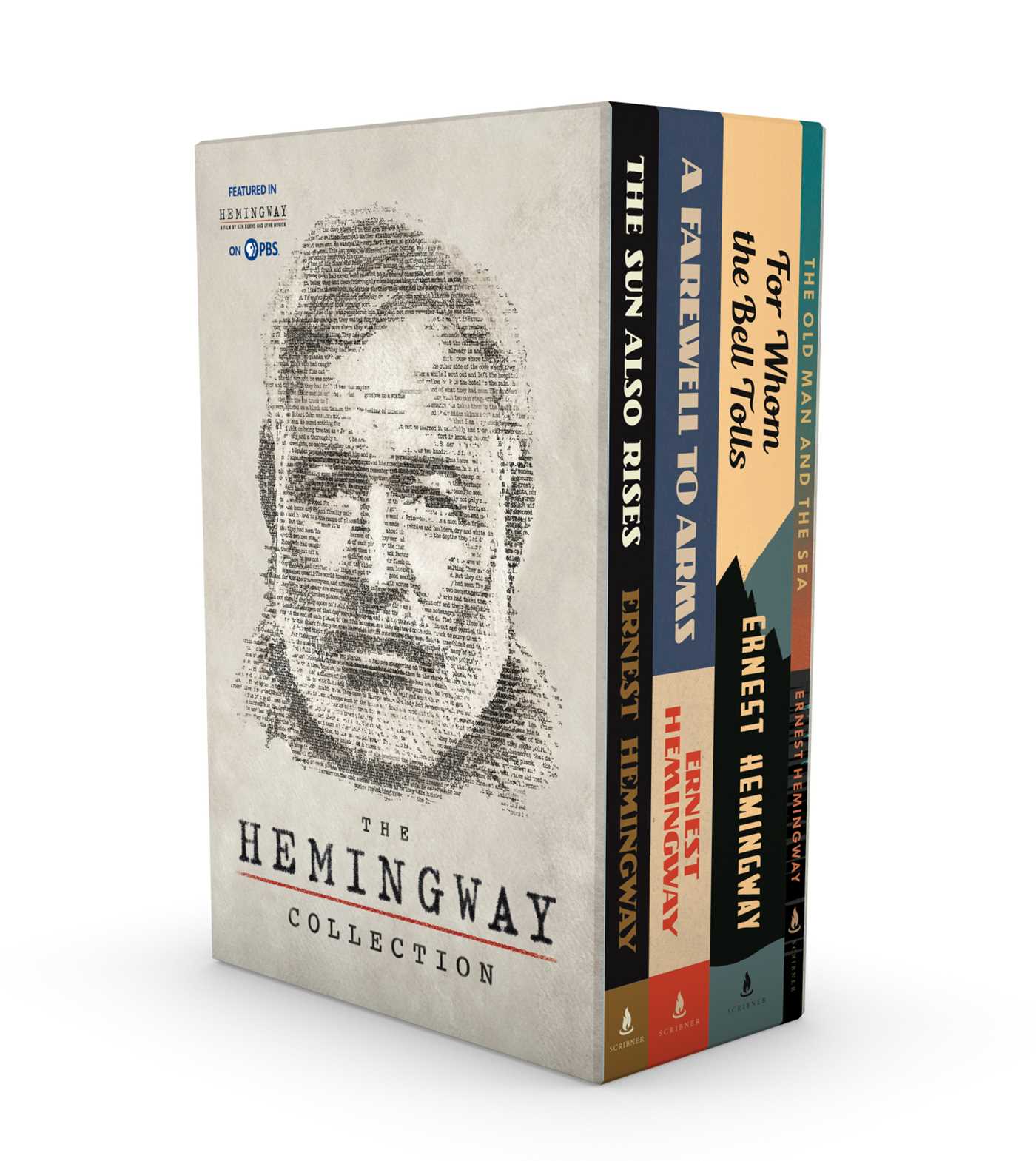
As a writer, I’ve had multiple run-ins with Ernest Hemingway. The first was in the spring of 2021, following the airing of the Ken Burns documentary, and the most recent was last month, after buying a large Hemingway boxed-set, which I wolfed down in two weeks. The set included The Sun Also Rises, and A Farewell to Arms, which I had previously tried to read all the way through and failed.

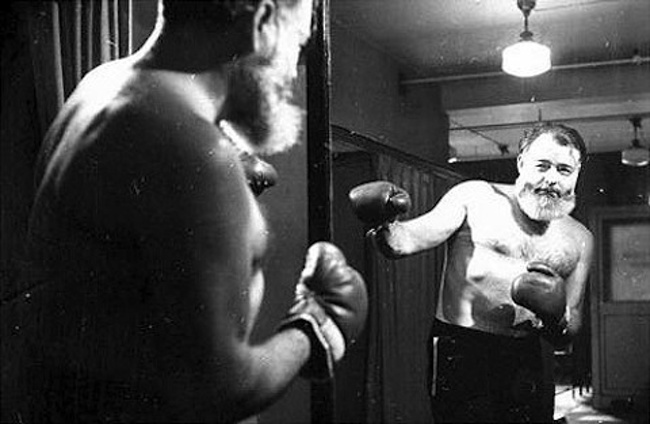
This time I did not fail. But perhaps I should have. You see, for the past year I have been completing a novel that has its stylistic roots in what I like to think of as “modern gothic” with what I hope is fluid and frankly beautiful prose. My work tends to come from a much different aesthetic place than those who follow the Hemingway method, i.e., Raymond Carver, Tobias Wolff, and George Saunders; yet to my chagrin I found, as I pressed through the great and tragic author’s oeuvre I was losing my sense of self, my sense of who I am as a writer. There are some writers, and artists in other fields, whose voice and style are so magnetic, so enveloping, that they instill in the reader or viewer the sense of nothing having existed before or after them. Hemingway is a quintessential example of this, and an author whom most aspiring writers need to tangle with at some point. And for me, this past month, my collision with Hemingway came, and I left the ring, as it were, feeling as if I’d been continually punched in the face. This could be due to the quick, jabbing, declarative nature of Hemingway’s prose—it stands to reason that he himself was an avid boxer—and clearly brought this quality into even his most lengthy, involved novels such as A Farewell to Arms and For Whom the Bell Tolls.

Some writers—I’d even say most—try a different approach with the reader. Some lull, some soothe, and some entertain. Hemingway does none of the above. Hemingway berates and belittles, but he also rescues and redeems. Which is why, even when I recently felt his voice becoming my own, and my boundaries yielding to his force of will, I did not put his books down, did not shunt my new boxed-set onto a high shelf, did not flee the ring. I stood firm. I withstood. I, and most importantly, my young novel survived.

***

I work with fiction writers almost every day, as an editor and a literary representative. Most of the time I think half of my job is to help each writer tangle with the demons embedded in their prose, thorny eruptions that can spring up at any moment. In even more poetic terms, I see myself as a Horatio, Hamlet’s loyal friend, who stands fast as the ghost of his father the fallen confronts the young prince and forces him to wrestle with his conscience. On the page we come face to face with ourselves, and when we read books we come face to face with other people. Naturally every writer, when working in the most effective capacity, will bring themselves to the page, so it stands to reason that when one reads Hemingway they not only read him, they face him, and sometimes even face off with him.

If you’ll allow one more boxing metaphor, when we pick up, say, A Farewell to Arms, we are contending with an experience that Hemingway has transmuted to the page in terms as stark as he could muster. He dares you to withstand him and what he experienced. You feel like you are slogging through the mud, feel like you are tangling through the trenches, and when Henry’s dear love Catherine Barkley dies in childbirth he makes you go through it with him, mourning her to the last page as he denies us even a smidgen of satisfaction. “After a while I went out and left the hospital and walked back to the hotel in the rain.” Henry does not cry. He does not scream. He simply stumbles on, injured and broken, just as we, having made it to page 332 stumble on.

I know all this sounds like I don’t like Hemingway very much. Quite the contrary—I love him. But it is precisely this love, this agony of inspiration, that writers must learn how to handle. When I was younger it was easy to read a page or two of A Moveable Feast and think, okay this is how it’s done, and immediately run to the computer or a notebook and put down a litany of irredeemably declarative sentences. Now that I am a bit older, this doesn’t happen as readily, and I am able, perhaps because of my sense of self—fragile though it continues to be—to manage it, and am able to cross the tightrope of influence and homage.

As Rainer Maria Rilke posited in Letters to a Young Poet an artist must work with whatever is only theirs, and no one else’s. This sounds easy enough, and yet it is probably one of the hardest things a writer can do, and maybe the biggest accomplishment next to putting a period on the final sentence of a great work. How does one withstand, to use a word I’ve deployed already too often, the gravitational pull of someone so monumentally important to our culture and still have faith and confidence in what they’re offering a reader? I know I used the second person when posing that question, but I am talking about myself as much as others. How was I supposed to let my own novel live when Hemingway had seemingly dashed apart my style with a few choice sentences? The word “confident” kept flooding back to my mind, because the way he comes across on the page is as someone who is so utterly convinced of his literary excellence and aesthetic brilliance that anything less—or more importantly, different—is exactly that, less.

But I am here to say: this is false. Though his confidence, even certainty in his style, made him the great writer we know him as, it does not mean other possible fictive valences are worthless, or worth less than his own. When analyzed further, how could it possibly be the only way? A signature of life is its diversity and essential uniqueness. Human beings are varied, not only in terms of race and creed, but also in personality, and yes, style. One writer cannot define the entirety of the canon, no matter how hard they try, or people try for them.

***

But again, I love Hemingway. And I also love what I am working on—you must. This may sound conceited, or foolhardy, but I think loving the pages on your desk is essential to those pages finding an audience and living. I believe a literary figure like Hemingway must be seen in the context of his times, for today, due to his lack of preamble and exposition, he might not have made it out of the pages of minor publications. But in the same way, do we judge Wilt Chamberlain, the only professional basketball player ever to score 100 points in a single game, by the standards of excellence in the current NBA? We do not.

This is all to say that ideas about the greatest writer or the greatest style are inconclusive. I firmly believe anyone, regardless of ultimate success, when they put pen to paper—or fingers to keyboard—are trying to put down the greatest sentence ever. No one enters this field with dreams of mediocrity. We slip into the ring bravely, and work with what we have, with what is most accessible; eventually, if we are lucky, we eschew all influence and find that now vague concept: our voice, that which comes solely from ourselves. We may have influences. We may have shadings in our work that relate or are in conversation with those who came before, but at heart our best work is apt to come when we are in touch with our innermost quality of command, our innermost narrative, our personal dreams. Hemingway had his dreams. And we have ours. But I suspect we will continue to box with him, and writers of all styles, backgrounds, and understandings, until this experiment ends—and let’s hope it never will.


M. G. Turner
June 2022