“Yr Obt Servant A Lincoln”–a Gift from an Old Friend


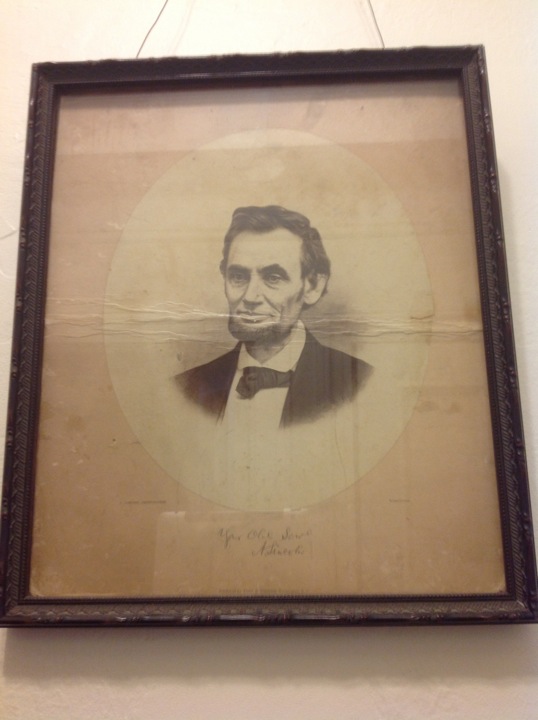
An Alexander Gardner photo of Lincoln, given to me by my late best friend, Robert Henry Adams, of Robert Henry Adams Fine Art, Chicago. Rob often gave me pieces he couldn’t re-sell, because of a defect, in this case the crease bisecting the center line. He said it came up at auction and he was the only who bid on it. Still, it is period and bears a Lincoln autograph, either machine-reproduced from his hand, or even possibly, from his hand in ink. Caption reads “Yr Obt Servant A Lincoln.” Rob’s portrayed in pictures and words elsewhere on this blog, here and here, the latter under the heading ‘Franconia College.’

From Pea-Shooters to Sonorous Voices: Time-Keeping, Then & Now

Early this morning I saw that Shaun Usher, whose blog Letters of Note is one of my favorite websites, had tweeted this historic photo and humorous message:

“Before alarm clocks there were knocker-upper’s. Mary Smith earned sixpence a week shooting dried peas at sleeping workers windows. Limehouse Fields. London. Undated. Photograph from Philip Davies’ Lost London: 1870 – 1945.”

Keeping with the time-keeping theme, later in the day I saw that Lucas Wittmann, Books Editor of the Daily Beast had tweeted about this obituary from The Economist, remembering the life of Brian Cobby, who for decades was the voice of what is known in Britain as “the talking clock.” From the magazine:

“For many people in Britain for much of the 20th century, indulging the national weakness for exact timekeeping, Time spoke from the other end of a telephone line. His number could be dialled; and from a room presumed full of chittering and whirring timepieces, Time would inform them that ‘At the third stroke, the time. . . will be ten twenty-seven and fifty seconds.’ His companion robot then chimed in: Pip—pip—pip.”

I’m grateful to Usher and Wittman, and the two publications, for publishing these rich evocations of time-keeping from the past two centuries. Here’s a full shot of the knocker-upper image:

Free Demos of Speakerfile

If you’ve been interested in learning more about Speakerfile–the company I rep to publishers, authors, publicists, and literary agents, that connects conference organizers with authors and experts who do public speaking–their CMO Cara Posey will be doing free Web demos on Wednesdays from 3-4 PM, limited to the first two dozen people who sign up. If you’d like to take advantage of one of these gratis sessions, I suggest you follow this link and register at the web page Cara’s posted.

If you’re just learning about Speakerfile for the first time, you may go to their home page by clicking on the promo placed near the upper right-hand corner of The Great Gray Bridge. It’s a robust Web platform with terrific SEO capability that can really drive discoverability of authors and thought leaders. The first client I’ve signed up for them–a forward-oriented author management company called Movable Type Management–got 9 bookings for their author clients in just the first few months after creating their own mini-bureau on the Speakerfile site, a bureau MTM also placed on its own website under the rubric ‘Author Booking.’

If you’re already engaged in public speaking, or you work with public speakers, I’ll be happy to explore with you how Speakerfile can help you and your associates get better bookings. Please let me know if you have any questions about Speakerfile.

#FridayReads, Nov. 30–“The Pot Thief Who Studied Billy the Kid”

#FridayReads, Nov. 30–Just starting The Pot Thief Who Studied Billy the Kid, by J. Michael Orenduff, manuscript of the latest mystery in the delightful Pot Thief series which I’m representing to publishers as agent. These novels, set in Albuquerque, New Mexico, feature protagonist Hubie Schuze, a pottery geek. Hubie loves digging in the desert for ancient pots and crafting copies of artifacts with his own hands. When not engaged in these activities, he is usually absorbed in reading a book, often a classic. He has a sidekick in sleuthing, Susannah Inchaustigui, a descendant of one of New Mexico’s Basque ranching families. They meet most afternoons at Hermanas Tortilleria, to sip margaritas and discuss their latest puzzler. The books are very funny and deserve a wide readership.

In the new book, Hubie is clandestinely digging for Anasazi pots in ancient cliff dwelling, when he grasps a withered human hand. He was hoping for an artifact, not a handshake and is puzzled by his discovery, since the Anasazi did not bury their dead in their living quarters.

Earlier titles in the series are The Pot Thief Who Studied Pythagoras, The Pot Thief Who Studied Ptolemy, The Pot Thief Who Studied Einstein, The Pot Thief Who Studied Escoffier, and The Pot Thief Who Studied D.H. Lawrence. While I am working to find Mr. Orenduff a major publisher for his books, the books are in the meantime available and sold at Amazon.com.

How a Community Makes a Book

I first met writer and literary journalist Robert Gray when I was Editor-in-Chief of Carroll & Graf Publishers and he worked at the splendid Northshire Bookstore in Manchester Center, Vermont. I loved that his email address at the time incorporated the phrase “marbleman,” as a personal homage to Vermont’s marble quarrying. We both later moved on but kept in touch, especially after he became a regular contributor to the daily book world read Shelf Awareness, and I started curating and writing The Great Gray Bridge. Robert’s pieces for Shelf Awareness are published under the rubric, “Deeper Understanding.”
Recently, I let Robert know about Rust Belt Chic: A Cleveland Anthology to which I’d contributed an essay, hoping the DIY energy that produced the book would appeal to him, and that he might want to cover it in his column. He took the opportunity to heart and today published a great piece, “Self-Pub, Sense of Place & Concentric Circles,” with passages like this:

“When you want to know about a place, ask the people who live there. When you want to read about a place, read the writers whose words reveal more than just the surface of a region’s past and present. What does that have to do with self-publishing? This: For a bookseller considering the possibility of stocking a self-published book, one reliable sign of a winner is a title with a tangible sense of place. Whether or not such a book eventually finds readers beyond the region, it must begin at the center–a pebble dropped in a local pond–before concentric retail sales circles can spread. In their introduction . . . editors Richey Piiparinen and Anne Trubek describe the project as “a community effort to tell the story of a city.” And that’s just what it is.” 

Later, Robert generously mentions my essay, “Remembering Mr. Stress, Live at The Euclid Tavern,” linking to an expanded version of it on this blog. I invite you to read Robert’s entire piece at this Shelf Awareness link, and my piece if you haven’t yet. Robert’s past columns can also be found at his website, Fresh Eyes Now.
I should add that the Nook, Apple, and Kindle ebook editions of Rust Belt Chic are currently being sold in their respective digital stores for the terrific price of $2.99 (link for Nook store, ITunes store, and Kindle store). Finally, I’m also happy to report that the first Rust Belt Chic event in the NYC area is coming up, Thursday, January 3 in Brooklyn at Public Assembly. I’ll be there to read, as will other northern Ohio transplants in the NYC area. It would be great to see you there!

Mayhem Takes a Holiday

Earlier this week, TV station NY1 reported that

“The New York City Police Department says not a single murder, shooting, stabbing or slashing was reported in the five boroughs on Monday. . . .Police officials could not say when they last saw a similar crime-free streak.”

Not to be glib about this good news, but hearing it I was reminded of the terrific 1934 film, “Death Takes a Holiday,” directed by Mitchell Leisen and with Frederic March cast as the figure of Death who pays an incognito visit to the human realm for a weekend, during which he becomes the house guest of a wealthy man and falls in love with his beautiful daughter. Over these days, it emerges in radio news bulletins that people have simply stopped dying. The usual mayhem–shipwrecks, car wrecks, personal vendettas–have unaccountably stopped leading  to the demise of even a single human being. As the weekend ebbs, the wealthy man realizes just who his strange guest is and it dawns on him that the romance with his daughter will inevitably lead to her being taken from him when Death returns to his spectral realm. As the engrossing plot unfolds, the older man pleads with Death to spare her and take him instead, and events spiral to a dramatic climax.

There is a small but sturdy sub-genre of films that personify Death. Among these are Ingmar Bergman’s “The Seventh Seal,” with Max Von Sydow costumed as a black-clad knight who plays chess against Death, hoping to forestall his inevitable demise for as long as their match continues. The black & white cinematography imbues this 1957 classic with unforgettable mood and atmosphere.

Another film of this sort that I admire is A Matter of Life and Death, directed by Michael Powell and Emeric Pressburger (I keep a link to an archive/fan site for this titanic duo on my personal blogroll in the right rail on this website) with David Niven playing a WWII pilot whose airplane is hit by anti-aircraft fire. During his lethal descent toward earth, he talks to and falls in love with a female radio operator–played by Kim Hunter–only to somehow survive the fiery wreck. Turns out that the representative of the deathly realm who was supposed to usher Niven to the beyond has been derelict in his duty. Under pain of penalty by heavenly authorities this sad sack angel must atone for his malpractice and reclaim the pilot, who says, basically, “Nothing doing, you’ve had your chance.”

While I recognize that New York City’s holiday from mayhem was bound to be shortlived, I’m grateful for the welcome respite we experienced this week, and for the fact that it reminded me of these great movies.