
An Award from the Peace Corps for Amb Vicki Huddleston’s “Our Woman in Havana”

As I learned when I edited Tales of a Muzungu, a memoir by former US Peace Corp worker Nicholas Duncan (Uganda, 2010-12), there’s a tight community of Peace Corps veterans who support each other’s work and cheer their colleagues’ career achievements. The latest example of this relates to a book I developed with Ambassador Vicki Huddleston, which I also represent as literary agent, Our Woman in Havana: A Diplomat’s Chronicle of America’s Long Struggle with Castro’s Cuba. Huddleston launched her foreign service career when she was a Peace Corps volunteer in Peru from 1964-66. Her book has been awarded the Special Peace Corps Writers Award for 2019, with the citation below. Her book, and her whole career, has been a testament to the foreign service. I’m proud of her for winning this award from her peers, and pleased to congratulate her here on my blog. If you want to read a great book about Cuba and the history of US policy toward the island nation, I heartily recommend her imperative book. You may also visit the author’s website.

https://peacecorpsworldwide.org/vicki-huddleston-wins-special-peace-corps-writers-award-for-rpcvs-2019-peru/

Our Woman in Havana: A Diplomat’s Chronicle of America’s Long Struggle with Castro’s Cuba
By Vicki Huddleston (Peru 1964-66)

Ambassador Vicki Huddleston (Peru 1964-66) served under Presidents Clinton and George W. Bush as Chief of the U.S. Interests Section in Havana. She also served as U.S. Ambassador to Madagascar and Mali. Her report for the Brookings Institution about normalizing relations with Cuba was adapted for President Obama’s diplomatic opening with Raúl Castro in 2014. She has written opinion pieces in the New York Times, Miami Herald, and Washington Post. She lives in Santa Fe, New Mexico.

Our Woman in Havana chronicles the past several decades of US-Cuba relations from the bird’s-eye view of State Department veteran and longtime Cuba hand Vicki Huddleston, our top diplomat in Havana under Presidents Clinton and George W. Bush. After the US embassy in Havana was closed in 1961, relations between the two countries broke off. A thaw came in 1977, with the opening of a de facto embassy in Havana, the US Interests Section, where Huddleston would later serve. In her compelling memoir of a diplomat at work, she tells gripping stories of face-to-face encounters with Fidel Castro and the initiatives she undertook, like the transistor radios she furnished to ordinary Cubans. With inside accounts of many dramatic episodes, like the tumultuous Elián González custody battle, Huddleston also evokes the charm of the island country, and her warm affection for the Cuban people. Uniquely qualified to explain the inner workings of US-Cuba relations, Huddleston examines the Obama administration’s diplomatic opening of 2014, the mysterious “sonic” brain and hearing injuries suffered by US and Canadian diplomats who were serving in Havana, and the rescinding of the diplomatic opening under the Trump administration. Huddleston recounts missed opportunities for détente, and the myths, misconceptions, and lies that have long pervaded US-Cuba relations. With Raúl Castro scheduled to step down in 2018, she also peers into the future, when for the first time in more than six decades no one named Castro will be Cuba’s leader. Our Woman in Havana is essential reading for everyone interested in Cuba, including the thousands of Americans visiting the island every year, observers who study the stormy relationship with our near neighbor, and policymakers navigating the nuances and challenges of the US-Cuba relationship.

Appreciating Hebridean Landscapes and the Work of Scottish Novelist Neil Gunn


For lovers of Scotland and the Hebrides, just offshore from the stunning isle of Mull, is an even smaller island, equally beautiful and shimmering in the silvery distance, called Ulva. This post kicks off with a memorable picture I took of Ulva from Mull during a solo Scottish sojourn I made in 1986, the first of five visits I’ve made to the country. In those pre-digital days I took the photograph with film and a .35 mm Minolta camera I still own, though now use only rarely.

Visually, I was struck by the recognition that headlands such as these on Ulva could almost mirror each other in their profiles and their contours. I remember the silvery cloud-filled day I made this image, and a very warm day some years later, when I took more photos of Ulva; each time I felt as if the landscape had set in motion a kind of rhyming action, with cliff shapes echoing each other as they receded into the distance.

On that trip, a bookseller in Edinburgh recommended a novel, Young Art and Old Hector,  by a Scottish novelist he thought I would enjoy reading. The author was Neil M. Gunn (1891-1973), and the recommendation set up a reading passion that I still cherish. I learned Gunn was a key figure in a mid-20th century flowering of Scottish writing, a kind of Celtic renaissance, that also included the poet and critic Hugh MacDiarmid. Gunn’s many novels were good, engrossing stories, often set in villages and the countryside, featuring characters—sometimes country folk, sometimes people leaving the country for town life, with young people and older folk—all of whom find they must contend with a changing social fabric, as longtime customs are giving way to a more modern society.

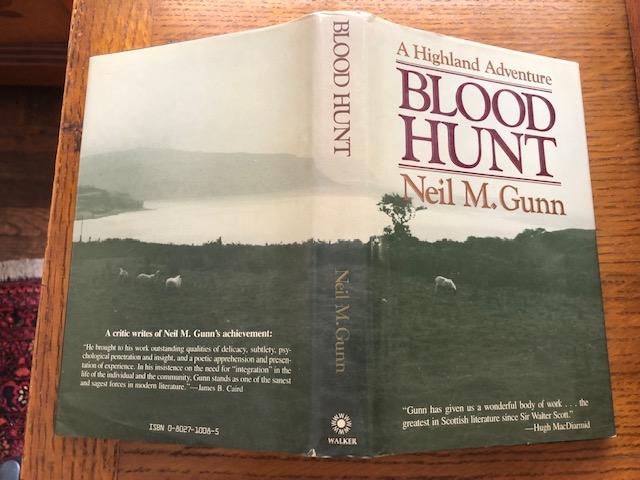
Then an editor with the small US publisher, Walker & Company, I found that very few of Gunn’s books had been published in the States, so I set about reading his work and acquiring rights to as many as I could get for Walker. My favorite was Blood Hunt, originally published in the UK in 1952. When I brought it out in the US in 1987 I added the reading line, “A Highland Adventure”. It seemed an apt tag line because in plot it resembled Victor Hugo’s Les Miserables, with a sympathetic fugitive being pursued by a single-minded, obsessive  police official. Harboring the fugitive is old Sandy, who, as I wrote on the flap copy, “after a lifetime at sea has returned to the land of his ancestors to enjoy his remaining years in the peaceful isolation of his Highland croft. His chief companions are his collie, his cow, a few hens, and his precious library. He’s also a friend to the village lads who quickly learn they can trust him with their secrets.” Sandy is a soft touch with sympathy for the young fugitive, Allan Innes, to whom he provides sanctuary.

When it came to select an image for the cover of the Walker edition, I was delighted to offer my art director colleague the chance to review my Mull photos, and that’s how the cover ended up as it is, also shown here. Included with this post are the picture I took that first occasion; portraits of myself and my wife, painter Kyle Gallup, taken when we visited the same locale together in 1992; the book jacket of Blood Hunt in multiple views with the book’s flap copy.

On one of two visits we made to Scotland in the 1990s, Kyle and I also visited the Summer Isles*, off the west coast and further north than Mull. The Summer Isles lie roughly across from a wee village on the mainland called Achiltibuie, where we rented a self-catering cottage for two weeks; the accommodation came with two bicycles for our use, and we rode all over the area. We also bought passage on a pleasure boat journey, sailing out to and around the Summer Isles, and were enchanted by them—they are populated mostly by birds, and we saw astonishing quantities of puffins, gannets, cormorants, and skuas (as is their way, the latter species dive-bombed us, going right for our caps, which we were glad to have on our heads).

During this visit to the northwest highlands, we made a gorgeous drive on a single-track road from Achiltibuie to the nearby larger town of Ullapool—where we shopped for groceries and found a bookstore—and then motored back to Achiltibuie at sunset. The light and colors setting in to the ocean to the west were staggeringly beautiful. At the bookstore I saw a biography of Neil Gunn, which I bought and began reading during our stay. I learned that for many years Gunn had a day job as an excise inspector, that is a government official making sure that whisky** distilleries were running ship-shape and paying their taxes. F.R. Hart and J.B. Pick, co-authors of Neil Gunn: A Highland Life, wrote that in his job, Gunn was obliged to drive hundreds of miles every week all over the highlands calling on distilleries. Amid that gorgeous landscape, the biographers report that he had one favorite drive above all others: the ride between Achiltibuie and Ullapool. It was a thrill to discover we had the same taste in sublime scenery!

If you have an affinity for naturalistic writing steeped in landscape and compelling characters, I suggest you look at the work of Neil Gunn, and a key book by Gunn’s friend and colleague Nan Shepherd, The Living Mountain.

*An upcoming post on this site will be about a forthcoming book, The Summer Isles: A Voyage of the Imagination by Philip Marsden (Granta Books, London, October 2019), an engaging writer by whom I published in 1994, The Crossing Place: A Journey Among the Armenians, in the Kodansha Globe trade paperback series. In his new book, Marsden chronicles a mostly solo sailing voyage he made from his home in Cornwall in southeast England up between the east coast of Ireland and the west coast of Scotland to the Summer Isles. I’m reading a galley now, and enjoying it very much. Once I get a finished copy, with the maps included, I will write about it.

**In 1935 Neil Gunn published a nonfiction book titled Whisky and Scotland: A Practical and Spiritual Survey.
blood hunt 4 inside flap

Encountering an Eddie Ellis Tribute to New York City in NYC

I was delighted to bump in to this quotation from my longtime author Edward Robb Ellis on a digital kiosk on Broadway the other night. All my blog posts about Eddie Ellis are collected here on this site.

RIP for Sam Schulman, the Last US Sailor from the Exodus 1947

My longtime author, humanitarian and photojournalist Ruth Gruber (1911-2016) has been gone a few years, but I still have a Google an alert for her name. I was glad via the alert to get a heads-up about the passing of Sam Schulman, the last surviving US crewman to have sailed on the ship Exodus 1947, the fate of whose human cargo Ruth chronicled for American and international newspapers in the fateful summer of 1947. The obit I first linked to on Facebook, and again here was written by his son Mark Schulman.

Here’s a moving video with Mr Schulman:
https://youtu.be/q1mQuh9dy30