
Celebrating the Year’s Best Books with the National Book Critics Circle

March 6 Update: Pleased to see that the NBCC blog Critical Mass has included my coverage of their annual awards in their latest news round-up.

1 Full programAfter the superb readings from 21 finalists on Wednesday night, the NBCC awards ceremony Thursday night was an inspiring close to the week of literary observances. On the earlier evening, more than 2/3 of the thirty nominated books were represented, while oddly, it turned out last night that of the six final recipients, only two of the authors were in the house to acknowledge the recognition. It was just the luck of the draw that four of the winners were unable to attend. Most of the audience, myself included, had read less than a handful of the finalists, whereas the NBCC critics, amazingly, read all the finalists. Each year that I attend their events I am struck again by their industry and their devotion to the critical enterprise.

The first two awards were announced prior to the ceremony. These were:

Nona Balakian Citation for Excellence in Reviewing: Recipient William Deresiewicz gave a lovely acceptance speech about criticism. He observed that critics have always drawn the enmity of artists and that criticism seems always called upon to justify its existence. He invoked Waiting for Godot, where the worst insult that Estragon can fling at Vladimir is “critic.” He quoted Stravinsky’s turnabout of Voltaire’s  ode to free speech, “What a reviewer said may be inconsequential, what I protest is his right to say it.” Throughout his talk, Deresiewicz reflected on the seclusion of writing about books, which nonetheless contrasts with the mutuality of reading them, in which we animate or re-animate the author’s work. Citing the New Yorker‘s Arlene Croce, his most affecting line was, “If art gives voice to our experience of life, criticism gives voice to our experience of art.”

Ivan Sandrof Lifetime Achievement Award: Sandra Gilbert and Susan Gubar, authors of The Madwoman in the Attic: The Woman Writer and the Nineteenth-Century Literary Imagination (1979) and editors of the Norton Anthology of Literature by Women, and a host of other trailblazing books. Gilbert and Gubar, though unable to attend, had each filmed splendid presentations that were screened for the audience at the New School, and can be viewed via this youtube link.

These were the awards in the NBCC’s six book categories:

Poetry: At the reading on Night One, of the three poets who read I had particularly enjoyed David Ferry’s reading from Bewilderment and A.E. Stallings’ rhymed poems from Olives. On Thursday night we learned from chair of the poetry panel David Biespiel that D.A. Powell’s Useless Landscape, or A Guide for Boys, published by Graywolf Press, was the top choice. Powell was not present, so his editor Jeffrey Shotts went to the podium and read a brief statement from the poet. It happened that Shotts and I had met the night before over drinks at Cafe Loup, and so were seated together in a row near the front of the auditorium as the awards began. Just before the event kicked off, Jeff told me that he might need to sneak past me if his author won. When the moment came, I clapped him on the back and let him out of our row.

Criticism: Like all the categories, this one was filled with standout titles. At the reading, Paul Elie, (Reinventing Bach), had read a fascinating passage about the blockbuster album of 1968, “Switched-on Bach,” for which Walter Carlos had played Bach on the recently invented moog synthesizer. Elie quoted Glenn Gould on the fusion of Bach and the new electronic instrument, where the Canadian pianist heard an ideal match. Gould relished the moog’s absence of vibrato and inflection, which I imagine probably had an aural quality for him akin to a harpsichord. Kevin Young (The Grey Album: On the Blackness of Blackness) read a passage about rappers and love songs, which fascinatingly play against type. The winner was Stranger Magic: Charmed States and the Arabian Nights by Marina Warner who was at home in England. Unfortunately, no one was present from her publisher Harvard University Press to accept the award.

Autobiography: On Wednesday night finalists Rena Grande (The Distance Between Us, a memoir of her Mexican family’s passage in to the United States) and Maureen N. McLane (My Poets, on the role of Gertrude Stein and Elizabeth Bishop in her reading life) had each read brilliantly. Likewise, an emotional moment came when George Hodgman, longtime editor for the late journalist Anthony Shadid read a moving passage from  House of Stone: A Memoir of Home, Family, and a Lost Middle East. The panel for this prize gave their nod to Swimming Studies by Leanne Shapton, who we learned has recently had a baby. Her publisher, David Rosenthal of Blue Rider Press, accepted in her place.

Biography: Wednesday night I had been enchanted by finalist Tom Reiss’s reading from The Black Count: Glory, Revolution, Betrayal, and the Real Count of Monte Cristo, a biography of novelist Alexander Dumas’ father. I had not known of the fascinating life led by Dumas pere, and I very much enjoyed later meeting and talking with him. And yet, it was hardly a surprise that the award was bestowed on Robert Caro for The Passage of Power: The Years of Lyndon Johnson, the fourth volume in his epic work on the 36th president. Kathy Hourigan of Knopf, accepted for Caro who had been prevented from attending because of an earlier scheduled speech.

Nonfiction: While all the categories were filled with extremely strong books, this category took the ribbon for some of the most amazing books of all, as a glance at the program below will confirm for you, too. Seated near me were Andrew Solomon, author Far From the Tree: Parents, Children, and the Search for Identity, and his editor Nan Graham of Scribner.  It was a pretty electric moment when Andrew’s book was given the award. He got a big laugh when reaching the podium he remarked with wit worthy of Oscar Wilde, “It’s obviously very unfashionable to show up. I hope you won’t think less of me for actually being here.”  The audience was plainly very glad for him, as was I.

Fiction: In this category, everyone who came for the readings the night before had been wowed by the regal Zadie Smith’s inspired animation of her own work, when like a ventriloquist she had given voice to her array of  characters in a gritty scene from a London park. The recipient of the award turned out to be Ben Fountain for Billy Lynn’s Long Halftime Walk. Fountain gave a moving talk. Along with thanking his agent Heather Schroeder of ICM, and staff at Ecco Books, his publisher, he acknowledged all the writers who’d been finalists, observing that “We’re all on the same team . .  on the team of beauty, truth, justice, love–all the corny reasons why we got in to this line of work. Let’s just keep remembering that.” He closed by thanking his family for their love and commented starkly “without that love I’d be lying in a ditch somewhere.”

With that the program ended, and many in the audience walked a block uptown to continue their conversations and celebrate at a jubilant reception benefiting the NBCC. You can view the program hear on my site in the window below. You may also view and listen to interviews that were done with all the finalists by students at the New School Graduate Writing Program, hosted at this site and co-sponsored by the NBCC and the New School. To begin, just click on one of the NBCC’s six nomination categories. I will add that if you love books and criticism, you can become a friend of the NBCC by joining the organization as an associate (non-voting) member. I relish my status as a friend of the NBCC. Likewise, if you live in NYC, or will be here visiting next year when they hold their annual readings and awards ceremony, I urge you to attend. Remarkably, the events are free of charge and open to the public. The only event for which there’s a cost is the benefit reception. You can find more information at the NBCC website, bookcritics.org. I invite you also to view the pictures I took, below the video window, and read about the night of readings, at this link, where I’ve posted another 20 photos.
  Please click here to see photos from the awards ceremony.

The Washington Post, Slouching Toward Irrelevance/Part II

What a crock. As predicted here on Feb. 16, the Washington Post has gone ahead and dumped the position of ombudsman at the newspaper. In an unctuous letter published this afternoon, Post publisher Katharine Weymouth insults the intelligence of her readers with these words:

The world has changed, and we at The Post must change with it. We have been privileged to have had the service of many talented ombudsmen (and women) who have addressed readers’ concerns, answered their questions and held The Post to the highest standards of journalism. Those duties are as critical today as ever. Yet it is time that the way these duties are performed evolves.

We will appoint a reader representative shortly to address our readers’ concerns and questions. Unlike ombudsmen in the past, the reader representative will be a Post employee. The representative will not write a weekly column for the page but will write online and/or in the newspaper from time to time to address reader concerns, with responses from editors, reporters or business executives as appropriate.

Beginning Monday, you may send questions or complaints to readers@washpost.com.We know that media writers inside and outside The Post will continue to hold us accountable for what we write, as will our readers, in letters to the editor and online comments on Post articles.

In short, while we are not filling a position that was created decades ago for a different era, we remain faithful to the mission. We know that you, our readers, will hold us to that, as you should.

There is so much phony talk in those paragraphs, I hardly know where to begin picking them apart.

What about the evolving media landscape makes the position of ombudsman out-moded? Is accountability so totally out of style? Aside from Ms. Weymouth’s specious argument that the media world has somehow evolved in a way that it’s no longer necessary to have an independent eye keeping watching over the paper and critiquing it when necessary, the most damaging admission in her letter is that a new, downgraded, reader representative will be a Post employee, lacking independence from the editorial and business sides of the newspaper. The Public Editor, as the position is named at the New York Times, has a contract that keeps that person free from influence of the classic fiefdoms at a daily newspaper. I believe that Post ombudspersons always had this status, but no more.

Weymouth claims that “we remain faithful to the mission,” but unspoken is what that purpose is. It surely can’t be a willingness to be accountable to readers and to history. She takes for granted that we will just what know it she means by that optimistic allusion. Alas, I do not.

NBCC Finalists Read from Their Books

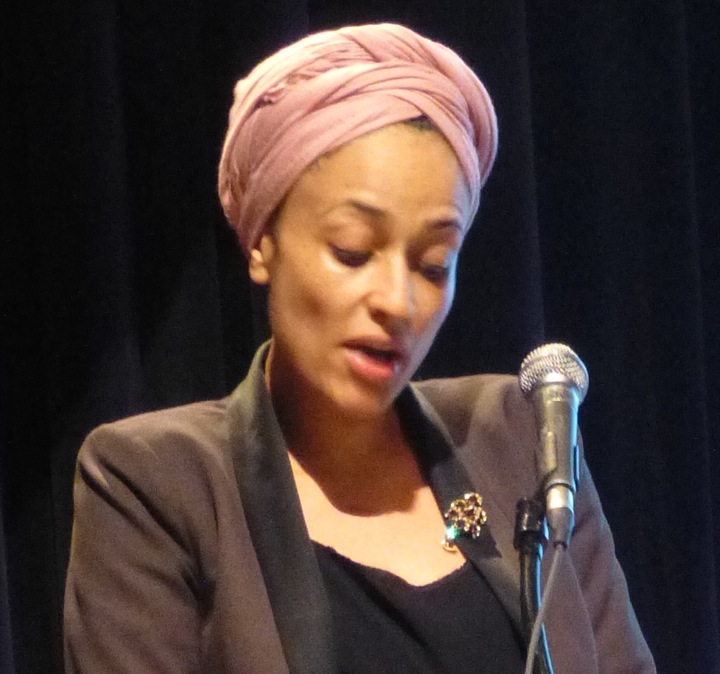
P1040029NBCC photoThis week brings the annual awards from the National Book Critics Circle (NBCC). The ceremony, to be held tonight, Thursday, Feb. 28, was preceded last night by a program in which more than 20 of the finalists read from their work. I’ll be going back to the New School tonight for the finale. Meantime, you can check out the finalists at this feature on galleycat.com, where they’ve assembled samples from all the honored titles. You may also peruse the program from last night listing all the readers and their books. Here too are the photos I took, such as this one of the elegant Zadie Smith, many of which show the author and their book cover projected alongside. I will post again after the ceremony tonight.
Saturday Update: The NBCC has now posted video of the readings night on their website:


Please click here to see all photos.

Hillary’s Next Book–Thoughts on a 21st Century Blockbuster

Hillary Clinton Gary CameronReutersI was glad to be consulted by reporter Ruby Cramer of BuzzFeed.com for a story about one of the activities Hillary Clinton is likely to undertake now that she’s left the State Dept. That is, a book she’s said she plans to write and publish. Here’s a link to the story, “Hillary Clinton’s Unwrittten Memoir the Talk of the Publishing World.”

Because Cramer had space only for brief quotes from me and the other editors from whom she sought comment, here’s a bit more on what I talked about with her.

I pointed out that on each previous occasion when Hillary’s published a book, It Takes a Village (1996) and Living History (2004), the book world has been on the verge or in the midst of huge changes. In ’96, Amazon.com was barely a year old as an online bookstore and the Interent was just beginning to influence and define the wider culture, with the enormous impact it would soon exert on the book business. In 2004, social media was barely a blip, with Myspace one year old, and Facebook just getting started. Consider that a new Hillary book coming out, probably in 2014 or 2015, will exist in a world not only influenced by the prevalence of myriad social networks, but in a digitally dominant book space, with ebook adoption possibly on the upswing a year or two hence. I would add that while fiction has dominated ebook sales to this point, a new memoir from Hillary could become the first mega-nonfiction ebook bestseller.

While the Buzzfeed article spends a few lines discussing how high her advance might go in dollars, and for good reason, given the potential for a mammoth sum, I had suggested something different to Cramer. I said that if she was willing to take less money upfront, Hillary and her representative Robert Barnett might aim for an arrangement that would see her share profits in the book with her publisher, after expenses for production, design, distribution, and marketing were earned out. This 50/50 sharing model, though by no means common yet among authors and publishers, would also override the usual royalty structure that now applies where authors typically earn an average 15% royalty on hardcover sales, based on the book’s retail price, and 25% of the net price on ebook sales. Among brand-name authors, it has been reported that Stephen King has had this sort of profit-sharing arrangement on at least some of his titles. I should add that King publishes frequently with Scribner, an imprint of Simon & Schuster. S&S was also Hillary’s publisher for her two earlier books.

I’ll close here by saying that Hillary’s next book–given her instant name recognition and worldwide notoriety, and the cultural moment–is likely to present opportunities for connecting a book with readers in a way hitherto unavailable to any author or publisher. The marketing campaign that could be arranged and implemented, given the array of tools now available, ought to be something the likes of which the book business has not seen before. It’s a book I’ll be very eager to read.

[Please note the photograph accompanying this post also ran with the Buzzfeed.com story. It is credited to Gary Cameron/Reuters.]

“Oh, No, Google, Don’t Pull a Hiring Bait & Switch!”

Despite the wording of the above tweet @GoogleLocalNYC is not really hiring, and it’s very unfortunate they’re making this claim anywhere, particularly in social media. Having been selected as a Google NYC Neighbor last spring, and after hearing a lot about community managers the past few days during NYC’s annual Social Media Week, it struck me this could be a position I’d be good at, so I clicked on their link, only to discover that while there are indeed positions to be filled, Google isn’t really doing the hiring. This is the first thing to be read when you visit the site with hiring info.

Important Notes:
Most positions are Temporary, Contract roles ( ~6 months to begin), hired via 3rd-Party staffing agency (i.e., not working directly for Google). We cannot make any guarantees about full-time Google employment opportunities at the conclusion of the Temporary contract, however the Local CM team is a great way to grow your career.

I find this a classic bait & switch, HR-style, contrasted with the literal message of the tweet. I note also that their final sentence, extolling the virtues of this experience for prospects,even though you may not end up working full-time at Google, is the arrogance that many hiring mangers display nowadays. The implicit message is

“Just remember–you’re lucky to have any work at all.”

I know it’s a hirer’s market, with job-seekers lacking leverage, but is it too much to expect that dishonesty–or at best, or carelessness–be banished from corporate hiring practices? The whole thing is unworthy of Google. I hope they take note of my reply, delete their original tweet, and revise any similar messaging they’re putting out. I’ll note it here if they do, and whether I get any kind of reply.

#FridayReads, Feb. 22–“Siege 13,” Stories by Tamas Dobozy

siege13-web#FridayReads, Feb. 22–Siege 13: Stories by Tamas Dobozy, an innovative collection of short fiction that oscillates between the Nazi siege of Budapest in 1944 and the present day. I’ve just begun digging in to the book, but find I’m already astonished by the fluency of the writing, and the way the stories pull me right in. I don’t have too much to say about it yet, so I’ll note here the review of it that ran in Quill & Quire, the magazine of the Canadian book industry (Siege 13 was published simultaneously in the US and Canada). The reviewer is writer Robert Wiersema:

The stories are varied in tone: some emphasize the horrors of war, while others–like “The Society of Friends,” about two men in love with the same woman – are darkly humorous. Gripping realism is comfortably juxtaposed with fantasy in stories like “The Ghosts of Budapest and Toronto.” The pieces in Siege 13 are also unified by Dobozy’s skill as a writer. Carefully crafted, but executed with seeming effortlessness, every sentence in this collection, every paragraph, is a thing of beauty, and the stories themselves are without flaws. That said, the combination of the author’s abilities and the book’s subject matter means Siege 13 should come with a warning: take it slow. These are stories that should not be rushed through.

I will definitely take my time. Meantime, if you’d like to know more about the writer, here’s the web page for the book from its US publisher, Milkweed Editions. They sent me a review copy some months ago, I’m glad I’m finally getting to the book. The striking cover was designed by Michel Vrana, a friend who I met at the first Book Camp, an unconference about publishing.