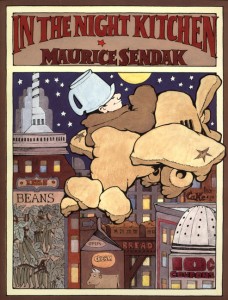
 With the news of Maurice Sendak’s sad passing today, I’ve been reminded of a brush with intolerance that I experienced many years ago, when one of his most popular books unexpectedly became an issue with a censorious customer.
When I worked in my family’s Cleveland bookstore, Undercover Books, the children’s book section was not my strong suit. I was responsible for ordering our adult books and shelving and merchandising them in their separate sections of the bookstore.
While I looked after the adult books, my sister Pamela ordered all our kids books and worked on the best ways to display them, including the type of merchandise that I regarded skeptically—board books, plush books, sticker books, scratch & sniff books, etc. Pam knew these titles and their authors best, and had a far better knack than I of finding a particular thin-spined book when a customer came in asking for a specific title, as they often did. She had it all over me in this department, and also on our brother Joel—whose chief responsibilities included future business planning and working on the main sales floor, waiting on customers face to face—and our parents Earl and Sylvia, who handled myriad duties such as bank deposits and bill-paying, as well as minding the cash register and waiting on regulars and walk-ins. But when it came to helping a grandmother, relative, or family friend seeking a book for a little one, or a middle-grader, the call often went out for Pam. But she couldn’t be available at all times and I recall she sometimes just wearied of being summoned for this often challenging duty. Grown-ups were so often unsure what a child might like they could take a really long time deciding on a gift book to buy, even after many offerings had been shown them. So, every now and then I would be pressed into duty to take care of a customer who simply had to buy a children’s book.
One such occasion arose one day in the early 1980s, when a rather elderly woman customer who I recognized from a previous visit to our store, a Mrs. Stewart, came in and without hesitation asked if we had Maurice Sendak’s In the Night Kitchen. She was emphatic in saying she wanted to purchase it, in fact, she said, “I want to buy all the copies you have.” I blanched, worrying if I’d be able to find a copy, or multiple copies if we had them—we always hated to miss a multiple copy sale if we could avoid doing so. There was something weird about Mrs. Stewart’s nervous energy, but it didn’t stop me from feeling satisfaction when I quickly put my hands on a copy, and established with certainty that it was our last one. Mrs. Stewart had come back to the children’s section with me and I eagerly presented it to her, adding that it was unfortunately our only copy, though I added, we would certainly be ordering more. She grabbed it from me, a bit aggressively, and said, “I’m going to buy it so no one else can. You should not be selling this book. It shows a naked boy and his private parts. I want you to stop selling this book. You must not reorder it or sell it any longer!”
Suddenly recalling that on her earlier visit to the store Mrs. Stewart had asked for a fundamentalist tract that we didn’t carry, I realized that I had a kind of religious fanatic on my hands, with some essential human right suddenly at stake, the freedom to read. By this time I was highly agitated, and more than a bit angry at her high-handed claim to tell me what books we should sell in our bookstore. Wanting to get her out of the store as quickly as possible, and before she made a scene in front of other customers, as smoothly as I could manage I took the book from her hands—as if I were simply walking her back up to the cash wrap where she could complete her transaction—mumbling some indistinct nicety about the naked boy in the book. Reaching the register, which was almost to the front door, I changed my tone and said as forcefully as I could without actually yelling, “I won’t sell you this book, Mrs. Stewart, and I won’t allow you to tell me what books we should be selling, or what is proper for customers to buy. You’ll have to leave now, please.”
Realizing that in my gambit to get her out of the store, I had also taken from her hands what she considered to be this very offensive book, she reached to regain possession of it but by now I was behind the counter and handed the copy to my mother. Angry and frustrated, Mrs Stewart began yelling, repeating with horror in her tone, “The boy in that book is naked and you should not be it selling it. I must buy that book so no one else can!”
Again, trying to avoid yelling over her, I said, “I will not sell you this book. Our customers have a right to buy any of our books, and we will not stop carrying this book just because you don’t approve of it.” She took a long time to decide to leave, though eventually she saw that I wasn’t going to sell her the book under any circumstances. She never came in our store again.
Over the years that have followed—as a bookseller, and later as an editor and publisher and engaged literary citizen—I alway take note of Banned Books Week as it comes around on the calendar (this year it will be held September 30-October 6), when libraries and bookstores are encouraged to make displays of books that intolerant people have demanded be removed from library stacks and bookstore shelves. I wonder about the sort of person who would do this, and then think of Mrs. Stewart with her strident voice and straining neck muscles—determined to persuade me that we must not allow anyone else to buy Maurice Sendak’s picture book, lest they see little Mickey’s nakedness—the very face of intolerance.
July 11, 2021
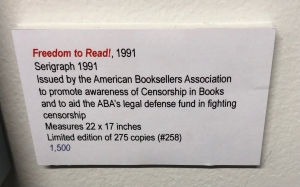
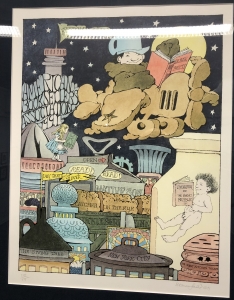
As a postscript to the 2012 post of mine above, I want to share an image of a poster Maurice Sendak drew to support the American Booksellers Association Freedom to Read campaign in 1991. A copy of the poster was part of an exhibit and sale at the Society of Illustrators in Manhattan that Ewan Turner and I attended yesterday at the invitation of children’s book scholar Michael Patrick Hearn. Note the many books labeled on it, from Catcher in the Rye to Native Son to The Giving Tree. His own In the Night Kitchen might’ve been on there, too, if old Mrs Stewart had had her way!

 Longtime book world friend Will Schwalbe published a lovely Op-Ed on Mother’s Day, drawn from his forthcoming The End of Your Life Book Club. It opens with Will and his ailing mother in a medical office awaiting a chemotherapy appointment. He asks her what she’s reading–it’s Wallace Stegner’s aptly titled Crossing To Safety. “It was a book that I’d always pretended to have read, but never actually had. That day, I promised her I’d read it.” Soon, over the months of treatment and convalescence until her passing, they find mutual comfort in discussing the books they are reading in a kind personal book club all their own.