Alexis Greene, Dramaturg, Author, Friend—RIP
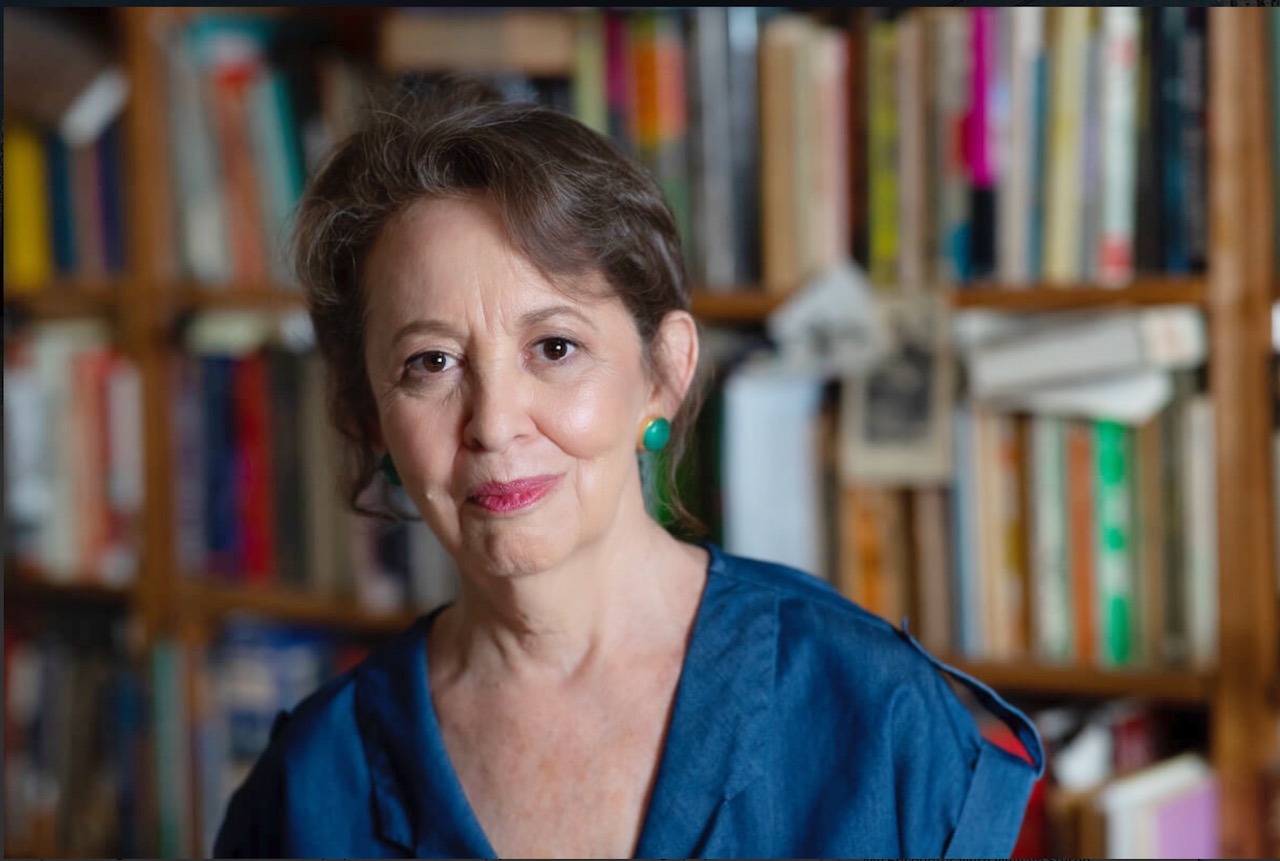
It’s with deep sadness that I announce to friends and colleagues that my dear friend and agency client Alexis Greene died on Sept 10, age 80, at her apartment on the upper west side of Manhattan. She had been suffering with ALS since November 2025. Her husband Gordon Hough sent this with the sad word of her passing:

“Her life’s work was about and for women in the theater. She was a dedicated and passionate historian and scholar, an author or editor of eleven books and many articles on the theater, a reviewer of productions on Broadway and in every other venue where plays are staged in NYC, a Tony-voter, a co-founder of Literary Managers and Dramaturgs of America, a site visitor for the National Endowment for the Arts, a member of the board of the League of Professional Theater Women, and a teacher of theater at NYU, City University, and the University of Bridgeport. She was withal a vibrant personality, an eager gardener—and a wonderful cook. I am blessed that she was my ever-so-loving wife for nearly forty years.”

Alexis and I began working together in 2019, when longtime publishing friend Cathy Hemming referred her to me. She came to me with two challenges. First, Alexis hired me to edit her manuscript on the playwright and director Emily Mann. At that point, the project was under contract to Southern Illinois University Press which, unfortunately, was going to require her to make a subvention—a payment—to facilitate publication. While editing the manuscript with her, I introduced her to publishing lawyer Robert Solomon who helped extract her from the contract, and then as her agent, I undertook efforts to place the book with a commercial publisher, which I did, licensing it to Applause Theater and Cinema Books. Emily Mann: Rebel Artist of the American Theater was published in November 2021. It got some excellent reviews, like these:

“Underscores, for theatre-makers, students, and researchers alike, the potential of performance as a radical force for change.”—Journal Of American Drama And Theatre

[An] excellent biography. Alexis Greene has written a lively and fascinating book about an important theater artist—artistic director, director, and playwright Emily Mann.”—Third Coast Review

In 2023, Alexis and Emily Mann conducted a conversation at the Princeton Public Library, which is preserved on youtube.

Sometime later, Alexis was commissioned to write a history of a notable theater company in Washington, D. C., the Shakespeare Theatre Company, which was published as Shakespeare Theatre Company: The History of a Classical Theater (Peter E. Randall Publisher, September 2025).  My adult son M. G. Turner and I were honored to edit the manuscript for Alexis.

Late last year, Alexis told me that she had been diagnosed with ALS, news that she conveyed to me with amazing equanimity and surprising good cheer. She set about putting her affairs in order, and enlisted me to work with her on two writing projects she wanted to see published in what she anticipated would probably be the last months of her life.

The first was a memoiristic essay, “Live Theater— An Incomparable Art Form,” which I read and edited with her,. then arranged to be published in The Arts Fuse, where it appeared last February. She wrote, in part,

“I fell in love with theater when I was nine years old. I was growing up in New York City, and in the fall of 1954, friends of my mother took me to see the Broadway musical Peter Pan, starring Mary Martin as Peter and Cyril Ritchard as the villainous Captain Hook. It was the first time I’d ever been inside a theater, and I loved where we were sitting: in a box on the right side of the magnificent Winter Garden Theatre. I loved the show, and I especially adored Margalo Gillmore, who played Mrs. Darling, the loving mother of the children whom Peter Pan invites to fly with him to Neverland. I was entranced by the gowns that Mrs. Darling wore—I wanted to be an actress….Eventually, I found my true calling: writing and editing books about theater companies and theater artists, especially women. All of these vocations intensified my love for live theater.”

The other was a poem, titled, “Love’s Mantle,” for which I arranged publication in The Seaboard Review of Books, in a feature package headlined Two Poems to End the Winter, alongside a poem of my own, “Creature Comforts.”

Snow descends in icy flakes,
Coating the hills and drifting ’round lakes.
Covering houses and fields and trees,
Snow whitens the world as far as you can see.

Cold to the touch.
Wet on your skin,
Snow, winter’s blanket,
Protects the life within.

Far beneath the drifts and mounds,
Animals burrow, cozy and warm.
All winter long they dream animal dreams,
Of running through grass, swimming in streams.

Digging deep holes is gopher’s reverie,
While building dams is beaver’s fancy.
Chipmunk sleeps with her store of food,
and skunk spends winter in a dozing mood.

Cold to the touch,
Wet on your skin,
Snow, winter’s blanket,
Protects the life within.

Far beneath the coat of snow
Flowers and plants wait to grow.
Nestling deep in the rich, dark ground,
Seeds yearn for spring and the call to rebound.

The lily awaits a sunny day,
When the snow becomes dense, then melts away.
Lily and iris, dandelion and clover
Will reach toward the sky when winter is over.

And you, sleeping soundly in our snow-covered home,
Do you dream of spring and places to roam?
What do you yearn for, as there you lie?
How will you grow? Will you reach for the sky?

Warm to the touch,
Soft on the skin,
Love, the truest mantle,
Protects life within.

Alexis’s ability to speak was affected by her condition, but even with that, we stayed in regular contact, sometimes on the phone, often via text or email. As I look back on my devices now, I see that barely a week went by without us exchanging frequent messages. In May I visited with her and Gordon at their handsome book-lined apartment, and the three of us had a delightful conversation. Later, in the summer, I told her about a new theater book I had licensed to Applause Books by our agency client Shauna Kelly, I’ve Got the Shakes: Performing Richard Foreman. Unexpectedly, she proposed to write a review of the book, which I promised to try and place in a suitable publication. She quickly read Kelly’s book and in little more than a week wrote a thoughtful 1,100-word review that distilled the rich content in Kelly’s oral history-style book. Bill Marx, editor of the Arts Fuse, agreed to publish it. It ran on July 2, under the headline, “Voices From Inside Richard Foreman’s Ontological Theater.” She closes it with these words:

“Foreman’s theater was not a theater of plays with linear structure, psychologically motivated characters, and realistic scenic design. Rather, Kelly’s book describes and evokes for theater lovers the experimental and stimulating body of work in which Foreman shaped a different vision of theater, with a vibrancy all its own.”

I am so glad that in the last months of her life I was able to help her publish her autobiographical essay on live theater, the poem, “Love’s Mantle,” and her review of I’ve Got the Shakes, along with her biography of Emily Mann and her history of the Shakespeare Theatre Company. On October 18, in New York City there will be a celebration honoring the memory of Alexis Greene, which I will be honored to attend. Without question, she was one of the most valued friends I’ve made in my decades-long publishing career.

As a coda to this tribute, I also want to share a poem that my son M. G. Turner wrote in honor of Alexis. Please read it below.

On the Passing of a Woman of the Theater

by M. G. Turner ©


We heard today she died,

The great woman of the theater

Who though she did not grace the stage

Wrote decorous and illuminated books

Upon the life of its art,

Thus making her a scholar

Of drama, tragedy, farce, and comedy

Perhaps even clown and parody


But now the curtain has slipped, dropped,

Descended, and the audience

Wanting more insightful demonstrations

Begrudgingly rises from its seats

With her still on their minds:

Alas she’s with the bard now,

Her heart beat its last to the thrum

Of his iambic pentameter

Which softly ended

All revels and revues.

First Pre-Pub Review of “City of Dark Dreams” is a Rave!

On top of the pub date announcement and cover reveal of M. G. Turner’s City of Dark Dreams: Tales from Another New York we shared a few days ago (see post below this one), the story collection just got its first advance review, from Publishers Weekly’s Booklife section, and they loved it!

“’The mystery is far more beautiful than any neatly presented fact that can be easily confirmed or denied,’ declares the narrator of the first tale in this marvelously unsettling collection of supernatural tales. That love of the mystery itself powers Turner’s interconnected stories set in an uncanny New York City’s Upper West Side. Turner’s people find themselves drawn into strange and unexplainable encounters, haunted by dreams and the dead, consumed by grief, loneliness, ambition, and the desire to understand what lies beyond the limits of human knowledge. The author’s nom de plume brings to mind M.R. James, that turn-of-the-20th-century master of the ghost story, and the storytelling here echoes both James’s work and the literary traditions from which it emerged. One tale, ‘The Witching Hour,’ opens as if it has been crafted to read aloud around the hearth: “Believe me when I say the following passages are not for the faint of heart, but rather for those whose nerves can handle an elaborate examination of psychically damaging phenomena.”

Despite some brilliantly realized old-school prose stylings, Turner’s stories move briskly and prove too spiky, surprising, and ambiguous—and even contemporary in their concerns—to be treated as plummy throwbacks. Here, all-too-relatable characters create the conditions for their hauntings through their deepest desires, and death looms over every entry. “The Botanist” follows a mother seeking contact with her dead daughter through a Spirit Flower, “The Second Wife” finds a scientist possibly recreating his dead wife, and “Stage Fright” concerns an actor who sees his own dead father while playing Hamlet.

Turner also uses uncertainty to deepen that sense of mystery. We never really find out whether the Minotaur actually exists, the stone eagle truly moves, or the lost manuscript possesses a will of its own; unlike much 21st century genre-fiction, that welcome ambiguity denies readers the false comfort of the unknown being made explicable. Turner’s cast proves deeply, revealingly human as they yearn to understand, control, and escape what ultimately lies beyond our control—and perhaps it is the mystery itself that gives life meaning.

Takeaway: Unsettling stories of an uncanny New York and its haunted inhabitants.
Great for fans of: Robert Aickman, Ramsey Campbell.

M. G. Turner’s “City of Dark Dreams: Tales from Another New York” to be published Jan 12, 2027

As mentioned on this site last year, Philip Turner Book Productions sold City of Dark Dreams: Tales from Another New York by M. G. Turner, with a Foreword by David Updike, to DarkWinter Press of Ontario, Canada. The collection of twenty-five short stories (245 pages, quality paperback, $18.99, ISBN: 978-1-998441-42-6) will be the first commercially published book by Turner, my adult son and partner in our editing and agency business. As per DarkWinter Press’s new catalog, it will be published on January 12, 2027.

As described in the catalog, the stories incorporate elements of mystery and shades of the macabre, examine themes of life and death, ponder whether mortality can be circumvented, imagine dreams impinging on reality, and find the uncanny in the everyday. Melding the tales into a unified whole is the setting, the Upper West Side of Manhattan, as well as a fictional college, Hudson University, which features in many of the tales and introduces a dark academia motif. A host of intriguing characters populate this world, intersecting and influencing each other’s lives, in a manner akin to the storytelling in David Lynch’s classic TV series, “Twin Peaks.”

In his Foreword David Updike writes,

“Mr. Turner describes his genre as ‘literary gothic,’ in the spirit of Edgar Allan Poe, and in the unhurried prose of another era, his tales unfold in mysterious, and sometimes malevolent ways. They take place in the pleasant west side neighborhoods along Riverside Drive, where Turner grew up, not far from Columbia and Barnard, and in the shadow of Riverside Church. Even the narration and dialogue seem tinged with the somewhat formal tones of an earlier era: it is a world where the classical references are still alive, but where unusual, paranormal events occur: a woman converses with her late husband through the medium of a ‘seeing stone’; in a nearby museum the statues of antiquity—Hera, Sapho, and Venus—come alive at night to converse and debate their shared pasts and conflicts, and then go silent again when the guards come in.”

Readers will relish experiencing Turner’s alternate Manhattan, a locale replete with mad scientists, bizarre specters, demonic figures, and familiar horror elements he makes his own. These are stories that comment on our times while also bringing a flair of magical realism to the genre, which will induce frights without slasher gore on the page.

We are also excited to announce that in July 2027 Baxter House Editions, an imprint of DarkWinter Press devoted to republishing contemporary classics, will publish a second M. G. Turner book, Dreams and Visions: Three Story Cycles, with a Foreword by James Fisher, editor of The Seaboard Review of Books. The book will be drawn from three chapbooks Turner published privately in 2025, comprised of Dreams of the Romantics, a story cycle inspired by Lord Byron and Mary and Percy Shelley, when in 1816 the literary friends gathered at a villa on Lake Geneva during the fateful “Year without a Summer;” Roman Visions, a story cycle inspired by Virgil and a final missing chapter from The Aeneid, as well as The Museum of Mind and Matter, an experiment in what Turner describes as “emotional archeology.”

M. G. Turner writes under a rubric he terms “literary gothic,” with tales that hearken back to the past and look to the future for answers to modern readers’ most pressing questions, be they environmental, spiritual, or existential. Creative touchstones for Turner include Edgar Allan Poe, who once lived in the neighborhood he writes about, the Upper West Side of Manhattan; Algernon Blackwood, one of the inventors of “weird” fiction; and Jorge Louis Borges. Turner dubs his oeuvre The Neighborhood Legendarium, an inter-related series of works that takes in City of Dark Dreams and the aforementioned chapbooks. Turner is also a poet and is working on compiling three volumes of poetry related to his stories and the city.

Sold: Four American History Classics by Ken Ackerman Coming Back into Print

In the early to mid-2000s, while an editorial executive with Carroll & Graf Publishers, one of my chief enjoyments was editing and publishing four stellar books of American history by Kenneth D. Ackerman. I found him to be a terrific researcher, and more adept than any writer I’d ever worked with at utilizing the text from carefully cited original sources, which he then paired with his own prose, often in the same sentence or paragraph.

The books we did then included a biography, Boss Tweed: The Corrupt Pol Who Conceived the Soul of Modern New York, which Pete Hamill reviewed on the cover of the NY Times Book Review, and Dark Horse: The Surprise Election and Political Murder of President James A. Garfield, on the tragically abbreviated presidency that contributed to the premature end of Reconstruction. The others were The Gold Ring, on Jay Gould and the financial scandal of 1869, and Young J. Edgar, on the early rise of the all-powerful FBI director.

I’m delighted to now have Ken as an agency client of Philip Turner Book Productions. Under that rubric, I’m excited to announce that we’ve licensed his backlist titles to Open Road Media for their Re-Discovery Lit program. It’s great to be working with Ken again!

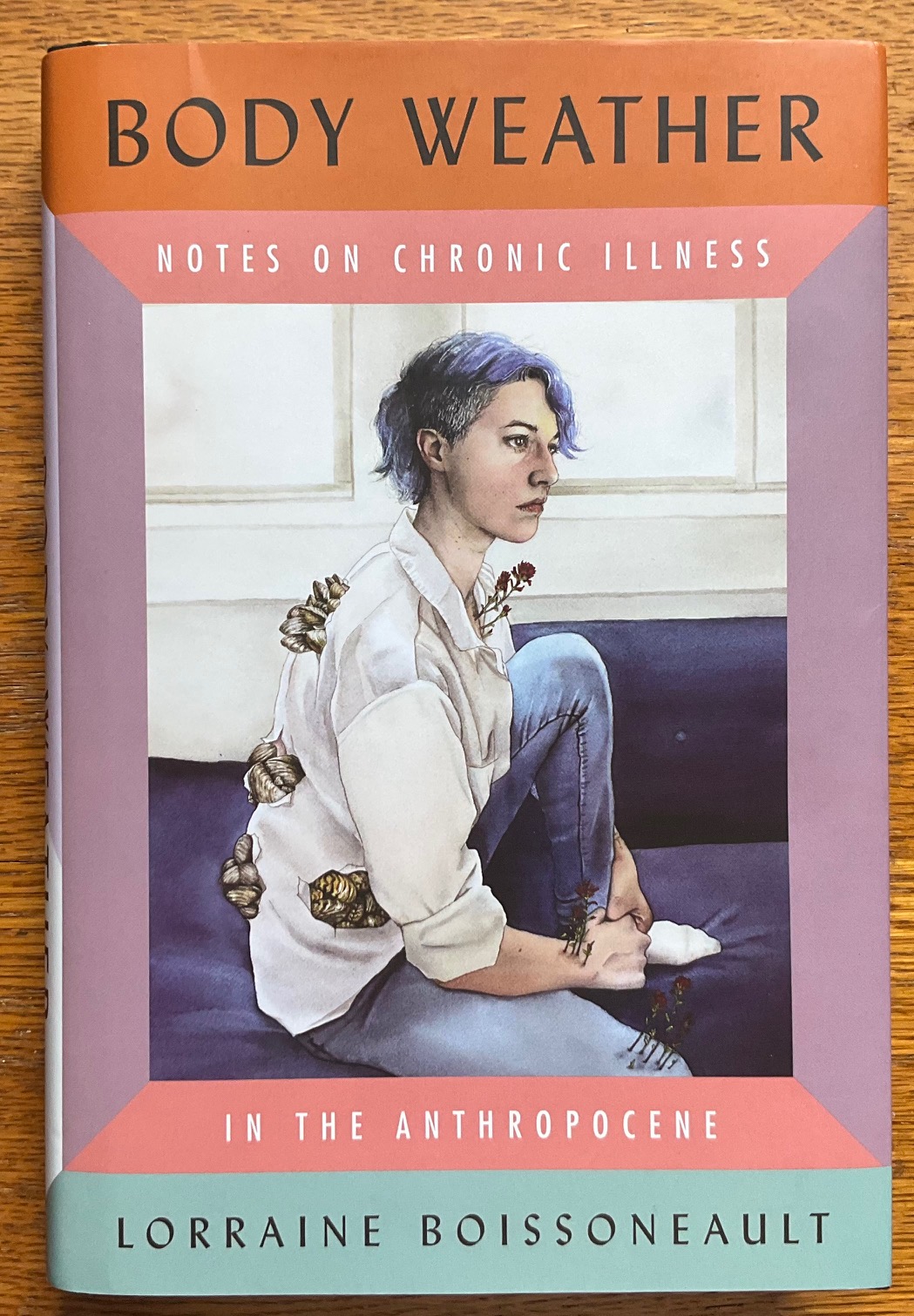
Celebrating Publication of “Body Weather: Notes on Chronic Illness in the Anthropecene” and Remembering Dr. Paul Epstein’s “Changing Planet, Changing Health”

In 2024, I was invited to serve as a juror on a three-judge panel that evaluated 99 entries for the Works-in-Progress Awards of the J. Anthony Lukas Prizes, sponsored by the Columbia Journalism School and the Nieman Foundation for Journalism at Harvard. After months of reading the book proposals and sample chapters, and many Zoom discussions among the three panelists, we announced a shortlist of fifteen works-in-progress; then following more discussion, we chose two works-in-progress as the finalists, whose authors would each receive $25,000. The works-in-progress awardees were Body Weather: Notes on Illness in the Anthropocene by Lorraine Boissoneault (to be published by Beacon Press), which was my favorite among all the entries, and The Life and Death of the American Worker: The Immigrants Taking on America’s Largest Meatpacking Company by Alice Driver (forthcoming from One Signal, Atria).

We drafted a citation for Body Weather, which was a product of me and my fellow panelists, Chris Jackson, Publisher and Editor-in-Chief, One World Publishing, Penguin Random House, and Erika Hayasaki, Professor at the University of California, Irvine, in the Literary Journalism Program, and author of Somewhere Sisters: A Story of Adoption, Identity and the Meaning of Family:

Body Weather is a visceral work of reported essays, masterfully braided with narrative research. Lorraine Boissoneault tells the story of living with chronic illness at a time when the planet is in a state of dire suffering. Climate change is bringing more hurricanes, lightning, tornadoes, fires and landslides. How will a distressed planet affect stressed, ill or disabled bodies? In poetic and haunting prose, Boissoneault unearths intersections between her unique experience living with illness, while also illuminating universal questions lodged within all of us: How do we learn to live with discomfort? “How do we seek refuge from our own bodies, from weather that wraps itself around the world?” The Lukas Prize will enable the author to travel from her home base in Chicago to the Saguenay fjord in northern Quebec, to Death Valley in California and to Australia’s outback to complete reporting for the book. Body Weather is a singular work of literary reportage, a firsthand, intimate account drawing profound connections between the body and the planet.

We were originally scheduled to present the awards in a ceremony at Columbia in May 2024, but due to months of strife on the school’s campus on the upper west side of Manhattan  following the Hamas attack in Israel on October 7, 2023, and the war that followed by Israel, the event was postponed. It was finally held a year later, in conjunction with the 2025 honorees, when I was excited to finally meet Lorraine Boissoneault. It was a thrill to introduce myself to her, and tell her I’d been a Lukas Prize juror and explain that her proposed book had first landed in my tranche of thirty-three proposals that I was to read and assess. She had traveled to NYC from Illinois. I found her a charming, soft-spoken person with a friendly twinkle in her eye. She told me that though her manuscript was still unfinished, she was confident of completing it, and that the monetary award was helping with the process, which made me very glad.

A few weeks ago I was delighted to get a message from Ms Boissoneault who informed me that she had indeed completed her book, and Beacon Press would be publishing it on April 21 of this year. She offered to send me a copy, which arrived a few days ago, with a lovely inscription from her. I’ve begun reading it and am finding it as evocative and insightful as the book proposal and sample chapters were. The final structure of the book, which had been hinted at in the sample material, has proven to be ingenious as it oscillates deftly from personal prose about her own health and conditions to reporting on the wider environment as it affects the health of the world’s population. Divided into five parts—Temperature-Thyroid-Denial is Part One—her first chapter is “When the Weather Has Teeth.” I was intrigued to learn she was born in Toledo, Ohio, a city know well, as I grew up in Cleveland, and had a set of grandparents and other relatives there. Her sentences convey a sense of reality lived with the weather as a factor influencing one’s life. Body Weather is a significant achievement, a rare memoir that is also a carefully reported book on personal, public, and planetary health.

An Earlier Imperative Book on Public and Planetary Health

Twenty years ago—when I was working as an editorial executive for Carroll & Graf Publishers, and always on the search for truth-tellers who might be the right person to write a book on an urgent topic—I listened to an interview by Terry Gross  on “Fresh Air” with a doctor/scientist whose outlook on the environment and impending changes in earth’s climate began to alter the way I view the planet. I was transfixed and shocked by what her guest, Paul Epstein, MD, MPH, discussed with her. He told her about emerging effects of climate change on people’s health. With three examples, he described the advent of unprecedented conditions:

  • 1)-Malarial mosquitoes populating at high elevations in Africa, where they were not previously known to breed;
  • 2)-Ticks occurring at latitudes where they also were not known before, fueling the growth of Lyme disease and West Nile virus;
  • 3)-Petroleum particulates attaching to ragweed that was proliferating because of increased CO2 in the atmosphere, which lodged in the airways of populations proximate to gas- and diesel-powered vehicles, making many people, including children, chronically asthmatic.

I quickly decided to contact Dr Epstein and see if he wanted to write a book on this imperative subject and his trailblazing research. When I called him in his office at Harvard, he was very open to speaking with me, though he couldn’t have known for certain I was legit, and he didn’t have a literary agent. It would take a couple years, and a job change for me to a new company, Union Square Press at Sterling Publishing, but I finally paired him with a co-author, science writer Dan Ferber, and commissioned a book that would be titled Changing Planet, Changing Health: How the Climate Crisis Threatens Our Health and What We Can Do About It.

At some point, we met up when Paul was in New York for meetings with officers at foundations, and executives who worked in a subset of the insurance industry; this was a field, also new to me called “re-insurance.” These were hugely-capitalized insurers that themselves insure all the major insurance companies, backstopping the policies the insurers must sometimes pay on, especially after natural disasters when claims can run up to tens and hundreds of millions of dollars. Beginning in the 1990s-early 2000s, Paul who had an analytical mind, had already seen that a future of devastating storms, floods, and wildfires was going to place the balance sheets of insurers under major stress, and even pose a major threat to the future world economy, where insurability undergirds many aspects of modern commercial society—real estate and home ownership in this country, for one. Swiss Re Group was one of the companies whose officers he met with in Manhattan. His advocacy was intended to make them work ever harder to communicate to all levels of the corporate world that preventative measures must be taken to undercut climate change and the surging growth of mega-storms.

We met at a restaurant in Chelsea and sat wrapt while he told me about the places he’d worked as a doctor, including Angola and Mozambique, and the granting institutions and foundations he was enlisting to donate to climate initiatives. He held a position as Associate Director of the Center for Health and the Global Environment of the Harvard Medical School; earlier he had worked as a physician trained in tropical health. As one capstone to his career, he also worked with the UN’s International Panel on Climate Change (IPCC), which was awarded the Nobel Prize in 2007.

In late 2008, Paul and Dan had delivered virtually the entire manuscript, and I’d nearly completed my full edit of it, when at the nadir of the recession in 2009, Sterling closed Union Square Press, my job was eliminated, the imprint shuttered, and their book contract canceled. Fortunately, Ferber’s agent was able to resell the book and it was finally published in April 2011 by the University of California Press, with endorsements from Dr Paul Farmer (RIP), Al Gore, Bill McKibben, and Elizabeth Kolbert. Paul sent me a copy with a personal inscription that I’m proud to share below. I sent him congratulations and we shared the satisfaction of knowing that after five years the book was at last making its way into the world.

Sadly, I learned soon after this that Paul had been ill for some time. I learned of his death, age 67, on November 20, 2011, in Cambridge, MA. I am still so sorry for the loss of Paul but so grateful for the chance to have known him and worked with him. It was a personal loss, and a global one. The path toward the signing of the Paris Climate Change Accord was well underway when he died, as it was then signed in 2015, with the USA a signatory to it, as well, which was the last year of President Obama’s second term. Many corporations, even companies associated with oil, were beginning to shift their priorities toward management of climate change risk, mitigation of public health harms from climate disruption seemed an attainable goal, and renewable energy was emerging. Lamentably, Obama’s immediate successor would peremptorily pull our country out of the Paris agreement and in his second term is doing even more to reverse progress. Paul would be deeply disappointed to know of that. And yet, his many humanistic contributions to our society endure. His exemplary life was chronicled in a New York Times obituary, in a Toledo Blade column by Tom Henry, and in this message from Physicians for Human Rights, which concluded with these words:

“For several generations of medical students and young professionals, [Paul Epstein] was a model of the physician activist, caring for the individual, one patient at a time, and at the same time crusading for the world so that we might leave behind us a chance for the health and well-being of entire populations and of the planet itself. His knowledgeable and daring voice inspired countless health professionals and activists to campaign for basic human rights, to ban landmines, to prevent disease, and to preserve the planet. We will always remember opening up the paper and reading yet another important piece from Paul—he will be sorely missed.”

It was a privilege to work with one pioneer for public health, Paul Epstein, and help him to develop his book, and equally an honor to discover the work of Lorraine Boissoneault, disability advocate and environment journalist, and also help her on her path to publication.

Desmond Morris, Bestselling Author on Primate Behavior, RIP

In turning to the NY Times’ Obituary section today, I see that a bestselling author for many decades, Desmond Morris, has died, age 98. Douglas Martin has written an excellent obituary headlined, “Desmond Morris, 98, Dies; Explored Humans’ Animal Instincts in ‘The Naked Ape,’” linked to here (no paywall).

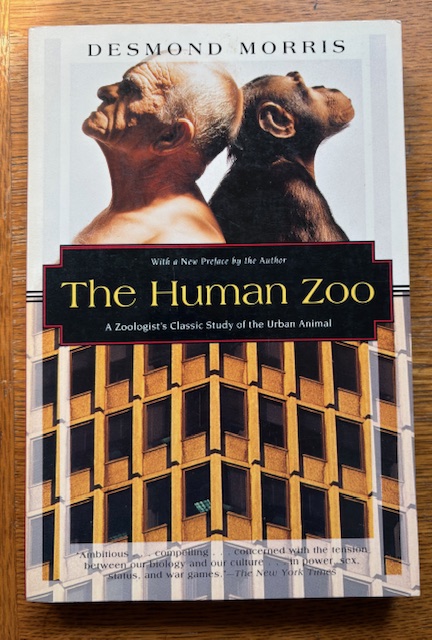
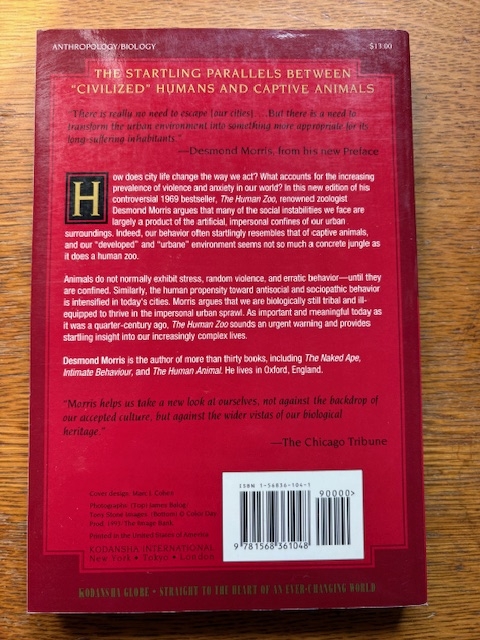
My wife Kyle Gallup and I had the good fortune to meet Mr. Morris in Oxford, England, in 1991, when I was republishing two of his most popular books, The Human Zoo and The Naked Ape as part of the Kodansha Globe nonfiction trade paperback imprint, a series I headed up, which focused on books of natural history, cross-cultural studies, anthropology, adventure, and beyond. It was a  sort of nonfiction precursor to the NYRB series of today.

Kyle and I happened to be visiting Britain and traveled from London to see Morris in Oxford, where we also were meeting a librarian I knew at the famous university, A. J. Flavell. After Mr Flavell gave us a fascinating tour of the Bodleian Library, including its many stacks below ground level, we met up with Desmond, who offered to drive us around Oxford’s picturesque environs in a cream-colored Rolls Royce he owned. He was a very gracious host.

Douglas Martin reports that Morris “graduated with highest honors in zoology from the University of Birmingham in 1951. By the early 1950s, he was selling his surrealist paintings in London and Belgium and had directed two surrealist films. Dr. Morris subsequently attended the University of Oxford, where he studied under the animal behaviorists and future Nobel laureates Nikolaas Tinbergen, Karl von Frisch and Konrad Lorenz [Kodansha Globe would also publish Lorenz’s book Man Meets Dog]. Dr. Morris received a doctorate in 1954 with a thesis titled “The Reproductive Behavior of the Ten-Spined Stickleback.” Martin adds that Morris became curator of mammals at the London Zoo in 1959. Though he became a popularizer of serious science, he definitely had the full academic background to go with it.

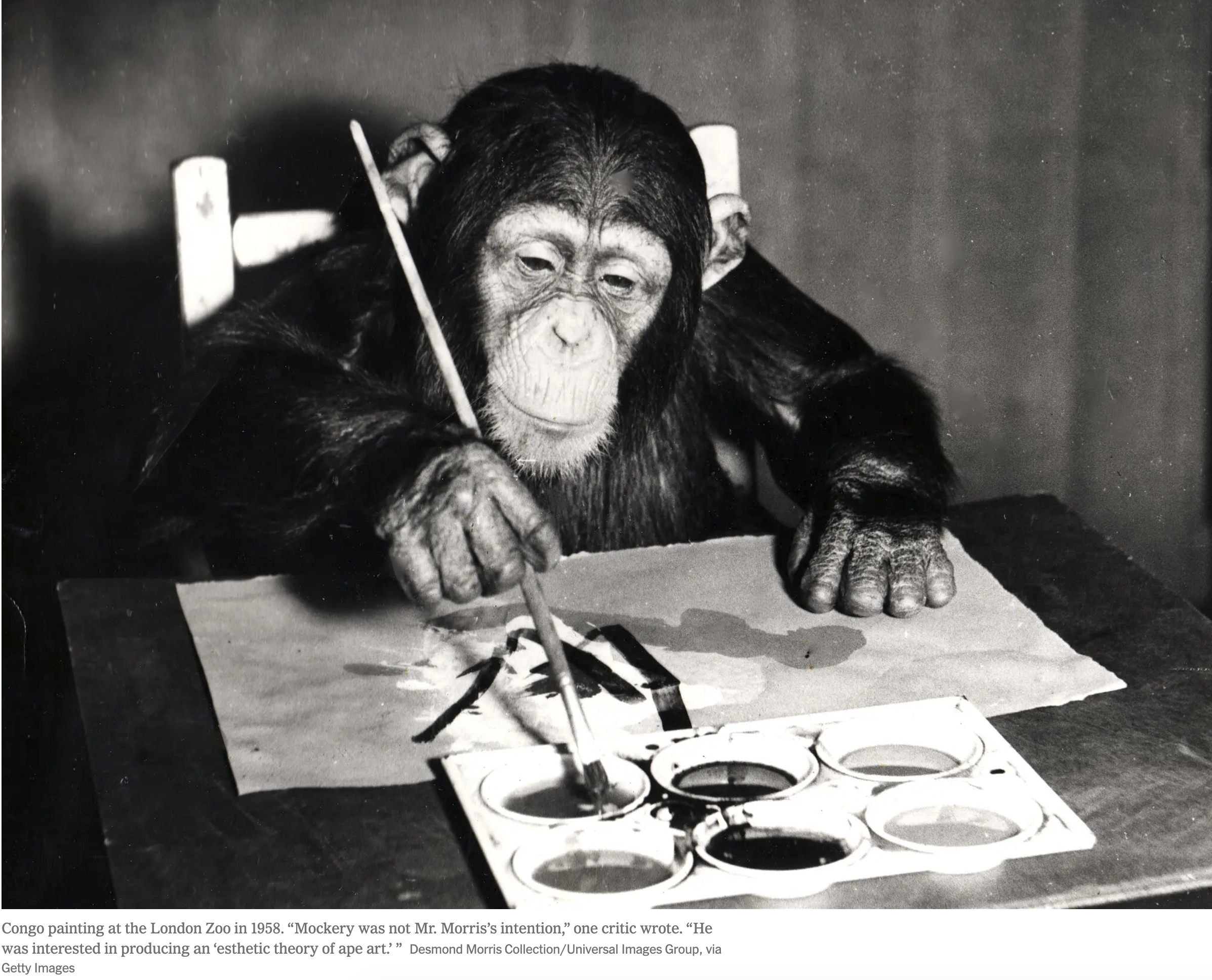
Arguably, his books mainstreamed the study of animal and human behavior like no writer before him had done. As mentioned, he also was a painter and also made a study of the question of possible picture-making among non-human primates. In 2018, he returned to art, publishing a book titled The Lives of the Surrealists. I was privileged to work with him back in the day.