A Favorite Film, “Treasure of the Sierra Madre,” With One of the Movies’ Greatest Laughs

CastI’ve seen “The Treasure of the Sierra Madre” many times, yet couldn’t resist watching it again when TCM aired the 1948 film this past Sunday night. It’s a great movie based on the mysterious B. Traven’s 1935 novel, The Treasure of the Sierra Madre. Its scenes unfold inexorably like the movements of a symphony. Walter Huston (Howard), Bogart (Fred C. Dobbs) and the too-little seen Tim Holt (Curtin) form the amazing core of a powerful cast. Howard is the moral center of the movie, possessing shaman-like wisdom and healing powers. As played by Huston, he also displays one of the most prodigious laughs I’ve ever seen or heard in the movies. At the film’s climax, as it becomes clear that all their dreams of wealth have gone up in dust, he gives vent to a laugh that seems to mock all human vanity and grandiosity, at which point Curtin also sees the cosmic humor in their dashed dreams, and he joins Howard in laughing at the outcome of their quest for riches. I just love their expressions and so took pictures of my TV at that point, with the rest of those photos, and other relevant images, at the bottom of this post.

Walter’s son John Huston, years later seen on-screen as character Noah Cross in “Chinatown” wrote the screenplay of “Treasure” and directed the film, winning an Oscar for each of those, while Walter won the statue for Best Supporting Actor.

Two more great movies with Walter Huston in leading roles are “American Madness” (1932), directed by Frank Capra, where he plays a Depression-era bank president preventing a run on his bank. The film celebrates the welfare of ‘the little people,’ not dissimilar to “It’s a Wonderful Life.” I also love “Gabriel Over the White House” (1933), directed by Gregory LaCava, who also worked with W.C. Fields, where Huston plays the president of the United States. At the outset, his President Hammond is unconcerned about the plight of the masses suffering in the Depression, and (in an evocation of the pleas of the real Bonus Army that FDR faced) he’s planning to crush the protests of the veterans massing outside the White House. However, after sustaining a providential blow to the head in a car accident, he turns over a new leaf and offers succor and hope to the desperate vets. Please click here to see all photos.

Album Covers as Art, or How Jazz LPs Changed Our World

IMG_0442Thursday night my wife and I greatly enjoyed the reception and opening for the new exhibit, “Jazz. Covers. Politics–Album Art in an Age of Activism.” We had been invited by Elisa Pritzker, artist and art curator, who assisted Nathan Cummings Foundation and Romare Bearden Foundation staff in mounting and hanging the show. They’ve assembled over 150 album covers as examples of social activism from America’s civil rights struggle, the opposition to the Vietnam War, and the campaign to end apartheid, among many other historic milestones shown.Brochure cover

The musicians and albums on display constitute a veritable hall of fame of jazz recordings, including Max Roach’s “We Insist!,” the signature piece for the whole exhibit, that used for its cover a news photograph of three African-American activists sitting in at a segregated southern lunch counter, as they and the white-uniformed counterman, all eye the camera challengingly; Nina Simone’s “Emergency Ward!,” with its backdrop of war headlines from daily newspapers; and Duke Ellington’s “Liberian Suite,” with its red masks, and his “Afro-Eurasian Eclipse,” with a tableau showing dozens of faces from the human family. The artists whose work is found on these covers are equally important, from Jacob Lawrence’s painting decorating a Jelly Roll Morton LP to several Romare Bearden works, on Wynton Marsalis, Billie Holiday, and Ricky Ford covers. There’s so much more on these walls: Miles Davis’s “Bitches Brew,” Paul Robeson’s “Songs of Free Men,” Marvin Gaye’s “What’s Going On,” and dozens more.

The spacious quarters of the Nathan Cummings offices on Tenth Avenue were ingeniously used to hang the album covers, as each time we turned a corner there was something new and splendid to see and read about, with insightful text alongside the images. In addition, a room was set aside for a listening booth where we sampled the music from the albums on display, and another room was reserved for a video about the album covers, musicians, and artists. The exhibit can be seen Monday-Friday, by appointment via email to exhibits@nathancummings.org. It will be up through August 23, so if you’re in NYC I urge you to make plans to see it. As an indication of the wealth of material on display, here are some pictures I took during our tour of the exhibit last week. Click here to see all photos

Open Culture–Great Site for Free Film Noir

One of my favorite films is “Out of the Past,” the 1947 classic with Robert Mitchum, Jane Greer, Kirk Douglas, and Rhonda Fleming. I’ve watched it many times, and enjoy it so much that when I re-view it now the scenes seem to unfold like movements in a symphony. Because I love it do much, I’m always on the lookout for other noir-ish standouts. If you don’t know “Out of the Past,” please see the visuals below, the box on my old VHS copy of the movie, and the jacket of the pseudonymous Geoffrey Homes’ book, Build My Gallows High, which he adapted in to the screenplay, under his real name Daniel Mainwaring. Given my fondness for film noir, and crime and detective fiction, I was recently delighted to discover that OpenCulture.com, which describes itself as “The best free cultural and educational media on the web,” has assembled a site with access and links to 475 movies, many noir flicks, all free of charge to watch.

As indicated in the tweet above, Kyle and I saw a good one last night, chosen almost at random from among Open Culture’s offerings. Set in San Francisco, Brian Donlevy plays a husband who survives a murderous attack on him by his adulterous wife’s lover. Minutes later, the attacker is himself killed, and Donlevy, who had first been assumed dead, later surfaces alive, only to be accused of murder. It’s filled with surprises and twists, and excellent performances–from the avuncular Charles Coburn as a police detective with an Irish brogue and Ella Raines, a beauty we had never seen on screen before, as Donlevy’s love interest, counterpoint to his vindictive wife. The sound and picture quality were excellent. It’s clear we’re going to be working our way through Open Culture’s vast collection.
* If, like me, you’re big fan of Robert Mitchum, I must also recommend Lee Server’s galvanic biography, Robert Mitchum: “Baby, I Don’t Care” (the subtitle is a line from “Out of the Past”).
Out of the PastOut of the Past back coverBuild My Gallows High

Update on Alamo Drafthouse Cinema–They’re Really Coming to Manhattan!

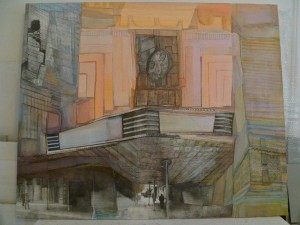
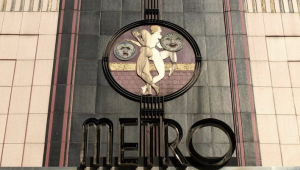
Alamo MetroIn the past year I’ve blogged twice about the announcement and expectation that Austin-based Alamo Drafthouse Cinema is really going to renovate the Metro theater in my Manhattan neighborhood and show movies there. However, despite press releases from Alamo that I’ve cited in my coverage, there’d been no sign of progress, leaving myself and others in the area unsure if it’s really going to happen. Finally, a banner on the old marquee I spotted the other day (pictured at the left) seems to make their plans clear at last: They’ll be opening in 2014. Here’s what I wrote about Alamo last summer:

[They’ve] begun seeking the city permits required to begin gutting the interior and renovating the space to accommodate the five screens and viewing spaces they envision for the theater which first opened to the public in 1933. For readers unfamiliar with the site, the classic Art Deco marquee–[seen below] in a photograph and below in a painting by my wife Kyle Gallup–has landmark status and will be preserved as is, though the interior has no similar exemption. I’m very pleased with this news, and look forward to having them in the neighborhood, perhaps in 2013, or the next year.
Metro-Theater-marquee-Kyle-GallupMetro-Theater-Alamo-fb-page

Turk Pipkin’s Documentary “Building Hope” Builds Empathy & Community

Turk Pipkin 2On a recent Tuesday night I went to the Tribeca Cinema for a screening of “Building Hope,” a documentary written, directed, and narrated by actor and author Turk Pipkin, who with his wife Christy also operates  The Nobelity Project. The film chronicles the building of the Mahiga Hope High School in rural Kenya, which now completed, is educating more than 800 students  each year. The film got an Audience Award at SXSW in 2011 and it’s easy to see why–it’s very watchable and moving, with a genuinely uplifting message, all without lapsing into saccharine simplicities. The school they designed and built with the labor of local tradespeople is also a model for sustainability, as they engineered an adjacent basketball court whose roof catches and saves rain water, providing much of what’s needed for the entire facility, in this region prone to drought. I highly recommend the film for anyone interested in education, the progress of young people in the developing world and sustainable design. It’s also a tight narrative with many memorable characters, just a fine nonfiction film.

At a restaurant near the Tribeca Cinema afterward I met an Austin native now living in Brooklyn, musician and singer Kat Edmonson, who wrote a song that’s in the soundtrack of “Building Hope.” It was fun talking with Kat and her boyfriend, Aaron, also in the music biz. Since that night I’ve enjoyed listening to her music. At Kat’s website, you can listen to a free download of her winsome love song, “Nobody Knows That.” When Turk sat down at our table, it was clear that she and Turk go back a ways. A thoughtful, friendly Texan, Pipkin’s visit to NYC coincided with the availability of the companion Building Hope book, and the imminent availability of the documentary in ITunes. I’m surprised to say, though Pipkin has written 10 books, I wasn’t familiar with him until Jette Momant of PR by the Book in Austin invited me to the screening. I’ve since learned he had a stand-up career doing comedy on the road with Rodney Dangerfield; appeared as the ping pong ball juggler in “Waiting for Guffman,” Christopher Guest’s 1996 mockumentary; written many TV shows; played a recurring character in “The Sopranos”; published two novels, one with Algonquin Press; and co-authored The Tao of Willie, with Willie Nelson, who also appears on-screen in “Building Hope.” Here’s a clip from this exceptional documentary, and below the video are photos, most of which I took at the screening, some of the film itself on screen: (Please click here to see all the photos.)

Windy Hudson River Bike Ride Photos

I shared a couple of these photos on Instagram earlier, but here are two others. They were all taken on a break during a very windy bike ride this past Saturday. Standing on a bluff above the Hudson River as as an intense, dramatic sunset glowed across the whole skyline, I am in upper Manhattan at about 165th Street, looking south down the river back toward the city. Though I’ve often ridden in strong wind along the Hudson, the gusts usually come from one direction. Saturday, they swirled and came from all points of the compass.