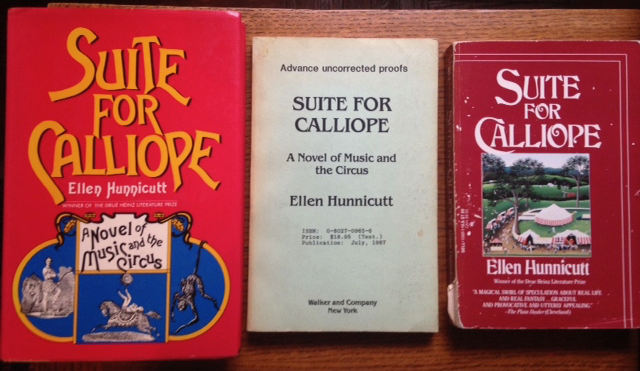
 I discovered Ellen Hunnicutt and her novel in my first publishing job, a six-week stint I did at Scribner Publishing as first reader/contest judge for the Maxwell Perkins Prize, named in honor of the house’s venerable editor of many important writers including F. Scott Fitzgerald, Thomas Wolfe, and Ernest Hemingway. Mildred Marmur, Scribner’s publisher at the time, then and since a great friend to me and many other publishing people, gave me what became my first break in publishing. I’d been referred to her to inquire about a full-time editorial job; I made an appointment, went to see her and introduced myself, explaining I’d worked in my family’s bookstore business for seven years, and wanted to become an editor. She said she had no full-time editorial positions open, but there was the Perkins contest to judge, and a conference room full of mailed submissions awaiting the attentions of a first reader. As a bookseller I’d read and sold A. Scott Berg’s Maxwell Perkins: Editor of Genius and was thrilled with the job. Working three days each week, I sat in Scribner’s conference room with jiffy bags and manuscripts stacked up around me like drying cord wood. My assignment was to unpack all these mailers and read between 5-50 pages of each entry, fill out a brief questionnaire, and signal a thumbs-down or -up for a possible second reading by the full-time editorial staff. Coincidentally, I recommended 70 entries, or 10%, for second readings. There was one entry I really loved, by a writer called E.M. Hunnicutt, for which I eagerly read far more than the 50 pages. My recommendation of it was more enthusiastic than for any other candidate, but it didn’t win the prize. Before finishing the job, I wrote down the author’s phone number and made a copy of the manuscript.
With this first stretch in the ink mines under my belt, I did soon get my first full-time editorial job, at Walker & Company, then a sleepy publisher of young adult non-fiction and genre fiction (Westerns, mysteries, Regency romances, etc.), published mostly for libraries. My genre was to be “men’s adventure.” Still, Walker had in its early years published books by John Le Carre and Flann O’Brien, so I was hopeful that I wouldn’t only be acquiring the male equivalent of bodice-rippers. My first week at Walker I called the E.M.-initialed author and soon found myself talking with “Ellen” Hunnicutt. She told me she’d long used the initials to disguise her gender, since she had sold many stories to Boys’ Life over the years. I told her how much I had liked reading her draft manuscript, with its compelling narrator, Ada, an adolescent girl and musical prodigy who’s fled a bizarre custody battle that engulfed her family in the wake of her mother’s death. She’s sought safe harbor amid a circus troupe that’s wintering over in a quiet Florida camp and found solace in composing a requiem for her late mom on the troupe’s calliope. Ellen and I hit it off beautifully and her novel became the first original manuscript I ever acquired. Over the year that followed, Ellen and I engaged in a vigorous dialogue about her novel and its theme–the creative purposes to which suffering and mourning may be put. In the course of my editing and her revising, Ellen became reinvigorated with her own book, which she’d earlier thought she’d finished. In the course of the edit, she told me about other circus and carny writers, like Jim Tully, whose his 1927 book, Circus Parade she praised for its unsentimental portrait of the raffish big-top life, which influenced her work. She explained she’d read many of Tully’s books early in her life and that his fiction and nonfiction chronicles of hobo life, circus characters, and the down-and-out of the Great Depression had still been widely read when she was a young woman.
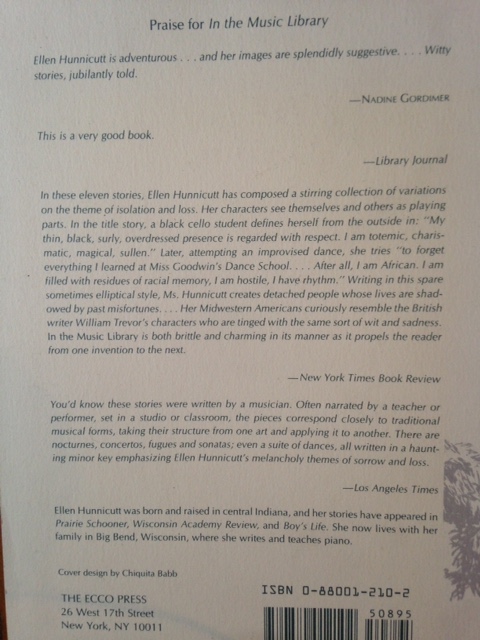
For the record, I should add that before Suite for Calliope was published in July of 1987 it received a starred review in Kirkus*; later, Dell bought the paperback rights, and Walker sold out its first hardcover printing. The starred Kirkus happened to land on my desk on May 4, a fateful date on my perpetual calendar: the anniversary of the shootings at Kent State in 1970, the date that Undercover Books opened for business in 1978, and Ellen Hunnicutt’s birthday, which I didn’t even know when I phoned her with the news and read it to her, in this time before fax machines were common, affording me the opportunity to place one of the happiest birthday calls I’ve ever made. And then, before the novel went to the printer, Ellen was notified she’d won the Drue Heinz Literature Prize for her short fiction, described in the Facebook post above, and that the senior judge for the award had been Nadine Gordimer, who wrote in her citation: “Ellen Hunnicutt is adventurous… and her images are splendidly suggestive….Witty stories, jubilantly told.”
Working with Ellen was a great privilege and affirmed my ardent interest in modern nomads and the circus life. For a 2004 Carroll & Graf anthology, Step Right Up: Stories of Carnivals, Sideshows, and the Circus, my editorial colleague who made the selections, Nate Knaebel, smartly chose to include a chapter from Suite for Calliope, which he wrote “describes the anticipation of opening day at an Indiana circus, and a near tragedy averted by the power of music.” Nate also included “With Folded Hands Forever,” a dark passage from Tully’s Circus Parade.
Ellen kept writing in the years that followed, and we remained in touch. However, I’m sad to report that the two books Ellen published in 1987 would be the only books she published in her lifetime, which came to an untimely end in 2003. She was 72. If you’re intrigued by the themes and motifs of her work, I urge you to seek out her books. As for Drue Heinz, the obit from the Pittsburgh Press-Gazette is linked to here. http://www.post-gazette.com/news/obituaries/2018/03/30/Drue-Heinz-former-publisher-of-The-Paris-Review-dies-at-103/stories/201803300124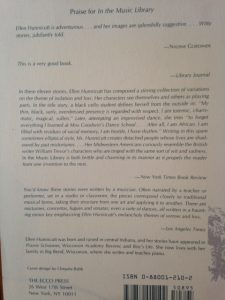
The starred Kirkus review of Suite for Calliope:
“An extraordinary first novel that, in its remarkable inventiveness, intelligence, and charm-struck humanity, should draw—and more than richly reward—readers of almost every inclination. Ada Cunningham, of Richmount, Indiana is the partly crippled daughter of gifted and highly eccentric parents: a journalist mother who declares Ada to be a prodigy, raises her as such (with flamboyant elan), then dies suddenly when her daughter is eight years old; and a father who is a musical genius, who came from poverty and was a transient violinist and artful dodger as a child, who gives Ada music lessons from the time she’s three, and who is committed to an asylum before she is 16. Life with these parents–as described by the brave, unflinching, quick, forgiving, and heartwrenchingly observant Ada–would be matter enough for many a novel, but this one soars on toward farther ends that keep the reader wide-eyed and enthralled. There’s a penetrating mystery at the heart of it all, and, before its solution: an aunt who comes into the picture with malevolent aims (she may even want to murder Ada), a burned house, legal proceedings–as result of all of which Ada, accused of being both a witch and a madwoman, flees Richmount and takes to the road (as her father did before her), supporting herself by her wits and by her gifted piano playing (in brothels and bars), until at last she finds sanctuary and refuge in the winter quarters of a circus troupe–with setting, color, and cast of characters worthy of yet another novel–where she becomes (and remains) calliope player, composer, and loved member of this wondrous new “family.” A summary leaves out far too much: the sturdy grace of Ada’s never-self-pitying voice; the continual feast of homely detail, and detail of music, musicians, and musical instruments, as weft as of the circus and its people; and the breathtaking symbolic depth of the whole, which, touched by the hand of this gifted writer, serves to place Ada’s birth, her flight, and her high artist’s quest among very august novelistic company indeed. A prodigiously masterful novel of profundity, breadth, and continual delight: waiting now only for what ought to be its very, very many readers.”

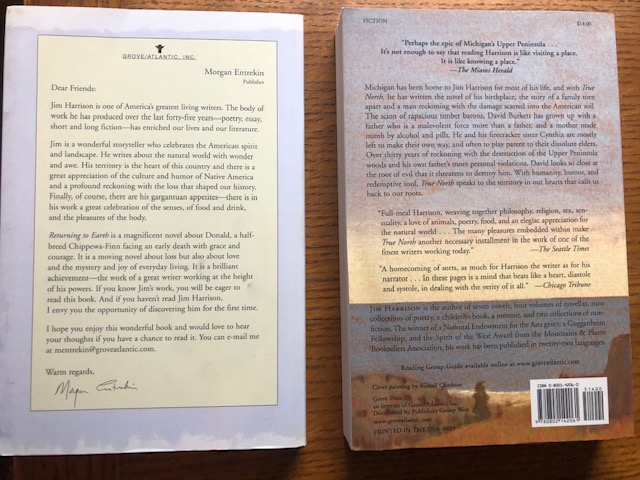
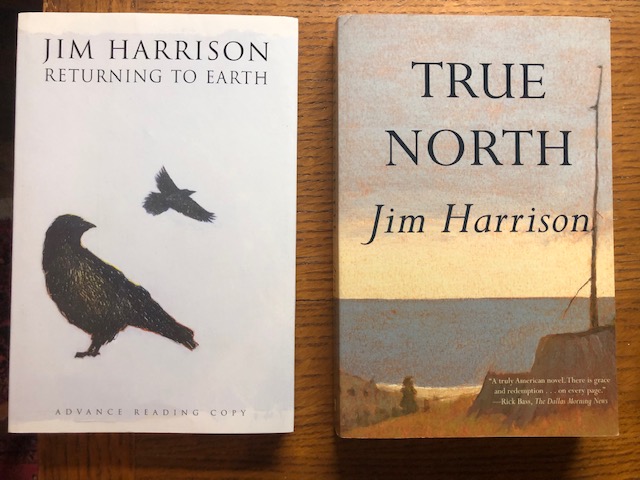
 I’m very excited to announce that under the banner of my literary agency Philip Turner Book Productions I’ve sold Devouring Time: Jim Harrison, a Life to Blackstone Publishing in print, ebook, and audiobook, on behalf of my author client Todd Goddard, associate professor of literary studies at Utah Valley University. This will be the first biography to chronicle the fascinating, large life of the acclaimed poet and fiction writer (1937-2016). Goddard will examine all aspects of Harrison’s creative life, and how he incorporated major life milestones in to his work. Among those momentous events:


 Posted with Blogsy