Remembering Woody Guthrie’s Sad Convalesence at Greystone Hospital

Wardy Forty postcardFriday night at Valentine, the gallery in Ridgewood, Queens, Kyle and I attended the opening of a very powerful exhibit, “Woody Guthrie’s Wardy Forty,” also the title of an accompanying book by photographer and curator of twentieth century ruins Phillip Buehler. It refers to the name Guthrie himself assigned to the section of Greystone Psychiatric Hospital, in Morris Plains, NJ, where he lived from 1956-61. On WoodyGuthrie.org, the site maintained by the late folksinger’s daughter Nora, the biographical sketch of Woody explains the circumstances surrounding this chapter in his life (edited for length below, I suggest you make time to read the whole sketch):

“Toward the late 1940s, Woody’s behavior started to become increasingly erratic, moody and violent….He was beginning to show symptoms of…Huntington’s Chorea, a hereditary, degenerative disease that gradually and eventually robbed him of his health, talents and abilities….It was later discovered to be the same disease which thirty years earlier had caused his mother’s institutionalization and eventual death. Shaken by inexplicable volatile physical and emotional symptoms, Woody left his family…taking off for California with his young protégé, Ramblin’ Jack Elliott….Woody met Anneke Van Kirk, a young woman who became his third wife….Becoming more and more unpredictable during a final series of road trips, Woody eventually returned to New York with Anneke, where he was hospitalized several times. Mistakenly diagnosed and treated for everything from alcoholism to schizophrenia, his symptoms kept worsening and his physical condition deteriorated. Picked up for ‘vagrancy’ in New Jersey in 1954, he was admitted into the nearby Greystone Park Psychiatric Hospital where he was finally diagnosed with…the incurable degenerative nerve disorder now known as Huntington’s Disease or HD. During these years, Marjorie Guthrie, family, and friends continued to visit and care for him. A new generation of musicians took an interest in folk music bringing it into the mainstream as yet another folk music revival. Joan Baez, Bob Dylan, The Greenbriar Boys, Phil Ochs, and many other young folksingers visited Woody in the hospital, bringing along their guitars and their songs to play for him, perhaps even to thank him.”

For his part, Phillip Buehler explores, photographs, and appreciates modern ruins. His website is called Modern-Ruins.com. When he stumbled on to Greystone the grounds had been abandoned for more than forty years. As it’s described in an statement accompanying the exhibit,

“After coming across thousands of negatives in the deserted darkroom, he researched the hospital and discovered that Woody Guhtire once lived there. He reached out to Guthrie’s daughter Nora…who gave him Guthrie’s case number. Buehler was then able to pull negatives from Guthrie’s file…beginning a ten-year journey that led to Wardy Forty: Greystone Park Hospital State Hospital Revisited.”

Copies of the book, a landscape format photography album with illuminating captions and text, were on hand at Valentine, while on the walls were hung small snapshots, many black & white, of Woody and family at Greystone; large format 4-color photos of the crumbling structure that was Greystone as Buehler found it; a slide show with the original text of Woody’s intake interview at the hospital running at timed intervals, which strikes the viewer with the singer’s innocence of the fact that his interlocutors seemed as it went along to increasingly believe he was mentally ill; and projected images of photographs taken of Woody at widely differing times, sadly showing his inexorable decline in health and demeanor. In a hallway off the main room is a display of intake photos of many Greystone patients with their patient number hovering above them, including that of Woody.

Nora Guthrie and Phillip Buehler were both on hand Friday night at Valentine. When Kyle and I came upon them, they were talking among themselves, but they welcomed us into their conversation and we enjoyed talking over the next little while. Nora told me with enthusiasm about the Woody Guthrie Center in Tulsa, Oklahoma, which she’s recently helped to establish in her father’s home state. She explained that it’s a study center for researchers, an educational facility for students of all ages, and a concert space for live music performances. Nora’s a warm and friendly person and it was a privilege to meet her this night. Buehler is also full of enthusiasm for his enterprises, and I was excited to tell him I share his interest in industrial archaeology and physical artifacts, as with my website photography of maritime and architectural artifacts, such as the Little Red Lighthouse and the Great Gray Bridge.

I recommend you check out Phillip Buehler’s book, which A.M. Homes has called “hauntingly beautiful.” It is available for purchase at WoodyGurthrie.org. I also urge you to see the exhibit, which will be up at Valentine until April 13. Below is more info on the exhibit and the gallery, along with pictures I took the other night, including this one of Nora Guthrie and Philip Buehler.Nora Guthrie&Philip Buehler

Night II of the NBCCs–Book Prizes Awarded

Monday March 17 update, video of the NBCC Awards ceremony:


—–
NBCC finalThe concluding evening of the National Book Critics Circle annual awards last night at the New School auditorium was a jubilant celebration of the book with generous recognitions given to critics and authors alike. Having enjoyed the author readings on Wednesday night I was eager to hear who the winners would be. The program began with remarks by NBCC president Laurie Muchnick, reminding the audience that members of the organization spend months each year reading and keenly debating the merits of all the books in the six categories. With the housekeeping taken care of, the procession of awards began.NBCC final ii

First up it was time for a new award, the John Leonard Prize, named in memory of the longtime NBCC member and ebullient NY Times reviewer.  Each year it will be given to an author for a first book, in any genre. It had earlier been announced that Anthony Marra, author of A Constellation of Vital Phenomena (Hogarth Press at Crown Publishing) was the inaugural recipient. His novel is set amid the war in Chechnya. Then, Katherine A. Powers, who has a regular books column in the BN Review, received the NBCC’s Nona Balakian Citation for Excellence in Reviewing. She gave a congenial talk setting forth her own principles of reviewing. Among these was that she tries to avoid lordly pronouncements of approval or condemnation, as if she were representing some “cohort of worthies.” She declared herself in service to the reader and the author, and quoted a memorable line from H.L. Mencken: “Criticism is prejudice made plausible.” Next, pioneering man of Hispanic letters Rolando Hinojosa-Smith received the Ivan Sandrof Lifetime Achievement Award for his contributions to the literature of Mexican-Americans.

After naming all five poet finalists, chair of the Poetry committee David Biespiel began the presentation of awards that, unlike the three above, were not decided until yesterday afternoon, only a few hours before this ceremony. After naming all the poet finalists while their four book jackets flashed across the on-stage screen, David announced that Frank Bidart was the recipient of the NBCC for his book Metaphysical Dog (FSG). Bidart brought some papers to the lectern, and joked that each time he’s nominated for something, he prepares remarks and when he doesn’t win, files them away, continually adding to them each time he’s on a shortlist. This got a laugh from the audience, especially, after he said, “It’s true.” In fact, his acceptance speech was an elegant one. He described himself as a neo-modernist, not a post-modernist, saying he didn’t feel the need to be in conflict with his poetic predecessors. As to his own work, citing the words of a critic who upon hearing Maria Callas for the first time had written that the experience was like “biting in to a lemon,” he offered a hope that his own poems offer readers a similarly astringent quality. Quoting a great sentence from King Lear, “Ripeness is all. Come on.” Bidart pointed out that profound as it is, it’s not actually the last line of the scene. Instead, Gloucester points playgoers to the plurality of existence, uttering, “That’s true, too.”

Next, the award in Criticism was given to Franco Moretti for his book Distant Reading (Verso Press), with essays that use data, charts and other apparatus to consider reading in new ways. With Moretti’s arrival at the lectern he made a confession that held true the rest of the night: he had not expected to win and didn’t prepare remarks. He had a lovely Italian accent and the audience found him charming.

With a new precedent oddly established by Moretti, each of of the four recipients who followed uttered a version of the same thing, accepting the award graciously, and briefly. As it happened, four times in a row, the audience laughed a little more at it, as the recipient would sheepishly cop to his or her forgivably mild dereliction. Mild because audiences always expect to be held for a long time, and this was a veritable vacation from standard awards palaver.

Autobiography committee chair Eric Banks announced Amy Wilentz and her book on Haiti, Farewell, Fred Voodoo (Simon & Schuster), as the recipient of the NBCC. Once behind the lectern Wilentz explained that she’d written earlier books on Haiti–a country she called her “muse”–and this one was the most autobiographical of them, but she implied that because it wasn’t a proper autobiography she had really expected a different winner to be called up to the stage. And her category was very strong, filled with great writers of first-person narrative, a favored genre of mine. Next up, Leo Damrosch, winner in Biography for Jonathan Swift: His Life and His World (Yale University Press), said that he’d always written for academics and so doubted his book would be selected. He was off before I could take a picture, so the one with this post is the one I took the night before, at the readings. Sheri Fink, whose Five Days at Memorial: Life and Death in a Storm-Ravaged Hospital (Crown Publishing) I first heard about when her editor Vanessa Mobley presented it at last year’s BEA Buzz panel. Fink seemed truly taken aback at this recognition given to her book. For the last award, in fiction, Chimamanda Ngozi Adichie of Nigeria allowed as how she had been so tickled to be on the same shortlist as her former professor, Alice McDermott, she just hadn’t thought her novel Americanah would win. As she walked to the stage, she shouted in jubilation, a celebration the audience audibly shared with her.

With that the ceremony–in a tidy 90 minutes–was over. Most of the audience repaired to another New School building one block away for the gala reception. A hungry and thirsty crowd met there and partied for a much greater stretch of time than the ceremony’s duration. During the party I met and spoke with many of the finalists: critic Katherine A. Powers; poet Denise Duhamel; essayist Franco Moretti; Marianne Moore biographer Linda Leavell; Whitey Bulger chroniclers Kevin Cullen and Shelley Murphy, and their editor at W.W. Norton, Tom Mayer; observer of New Orleans’ tragic triage, Sheri Fink; novelist Ruth Ozeki; and one of my favorite writers at The New Yorker, Lawrence Wright, whose reading from Going Clear I had found so chilling the night before. I also enjoyed talking with NBCCers Walton Mayumba, Karen Long, Anne Trubek, Tom Beer, Eric Liebetrau and his writer wife, Signe; Ron Charles; and Marcela Valdes. Also enjoyed meeting for the first time one of my favorite tech writers, Andrew Leonard, there celebrating the memory of his father John Leonard; book agent, Andrew Blauner; editor Philip Marino of Liveright; journalist Casey Schwartz, Riverhead Books publicist Katie Freeman; and indie publicist Michelle Blankenship. Below are my pictures from last night. If you enjoyed this post, don’t miss its counterpart on the readings.

Finalists’ Readings at Last Night’s NBCCs

Monday March 17 update, video of the NBCC Readings night:

—–
NBCC readingsAs I try to do every March when the calendar comes round to the annual awards week of the National Book Critics Circle, I attended last night’s program of readings given by many of the nominated finalists. To the left is the evening’s program. Highlights were numerous, including Chimamanda Ngozi Adichie’s humorous narrator’s observations about blogging, of all things, from her novel, Americanah; Alice McDermott, with a carefully paced reading from Someone; Ruth Ozeki’s rendering of the book-within-a-book in A Tale for the Time Being; I later had a nice conversation with Ozeki about a favorite novel of mine that also has a book-within; Denise Duhamel read a narrative poem that cleverly portrayed a bickering couple observing a bickering couple from a distance, from her collection Blowout; Hilton Als, with a personal essay about Malcolm X and his mother, from White Girls; Rebecca Solnit read a passage from The Faraway Nearby about a basket of fragrant apricots; Amy Wilentz’s evocation of a chaotic street scene in Haiti from Farewell, Fred Voodo; Scott Anderson with T.E. Lawrence’s surprising refusal of a knighthood from the British monarch; Leo Damrosch’s bawdy portrait Jonathan Swift in His Life and His World; Sheri Fink’s shocking chronicle of doctors and nurses in Katrina-stricken New Orleans resorting to euthanasia in Five Days at Memorial; George Packer’s grim rendering of societal decline, typified by a Rust-belt denizen in The Unwinding; and Lawrence Wright’s chilling account of brow-beating and mistreatment among scientologists in Going Clear.

All day today, NBCC board members will be making their final selections from the shortlists. I look forward to going back tonight to The New School auditorium in Greenwich Village for the ceremony, and for the festive reception that follows. The NBCC is a great organization of dedicated readers and writers. You can follow them on Twitter, @BookCritics, and check them out on the web, NBCC. Writing students at The New School interview each of the finalists, so you can also look for those videotaped conversations on the NBCC site. If you live in New York City, I recommend you attend the readings and/or the awards night, for  these are two of the best literary nights of the year. Both events are free of charge, with only the fund-raiser/reception having an admission fee. If you want to support the work of the NBCC and their awards–the only book prizes given by full-time critics and reviewers–you can sign up to become an associate, non-voting member. I renew my membership each year. Here are the best pictures I took from my seat last night.

Lee Lorch, an Exiled American Hero Who Found a Haven in Canada

Until reading this March 1 obituary by David Margolick about Lee Lorch I had not known about this brave man, or the vital role he played in ending racial bias in publicly-subsidized housing in New York City and the rest of the United States.

A WWII vet, Lorch came home from the war amid a nationwide housing shortage that was particularly severe in New York City. Then living with his wife Grace and daughter in what the NY Times reports Lorch called “‘half a Quonset hut’ overlooking Jamaican Bay in Queens,” he applied to live in the housing complex of Stuyvesant Town then being developed on the east side of Manhattan by Metropolitan Life Insurance Company with generous subsidies and accommodations from the city. He learned that African-Americans were explicitly barred from living in the development, as Met Life’s chairman Frederick Ecker told news media, “Negroes and whites don’t mix. If we brought them into this development, it would be to the detriment of the city, too, because it would depress all the surrounding property.” The Lorches and fellow tenants invited African-American families to come stay in there apartments as their guests, a move that drew Met Life’s ire and threats of eviction.

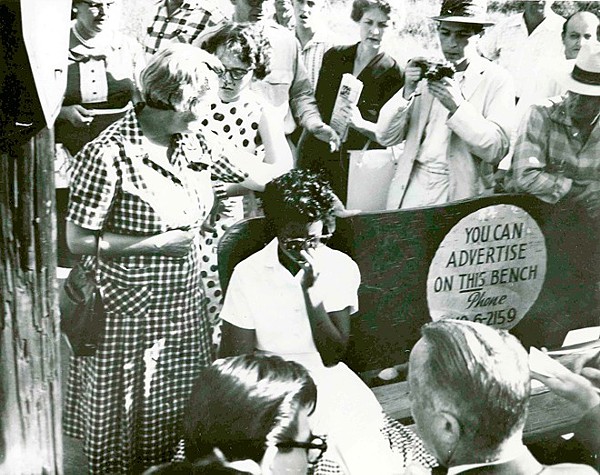
As a result, Lee Lorch lost his job teaching math at City College, and was made unwelcome at other universities where he applied to teach, including Penn State, which hired and then fired him in less than a year. For a time, he and his family were in Little Rock, Arkansas, where in 1957 Grace famously comforted Elizabeth Eckford, one of the “Little Rock Nine,” as she tried to attend Little Rock Central High School.Grace Lorch and Elizabeth Eckford

In addition, Lorch’s unapologetic membership in the American Communist Party caused civil rights leaders, including Thurgood Marshall, to keep their distance from him. After years of erratic employment in the States, in 1959 Lorch was offered a teaching position in Calgary, Alberta, Canada, and later York University in Toronto. The Lorches emigrated and much like young draft-age American males of the Vietnam era, the Lorches found a new home and haven north of the 49th Parallel.

Lorch lived a remarkable life, and one that should be remembered. In addition to the March 1 NY Times obit and a 2010 article, here are other Web resources:

1) Video with a 2010 interview of Lee Lorch

2) A segment with Lee Lorch’s daughter Alice from CBC’s As It Happens, remembering her father and the family’s life in Canada.

3) A review of David Margolick’s book Elizabeth and Hazel, on Elizabeth Eckford, of the Little Rock Nine, and Hazel Bryan, a white woman who yelled at her as she tried to enter Central High School in 1957.

4) An Arkansas Times Web feature with lots more information on the Little Rock Nine.

Cross-posted on my blog Honourary Canadian.

Pete Seeger Tribute Night at the Jalopy Tavern

Jalopy photoAs a follow-up to the post below, Celebrating Pete Seeger & Enjoying “Mr Personality”–a Music-filled Weekend in NY, the Pete Seeger tribute turned out to be a fun night. The program, well organized by folksinger Jan Bell, was held at the Jalopy Theatre in the Red Hook section of Brooklyn. The Jalopy, and its next-door tavern, are a combined performance space, instrument store, bar and restaurant. About ten acts peformed Sunday night, playing from a single song to several tunes. Most of the songs were compositions of Seeger’s, or songs the performers believed influenced Pete, or were influenced by him. Proceeds from the sold-out show benefited WhyHunger, a social service organization that is a legacy of the great singer and activist Harry Chapin. $900 was raised to support their important work.

Below are pictures from the show, with captions describing what the artists played. In addition to the musicians pictured here, artists who performed at the tribute included: Tamar Korn, Ernie Vega and Samoa Wilson, Wyndham Baird, Geoff Wylie, and Feral Foster. If you’ve never been to the Jalopy, I recommend you take in some shows there. The venue offers great company in a mellow setting, superb musicians, and very fair admission and food and drink prices. Also, please note that April 18-20, the Brooklyn Folk Festival, organized by Eli Smith (pictured below) will be held at Bell House. I give the Jalopy and the Festival my highest recommendation.

Celebrating Pete Seeger & Enjoying “Mr Personality”–a Music-filled Weekend in NY

Good musical weekend unfolding. Tonight Kyle, Ewan, and I are going to a Pete Seeger tribute show at the Jalopy Theatre in the Red Hook section of Brooklyn. We enjoy the music and the community that surrounds the Jalopy, where one of the house bands is the Downhill Strugglers, a group that includes people who will be playing tonight, such as John Cohen, founding member of the New Lost City Ramblers, Eli Smith and Jackson Lynch. Smith is the founder of the Brooklyn Folk Festival, coming up soon on its sixth year April 18-20 at the Bell House. I hope to post some photos and a report later on about tonight’s tribute to Pete Seeger.

Lloyd PriceWe kicked things off on Friday night when Kyle and I went to see rhythm & blues legend Lloyd Price, aka “Mr. Personality.” The hitmaker behind such chart-toppers as the eponymous “Personality” and “Stagger Lee” began his performing career in 1949, as a singer with a band that included Fats Domino on piano. He will turn 81 on March 9. We were guests of our friends Mike Shatzkin and Martha Moran, who also invited two other old friends of theirs. One was Linda Davis, originally from Liverpool, England. She still has a charming accent, if not, she says, as pronounced as it was when she first came to the States in the ’70s. She told us that back in the day she worked as a coat check clerk in dance halls where the local Liverpudlian music scene of the early ’60s unfolded. She saw twin bills with Gerry and the Pacemakers and the Beatles. Imagine! Mike and Martha’s other friend whom we enjoyed meeting was Tracy Young, a magazine writer. Linda and Tracy had also not met each other before then. All the ingredients were assembled for a great evening, thanks to Mike and Martha.

There was, however, a fly, or a flaw, in the soup: The venue stunk. It’s called The Cutting Room, and it should be cut out of the address book of any live-music fan who expects a club to be run to a minimal standard of consideration and courtesy, with fair value for the customer. I won’t even link to it because it really doesn’t deserve your traffic, either the Web kind or walk-in. I will though link to its Yelp page where my friend Mike left his comment which begins “This is the worst-run club in my 47-year history of going out to hear live music in New York City.” None of us will ever go there again. Fortunately, the company was first-rate and it was a special treat hearing the ebullient Lloyd Price, who moves around on stage, singing and performing with tremendous ease. Not only does he make it look easy, he does it all with great good humor. He put on a fun show with an excellent band that was so numerous on stage there were several horn players I never did actually see, given our partial view. Below is a youtube clip of his 1952 hit “Lawdy Miss Clawdy.” Also, more of the photos Kyle and I took from our perch above the stage.

http://youtu.be/nQZVufJfcG0