
Alamo Drafthouse Cinema Abandons Renovation of Metro Theater in NYC
@philipsturner Unfortunately yes. You can read our announcement here: http://t.co/oErOuiOUan
— Alamo Drafthouse NYC (@AlamoNYC) December 9, 2013
Despite earlier reports from Austin, Texas-based Alamo Drafthouse NYC that they would be renovating the Metro Theater on Manhattan’s Upper West Side on Broadway at 100th Street, word came today that actually the movie chain has abandoned those plans. This is a big disappointment for all denizens of my neighborhood who lament the lingering blight of recession upon our neighborhood, and had hoped that this new establishment would bring renewed life to this part of town. More’s the pity, since my wife, artist Kyle Gallup, had some years ago created a visual homage to the theater’s facade, which we hoped to see back up in lights sometime in 2014. Alas, it doesn’t look like it’s going to happen. Below you can see images of the banner on the Metro marquee that will presumably come down soon, a photo of the facade, and Kyle’s painting. 


RIP Saul Leiter, Important NYC Photographer Appreciated in the NY Times
Thanksgiving Afternoon Update: After tweeting and posting about Saul Leiter last night, I’ve seen a few more pieces on him today, and have had quite a wide reaction to what I’d shared. The best piece today is Teju Cole’s postscript on Leiter in The New Yorker. The Brooklyn writer, born to Nigerian parents in the US, was best known to me for his 2102 novel Open City, but now I see he’s also accomplished in photography, writing about it and taking pictures. This is from the end of his fine New Yorker appreciation:
“The content of Saul Leiter’s photographs arrives on a sort of delay: it takes a moment after the first glance to know what the picture is about. You don’t so much see the image as let it dissolve into your consciousness, like a tablet in a glass of water. One of the difficulties of photography is that it is much better at being explicit than at being reticent. Precisely how the hypnotic and dreamlike feeling is achieved in Leiter’s work is a mystery, even to their creator. As he said in “In No Great Hurry,” laughing, “If I’d only known which ones would be very good and liked, I wouldn’t have had to do all the thousands of others.”
—
RIP Saul Leiter, key figure among NY photogs, 1st to shoot color routinely, was also a painter. See also #Lens blog. http://t.co/MQ6szk9qy3
— Philip Turner (@philipsturner) November 28, 2013
Lens blog on photog Saul Leiter by his friend Tony Cenicola. God, I wld love to have seen ’50s NYC. http://t.co/OOUXBHkqqf @nytimesphoto
— Philip Turner (@philipsturner) November 28, 2013
Before photog Saul Leiter died this TUES-@CaraNYT wrote abt his art, “like taking a dart to the heart.” @nytimesphoto http://t.co/YIs2u7mj5a
— Philip Turner (@philipsturner) November 28, 2013
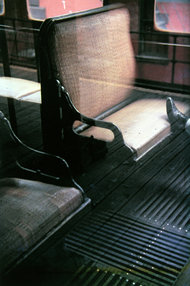 Saul Leiter was an amazing photographic artist who I am only just learning about now, because of the obituary on him by Margalit Fox; the Lens blog post about him by friend Tony Cenicola, in today’s NY Times, and a Lens blog post by Cara Buckley from November 15 about a new film on Leiter, “In No Great Hurry: 13 Lessons in Life With Saul Leiter.” Much of his work is at the Howard Greenberg Gallery in NYC. I urge you to look at his work there. This is from Cara Buckley’s post:
“There is something so poignant about Saul Leiter’s work that looking at it can feel like taking a dart to the heart. Drenched in luxuriant, saturated colors, the images instantly transport the viewer into the photographer’s shoes: peeping from beneath an awning to a snow-swept street, or through a befogged cafe window, weeping with condensation, to a man taking pause on a wintry sidewalk. Intimate and empathetic, Mr. Leiter’s photographs relay what all New Yorkers know about their roaring, daunting home: that life in the city is filled with stolen glimpses and fleeting, quietly personal and often gorgeous moments.”
Talking Transition–for Mayor de Blasio & NYC’s New Government–w/PEN America
 As a member of PEN America, I was invited to participate in a PEN speak-out Tuesday night that was part of Talking Transition, an event going on all week and next in Soho, providing input on policy and priorities to NYC’s incoming mayor Bill de Blasio, all citywide officeholders, and the new members of our City Council. Talking Transition is taking place in a big heated tent that’s set up on the north side of Canal Street, along Sixth Avenue. Each day this week has been devoted to a different topic–Tuesday night had an emphasis on Arts & Culture. PEN chose to devote its 90-minute slot to “Keeping NYC a literary and cultural capital.” On Twitter, you can follow transition events @TalkNYC2013 and the hashtag #TalkingTransition.
Each member who chose to speak was given just a 3-minute slot, so we really had to trim our points down to the minimum. The group was comprised of almost two dozen speakers, including several poets, administrators of poetry and literary programs, and publishing colleagues. The evening moved along with alacrity in front of a pretty good-sized audience under the big tent. This was the preliminary list of speakers, which came off with only a few small changes. I titled my own talk “Support the Book Economy, Foster Publishing Experiments.” The transcript of my remarks, delivered almost verbatim, is here, and below them is a key point I would’ve made if I’d had a bit more time.
Support the Book Economy, Foster Publishing Experiments.
When the recession hit in September 2008, the book economy in New York, was already in a parlous state. To choose just two measures, the rate of closure among indie bookstores was rising and the income of mid-list authors was declining, along with their access to being published at all. A few months later, in January 2009, I was swept out of corporate publishing when the imprint where I’d been editorial director was shuttered. Much as I could talk about my experiences over the past five years, the new business I started, or my three decades in the book business, this talk is not about me, for I am only one among 100s of publishing professionals who lost full time jobs in the months and years since the economic collapse who have yet to again find full employment. To get at the scale of the problem, consider that in 2009 Publishers Weekly started a “Comings & Goings” feature that allowed folks to submit their contact info so that others who wanted to be in touch, to hire them, or just to network, could do so. It had over 200 names at one point. And then last month another book news outlet, Media Bistro’s galleycat, created a directory of just freelance editors, which after a few weeks already has nearly 300 people in it. Based on my observations of book industry layoffs, I’m sure that these figures of self-selecting people only hint at the total numbers.
Clearly, there is still a wealth of great publishing talent in the city. That’s good news. And yet while many of us are still working as editors, marketers, and publicists, or working in adjacent fields like online news, often we are not being paid adequately, and sometimes not at all, for time spent on publishing tasks we hope will one day turn in to full time jobs or paying assignments. Regrettably, this condition persists even while the book industry has experienced a boom from digital reading that’s given greater exposure to book culture, increased the engagement of many readers, and left thousand of readers more avid for books, print and digital.
Yet, even while the boom has grown, the benefits of it are not being felt by most of the under-employed full time publishing workers. This crisis offers the city an opportunity to capitalize on the talents of all these bookpeople with publishing incubators that would foster innovation, experiments, and new models to help business-savvy bookpeople turn their enterprises and current projects in to job-creating engines of the book and the New York City economy.
Therefore, I urge City Council, Mayor-elect de Blasio, and all citywide officeholders to establish public-private partnerships and other initiatives that would help make available low-cost or no-cost business enterprise advice (legal, accounting, financing); no-cost or low-cost workspaces where people could share cubicles, WiFi, and conference rooms. With philanthropic support, or venture capitalists with money looking to do good, a fund for experiments could be launched, with grants being provided to offer recognition, encouragement, and a stipend. I urge the tech community, really a first cousin to digital publishing, to work with bookpeople to create new initiatives that will elevate the entrepreneurial efforts of New York City’s publishing community.
My addendum to these comments is an explicitly political point. One of the reasons that the economy remains anemic in New York City and around the country–with a lack of full employment for millions of people, not just publishing professionals–is that obstructionists in Congress have imposed austerity on the country. Since 2010, right-wing politicians have thwarted any ongoing economic stimulus that would, if enacted, help prime the pump and accelerate demand. This has been denied us, even at a time of very low interest rates. Now, with the victories of Mayor-elect de Blasio, many progressive citywide officeholders, including by far the most progressive City Council since I moved to New York in 1985, I hope that the city, and my own precious book industry, can have, courtesy of the new actors in city government, its own local and direct stimulus that will benefit publishing, readers, authors, and all of New York City.
Finally, here are pictures I took Monday and Tuesday night when I attending Talking Transition events. PEN Participants had been asked to submit favorite quotations, our own, or those of other writers, which you’ll see in a tweet cloud in many of the photos.Please click here to view them.
Romare Bearden and Albert Murray Enjoying a Harlem Afternoon
Love this color video of friends-artist Romare Bearden&writer Albert Murray talking art on a Harlem terrace in 1981. http://t.co/B4u3Zl5T4z
— Philip Turner (@philipsturner) November 4, 2013
The important African-American artist Romare Bearden was at one time good friends with my late author, Edward Robb Ellis, author of A Diary of the Century: Tales from American’s Greatest Diarist (1995). Ellis wrote at length about their friendship in that book, which reflected on Bearden’s upbringing in Pittsburgh, and the life he lived that led to his distinctive style of collage-making and painting. In the years since I worked with Eddie, whenever I read about Bearden, I feel I almost know him, from Eddie’s fulsome recollections. When the writer and critic Albert Murray died last August, he was eulogized in many venues, most memorably for me by Paul Devlin in Slate, where I was delighted to be reminded that Bearden and Murray had also been very close, as friends, and indeed as frequent collaborators (when Bearden needed something written, Murray often wrote it). Typifying their relationship is the revealing video I tweeted out earlier tonight, and which I’m eager to share here, too.
Atmosphere and Color–Painter Greg Kwiatek’s Exhibit at Lynch Tham Gallery
 On Wednesday night Kyle and I went to the opening of a new exhibit of work by her longtime friend, painter Greg Kwiatek. It’s a gorgeous show, at Lynch Tham Gallery, 175 Rivington Street on the LES of Manhattan, where it will be up until December 22. As Kyle put it, Greg’s work “alludes to landscape painting, but they are also quite abstract.” Skyscape might be even more accurate, as there is little land in these pictures, instead they are atmospheric renderings of sky, cloud, and light, both from sun and moon.
On the Web page devoted to his exhibit Greg writes,
My recent work is a continuation of issues that have been of interest to me for many years – atmospheric light, tonal color, saturated color, and the moon as an icon. It is against my nature to simply be a painter of the moon, even though I’ve great respect for those who have done so. That said, I’ve attempted to employ the moon, and the sun in full form and circular abstraction as well. This gives me more latitude through the working process and prevents me from painting myself into a corner. It is my nature to drift with the sky, the ocean and sand. These forces are powerful springboards and they humble me. They are timeless and it is my mission to respond to them as best I can.
These are challenging paintings to photograph, especially in a crowded opening with an IPhone, but here are some pics I took. I recommend you see the show for yourself. It’s beautiful work.