How a Community Makes a Book

I first met writer and literary journalist Robert Gray when I was Editor-in-Chief of Carroll & Graf Publishers and he worked at the splendid Northshire Bookstore in Manchester Center, Vermont. I loved that his email address at the time incorporated the phrase “marbleman,” as a personal homage to Vermont’s marble quarrying. We both later moved on but kept in touch, especially after he became a regular contributor to the daily book world read Shelf Awareness, and I started curating and writing The Great Gray Bridge. Robert’s pieces for Shelf Awareness are published under the rubric, “Deeper Understanding.”

Recently, I let Robert know about Rust Belt Chic: A Cleveland Anthology to which I’d contributed an essay, hoping the DIY energy that produced the book would appeal to him, and that he might want to cover it in his column. He took the opportunity to heart and today published a great piece, “Self-Pub, Sense of Place & Concentric Circles,” with passages like this:

“When you want to know about a place, ask the people who live there. When you want to read about a place, read the writers whose words reveal more than just the surface of a region’s past and present. What does that have to do with self-publishing? This: For a bookseller considering the possibility of stocking a self-published book, one reliable sign of a winner is a title with a tangible sense of place. Whether or not such a book eventually finds readers beyond the region, it must begin at the center–a pebble dropped in a local pond–before concentric retail sales circles can spread. In their introduction . . . editors Richey Piiparinen and Anne Trubek describe the project as “a community effort to tell the story of a city.” And that’s just what it is.” 

Later, Robert generously mentions my essay, “Remembering Mr. Stress, Live at The Euclid Tavern,” linking to an expanded version of it on this blog. I invite you to read Robert’s entire piece at this Shelf Awareness link, and my piece if you haven’t yet. Robert’s past columns can also be found at his website, Fresh Eyes Now.

I should add that the Nook, Apple, and Kindle ebook editions of Rust Belt Chic are currently being sold in their respective digital stores for the terrific price of $2.99 (link for Nook storeITunes store, and Kindle store). Finally, I’m also happy to report that the first Rust Belt Chic event in the NYC area is coming up, Thursday, January 3 in Brooklyn at Public Assembly. I’ll be there to read, as will other northern Ohio transplants in the NYC area. It would be great to see you there!

Mayhem Takes a Holiday

Earlier this week, TV station NY1 reported that

“The New York City Police Department says not a single murder, shooting, stabbing or slashing was reported in the five boroughs on Monday. . . .Police officials could not say when they last saw a similar crime-free streak.”

Not to be glib about this good news, but hearing it I was reminded of the terrific 1934 film, “Death Takes a Holiday,” directed by Mitchell Leisen and with Frederic March cast as the figure of Death who pays an incognito visit to the human realm for a weekend, during which he becomes the house guest of a wealthy man and falls in love with his beautiful daughter. Over these days, it emerges in radio news bulletins that people have simply stopped dying. The usual mayhem–shipwrecks, car wrecks, personal vendettas–have unaccountably stopped leading  to the demise of even a single human being. As the weekend ebbs, the wealthy man realizes just who his strange guest is and it dawns on him that the romance with his daughter will inevitably lead to her being taken from him when Death returns to his spectral realm. As the engrossing plot unfolds, the older man pleads with Death to spare her and take him instead, and events spiral to a dramatic climax.

There is a small but sturdy sub-genre of films that personify Death. Among these are Ingmar Bergman’s “The Seventh Seal,” with Max Von Sydow costumed as a black-clad knight who plays chess against Death, hoping to forestall his inevitable demise for as long as their match continues. The black & white cinematography imbues this 1957 classic with unforgettable mood and atmosphere.

Another film of this sort that I admire is A Matter of Life and Death, directed by Michael Powell and Emeric Pressburger (I keep a link to an archive/fan site for this titanic duo on my personal blogroll in the right rail on this website) with David Niven playing a WWII pilot whose airplane is hit by anti-aircraft fire. During his lethal descent toward earth, he talks to and falls in love with a female radio operator–played by Kim Hunter–only to somehow survive the fiery wreck. Turns out that the representative of the deathly realm who was supposed to usher Niven to the beyond has been derelict in his duty. Under pain of penalty by heavenly authorities this sad sack angel must atone for his malpractice and reclaim the pilot, who says, basically, “Nothing doing, you’ve had your chance.”

While I recognize that New York City’s holiday from mayhem was bound to be shortlived, I’m grateful for the welcome respite we experienced this week, and for the fact that it reminded me of these great movies.

Green-wood Cemetery, Pumelled By Sandy

Ever since Superstorm Sandy hit NYC October 29th, I’ve wondered how Green-wood Cemetery in Brooklyn–with its 470 acres and 1000s of trees–had fared. Earlier in October, I had written about my first visit there, when a new statue at the graveside of New Orleans composer Louis Moreau Gottschalk was unveiled. At the time, I wrote this about the cemetery:

The complex, 478 acres of rolling hills (making it more than half the size of Manhattan’s Central Park), big hardwood trees, and sparkling views of Manhattan and NY Harbor, was founded in 1838 as a non-denominational burial ground that also offered what was described then as a “rural” location. To the urbanites who conceived Green-wood, it was important to create a pastoral, soothing place for mourners to say goodbye to their loved ones. . . . It is still pastoral and still a balm to the daily cares of city-dwellers.

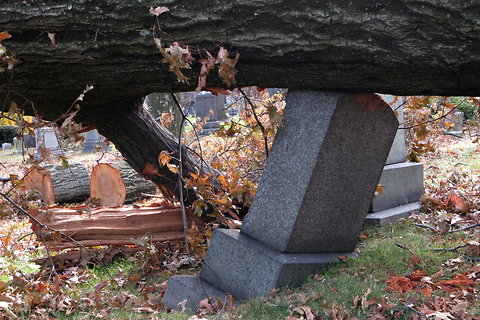
Sunday’s NY Times had the regrettable answer about the effects of Sandy on Green-wood. According to the story by David Dunlap, and the accompanying photo slideshow, 100s of trees were toppled in the storm and many headstones and gravesites were broken and wrecked, as can be seen here in one of Dunlap’s photos. The harm done at Green-wood is is just one more of the many injuries suffered by New York City in the past month.

Would a Lawyer Today Dare Send Such a Funny & Profane Letter?

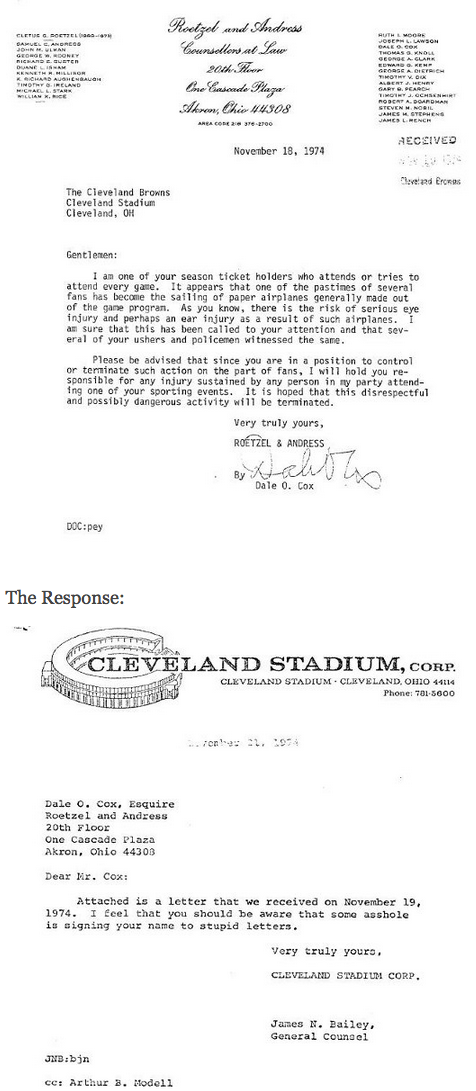
If it’s Sunday, it must be football, right? In keeping with the day, Shaun Usher, the British proprietor of the always-splendid website Letters of Note has reposted on his site’s Facebook page a funny exchange of correspondence that I chuckled over when he first shared it last February. It gave me another good laugh today. Shaun’s placed the 1974 letters under the heading Regarding Your Stupid Complaint. They were between Dale O. Cox, Esquire, a persnickety Cleveland Browns season ticket holder, and the Browns’ team office.

As readers of this blog may recall, from pieces such as How to Enjoy Sports Even When Your Teams Have a History of Failure, and a Personal History essay, I grew up following the ups and (often the) downs of Cleveland sports teams. With my late father and brother, I had the great good fortune to attend the last professional sports championship of a Cleveland team–when in the 1964 NFL title game the Browns upset the Baltimore Colts, 27-0. As the scanned copy of a grade school composition of mine will attest, the season ticket holders we sat near in the upper deck in Section 42 were a colorful bunch, like “Bert, a lover of wine” who “often fixe[d] himself a Diet-Rite and wine cocktail,” and Eddie, who “As soon as the first half ends, breaks out [a] thermos of chili . . . he shares with John, while John splits one of his many bottles of wine with him.” (See bottom of post for the whole piece.)

In the summer of 1977, after I was graduated from Franconia College, I worked as a beer vendor at Cleveland Indians’ baseball games. I enjoyed walking the wide open grandstands of cavernous Municipal Stadium, calling out such pitches as “Beer Here!” and “Get Your Cold Ones!”. My happy run as a vendor ended though when I worked a Cleveland Browns pre-season game, and was appalled to discover that the placid beer-drinking Indians fans I’d come to enjoy serving had morphed into, as I wrote in that personal history essay, “an unruly, inebriated mass. . . I was lucky I didn’t have my rack of beers stolen along with all my earnings.

With these recollection of public drinking and intoxication at Municipal Stadium, you can see why I derive such a good laugh from the correspondence between Mr. Cox and the Browns (headings and signatures abridged):

November 18, 1974

The Cleveland Browns
Cleveland Stadium
Cleveland, OH

Gentlemen:

I am one of your season ticket holders who attends or tries to attend every game. It appears that one of the pastimes of several fans has become the sailing of paper airplanes generally made out of the game program. As you know, there is the risk of serious eye injury and perhaps an ear injury as a result of such airplanes. I am sure that this has been called to your attention and that several of your ushers and policemen witnessed the same.

Please be advised that since you are in a position to control or terminate such action on the part of fans, I will hold you responsible for any injury sustained by any person in my party attending one of your sporting events. It is hoped that this disrespectful and possibly dangerous activity will be terminated.

Very truly yours,

Dale O. Cox

The Browns’ reply, from their General Counsel and cc:d to team owner Art Modell, was written only three days later:

Dear Mr. Cox:

Attached is a letter that we received on November 19, 1974. I feel that you should be aware that some asshole is signing your name to stupid letters. 

Very truly yours, 

CLEVELAND STADIUM CORP. 

James N. Bailey,
General Counsel

cc: Arthur B. Modell

Cleveland Browns letters

In the years following the exchange with Mr. Cox, Art Modell–who died this past September at age 87–would later be tagged with infamy among many Cleveland sports fans for relocating the Browns to Baltimore in 1996. Yet it’s plain to me that at least in 1974 he was still a stand-up guy, or he wouldn’t have condoned his team attorney sending such a funny, profane letter to a customer who was himself a lawyer, and one who included in his letter an implied threat of litigation–“I will hold you responsible for any injury sustained by any person in my party attending one of your sporting events.” Would any caution-ridden lawyer today dare to send such a letter in response? If you have thoughts on this and would like to continue the conversation, please let me know what you think in the comments field below. A final point on Mr. Usher’s Letters of Note presentation for this exchange. He uses a photo in it of a Cleveland stadium, but it is the new Browns stadium, built and opened in 1999, on the site of the old Municipal Stadium, where I attended games as a boy and worked in 1977.

A grade school essay of mine on the fans I sat near at Cleveland Browns’ games.

Who Knew? Paved Roads Were the Result of Lobbying by Bicyclists

This tweet by prolific travel essayist Taras Grescoe caught my eye.

I followed the link to a website for what turns out to be a forthcoming book titled Roads Were Not Built for Cars, by Carlton Reid. At the site I found an interior spread with a cover and author info.

I had not really thought about it much before, but what I’ve read here reveals the author’s revisionist thesis that while Henry Ford and his ilk were eager to claim credit for the advent of paved roads in the 1920s, there had actually been a “Good Roads” movement harking as far back as the 1880s, when bicyclists began advocating for better riding surfaces. The writing and publication of the book has evidently been sponsored by bicycle makers in the UK and North America; with this underwriting it’s going to be a free, no-charge ebook download. I find what I’ve read in the spreads at the website reveals a fascinating, heretofore hidden aspect of modern transportation history–the development of decent roads not only made travel more enjoyable for individuals in all kinds of wheeled vehicles, it also enabled farmers and tradespeople to bring their goods to more readily bring their goods to market, spurring economic growth. If you’re interested in reading more on this topic I urge you to go to the book’s website and leave your email address so you can be notified when the book is ready.

Now that I think more about this, I’m reminded of a historical point raised in Alex Shoumatoff’s superb book, The Mountain of Names–a history of kinship that I had a chance to republish in paperback in 1995–which reported that the appearance of the bicycle in rural villages of Europe in the 19th century overnight extended the “courtship range” of male suitors  to a great many more miles than had ever previously been the case. I’ve previously blogged about Shoumatoff’s book in relation to the Mormons’ practice of posthumous baptism, which the late Christopher Hitchens tartly dubbed “a crass attempt at mass identity theft from the deceased.”

Manitoba Music Showcase at NYC’s Arlene’s Grocery, Nov. 13

Tuesday night from 8-10:30 PM Arlene’s Grocery on the Lower East Side will feature a great bill with musical acts visiting NYC from the Canadian province of Manitoba. It’ll be the second year in a row that ManitobaMusic.com is hosting this showcase. Last year I had the good fortune to discover two of the acts who are returning tomorrow night, along with two new acts I’m eager to hear for the first time.

The two acts making return visits are Chic Gamine (pictured above) a five piece outfit composed of four female singer/instrumentalists from Winnipeg, and the lone guy, the drummer, from Montreal. With great verve and stage presence, they perform an energetic melange of anglophone, francophone, and First-Nation tinged rootsy pop. Songs like “Closer,” on video here from their website show their tremendous talent and inspired songwriting.

I love their sound, their style, their great look, and am eager to hear them and meet them once more, and their outgoing manager Jeff Horowitz, who made sure I knew about this gig.

The other artist I’m eager to hear again is singer/songwriter JP Hoe (pictured below) also from Winnipeg. A year ago he gave me a demo of his forthcoming album, “Mannequin,” with terrific songs such as “Bingo Palace” and Do I Know You?, and I’m glad to see it’s since been released and he’s been touring North America in support of it, including dates in Los Angeles, Portland, OR, and NYC, as well all over Canada.

Their are two other acts tomorrow night, The Magnificent 7s and Greg MacPherson. I’m eager to hear them too, since ManitobaMusic.com has shown themselves to be so adept at presenting great talent to New Yorkers. If you’re eager to hear some great music, I suggest you come out to Arlene’s Grocery on Stanton St. to hear these talented musicians from Manitoba. The cover is just $5. Here’s the line-up: