Ernest Hemingway and the Agony of Inspiration by M. G. Turner
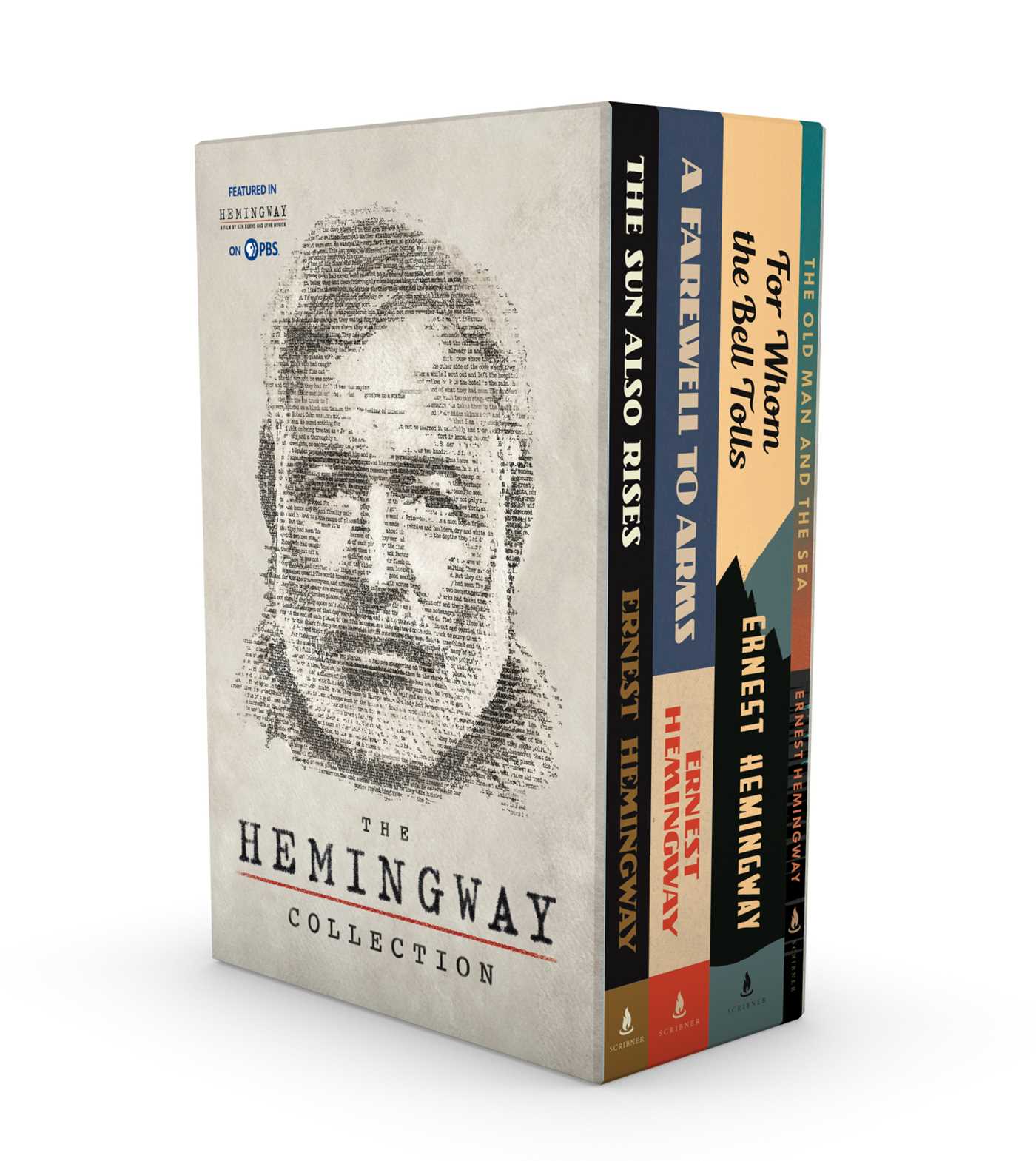
As a writer, I’ve had multiple run-ins with Ernest Hemingway. The first was in the spring of 2021, following the airing of the Ken Burns documentary, and the most recent was last month, after buying a large Hemingway boxed-set, which I wolfed down in two weeks. The set included The Sun Also Rises, and A Farewell to Arms, which I had previously tried to read all the way through and failed.

This time I did not fail. But perhaps I should have. You see, for the past year I have been completing a novel that has its stylistic roots in what I like to think of as “modern gothic” with what I hope is fluid and frankly beautiful prose. My work tends to come from a much different aesthetic place than those who follow the Hemingway method, i.e., Raymond Carver, Tobias Wolff, and George Saunders; yet to my chagrin I found, as I pressed through the great and tragic author’s oeuvre I was losing my sense of self, my sense of who I am as a writer. There are some writers, and artists in other fields, whose voice and style are so magnetic, so enveloping, that they instill in the reader or viewer the sense of nothing having existed before or after them. Hemingway is a quintessential example of this, and an author whom most aspiring writers need to tangle with at some point. And for me, this past month, my collision with Hemingway came, and I left the ring, as it were, feeling as if I’d been continually punched in the face. This could be due to the quick, jabbing, declarative nature of Hemingway’s prose—it stands to reason that he himself was an avid boxer—and clearly brought this quality into even his most lengthy, involved novels such as A Farewell to Arms and For Whom the Bell Tolls.

Some writers—I’d even say most—try a different approach with the reader. Some lull, some soothe, and some entertain. Hemingway does none of the above. Hemingway berates and belittles, but he also rescues and redeems. Which is why, even when I recently felt his voice becoming my own, and my boundaries yielding to his force of will, I did not put his books down, did not shunt my new boxed-set onto a high shelf, did not flee the ring. I stood firm. I withstood. I, and most importantly, my young novel survived.

***

I work with fiction writers almost every day, as an editor and a literary representative. Most of the time I think half of my job is to help each writer tangle with the demons embedded in their prose, thorny eruptions that can spring up at any moment. In even more poetic terms, I see myself as a Horatio, Hamlet’s loyal friend, who stands fast as the ghost of his father the fallen confronts the young prince and forces him to wrestle with his conscience. On the page we come face to face with ourselves, and when we read books we come face to face with other people. Naturally every writer, when working in the most effective capacity, will bring themselves to the page, so it stands to reason that when one reads Hemingway they not only read him, they face him, and sometimes even face off with him.
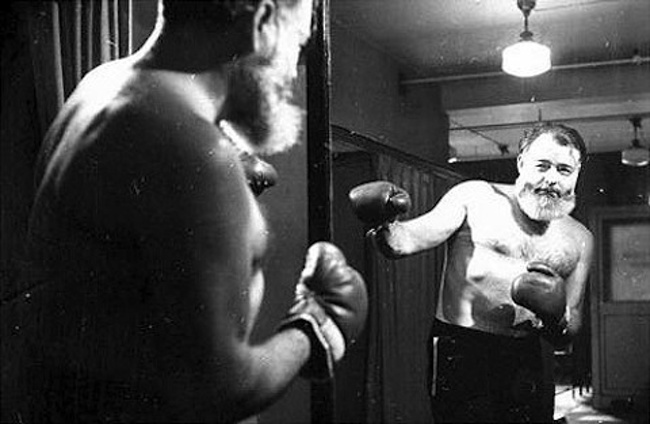
If you’ll allow one more boxing metaphor, when we pick up, say, A Farewell to Arms, we are contending with an experience that Hemingway has transmuted to the page in terms as stark as he could muster. He dares you to withstand him and what he experienced. You feel like you are slogging through the mud, feel like you are tangling through the trenches, and when Henry’s dear love Catherine Barkley dies in childbirth he makes you go through it with him, mourning her to the last page as he denies us even a smidgen of satisfaction. “After a while I went out and left the hospital and walked back to the hotel in the rain.” Henry does not cry. He does not scream. He simply stumbles on, injured and broken, just as we, having made it to page 332 stumble on.

I know all this sounds like I don’t like Hemingway very much. Quite the contrary—I love him. But it is precisely this love, this agony of inspiration, that writers must learn how to handle. When I was younger it was easy to read a page or two of A Moveable Feast and think, okay this is how it’s done, and immediately run to the computer or a notebook and put down a litany of irredeemably declarative sentences. Now that I am a bit older, this doesn’t happen as readily, and I am able, perhaps because of my sense of self—fragile though it continues to be—to manage it, and am able to cross the tightrope of influence and homage.

As Rainer Maria Rilke posited in Letters to a Young Poet an artist must work with whatever is only theirs, and no one else’s. This sounds easy enough, and yet it is probably one of the hardest things a writer can do, and maybe the biggest accomplishment next to putting a period on the final sentence of a great work. How does one withstand, to use a word I’ve deployed already too often, the gravitational pull of someone so monumentally important to our culture and still have faith and confidence in what they’re offering a reader? I know I used the second person when posing that question, but I am talking about myself as much as others. How was I supposed to let my own novel live when Hemingway had seemingly dashed apart my style with a few choice sentences? The word “confident” kept flooding back to my mind, because the way he comes across on the page is as someone who is so utterly convinced of his literary excellence and aesthetic brilliance that anything less—or more importantly, different—is exactly that, less.

But I am here to say: this is false. Though his confidence, even certainty in his style, made him the great writer we know him as, it does not mean other possible fictive valences are worthless, or worth less than his own. When analyzed further, how could it possibly be the only way? A signature of life is its diversity and essential uniqueness. Human beings are varied, not only in terms of race and creed, but also in personality, and yes, style. One writer cannot define the entirety of the canon, no matter how hard they try, or people try for them.

***

But again, I love Hemingway. And I also love what I am working on—you must. This may sound conceited, or foolhardy, but I think loving the pages on your desk is essential to those pages finding an audience and living. I believe a literary figure like Hemingway must be seen in the context of his times, for today, due to his lack of preamble and exposition, he might not have made it out of the pages of minor publications. But in the same way, do we judge Wilt Chamberlain, the only professional basketball player ever to score 100 points in a single game, by the standards of excellence in the current NBA? We do not.

This is all to say that ideas about the greatest writer or the greatest style are inconclusive. I firmly believe anyone, regardless of ultimate success, when they put pen to paper—or fingers to keyboard—are trying to put down the greatest sentence ever. No one enters this field with dreams of mediocrity. We slip into the ring bravely, and work with what we have, with what is most accessible; eventually, if we are lucky, we eschew all influence and find that now vague concept: our voice, that which comes solely from ourselves. We may have influences. We may have shadings in our work that relate or are in conversation with those who came before, but at heart our best work is apt to come when we are in touch with our innermost quality of command, our innermost narrative, our personal dreams. Hemingway had his dreams. And we have ours. But I suspect we will continue to box with him, and writers of all styles, backgrounds, and understandings, until this experiment ends—and let’s hope it never will.


M. G. Turner
June 2022

Remembering Publishing Pal Peter Warner, RIP

I am happy I can revisit a blog post I wrote and published almost nine years ago, when publishing friend Peter Warner was launching a book of his own, The Mole—The Cold War Memoir of Winston Bates: A Novel. It was a clever turn on meta spy fiction, and I loved it reading it back then. I share this today, to honor Peter, who died last September, age 79, and for whom there will be a memorial tomorrow which I’m going to attend. Peter was for years the chief in NYC for Thames & Hudson, the publisher of illustrated books, where he was a participant in dozens and dozens of international co-publishing arrangements. The occasion for my post was the novel’s launch party, hosted by Will Balliet, a longtime editorial colleague of mine when we were both at Carroll & Graf, who succeeded Peter at T & H.

Peter and I were members of a monthly lunch club, Book Table, where I always enjoyed conversing with him. His literary skills were prodigious, and extended to this engrossing thriller, a historical narrative that spans the Suez Crisis, the downing of an American U-2 plane, the Bay of Pigs, Vietnam, and Watergate, all told in a faux memoir by Canadian protagonist Winston Bates. I loved it, and so did readers like author Stacy Schiff. She blurbed it thus: “Who better to trust for a through-the-looking-glass tour of Cold War Washington than a short, self-doubting Canadian with a photographic memory? A rich, buoyant ruse of a novel.” I am glad I can share word of it again with friends here.

Looking Back on 2021, Our Year in Editing and Agenting

Yesterday I began totaling up the volume of our business in 2021, to prepare for writing an annual year-end blog post, and I’m pleased to confirm it was by far the best year Philip Turner Book Productions has had since I began operating outside the staff job/corporate publishing world in 2009. My son Ewan, 25, has been working with me for the past two years; it’s good to have a colleague and partner. As Executive Editor and Literary Agent, he heads up our New Stories division, devoted to cultivating new work in fiction, narrative nonfiction, and memoir.

Looking back on the year that ends today, I see that in 2021,

  • We edited manuscripts and book proposals from twenty-five different authors;
  • We sold ten new titles to book publishers, books that will be published in 2022 and beyond. and one title to an audiobook company which came out in 2021. We dispersed advances and royalties to fifteen authors and rights holders. Our sales this year were:
  1. THE BARRENS: A Novel of Love & Death in the Canadian Arctic by father-daughter duo Kurt Johnson and Ellie Johnson, sold to Arcade Publishing, who will publish it on May 3, 2022. This is the first title we’ve sold under our New Stories rubric.
  2. PICTURE SHOW PLAYLIST: Pop Music in Film from the Crystals to Rihanna by Nate Patrin, sold to University of Minnesota Press, whose first book Bring that Beat Back: How Sampling Built Hip-Hop, we also sold to UMP, which they published in 2020.
  3. LURKING UNDER THE SURFACE: Horror, Religion, and the Questions that Haunt Us by Brandon Grafius, sold to Broadleaf Books, which will be published around Halloween 2022.
  4. YOURS, FOR PROBABLY ALWAYS: Martha Gellhorn’s Letters of Love & War, 1930-1949 by Janet Somerville, sold to Penguin Random House Audio with actress Ellen Barkin as the narrator of the audiobook, published in May 2021.
  5. CINEMA OF SWORDS: A Popular Guide to Movies & TV Shows About Knights, Pirates, and Vikings (Plus Samurai and Musketeers) by Lawrence Ellsworth, translator of Alexandre Dumas, sold to Applause Theater and Cinema Books
  6. .

  7. THE ULTIMATE PROTEST: Malcolm W. Browne, Vietnam, and the Photo that Stunned the World by Ray E. Boomhower, sold to University of New Mexico Press, which in November 2021 published Boomhower’s Richard Tregasksis: Reporting Under Fire from Guadalcanal to Vietnam
  8. ROOSEVELT SWEEPS NATION: FDR’s 1936 Landslide and the Triumph of the Liberal Ideal by David Pietrusza, sold to Diversion Books, to be published August 2022.
  9. LAST CIRCLE OF LOVE, a novel by Lorna Landvik, acquired by the Lake Union imprint, Amazon Publishing
  10. HEROES ARE HUMAN: Lessons in Resiliency, Courage and Wisdom from the COVID Front Lines by Bob Delaney with Dave Scheiber, co-authors of the bestselling Covert: My Years Infiltrating the Mob, placed with City Point Press, distributed by Simon & Schuster, to be published Fall 2022.
  11. THE KREMLIN’S NOOSE: Vladimir Putin’s Blood Feud with the Oligarch Who Made Him Ruler of Russia by Amy Knight, sold to Northern Illinois University Press distributed by Cornell University Press; we earlier sold Knight’s Orders to Kill: The Putin Regime and Political Murder (St Martin’s Press, 2017).

In 2021, books that we had sold in earlier years were published:

1) Ten Garments Every Man Should Own: A Practical Guide to Building a Permanent Wardrobe by Pedro Mendes, published by Dundurn Press.
2) Emily Mann: Rebel Artist of the American Theater by Alexis Greene, published by Applause Theater and Cinema Books
3) Between Two Kings: A Sequel to The Three Musketeers (Musketeers Cycle, Book 5) by Alexandre Dumas, translated by Lawrence Ellsworth, published by Pegasus Books
4) Richard Tregaskis: Reporting Under Fire from Guadalcanal to Vietnam by Ray E. Boomhower, published by University of New Mexico Press, and as an audiobook by Blackstone Publishing.
5) The Pot Thief Who Studied the Woman at Otowi Crossing (The Pot Thief Mysteries Book 9) by J. Michael Orenduff, published by Open Road Media.
6) In addition, a manuscript I edited in 2021, THE MOST PRECIOUS GIFT: Memories of the Holocaust, A Legacy of Lisette Lamon, was self-published by David Mendels, the late author’s son.

Also, coming in 2022 will be an anthology about the book business, Among Friends: An Illustrated Oral History of 20th Century Publishing and Bookselling edited by Buz Teacher, co-founder of Running Press. It will be published by the University of Pennsylvania Press, and I have contributed a personal essay entitled, “The Education of a Bookselling Editor.”

Ewan continues to write his own fiction, having completed a story collection in the realm of anthology horror, and is working on a novel. As he likes to say, his touchstones fall somewhere between F. Scott Fitzgerald and Rod Serling. His work may be read upon request.

After 2022, we eagerly anticipate publication of DEVOURING TIME: Jim Harrison, a Life by Todd Goddard, the first biography of the acclaimed fiction writer, master of the novella, gourmand, ardent friend, hunter and fisher, which we sold to Blackstone Publishing.

Entering what will be my thirteenth year working as an independent editor and literary agent—a longer tenure than any of my in-house positions—I am more energized than ever by the opportunities to work closely with authors, more than closely than I was able to do during my latter years in corporate publishing. Even with the many challenges the book industry is facing, such as many bookstores open for only limited, distanced hours due to the lingering pandemic, I am optimistic about the book business, as readers are eager to have the companionship of books, and writers are driven to tell their singular stories.

We work on a wide range of material with special affinity for imperative books that really matter in people’s lives. I’m always interested in first-person work from authors who’ve passed through some crucible of experience that leaves them uniquely equipped to write their book. If you have a project you’re developing, or a personal essay, and want to discuss your work, or a project you think may be ready to offer to publishers, please don’t hesitate to contact one or both of us. We already have a number of terrific projects lined up to edit and represent in the new year, and we’re hopeful 2022 will be a strong year in publishing and the book business, , and a better year for us all. 

As always, please get in touch if you or someone you know is seeking guidance about publishing. Ewan can be reached at ewanmturner [@] gmail [.] com, while my contact info is philipsturner [@] gmail [.] com.

Listing Notable Current Affairs Titles I’ve Worked On

For an editorial assignment on a current affairs title with a major publisher that I’m being considered for—in what amounts to a competitive situation among other candidates—I listed a dozen notable titles I’ve acquired, edited, published, and/or agented over my years in publishing. Below is a screenshot of that list for readers of this blog who may be curious about some of the titles I’ve chosen to work on and be involved with over the years. I should add there are many such titles beyond this dozen. Please let me know if the editorial and publishing services provided by me and my business partner Ewan Turner might be of interest to you.

*So Wrong for So Long: How the Press, the Pundits—and the President—Failed on Iraq by Greg Mitchell, w/a Preface by Bruce Springsteen; The Baby Thief: The Untold Story of Georgia Tann, the Baby Seller Who Corrupted Adoption by Barbara Bizants Raymond, a Publishers Weekly Best Book of the Year; and Ahmad’s War, Ahmad’s Peace: Surviving Under Saddam, Dying in the New Iraq by Michael Goldfarb, a NY Times Notable Book.

Publishing November 15, “Richard Tregaskis: Reporting Under Fire From Guadalcanal To Vietnam”

As mentioned on this blog, I’m a lifelong fan of reading biographies, and it’s a delight to work on so many good ones, like Ray E. Boomhower’s new portrait of the life and career of Richard Tregaskis, one of the most accomplished combat correspondents of the twentieth century. Here’s how the catalog copy for University of New Mexico Press’s High Road imprint describes the book:

In the late summer of 1942, more than ten thousand members of the First Marine Division held a tenuous toehold on the Pacific island of Guadalcanal. As American marines battled Japanese forces for control of the island, they were joined by war correspondent Richard Tregaskis…one of only two civilian reporters to land and stay with the marines, and in his notebook he captured the daily and nightly terrors faced by American forces in one of World War II’s most legendary battles–and it served as the premise for his bestselling book, Guadalcanal Diary.

One of the most distinguished combat reporters to cover World War II, Tregaskis later reported on Cold War conflicts in Korea and Vietnam. In 1964 the Overseas Press Club recognized his first-person reporting under hazardous circumstances by awarding him its George Polk Award for his book Vietnam Diary. Boomhower’s riveting book is the first to tell Tregaskis’s gripping life story, concentrating on his intrepid reporting experiences during World War II and his fascination with war and its effect on the men who fought it.


Richard B. Frank, author of Guadalcanal: The Definitive Account of the Landmark Battle, says of the new biography:

“Alongside Ernie Pyle, Tregaskis was perhaps the most outstanding American war correspondent of WWII. [He’s] best know for…Guadalcanal Diary, but that book covered only one small chapter of his reporting from the front lines. Ray Boohmoer’s excellent new biography finally does justice to Tregaskis in this deeply researched, thoughtful portrait of the man and his times.”


The book’s official pub date will be November 15, and I’m getting an early start on congratulating the author, for whom I’ve already sold a second biography of an important journalist to UNMP, The Ultimate Protest: Malcolm W Browne, Vietnam, and the Photo that Stunned the World. Congrats, Ray!


Publishing November 1, 2021—“Emily Mann: Rebel Artist of the American Theater” by Alexis Greene

One of the joys of being a provider of editorial and publishing services is the opportunity to work on terrific books that I enjoy reading, and which I know a great many readers will also enjoy. As a longtime fan of biography, I’m especially pleased that I get to work on so many excellent life stories, like Emily Mann: Rebel Artist of the American Theater by Alexis Greene, finished copies of which just arrived in my office today, good timing in view of the book’s November 1st publication date.

As I wrote when I sold the book to Applause Theater and Cinema Books earlier this year:

This will be the first book about Mann, a trailblazing woman playwright and stage director, artistic director of the McCarter Theatre in Princeton from 1993-2020. It chronicles the story of Mann’s path through a field where women have often struggled for the opportunity to direct the work of other playwrights, leave alone see their own plays produced.

Greene chronicles Mann’s role in the growth of a socially-oriented theater with plays she’s written that explore current events and issues while focusing on the lives of under-recognized groups in society, in scripts virtually ripped from the headlines and braided together from archives, diaries, public records, and interviews conducted with participants in momentous events. Dubbed a “theater of testimony” Mann has written such plays as “Execution of Justice,” on the murder of Harvey Milk and Mayor Moscone in San Francisco; “Greensboro (A Requiem),” on a deadly 1979 KKK attack; “Mrs. Packard,” based on the true story of a 19th century minister’s wife committed to an asylum when she abandoned the church; “Having Our Say,” based on the bestselling book of the same title, on the centenarian African American sisters Sadie and Bessie Delany; and “Gloria: A Life,” drawn from the life and career of Gloria Steinem. Her development of a kind of new documentary theater has been influential in many ways.

A New York City native, Alexis Greene is the author and editor of numerous books about theater, including The Lion King: Pride Rock on Broadway, written with Julie Taymor, and the biography Lucille Lortel: The Queen of Off Broadway. Her career spans acting, theater criticism, and teaching (she holds a PhD from the Graduate Center of the City University of New York).”

It’s the first biography of the pathbreaking director and playwright, known best for her “Theater of Testimony,” documentary-style plays drawn from public documents and oral histories. If you’re a theater-goer, and enjoy inspiring life stories, I heartily recommend Emily Mann: Rebel Artist of the American Theater.