Tag Archive for: literature

RIP David Pryce-Jones (1936-2025), A True Man of Letters Whose Work Revealed Anti-Semitism in the UK

January 11, 2026 Update

As an addenda to the tribute below I published last month about British man-of-letter David Pryce-Jones, in which I mentioned that he and actress Helena Bonham-Carter were cousins, I want now to share an article by Juliet Conway in the Daily Mail that highlights their close relationship:

“Helena has long credited David’s 2015 memoir Fault Lines with helping her understand the dramatic history behind the ‘melting pot’ that is her maternal heritage.

The book recounts life at Royaumont with Helena’s maternal grandparents, Eduardo Propper de Callejon – the Spanish diplomat who saved thousands of Jews by issuing illegal visas – and his wife Helene, known as Bubbles, an Austrian-Jewish heiress from the Springer industrial dynasty.

‘It would make a great sitcom or drama,’ Helena has said of the family’s wartime adventures. ‘There were so many characters, so dramatic and funny and bonkers. And David captured it all.’

His death marks the passing of the last of a generation whose real-life dramas—wartime heroism, family feuds, literary scandals —were as vivid as anything in Netflix’s The Crown, in which the actress played Princess Margaret.

And as Helena once joked: ‘I’d have to approach [Crown writer] Peter Morgan. “I’ve got a whole other family story for you. Forget the fifth, and sixth seasons [of The Crown]. You’re coming with me, mate.”‘

December 17, 2025

I was saddened by the recent passing of David Pryce-Jones (1936-2025), which I read about in a Times of London obituary. (It’s linked to here, though you may hit a paywall, so I’ve also pasted it in below in five sequential screenshots.) We became acquainted via letters and email, beginning in 2023, though never met in person. I had sent him a letter after discovering his books thanks to a biography, The Maverick: George Weidenfeld and the Golden Age of Publishing by Thomas Harding. Harding’s book on the dynamic British publisher Lord Weidenfeld (1919-2016) was not a cradle-to-grave biography, but instead devoted a chapter to a dozen or so of the most important books Weidenfeld published in his prolific career, some of which courted controversy; among them were Saul Bellow’s Herzog, Mary McCarthy’s The Group, Watson and Crick’s The Double Helix, Nabokov’s Lolita, and a writer who was then new to me, David Pryce-Jones and his nonfiction book Unity Mitford, a Quest, published in 1976.

One of the five Mitford sisters, Unity had a notorious romance with Adolf Hitler in the 1930s. For writing about her life some members of the Mitford family sued Pryce-Jones for libel, intent on suppressing the book, while some upper crust Brits inveighed against Pryce-Jones for spotlighting deep currents of anti-semitism in British society; he was Jewish, and as a three-year old had been evacuated from France through Dunkirk where he was when WWII began. Weidenfeld and Pryce-Jones were faced with a decision to halt publication, or go forward, despite the threat of significant monetary damages if they lost in court. They refused to back down, the book was published, and Pryce-Jones was vindicated; it is still in print today.

I found the whole story of his family, told in the memoir Fault Lines, quite inspirational, particularly the actions of his maternal grandfather, a Spanish diplomat named Eduardo Propper de Callejón who during WWII, defied contrary orders from the Franco government and used his diplomatic portfolio to sign visas for refugees; his bravery warrants a place for him alongside the heroic exploits of the American journalist Varian Fry, who helped rescue Jews in France, and the Japanese diplomat Chiune Sugihara, who signed visas for many in Lithuania. Indeed, Propper de Callejón is honored at Yad Vashem. Among David’s relatives was the British actress Helena Bonham-Carter, also a grandchild of the Spanish diplomat. She explores the WWII period in this interview on youtube. Among the people her and David’s grandfather saved was the person who later started Unicef.

The Times of London obit explains that he had a complicated relationship with his father Alan Pryce-Jones, who was editor of the Times Literary Supplement. The elder Pryce-Jones can be seen in a fascinating interview he conducted with W. Somerset Maugham in 1955, also on youtube. The Maugham interview, which my adult son and business partner M. G. Turner discovered during Covid, led to me recognizing the name of David Pryce-Jones when I encountered it in Thomas Harding’s book on Lord Weidenfeld.

David was a true person of letters, the likes of which there are few today, among men or women. He was a foreign correspondent, memoirist, essayist, novelist, biographer, and devoted letter writer. Another book of his that I enjoyed enormously was Signatures, in which he tells the stories behind the many inscribed books that populated the bookshelves in his personal library, chronicling more than ninety literary relationships in his life, among them with W. H. Auden, Beryl Bainbridge, Saul Bellow, Isaiah Berlin, Paul Bowles, Cyril Connolly, Martha Gellhorn, Lawrence Durrell, Robert Graves, Aldous Huxley, Alfred Kazin, Amos Elon, Philip Glazebrook, Arthur Koestler, Jessica Mitford, V. S. Naipaul, Edna O’Brien, Alan Sillitoe, Muriel Spark, J. B. Priestley, Isaac Bashevis Singer, Hugh Nissenson, and Dame Rebecca West, among many others. It is an extraordinarily enjoyable book. Just two pages from the Table of Contents are shown below in blue type. He led an extraordinary life, and was a kind man. RIP. 

Recently Published, Alexis Greene’s “Shakespeare Theatre Company: The History of a Classical Theatre”

A treasured author of Philip Turner Book Productions is Alexis Greene (Emily Mann: Rebel Artist of the American Theater, Applause Books, 2021) who this fall published a fantastic book for which we were proud to arrange publication; it will make an ideal gift for lovers of the Bard, the written word and the theatrical arts. The book is Shakespeare Theatre Company: The History of a Classical Theatre (Peter Randall Publishers, September 2025). It’s a sumptuous, coffee-table book that tells the engaging story of how this nonprofit theatre in Washington, DC, became one of America’s foremost centers for the performing arts. Illustrated with more than 250 dramatic photographs of productions and performers, Greene’s history takes readers from the earliest performances of Shakespeare in America; through the establishment of the Folger Shakespeare Library; the founding of the enthralling Shakespeare Theatre Company (STC); and its current role as a theatre that embraces Shakespeare, as well as other classical playwrights and contemporary dramatists. This unique history was envisioned and commissioned by longtime supporter of the STC, Lawrence Hough to commemorate the 40th anniversary of the company. Ewan Turner and I were honored to edit the text with Alexis Greene, as well.

Shakespeare Theatre Company was recently featured in Washington Unbound, linked to here, and Alexis was interviewed for the same publication in “A Glimpse Behind the Scene of One of Washington’s Finest Theaters.”

Actors and theatre professionals have praised the book, with comments like this:

“I am utterly fascinated by Alexis Greene’s superb account of Washington, D.C. Shakespeare Theatre Company’s existence. She highlights its leadership under five very different artistic directors as well as its operation from small to big physical homes, never failing to convey a vivid personal sense of the actors, directors, and writers that are involved in each decade of its productions. She doesn’t shrink from quoting the good and less-than-good reviews they encountered and gently threads her own feelings about the long-overdue employment of women directors. A volume worthy of a special place on your bookshelf.” Gail Merrifield Papp, author of Public/Private: My Life with Joe Papp at the Public Theater.

“On Browsing in Bookstores, a Pastime” by M. G. Turner

There is something uniquely magical about walking inside a bookstore, preparing to browse: you cross the threshold and suddenly you have been transported, quite literally, to a world of books. As the atmosphere settles, you notice there is a quiet here that reigns supreme, a quiet comparable perhaps only to that of a library; a pregnant hush fills the air and instills a state of calm that you would be unlikely to find elsewhere. Especially in New York City where the aggressive frenzy of life never ceases, the bookstore—and its ill-treated cousin, the library—can be an oasis, a place of refuge, a second home that can be utilized when other options of play or fun or drink have been depleted or appear uninviting.

When times are tough the world of books calls to us, and if we’re lucky we heed that call—the call of what we must do and not what we ought to. There is no greater pleasure than going to a bookstore with an objective in mind, say to purchase some work or other by Balzac and leaving inexplicably with a Faulkner. Bookstores divert our expectations. The shelves in many of New York’s finest are crammed high to the ceiling with both old and new tomes that at first speak to us in voices we may only hear subliminally. Thus visuals are our calling card, our way in. Often it is the seductive glint of a spine or the flicker of a cover that catches our eye, and as we pull the book off the shelf, and stare at it, a love affair begins. The eye tries to comprehend what the soul sees clearer. We know there is some future here for us, our paths will diverge together, we will save that spark and let it grow—that is, if we are lucky and decide not to put whatever work we have found back on the shelf where it will be consigned to wait a while longer for the coming of its true owner.

But if we hold in our hands the book we are meant to read, then we are giving ourselves over to something unconscious and in some ways very powerful. What we are giving ourselves over to is Fate. For reading books, and at the outset, buying books, is very much like making friends. The object itself transcends the lucid boundaries of paper and ink; it is so much more, and because of that the weight of a decision rests heavily on our shoulders. Do you buy another Nabokov? No, you’ve already read four of him. Another Tolstoy? You haven’t even finished Anna Karenina. A new edition of Ulysses? You have two already, dog-eared and disgruntled and waiting to be finished. You walk on aimlessly, through the aisles, dodging people taking on a similar pursuit: beautiful girls in faded jean jackets and sunglasses on their foreheads, old men stooping over dangerously to get a look at some old and beaten Melville, and the others like yourself trying to work themselves up into a state of rapt determination, studying the walls, trying to discern the titles of famous works, squinting as if at the hieroglyphics of Luxor.

The weight of a book in hand is equivalent to the weight of gold. You measure it, test it, consider whether you can withstand the flurry of its pages, the emotional impact of its premise. Stories are contained within stories, characters within characters, subtlety gives way to novelty, novelty to extremity, enjoyment to a cessation of pain. For that is what all the browsers, including yourself are looking for: a place to stop and sit awhile, to direct thought consciously toward a more righteous purpose, feeding the imagination a meal it cannot make on its own.

The shelves are calling to you. You know not to make a mistake. Occasionally you do make one and you are back at the register the next day making the same hurried, nervous claim: “I bought this for my friend but it turns out he already had it.” Several Hemingways have found their way back to this bardo. Tolstoy’s What is Art? was too polemical for your taste. A copy of the Master and Margherita whose translation you utterly hated was happily parted with. Silently, the cashier, gives you store credit and with this slip, handed over with a subdued frown—half-judgement, half-dismay—you are now able to go back to the walls, back to the drawing board as it were, to feast your eyes over the multitude of possibilities, the bold, broad scope of world literature staring you so determinedly in the face.

And finally you find what you’re looking for. And that pain does cease. Until of course you finish the book at a remarkable clip and opt to do it all again. The energy to read recycles, reincarnates, reinvigorates, and you hope never to give up the journey; even after you have lined up your finished books like the proud trophies they are, there is always a little more room, another book case to fill, another story to sink into. Finished Mann’s Buddenbrooks, well there’s always The Magic Mountain or Doctor Faustus. You’ve read those two Flauberts but there’s more Proust to dig into, a seemingly endless supply of it. Turgenev always wins over the other, more popular Russians, but there is not much of him along the walls, save the obvious in Fathers and Sons. You’d read more Dostoyevsky if you didn’t hate his guts and think he was an anti-semite and in many ways a difficult and stifling writer. You need to read more women, it’s a fault of the whole system, the whole structure, but for your part you do love Woolf, Chopin, Cather, Stein; Wharton is an undeniable great but her meanness never ceases and it’s not clear she even likes her characters.

But no matter who you choose—or rather who chooses you—the point is never to give up on books or decline what they have to offer. The point is to never cease searching for some little taste of paradise that we had previously lacked, to find the good in the bad, the large in the small, the mediocre in the great. You can see in three dimension and you can read in four. To live other lives is to live your own more fully. You can’t believe it sometimes, the depth, the brevity, the longevity, the incalculable gifts given to us by people who worked sitting down. It is connection that we are looking for when we pace like ghosts up the hallways of some magnificent temple of literature, filled to bursting with every voice; male, female, Black, white, and all varieties of humanity. Nothing can touch us, and by the same token, everything can. For we want it to. We will it to. For if Fate has deemed it, we go home happy—and if we’re lucky, stay that way.

M. G. Turner

Sold: “Devouring Time: Jim Harrison, a Life” by Todd Goddard

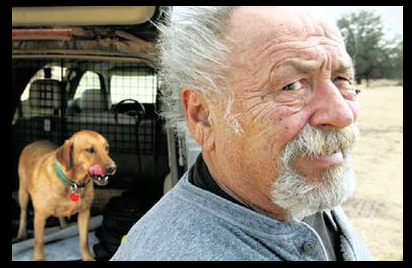
I’m very excited to announce that under the banner of my literary agency Philip Turner Book Productions I’ve sold Devouring Time: Jim Harrison, a Life to Blackstone Publishing in print, ebook, and audiobook, on behalf of my author client Todd Goddard, associate professor of literary studies at Utah Valley University.  This will be the first biography to chronicle the fascinating, large life of the acclaimed poet and fiction writer (1937-2016). Goddard will examine all aspects of Harrison’s creative life, and how he incorporated major life milestones in to his work. Among those momentous events:

  •  The fatal car wreck that killed Jim’s father and sister when he was twenty-four; he blamed himself as they were heading to a weekend stay at a family cabin for which Jim had intended to join them until his last-minute cancellation delayed their departure. The tragedy spiraled Jim in to a deep depression, while also spurring his dedication to writing, as he soon after published his earliest poems and met Denise Levertov who shepherded his first book to publication, a poetry collection from Norton.
  • Jim received an introduction to Jack Nicholson who became a patron, supporting him financially through the completion of the three novellas that would become the collection,  Legends of the Fall; this relationship led to work on film projects and relief from the money woes that had long burdened him. Through this he also formed associations with many Hollywood figures including Anjelica Huston, John Huston, John Belushi, director Bob Rafelson and his wife Toby, who had made the match with Nicholson, and Stanley Kubrick, with whom Jim played chess.
  • Working with publisher Seymour Lawrence, who embraced the idea of publishing a collection of novellas, an unorthodox experiment that other publishers of the day were not eager to take on. Interviews by the biographer with Harrison’s longtime agent Bob Datilla explore the relationship between the writer and publisher.

Harrison’s sense of place will also be key to the narrative, as Goddard explores the importance of landscape in Jim’s poetry and fiction, mapping his life and situating him topographically. This process will unfold throughout the book in a number of important locales, from the lakes and forests of Michigan, to the crashing surf of the Florida Keys, to Greenwich Village where he drank with Jack Kerouac at the Five Spot bar, to hardscrabble Durango, Mexico, as well as Montana, Hollywood, Arizona, and Provence, France.

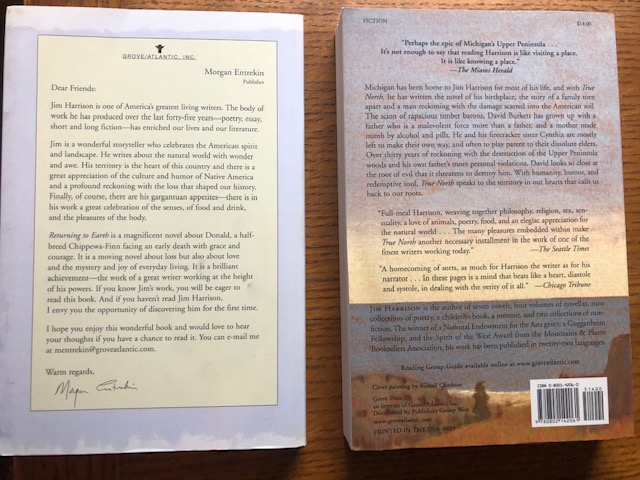
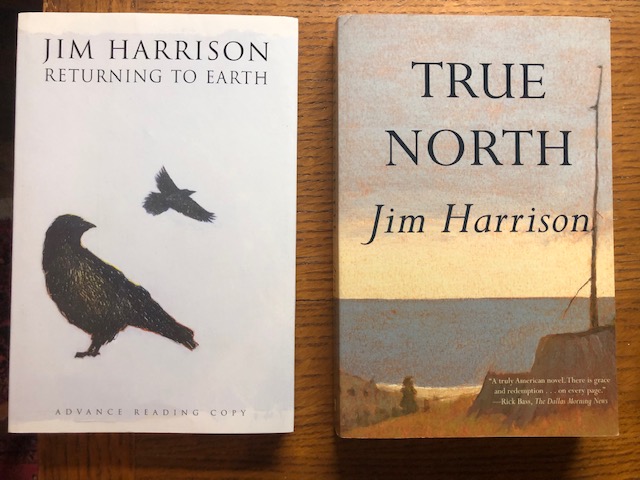
Todd Goddard regularly teaches Harrison’s fiction and poetry, and has presented research on Harrison’s works for the Jim Harrison Society at the American Literature Association’s annual conference. His research is well underway, already taking him in to the Harrison archive courtesy of the late author’s estate, thanks to an introduction by generous executives at Grove Atlantic. The archive includes correspondence with Raymond Carver, Francis Ford Coppola, Annie Dillard, Louise Erdrich, Allen Ginsberg, Barry Lopez, Peter Matthiessen, Norman Mailer, Gary Snyder, David Foster Wallace, Terry Tempest Williams, and Tom McGuane.

Goddard is also in touch with the The Jim Harrison Author Page on Facebook, where more than 10,000 fans celebrate the writer’s life, from preparing a special cassoulet to arranging bookstore discussions of Harrison’s work.

In Harrison’s later years, he was twice a featured guest on Anthony Bourdain’s TV shows, gaining a status as an elder statesman of American letters and enlightened living. With such biographies as Madison Smartt Bell’s work on Robert Stone (Doubleday, published this month), it’s a propitious time for this biography of Jim Harrison.


National Book Critics Circle Annual Finalist Readings, March 16 2016

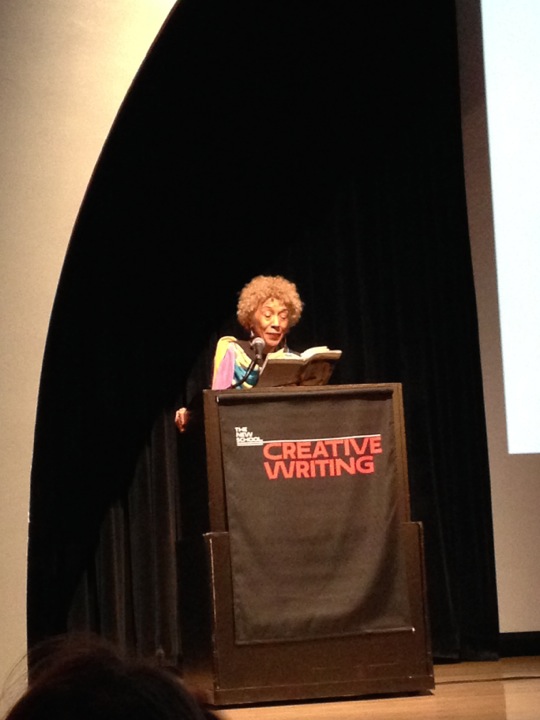
Margo JeffersonThe National Book Critics Circle’s annual literary extravaganza began last night, a two-night affair I’ve attended every year since the early 2000s (and written about on this blog before). Last night 25 of the authors whose books are finalists for the awards in the six categories which will be given tonight read from their books. No admission charge for the readings or the awards tomorrow, NY’s best free literary program every year. There’s a post-awards benefit tomorrow night, the only part of the wordfest that carries a charge. I’ll be there again tonight. Glad I got good pictures in the darkened auditorium at The New School on West 12th St.