Tag Archive for: Urban Life & New York City

What My Manhattan Street Looked Like This Morning

Wednesday Update: City crews came this morning and cleared away and chopped up the downed tree from our street. Thank you! I wish the rest of the city could have as easy and quick solution as we had today.

Storm damage outside my apartment building has those of my neighbors with cars unable to move them. These are pictures taken at around noon today. Twelve hours later, the fallen tree still bisects my Upper West Side block, and we still have no traffic on our side street between Riverside Drive and West End Avenue. Note how fortuitously these limbs crashed toward the pavement–none of the cars has so much as a scratch or a cracked windshield. Strangely delicate destruction.

Coming Back from Hurricane Sandy in NYC

In response to friends and readers who’ve begun asking about the welfare of me and my family, thank you for your concern. I’m posting with the good news that my wife and son and I are all well this Tuesday morning, after the hurricane blew through the tri-state area. Despite the widespread loss of electricity throughout New York City, reportedly affecting more than 750,000 fellow NYers, we did not lose power, nor suffer any issues with our apartment on Manhattan’s Upper West Side. While our hearts bleed with the news that there’ve been at least 10 fatalities in the city, and an incalculable loss of property and key city infrastructure, we are okay.

I should add that this day, October 30, is the one-year anniversary of the first blog item I posted on this site, Seasonal Thoughts. Interestingly it was about another weather event, a big snowstorm that occurred last year on this day. So, it’s a kind of birthday for The Great Gray Bridge.  Thank you for being one of my readers, and for your concern about our well-being.

Thoughts on the Storm, the Election & Why FEMA Runs Best Under DEMs

As I sit here in my Manhattan stronghold, with batteries, candles, water, food, and supplies socked in, I’m thinking about the effect this storm may have on the presidential campaign. Like when the Olympics were held last summer, and the competition had the collateral effect of diverting the attention of the media and millions away from the campaign, I’m thinking there will be a smilar effect this week, with the likely effect of freezing the campaign in place.

Though surrogates will probably continue to be heard in the media, their efforts will be dampened, while campaigning by the two candidates and their running mates is coming to a near-standstill for at least 2-3 days. In the meantime, President Obama visited FEMA HQs for a briefing this afternoon. CNN reported on his FEMA visit:

“You need to take this seriously and take guidance from state and local officials,” Obama said at the Federal Emergency Management Agency headquarters in Washington. “This hasn’t hit landfall yet,” he said. “So we don’t yet know where it’s going to hit, where we’re going to see the biggest impacts and that’s exactly why it’s so important for us to respond big and respond fast as local information starts coming in.” Before speaking to reporters, Obama said he met with officials from FEMA and other agencies, as well as spoke by phone with governors and mayors whose states and cities may be impacted by the storm. Obama said he is “confident that the resources are in place.”

Barack can do presidential things like that, but since Mitt has no job, apart from running for office, he can’t do anything constructive. He may be tempted to to do something photo-op-ish like visit a shelter or an evacuation center, but it would look excessively opportunistic, especially after Paul Ryan was recently caught trying to wash a food pantry’s pots and pans when they weren’t even dirty.

Do you remember how well FEMA operated during the Clinton administration, with James Lee Witt at the helm of the agency? Then, under Geore W. Bush, with hacks Joe Allbaugh and Mike Brown in charge, FEMA was a basket case. Katrina happened after the Bushies had let the agency go to pot. It’s so clear that government agencies like  FEMA run better under DEMs, than under Repubs. Maybe this storm will have the effect of reminding the country of that, and which party they want in charge of the White House, under circumstances like these.

Since I believe that the president is ahead in Ohio and key swing states, I’m okay with an event like this that freezes the campaign in place, though I’m disappointed with the disruption of early voting and the possible muting of the president’s case for re-election. There is no precedent for a storm like this, landing just a few days before a presidential election. It’s terra incognita in historical terms, so we really don’t know what effect this may have. Still, I’m hoping the millions of people in the storm’s path will be safe, and the country will be reminded of why we need to have an adequately funded government, with agile and responsive agencies like FEMA.

Two NYC Mayors, Falsely Lionized by Big Media

What is it about NYC mayoral administrations that they tend to be falsely celebrated, even mythologized, by people outside the city, especially by members of the national press, while the actual denizens of Gotham must live under the misrule of these sanctimonious characters?

I first noticed this phenomena during the Giuliani administration, between 1992-2001. As mayor, Rudolph Giuliani was a daily irritant in the city, continually choosing confrontation over conciliation, seldom missing a chance to stoke the embers of urban enmity–between the police and the people; black and white citizens; between Manhattanites and residents in the other boroughs. On and on it went, year after year. When Abner Louima was sodomized by members of the NYPD, a word of apology never crossed that mayor’s lips. The same was true when Amadou Diallo was shot by police. Giuliani picked fights with museums and routinely showed contempt for free speech and free expression. It was like being trapped in a room with an unremittingly argumentative neighbor.

In the fall of 2001, as Giuliani’s second and final term was at last beginning to wind down, with a mayoral primary that would begin the process of choosing his successor scheduled for Tuesday, September 11, 2001, tragedy struck the city, with 3000 people murdered in one morning. The chaos in the city, which I personally experienced, was worsened by the fact that Giuliani had unaccountably chosen to locate the city’s emergency response center in the World Trade Center, even though the WTC complex had already been a bombing target, in 1993. Overnight, the titular head of city government found himself the beneficiary of sympathy and concern from people around the world. The object of all this empathy responded by suggesting that the scheduled election should be canceled, so that he could stay in office an extra few months. He claimed to be an indispensable leader, one for whom the democratic process should be abrogated; many New Yorkers believed differently.

In the months that followed, before Michael Bloomberg won the election and was inaugurated as the next mayor, Giuliani basked in the notoriety associated with his supposedly excellent stewardship of the city, but again, many residents of New York City knew better–he was just an autocratic and divisive pol who hadn’t been changed it all by the events of 9/11. The only thing that was new was the national press’s unwarranted celebration of him. The accurate reality of Rudy Giuliani was typified when, during the 2008 presidential primaries, candidate Joe Biden, said,

“And the irony is, Rudy Giuliani, probably the most underqualified man since George Bush to seek the presidency, is here talking about any of the people here. Rudy Giuliani… I mean, think about it! Rudy Giuliani. There’s only three things he mentions in a sentence — a noun, a verb, and 9/11. There’s nothing else! There’s nothing else!”

This brings me back to Bloomberg, who actually surpassed Giuliani’s anti-democratic tendencies when in 2009 he engineered the overthrow of term limits that he had earlier claimed to support, thus allowing him to run for a third term. Now it was him claiming, amid the recession of 2008, that he was supposedly the indispensable pol. The one-time Democrat who became a Republican to run for mayor, gave the Bush-Cheney ticket the keys to city for the 2004 Repub convention, sacrificing civil rights and free speech. After this, he next became a so-called independent in his second run for mayor. Truth is, he was never independent of the things the city needed him most to be an honest broker on, such as preventing monied interests–Wall Street, big banks, and real estate–from controlling the city.

In today’s NY Times, frequently a mouthpiece for the Bloomberg administration, we learn that the mayor doesn’t approve of the presidential candidates. He claims neither Mitt Romney nor President Obama is willing to tackle hard problems, implying that he would if he were president.

“This business of ‘Well, they can afford it; they should pay their fair share?’ Who are you to say ‘Somebody else’s fair share?’”  . . . . A solution, he said, would be to allow the Bush-era tax cuts to expire as scheduled at the end of this year. Mr. Obama supports allowing them to expire for those with household incomes of more than $250,000, a delineation that Mr. Bloomberg said was unfair, arbitrary and fiscally irresponsible.”

So the billionaire mayor believes that middle class Americans, who’ve been hammered by predatory economic policies for years, should pay higher taxes? As a New Yorker fed up with the mayor’s tiresome sanctimony, given an opportunity I would remind him that in the negotiations to raise the debt ceiling in summer 2011, President Obama tried to strike a grand bargain that would have cut spending in exchange for higher taxes on wealthy Americans. It was congressional Repubs that said no.

The Times’ reporter Jim Rutenberg should have reminded readers of what I remember as Bloomberg’s opposition to the Dodd-Frank law. Moreover, he opposed other sensible reforms that would rein in Wall Street, and also failed to support the creation of the Consumer Financial Protection Bureau, which was set up by Elizabeth Warren, and for which President Obama was forced to make a recess appointment of Richard Cordray to run it, since national Republicans refused an up or down vote on the former attorney general of Ohio to run the CFPB.

And, on what Rutenberg calls Bloomberg’s “signature issue of gun control,” we learn the mayor’s unhappy with the president. I share his advocacy of new gun laws, and of course, I’m frustrated with the stranglehold the NRA exerts over politicians. But in the last debate, the president spoke of his interest in re-imposing an an assault weapons ban. For his part, Mitt Romney said that he believes no new laws are necessary. That’s a big difference between the two, especially when you consider that the NRA has tried to demonize and demagogue the president ever since he took office, and recently endorsed Romney.

As shown by the examples of our last two mayors, New York City is portrayed in all sorts of false and inaccurate ways in the media; if you actually live here you come to see that these media portraits are often wildly at odds with the reality of the city and the way our so-called leaders are actually perceived by New Yorkers.

A Saturday Neighborhood Political Rally

Tweeted this out a few minutes ago.


“Was just at the off’cl opening of the Manhattan Upper West Side #Obama2012 Victory HQ. Local pols Stringer&Inez D. + nabes came to cheer.”

After the exhortatory appeals to work and volunteer to phone bank, to go on bus and field trips to Staten Island, Beacon, NY, up the Hudson a bit, and to Elkins Park, PA, I walked around inside the bright, new office, and met a few people. It’s on the west side of B’way, bet. 102nd St and 103rd, not even a full crosstown block from my home. I made calls to swing states in 2008, and with a month to go before Election Day, I’m about to start again. Now, with the office so close to home, I can go there too!

I didn’t happen to have my camera with me, or I would have illustrated that tweet, and this post on it. As ever, thanks for reading my blog.

“Life is a Carnival”*

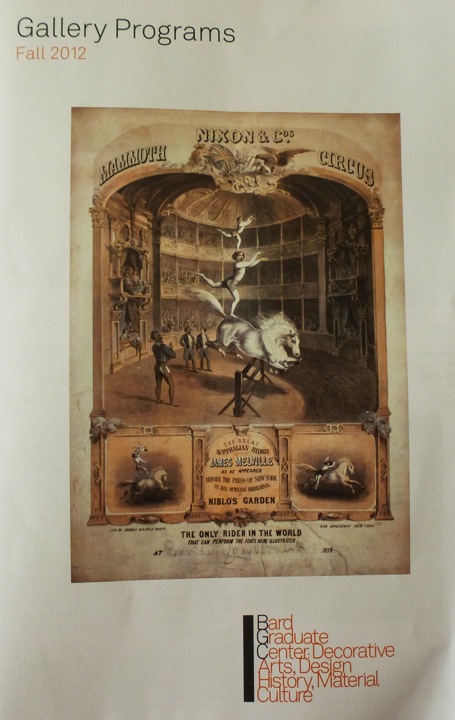
The Bard Graduate Center on West 86th Street is a gem of a small New York museum. On my birthday last Saturday, Kyle asked me what I wanted to do for fun. I suggested we go view Bard’s current exhibit, “Circus and the City: New York, 1793-2010.”

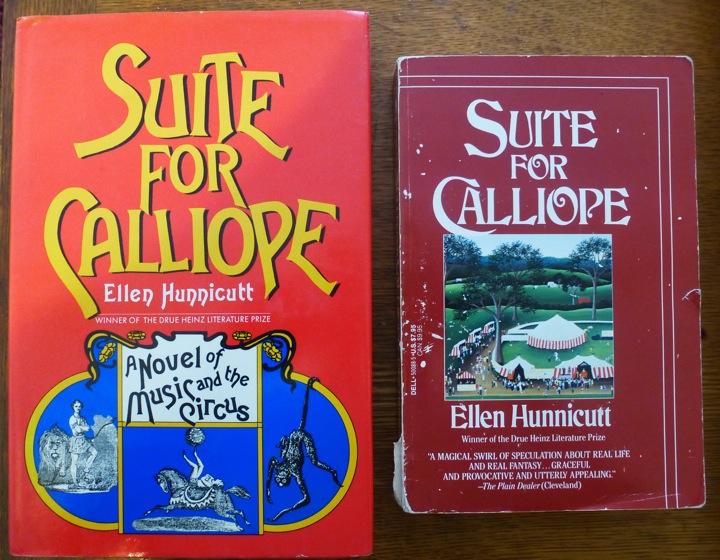
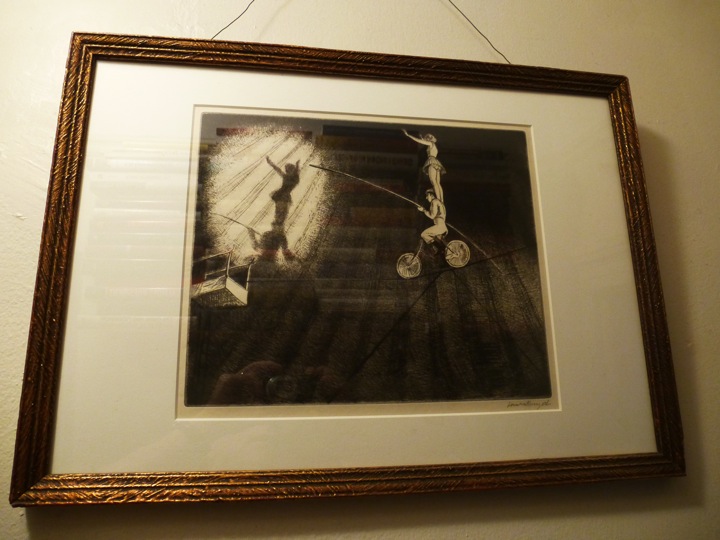
I’ve loved the circus for years, and have even collected artwork on it, like the print below of high-wire artists on a bike, by Dame Laura Knight. I bought it  in 1987 from my late art dealer friend Robert Henry Adams when I was editing and publishing the splendid circus novel, Suite for Calliope: A Novel of Music and the Circus, by Ellen Hunnicutt, who won the Dru Heinz Literature Prize that same year for her short fiction collection, In the Music Library. Ellen’s novel centers around a young female protagonist who’s a runaway from a bizarre custody battle in her family. Holed up in the safe harbor of the Florida winter quarters of a circus troupe, throughout the novel she’s using their calliope to compose a musical work in memory of her late mother. The novel’s theme is how we may turn our mourning and loss to the service of art and creativity. For the record, Ellen passed away in 2005. I hope some day to republish her novel.

Much as I’ve read about circus lore, I had not understood a key aspect of the historical record as documented by the exhibit: the central role that NYC played in the growth and development of the circus throughout North America. Many of the biggest promoters were headquartered in Manhattan, the continent’s entertainment capitol. Once the circus began moving from town to town via train cars, Gotham’s status as a rail hub, as well as its large, diverse population, made it the essential city for promoters and performers alike.

The 20th century was covered on the third floor of the exhibit, with great photographs by Weegee, best known for his lurid crime scene photography, here depicting circus audiences enthralled by performances. There was also a video monitor showing a film of female stunt artist Tiny Kline performing the “Slide for Life,” in which she clamped down on a kind of leather bit she’d placed in her mouth, then slid on a cable for a 1,000 feet hanging above Times Square.

Along with the exhibit, which comprises more than 200 works displayed on three floors of the museum, there will be nine public talks given beginning October 11 and stretching into 2013, ending on January 31, discussing female equestrians; performance photography; the design and typography of circus posters; P.T. Barnum and Ralph Waldo Emerson; Alexander Calder; clowning; and the circus of the future. I hope to be there for one or more of these presentations. Meantime, here is a gallery of images from the exhibit. Please click through to view art and images from the exhibit.

*Thanks to The Band, for use of the title of their song, “Life is a Carnival, written by Rick Danko, Levon Helm, and J.R.R. Robertson, from their 1971 album, “Cahoots.”