Listing Notable Current Affairs Titles I’ve Worked On

For an editorial assignment on a current affairs title with a major publisher that I’m being considered for—in what amounts to a competitive situation among other candidates—I listed a dozen notable titles I’ve acquired, edited, published, and/or agented over my years in publishing. Below is a screenshot of that list for readers of this blog who may be curious about some of the titles I’ve chosen to work on and be involved with over the years. I should add there are many such titles beyond this dozen. Please let me know if the editorial and publishing services provided by me and my business partner Ewan Turner might be of interest to you.

*So Wrong for So Long: How the Press, the Pundits—and the President—Failed on Iraq by Greg Mitchell, w/a Preface by Bruce Springsteen; The Baby Thief: The Untold Story of Georgia Tann, the Baby Seller Who Corrupted Adoption by Barbara Bizants Raymond, a Publishers Weekly Best Book of the Year; and Ahmad’s War, Ahmad’s Peace: Surviving Under Saddam, Dying in the New Iraq by Michael Goldfarb, a NY Times Notable Book.

Publishing November 15, “Richard Tregaskis: Reporting Under Fire From Guadalcanal To Vietnam”

As mentioned on this blog, I’m a lifelong fan of reading biographies, and it’s a delight to work on so many good ones, like Ray E. Boomhower’s new portrait of the life and career of Richard Tregaskis, one of the most accomplished combat correspondents of the twentieth century. Here’s how the catalog copy for University of New Mexico Press’s High Road imprint describes the book:

In the late summer of 1942, more than ten thousand members of the First Marine Division held a tenuous toehold on the Pacific island of Guadalcanal. As American marines battled Japanese forces for control of the island, they were joined by war correspondent Richard Tregaskis…one of only two civilian reporters to land and stay with the marines, and in his notebook he captured the daily and nightly terrors faced by American forces in one of World War II’s most legendary battles–and it served as the premise for his bestselling book, Guadalcanal Diary.

One of the most distinguished combat reporters to cover World War II, Tregaskis later reported on Cold War conflicts in Korea and Vietnam. In 1964 the Overseas Press Club recognized his first-person reporting under hazardous circumstances by awarding him its George Polk Award for his book Vietnam Diary. Boomhower’s riveting book is the first to tell Tregaskis’s gripping life story, concentrating on his intrepid reporting experiences during World War II and his fascination with war and its effect on the men who fought it.


Richard B. Frank, author of Guadalcanal: The Definitive Account of the Landmark Battle, says of the new biography:

“Alongside Ernie Pyle, Tregaskis was perhaps the most outstanding American war correspondent of WWII. [He’s] best know for…Guadalcanal Diary, but that book covered only one small chapter of his reporting from the front lines. Ray Boohmoer’s excellent new biography finally does justice to Tregaskis in this deeply researched, thoughtful portrait of the man and his times.”


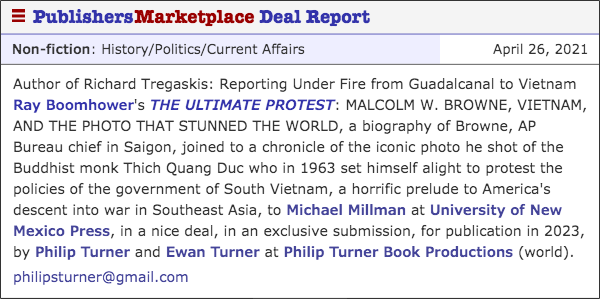
The book’s official pub date will be November 15, and I’m getting an early start on congratulating the author, for whom I’ve already sold a second biography of an important journalist to UNMP, The Ultimate Protest: Malcolm W Browne, Vietnam, and the Photo that Stunned the World. Congrats, Ray!


Publishing November 1, 2021—“Emily Mann: Rebel Artist of the American Theater” by Alexis Greene

One of the joys of being a provider of editorial and publishing services is the opportunity to work on terrific books that I enjoy reading, and which I know a great many readers will also enjoy. As a longtime fan of biography, I’m especially pleased that I get to work on so many excellent life stories, like Emily Mann: Rebel Artist of the American Theater by Alexis Greene, finished copies of which just arrived in my office today, good timing in view of the book’s November 1st publication date.

One of the joys of being a provider of editorial and publishing services is the opportunity to work on terrific books that I enjoy reading, and which I know a great many readers will also enjoy. As a longtime fan of biography, I’m especially pleased that I get to work on so many excellent life stories, like Emily Mann: Rebel Artist of the American Theater by Alexis Greene, finished copies of which just arrived in my office today, good timing in view of the book’s November 1st publication date.

As I wrote when I sold the book to Applause Theater and Cinema Books earlier this year:

“This will be the first book about Mann, a trailblazing woman playwright and stage director, artistic director of the McCarter Theatre in Princeton from 1993-2020. It chronicles the story of Mann’s path through a field where women have often struggled for the opportunity to direct the work of other playwrights, leave alone see their own plays produced.

Greene chronicles Mann’s role in the growth of a socially-oriented theater with plays she’s written that explore current events and issues while focusing on the lives of under-recognized groups in society, in scripts virtually ripped from the headlines and braided together from archives, diaries, public records, and interviews conducted with participants in momentous events. Dubbed a “theater of testimony” Mann has written such plays as “Execution of Justice,” on the murder of Harvey Milk and Mayor Moscone in San Francisco; “Greensboro (A Requiem),” on a deadly 1979 KKK attack; “Mrs. Packard,” based on the true story of a 19th century minister’s wife committed to an asylum when she abandoned the church; “Having Our Say,” based on the bestselling book of the same title, on the centenarian African American sisters Sadie and Bessie Delany; and “Gloria: A Life,” drawn from the life and career of Gloria Steinem. Her development of a kind of new documentary theater has been influential in many ways.

A New York City native, Alexis Greene is the author and editor of numerous books about theater, including The Lion King: Pride Rock on Broadway, written with Julie Taymor, and the biography Lucille Lortel: The Queen of Off Broadway. Her career spans acting, theater criticism, and teaching (she holds a PhD from the Graduate Center of the City University of New York).”

It’s the first biography of the pathbreaking director and playwright, known best for her “Theater of Testimony,” documentary-style plays drawn from public documents and oral histories. If you’re a theater-goer, and enjoy inspiring life stories, I heartily recommend Emily Mann: Rebel Artist of the American Theater.

Cover Reveal for “The Barrens: A Novel of Love and Death in the Canadian Arctic”

Delighted to share the superb cover for The Barrens: A Novel of Love and Death in the Canadian Arctic by our agency clients Kurt Johnson and Ellie Johnson, coming in May 2022 from Arcade Publishing.

Below are all the blurbs we’ve already received for this engrossing novel.

“I’ve rarely come across a novel that’s simultaneously so economical and fulsome, that’s as restrained as it is brimming with unspoken wisdom, and that manages all this while also being propulsive in its storytelling. It’s bravura work that demands a wide audience.”—Peter Geye, author of Wintering and Safe from the Sea

“The Barrens grabbed me from the opening pages and never let go, a riveting adventure story written by a father-daughter team who clearly have wilderness chops.”—Michael Punke, author of The Revenant and Ridgeline

“A deeply compelling tale, told in vivid, elegant but concise prose, The Barrens carried me along, swiftly as the river at the heart of the story. The central character, Lee, will break your heart, although she’ll have none of it. Love, loss, life and death, against a landscape as raw and ancient as the human heart. Most highly recommended.”—Jeffrey Lent, author of In the Fall

“As harrowing as the whitewater adventure it chronicles, The Barrens is an epic tale of wilderness survival and death in the techno age. The writing throbs with presence: the life-force embedded in Canada’s northern frontier landscape and in the life-scape of its queer young heroine as she journeys toward selfhood. Co-authors Kurt and Ellie Johnson reveal the pulse of identity, born of the stories we weave. A mesmerizing, devastating read.”—Carol Bruneau, Canadian author of Brighten the Corner Where You Are: A Novel Inspired by the Life of Maud Lewis

“The Barrens is the raw and moving story of two young women paddling by canoe down one of North America’s the most remote rivers—of their coming of age, their love, and terrible loss. I’ve rarely come across a text that is so visual, and so tangible. The Barrens is a vivid portrayal of the Canadian subarctic, and of the human drive to persevere.”—Alex Messenger, author of The Twenty-Ninth Day: Surviving a Grizzly Attack in the Canadian Tundra

#debutnovels #wildernessfiction #canoeing #paddling #Canada #ThelonRiver #queerlit #writers #writingcommunity

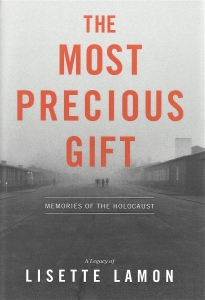
Recommending “The Most Precious Gift: Memories of the Holocaust, a Legacy of Lisette Lamon”

Readers of this blog may recall that I worked with photojournalist Ruth Gruber, editing her work and helping her publish six of her eighteen books during her career as a trailblazing woman photojournalist and chronicler of displaced persons (DPs) after the Holocaust. Books we worked on together include Haven: The Dramatic Story of 1000 WWII Refugees and How They Came to America (Carroll & Graf Publishes, 2000) and Exodus 1947: The Ship that Launched a Nation (Union Square Press, 2008).

In the same vein, in 1999 while Executive Editor at Crown Publishing, I acquired rights to IBM and the Holocaust: The Strategic Alliance Between Nazi Germany and America’s Most Powerful Corporation by Edwin Black. And in the early 1990s, I edited Solly Ganor’s affecting wartime memoir, Light One Candle: A Survivor’s Tale from Lithuania to Jerusalem, which recounted his survival in the Kaunas (Kovno) ghetto and as a teenaged forced to labor underground in a dangerous mine. Let it suffice to say that Holocaust-themed titles are very much a part of my publishing persona.

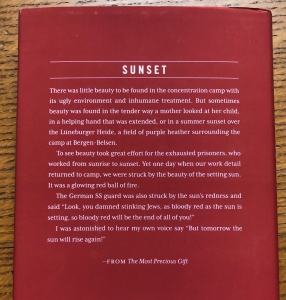
That is why I was excited recently when we had the opportunity to edit a remarkable first-person primary source narrative of the Holocaust titled The Most Precious Gift: Memories of the Holocaust, A Legacy of Lisette Lamon.

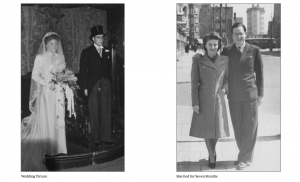
Lisette Lamon was nineteen and engaged to Benno, the young man she loved, when with her parents she fled from Amsterdam to New York City prior to the Nazi invasion of Holland. Unable to bear the separation from her fiancé, she returned to Amsterdam so they could marry. Soon after their wedding, the Nazi occupiers of the Netherlands came to their home, to arrest a young man who had been rooming with them. In his absence, Benno was arrested instead and deported to the Mathausen concentration camp in Austria, where he would die  under Nazi captivity. Lisette became a motivated member of the Dutch Resistance, a courier for the movement. However, her work was discovered by the occupiers. She was arrested and sent to the Westerbork transit camp in the Netherlands, then to Bergen-Belsen in Germany.
These shattering developments are established in the first few chapters of this emotive book, followed by a clear-eyed report on daily life in the camps, chronicled in thirty-five vignette-length chapters. In one chapter, “Euphemisms,” Lamon writes about the vocabulary inmates coined to express what they endured—a “Slipper Parade: the shuffling of inmates in the morning on the way to the washroom”; “Transport Noir: a trip to a death camp”; and “Vitamin R: a right connection that might help an inmate gain an extra ration of food.”  She writes about achingly beautiful children and stalwart adults who struggled to survive amid deprivation, overwork, malnourishment, and cruel treatment; the decline of the German fighting machine; and the survivors’ hope that if they could only stay alive long enough, they might be liberated by the Allies.

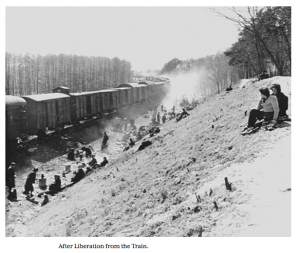
As Allied armies closed in on Bergen-Belsen, Lisette was placed with hundreds of other prisoners on a train car that was driven to the middle of a high bridge. The Germans intended to blow up the span, sending the inmates crashing into the river below and preempting the Allies’ push across the vital link into Nazi-held territory. But liberation came an hour before the explosives could detonate. When an American soldier asked the English-speaking Lisette if she would serve as an interpreter, she seized the opportunity to ask if a note could be sent to her parents in New York City informing them that their daughter was still alive. The officer gasped in astonishment when he looked at the address she gave him and saw it was the same Upper West Side apartment building where his own parents lived in Manhattan!
Lisette Lamon (1920-1982) remarried in the United States, and had a family with her new husband. She became a psychologist who pioneered in providing trauma counseling to survivors of the Holocaust, at a time when the category of survivors of the Holocaust was still a relatively new phenomenon, around the time that journalist Helen Epstein published her seminal book, Children of the Holocaust: Conversations with Sons and Daughters of Survivors (G.P. Putnam, 1979). The manuscript of The Most Precious Gift came to me from David Mendels, the adult son of the author. David and I were friends and classmates at Franconia College in the 1970s, when I often heard from him about his remarkable mother and her Holocaust stories. After we edited the manuscript in consultation with David, the book was recently published in a handsome edition (French Hill Publications, hardcover with jacket, book design by Neuwirth & Associates, 195 pages, 11 photos, $19.45) and we’re gratified to help him get the word out about his mother’s written legacy. We consider the title an ideal expression of what makes this book so special—it is indeed a most precious gift, an ideal Mother’s Day present, for instance. It is available as an ebook, as well as the handsomely printed and bound hardcover, which you may order it via this link.

Sold: “The Ultimate Protest: Malcolm W. Browne, Vietnam, and the Photo that Stunned the World” by Ray E. Boomhower

One of the pleasures of having been an active literary agent for several years now is the satisfaction I get from selling a subsequent book by an author whose earlier book that I sold is already on the way to being published. This is the case with Ray E. Boomhower, whose biography of combat reporter, Richard Tregaskis: Reporting Under Fire From Guadalcanal to Vietnam will be published this November under the High Road Books imprint of the University of New Mexico Press. Yesterday we announced that Boomhower’s next book, The Ultimate Protest: Malcolm W. Browne, Vietnam, and the Photo that Stunned the World, has also been acquired by University of New Mexico Press. The book will detail how Browne—a most unlikely war correspondent who switched from life as a chemist to a journalist, and became the Associated Press’s bureau chief in Saigon at age 32—was the only Western reporter on June 11, 1963, to capture, with a cheap Japanese Petri brand camera, the image of Thich Quảng Đức, the Buddhist monk who immolated himself to protest the Catholic-dominated administration of South Vietnamese president Ngo Dinh Diem.

Boomhower, who began publishing books long before we began working together (in fact, The Ultimate Protest will be his nineteenth title), has made a speciality of tracking the work of journalists at war, with earlier books on Ernie Pyle and Robert Sherrod, and the forthcoming book on Tregaskis, best known for publishing Guadalcanal Diary, the 1943 bestseller that was the first book in the US to emerge from the Pacific theater.

Chronicling the impact of the gruesome photo inside the Kennedy administration, from the draft manuscript:

“Jesus Christ!”

The sharp expletive uttered by President John F. Kennedy interrupted the telephone conversation he had begun early on the morning of Tuesday, June 11, 1963. The president was talking with his brother, Robert Kennedy, the Attorney General of the United States, who had called to discuss what to do if Alabama governor George Wallace made good on his promise to deny the entry of two African American students, Vivian Malone and James Hood, into the University of Alabama.

The impetus for the president’s exclamation had not been Wallace’s intransigence, but a photograph he saw splashed on the front pages of newspapers delivered to him that morning. Since May 8, 1963, when a company of Civil Guards had killed Vietnamese civilians protesting a new governmental decree outlawing the flying of the Buddhist flag on Buddah’s birthday in Hue, South Vietnam had been wracked by demonstrations. The awful image that had so startled the president showed a man—a seventy-three-year-old Buddhist monk named Thich Quảng Đức—engulfed in flames while calmly, it seemed, sitting in the lotus posture on a street in Saigon, South Vietnam.

Browne, who had been tipped off about the demonstration the evening before, was the only Western reporter on the scene to photograph the horrific event. Although the monk, as he burned, uttered no sound nor changed his position, Browne could see that his “features were contorted with agony” and could hear moans from the crowd that had gathered, as well as the ragged chanting from the approximately 300 yellow-robed monks and gray-robed Buddhist nuns who had joined the protest.

“Numb with shock I shot roll after roll of [35mm] film, focusing and adjusting exposures mechanically and unconsciously,” Browne recalled. “Trying hard not to perceive what I was witnessing I found myself thinking: ‘The sun is bright and the subject is self-illuminated, so f16 at 125th of a second should be right.’ But I couldn’t close out the smell.” The AP correspondent was almost overwhelmed by the smells of joss sticks—incense burned for religious rituals—mixed with burning gasoline and diesel fuel and the odor of burning flesh.