Tag Archive for: Undercover Books

Herman Graf in 2012, Celebrating 51 Years in the Book Biz (now with a Bob Wietrak 2018 update)

February 6 2018 Update: With the sad passing this week of Bob Wietrak, longtime bookseller and publishing executive—with whom I was a colleague at Macmillan from 1987-1990—I want to point out to friends and readers of this blog that Bob was involved in a harrowing episode at one of our annual book conventions, at an ABA in the 1980s, the one time the trade show was held in Las Vegas. A key figure in the incident was Herman Graf, the longtime publishing pal whose surprise birthday party I wrote about below in 2012. Bob was at that party, too, seen in the background of the photo below.
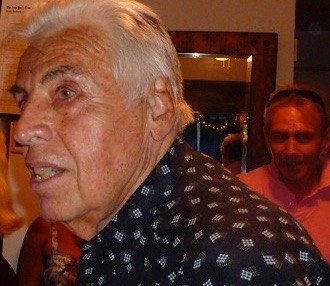
In a phone call tonight Herman reminded me of some of Bob’s best qualities. Herman told me, “He had an uncanny talent for predicting what books would work big. He also had a knack for making publishers feel generally satisfied about the ordering and marketing decisions that the national book chain made about what books to feature, while also keeping B&N’s upper management satisfied.” Bob was laid off in a big B&N purge in 2011, when 40 people were let go, and went on to later jobs with online book sites Bookish and Zola. (I know about B&N’s corporate purges first-hand as in 2009 I was let go in a twenty-person layoff from Sterling Publishing, B&N’s publishing division, where I worked as Editorial Director, V-P of Union Square Press.) Nearly seven years after the party for Herman, I’m really glad that Bob Wietrak was there that night.

——
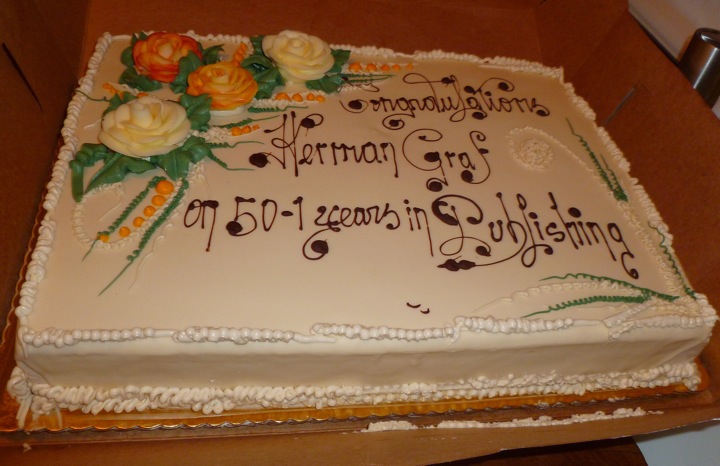
Last night Kyle and I were delighted to join a group of several dozen well-wishers who sprung a surprise party in honor of Herman Graf and his 51 years in publishing. Herman walked in on the hushed throng which had assembled in the living room of Tony Lyons, founder of Skyhorse Publishing, expecting to join Tony for dinner, when in unison we let out with our “Surprise.” More than a bit stunned, Herman said, “It’s not my birthday.” It’s not even my Bar Mitzvah.” We took the photos accompanying this post in the first few minutes after he walked in to find a party had been laid for him.

Herman began his publishing career in 1961, doing stints with McGraw-Hill, Doubleday, Arco Books, and then Grove Press, where he worked in sales and marketing during the indie press’s 60s and 70s heyday. This was the time when Grove was bringing writers like Samuel Beckett, Eugene Ionesco, Jean Genet, and Mikhail Bulgakov to American readers, even while founder Barney Rosset was frequently in court, accused of distributing “obscene” literature, like D. H. Lawrence’s Lady Chatterly’s Lover. Herman rode that tiger with Barney, and other key Grove executives, such as Kent Carroll, Fred Jordan and Richard Seaver. That era is covered well in the 2007 documentary “Obscene,” made by Dan O’Connor  and Neil Ortenberg, also old colleagues of Herman’s, and mine.

The ride was so rollicking that in later years Herman liked to say, “I was the Billy Martin of publishing; Barney fired me three times, and rehired me twice.” There was something to this George Steinbrenner-Billy Martin analogy, as Herman, like the brawling, ill-fated Yankee manager, could handle himself in a tight spot, having been a fair boxer when he grew up in the Bronx. Once, at a Las Vegas ABA in the early 80s—the annual convention of the book industry—Herman found himself defending a number of bookseller friends including the genial Barnes & Noble executive Bob Wietrak. Bob and other B&N people found themselves on the wrong side of some ornery Vegas bouncers intent on vacating an after-hours club at an early hour, even though B&N management had secured the room for the night to host a publishing party. These bouncers were attacking the B&N people, slamming them and pushing them. Herman stepped between Bob and the bouncers, and over the next few minutes bulled, brazened, and punched his way out of the club with Bob and others in tow. I know this story is true—I heard about it not only from Herman, but from my late brother Joel, a bookseller—who happened to also be at the venue that night.

In 1978, my sibling and I with our parents began operating our Cleveland indie bookstore chain, Undercover Books, and like many stores of the time, we were glad to have an obscure bestseller land in our laps, A Confederacy of Dunces, the posthumous novel of John Kennedy Toole. The book came with a star-crossed and tragic pedigree–the author had killed himself after failing to get it published, whereupon his grieving mother managed to get it into the hands of Walker Percy. The great southern novelist championed it and convinced editors at the University of Louisiana Press to publish it in hardcover. However, that wasn’t the end of the story. Meantime, Grove Press had acquired rights to publish a paperback edition, but the university press edition, though attracting much critical attention and press, had not really sold a lot of copies in hardcover. Herman, though working for Grove, took it upon himself to sell many thousands of copies of the LSU press edition to national wholesalers, such as Ingram where Cathy Hemming ordered copies. The market was seeded for the paperback edition. When Grove published it some months later it sold hundreds of thousands of copies, and millions since, in part owing to Herman’s work for the hardcover of another publishing house.

Herman told me that story sometime after 2000, the year he hired me to work with him at Carroll & Graf, the company he started in the mid-70s. Last night it was great seeing old C&G colleagues, Peter Skutches, Failey Patrick, Tina Pohlman, Bea Goldberg, and Claiborne Hancock. One of our authors, Stan Cohen was there, and his agent, Peter Sawyer. Agent, Laura Langlie, a friend to C&Gers, was also there. Norton execs Bill Rusin and Dozier Hammond also gave their best wishes in person, as did Bob Wietrak.

The seven years I spent with C&G were among the most productive, fun, and successful years of my publishing career. I learned so much working with Herman and got to hear some of the best–and often the funniest–stories about the business. Together we acquired many terrific books and published them creatively and energetically, including Susan MacDougal’s The Woman Who Wouldn’t Talk: Why I Wouldn’t Testify against the Clintons and What I Learned in Jail and Ambassador Joseph Wilson’s The Politics of Truth: Inside the Lies that Led to War and Betrayed My Wife’s CIA Identity, both of which became NY Times bestsellers. The years there finally confirmed me on an editorial path I had begun to hew to by 2000, but had not yet fully embarked on–of publishing truthellers, whistleblowers, muckrakers, authors of such singular witness that only they could write the book in question.

Herman now works with Skyhorse Publishing, for whom a book he acquired, The General: Charles de Gaulle and the France He Saved by Jonathan Fenby, got a great review in last Sunday’s New York Times Book Review. He is not stepping back or slowing down.

Thanks to Tony Lyons and Jennifer McCartney of Skyhorse Publishing, and Claiborne Hancock, who after leaving Carroll&Graf started his own company, Pegasus Books. They did a great job of hosting and organizing the surprise party for our friend and colleague, Herman Graf.


To Share or Not to Share

Interesting piece by book publicist Brian Feinblum* of public relations firm Media Connect, on what makes people want to share content online, and what makes them decline to do so. The riddle he’s trying to solve is a key one in the Internet age, and one that strikes me as analogous to a question I often pondered when I ran my bookstore, Undercover Books: what makes browsers apt to pick up a book and put it back down again, or what makes a customer walk to the cash register with a firm resolve to buy the book. I haven’t worked in retail since 1985, but I still think about consumer behavior, and nowadays, online behavior. The analogy isn’t an equivalent one, because sharing online doesn’t cost money, but clicking the share button does represent an investment of one’s prestige or reputation. Feinblum must be doing something right, because I decided to share his link and word of his article.

* Full disclosure: I’m on Feinblum’s email list and received a message from him where he asked his subscribers to consider sharing the above article. After reading it, I decided I would because I could stand behind its content as offering something valuable to my readers too.

If It Must Be Done–A Model for Laying Off People Decently

As a longtime publishing staffer who was let go in a major layoff at Sterling Publishing more than three years ago, when downsizing at publishing houses is announced, I read the notices with a combination of concern and regret for the folks losing their jobs, now colleagues of mine in the forced evacuation from the ranks of corporate publishing. It’s analogous to reading the New York Times obituaries to learn who’s recently died, before looking at any other section of the paper. This is not schadenfreude*, pleasure derived from the suffering of others, but something more its opposite–there ought to be a word for the vicarious experience of misery alloyed with empathy upon learning that still more people will soon be joining the ranks of the unemployed, the disemployed, and for how long it cannot be known.

Readers of this blog may recall that in an essay entitled Three Years Ago Today I’ve written about the day in 2009 when I was laid off as Editorial Director of Sterling’s Union Square Press. Covertly summoned to the office of the HR director Denise Allen, she and my supervisor Jason Prince were waiting for me with grim faces. After they lowered the boom, they “asked” me to leave the office later that day for the last time. “Asked” was really a euphemism for “demanded.” Any personal items I could not grab that day–and I had a substantial work and reference library in my office–would be boxed up and shipped to me, they said. I returned to my office in shock to find that I had already been denied access to my work email.

I do know why HR professionals claim that this is the safest way to let people go, lest a dismissed employee make the survivors uncomfortable in the now-shadowy presence of a person who an hour earlier was a colleague; deride the company in the presence of remaining staff or make off with company secrets; or go ‘postal’ and harm higher-ups and co-workers. What’s more, Sterling is owned by Barnes & Noble, a publicly traded company, and during my Sterling tenure B&N was hyper-averse to news and publicity they couldn’t control–even denying book editors the ability to trumpet their latest acquisitions in industry newsletters like Publishers Lunch without first having the announcements vetted by corporate PR. During my Sterling tenure, this aversion to unwanted publicity even extended to the fact that B&N declined to name people who lost their jobs in layoffs, nor was the number of people let go ever confirmed. However, much as negative consequences from treating people decently may be feared, I believe that what this behavior does instead is subtract at least a bit of humanity from everyone in the equation. I note ruefully, but again without any satisfaction, that Jason Prince was himself laid off from Sterling earlier this year. I take no pleasure in this turnabout, and wonder if he was himself on the receiving end of such lousy treatment the day he learned of his dismissal.

With the above as personal prologue, I note with regret that HarperCollins yesterday announced a reorganization of their Sales Department that will lead to the elimination of the positions of at least five senior employees. But there was something novel about the press release put out by Harper’s President of Sales Josh Marwell**–the degree to which he names, acknowledges, and even thanks the people who are losing their jobs. The entire text ran in galleycat.com. The mensch-like passage reads:

After 18 years at HarperCollins, Jeff Rogart, VP, Director of Distributor Sales will retire at the end of August. Jeff’s unique combination of deep industry knowledge, direct style and kind charm has earned him the respect and love from colleagues both inside and outside the company. He will be truly missed. I regret to announce as a result of these changes that Ken Berger, Mike Brennan, Mark Hillesheim, Kathy Smith and Jeanette Zwart, our respected and beloved colleagues will be leaving the company on July 20th. Please join me in thanking them for their hard work, true dedication and warm collegiality in the countless contributions they have made to our company. We wish them only the best in the future.

When you get laid off you invariably, unavoidably, experience a kind of professional death. The process of being shown the door is sort of like getting ferried to the other side, but the process that put me on the boat across my personal River Styx was not as kind or forgiving as the ferryman Charon was with his passengers. And yet, you might say that over the past three and a half years rather than going where the souls of the departed reside, I’ve pretty much managed to be reborn professionally, not buried. That though would be a story for another post. For now, I just want to say I wish Jeff Rogart well in his retirement, and that I feel really bad for Ken Berger, Mike Brennan, Mark Hillesheim, Kathy Smith and Jeanette Zwart, the latter whom I have known personally over the years. I wish them well on their journey into post-corporate life, no matter how brief or long-lived, and assure them that if they ever want to consult with me about my experience of it, I will be glad to share whatever practical advice and insight I can muster. I’m relieved that Josh Marwell and HarperCollins named them, that they were praised and given the professional courtesy they are due, and that under lousy circumstances their dignity was preserved and that their departure will not be so rushed or precipitous as mine. I cannot comment of course on the terms of severance under which they’re leaving the company–I hope they were generous–but as for announcing layoffs, this is a model for how to do it right.

*For an insightful discussion of schadenfreude and related words, I refer you to this excellent blog post by musician and songwriter Zak Claxton.

**Full disclosure: I have known Josh Marwell for more than thirty years, since he was a sales rep to my Cleveland bookstore, Undercover Books, representing St. Martin’s Press. We have not discussed the current matter.


Ebook as Gifts?

When I began my career in the book biz as a retail bookseller, among our busiest months were May and June–graduation season–when young people were often gifted with dictionaries, atlases, books of quotations, and other works of popular reference. The gift book buyers at this time of year seemed to want to say by their selections, “I want you to have a useful book, a pragmatic book of practical instruction that will aid you as you embark on your life’s journey.” To me, this was one of the most ennobling duties of being a bookseller–helping a gift purchaser pay an implicit compliment to their recipient, investing them with an expectation that they would soon be going places in their still-young lives. At Undercover Books, when we gift-wrapped and shipped out or hand-delivered a book selected as a result of this process, I felt it was forcefully communicated to the recipient that their benefactor really cared about them, and believed they would amount to something. Here on the first day of June in 2012, thirty-four years after opening that bookstore–and twenty-six after I became an editor and publisher–I find that while my new vocation yielded many new and unexpected satisfactions, the sacred exchange of helping customers choose gift books like this was one of the things I still miss most.

As e-reading has taken hold, with new models of digital publishing emerging every month, I have often wondered how, and whether, booksellers can find some way to lend the presentation of a free download some of the nobility of the process I always relished. Music doesn’t offer much of a model, where say the presentation of an ITunes gift card lacks appeal. It may well be that giving something insubstantial like a download is just not the same as a gift that has some heft.

I thought of all this today after reading an article at geekwire.com which reports as in so many things related to e-commerce, Amazon.com has already spent some time and corporate brainpower thinking about the gift-buying process, even going to the extent of filing for and now receiving “a patent on what has become a common method of giving presents—a system for selecting digital gifts such as movies, music or e-books, sending an electronic notification to a recipient, and allowing them to download the gift.”

Well, Amazon has the patent they sought, but there’s no sign in the article that they’ve discovered any way of imbuing the purchase and presentation of a download with any special significance. For that, we’ll have to wait for another day, if indeed it ever arrives at all.

Joel C. Turner, May 26, 1951-Dec. 8, 2009

On this anniversary of what would have been my late brother Joel’s 61st birthday, my sister Pamela and I remember him with all the force of memory and familial affection, as well as our departed parents, Earl and Sylvia. On May 4, 1978, the five us founded Undercover Books, the bookstore that would give all three of us siblings our adult careers. For those who didn’t know Joel–or who did and want to be reminded of his personality and accomplishments, which included a run for Congress in 2000 and earlier being among the very first online booksellers, several years before Amazon.com–you may read an obituary in the Cleveland Plain Dealer and the remembrance I wrote that was excerpted in Shelf Awareness and Bookweb. The entire piece is pasted in below, set in the Comic Sans font to which Joel was partial (for readers able to view it that way) along with photos of him.
—-

December 9, 2009

Dear Friends and Colleagues,


It was with great regret and sadness that we write to inform you of the recent, sudden passing of our dear brother, Joel C. Turner, 58 years old. 


Many of you will recall that we three siblings together opened Undercover Books, in Shaker Heights, Ohio in 1978, on May 4 of that year, with the hard-working assistance of our parents, Earl (deceased, 1992) and Sylvia (deceased, 2006). From the original location at Van Aken Shopping Center, our family-run independent chain grew to occupy a location in the historic Old Arcade of downtown Cleveland, and a shop that also featured the sale of record albums and the then-new format of CD-ROMs, in Chagrin Falls, Ohio. Joel’s role in the bookstores’ success and the good reputation we enjoyed in the book world was vital and indispensable. He was always generating exciting new ideas that drove our growth. Joel was a constant reader, a passionate believer in books and the power of the printed word. He derived tremendous satisfaction from selling books to the devoted readers whose trade we cultivated in our bookstores. 

We were fortunate to open our business at a moment when throughout the country and particularly the midwest, much book retailing was migrating from older downtowns to suburban locales, as the book departments of long-established department stores and old-line independents gave way to new indies like us. Soon, we were being regularly called upon by publishers’ sales reps from all parts of the industry, as Undercover Books became a go-to store for houses eager to break out books on the national scene. Notable authors who launched books at our stores included Mark Helprin (“Winter’s Tale”), Richard North Patterson (“The Lasko Tangent”), and Walter Tevis (“Queen’s Gambit”).  

The stores, indeed the Turner family home, helmed by Sylvia’s extraordinary cooking and hospitality and Earl’s gregarious nature, and Joel’s energetic raconteurship, also became a favorite stop for sales reps and authors.


By the early 1990s, competitive and economic pressures had mounted, and Joel had the vision to reduce the brick & mortar concentration of our enterprise and transform it into an operation that served businesses, corporate libraries, schools, and public institutions. As this shift occurred, the name of the business became Undercover Book Service, which soon also had an online presence, surely one of the first online booksellers. He also developed a sideline in the antiquarian and second-hand side of the trade. Joel was a true bookseller, and also served the book industry through active participation as an officer and board member of the American Booksellers Association.  


In this decade, he and Sylvia moved to a lovely part of North Carolina, where he helped her live very comfortably for the remaining years of her life. After Sylvia’s death, he built for himself a beautiful home on a scenic mountaintop in the town of Bostic,  Rutherford County, North Carolina, where he died in his sleep this past weekend.  In addition to the two of us–his younger brother and older sister–Joel is survived by nephew and niece Benjamin and Emma Taylor; nephew Ewan Gallup Turner; brother-in law Ev Taylor; sister-in-law Kyle Gallup; cousins Stephanie Shiff Cooper and Brian Shiff; and Uncle Myer Shiff and Aunt Linda Shiff. 


Plans for memorializing Joel are being considered as we write this to you. For those wishing to mark Joel’s life with a charitable donation we urge you to make contributions to the American Booksellers Foundation for Free Expression (ABFFE,  http://www.abffe.com/) or for medical research in search of a cure for diabetes.  

We write in sadness, but with fondness and appreciation for all the years that we three Turner siblings and our parents were recipients of your generous affection, respect, and consideration.  The bookstores gave all of us, and especially Joel, great enjoyment and satisfaction, along with so many wonderful friends. Feel free to send this message on to any of your contacts in the book world. 

Sincerely, 

Philip Turner (philipsturner@gmail.com) and Pamela Turner (pturnertaylor@roadrunner.com)

// more. . . Please click through to the full post to see all photos.


A Renovated Digital Home for the CBC Archives

Cool stuff on the Web from the CBC Archives is now accessible to virtually all computer users. The national broadcaster of Canada goes back to 1936 but until now their Internet archive was more frustrating than enlightening. Now, however a post on the CBC’s in-house blog explains that the old site has been updated, with a side benefit that MAC users–formerly shut out–should now have as full access as folks on Windows machines. It does look much better now and you can savor TV and radio clips of musicians Neil Young, Leonard Cohen, Glenn Gould, writers Margaret Laurence, Margaret Atwood, Alice Munro, Farley Mowat, and Pierre Berton, comedians Bruce McCullough and Scott Thompson from Kids in the Hall and Catherine O’Hara of SCTV and Patrick Watson* (the longtime broadcaster, not the current day musician), to name only a handful. I should add it’s not all about the artistic luminaries–the correspondents and journalists who’ve long made up the CBC, such as Patrick Watson* (the longtime broadcaster, not the current day musician) and the late Barbara Frum, co-host for many years of “As it Happens,” Canada’s “All Things Considered,” represent great broadcast talent. This archive is a veritable youtube for Canuckaphiles and honorary Canadians like me. For a taste of one artist, enjoy this 2 1/2 minute clip on stellar rapper Cadence Weapon, celebrating his selection in 2009 as Poet Laureate of Edmonton, Alberta.

*In 1979, one year after my family bookstore Undercover Books opened for business, Patrick Watson published an excellent suspense novel titled Alter Ego. My brother Joel read it and wrote to Patrick inviting him to visit our store. With the participation of his publisher, Viking, Patrick visited our store for an autographing and a great book party that moved from the store to my family’s nearby home. I recall that Patrick, an accomplished pilot, flew his own small plane from Toronto to Cleveland. I bumped into him in 2003 on the convention floor at Book Expo Canada. We had a pleasant reunion. He’s a grand fellow and has had a fascinating career as broadcaster, actor, author, and engaged citizen. Apart from the thriller Alter Ego, Patrick is also the author of a book in my art book library, Fasanella’s City, on the American painter known for his colorful canvases that depict May Day celebrations and demonstrations of workers’ rights amid clamorous scenes of urban density.