Recommending “The Most Precious Gift: Memories of the Holocaust, a Legacy of Lisette Lamon”

Readers of this blog may recall that I worked with photojournalist Ruth Gruber, editing her work and helping her publish six of her eighteen books during her career as a trailblazing woman photojournalist and chronicler of displaced persons (DPs) after the Holocaust. Books we worked on together include Haven: The Dramatic Story of 1000 WWII Refugees and How They Came to America (Carroll & Graf Publishes, 2000) and Exodus 1947: The Ship that Launched a Nation (Union Square Press, 2008).

In the same vein, in 1999 while Executive Editor at Crown Publishing, I acquired rights to IBM and the Holocaust: The Strategic Alliance Between Nazi Germany and America’s Most Powerful Corporation by Edwin Black. And in the early 1990s, I edited Solly Ganor’s affecting wartime memoir, Light One Candle: A Survivor’s Tale from Lithuania to Jerusalem, which recounted his survival in the Kaunas (Kovno) ghetto and as a teenaged forced to labor underground in a dangerous mine. Let it suffice to say that Holocaust-themed titles are very much a part of my publishing persona.

That is why I was excited recently when we had the opportunity to edit a remarkable first-person primary source narrative of the Holocaust titled The Most Precious Gift: Memories of the Holocaust, A Legacy of Lisette Lamon.

Lisette Lamon was nineteen and engaged to Benno, the young man she loved, when with her parents she fled from Amsterdam to New York City prior to the Nazi invasion of Holland. Unable to bear the separation from her fiancé, she returned to Amsterdam so they could marry. Soon after their wedding, the Nazi occupiers of the Netherlands came to their home, to arrest a young man who had been rooming with them. In his absence, Benno was arrested instead and deported to the Mathausen concentration camp in Austria, where he would die  under Nazi captivity. Lisette became a motivated member of the Dutch Resistance, a courier for the movement. However, her work was discovered by the occupiers. She was arrested and sent to the Westerbork transit camp in the Netherlands, then to Bergen-Belsen in Germany.

These shattering developments are established in the first few chapters of this emotive book, followed by a clear-eyed report on daily life in the camps, chronicled in thirty-five vignette-length chapters. In one chapter, “Euphemisms,” Lamon writes about the vocabulary inmates coined to express what they endured—a “Slipper Parade: the shuffling of inmates in the morning on the way to the washroom”; “Transport Noir: a trip to a death camp”; and “Vitamin R: a right connection that might help an inmate gain an extra ration of food.”  She writes about achingly beautiful children and stalwart adults who struggled to survive amid deprivation, overwork, malnourishment, and cruel treatment; the decline of the German fighting machine; and the survivors’ hope that if they could only stay alive long enough, they might be liberated by the Allies.

As Allied armies closed in on Bergen-Belsen, Lisette was placed with hundreds of other prisoners on a train car that was driven to the middle of a high bridge. The Germans intended to blow up the span, sending the inmates crashing into the river below and preempting the Allies’ push across the vital link into Nazi-held territory. But liberation came an hour before the explosives could detonate. When an American soldier asked the English-speaking Lisette if she would serve as an interpreter, she seized the opportunity to ask if a note could be sent to her parents in New York City informing them that their daughter was still alive. The officer gasped in astonishment when he looked at the address she gave him and saw it was the same Upper West Side apartment building where his own parents lived in Manhattan!

Lisette Lamon (1920-1982) remarried in the United States, and had a family with her new husband. She became a psychologist who pioneered in providing trauma counseling to survivors of the Holocaust, at a time when the category of survivors of the Holocaust was still a relatively new phenomenon, around the time that journalist Helen Epstein published her seminal book, Children of the Holocaust: Conversations with Sons and Daughters of Survivors (G.P. Putnam, 1979). The manuscript of The Most Precious Gift came to me from David Mendels, the adult son of the author. David and I were friends and classmates at Franconia College in the 1970s, when I often heard from him about his remarkable mother and her Holocaust stories. After we edited the manuscript in consultation with David, the book was recently published in a handsome edition (French Hill Publications, hardcover with jacket, book design by Neuwirth & Associates, 195 pages, 11 photos, $19.45) and we’re gratified to help him get the word out about his mother’s written legacy. We consider the title an ideal expression of what makes this book so special—it is indeed a most precious gift, an ideal Mother’s Day present, for instance. It is available as an ebook, as well as the handsomely printed and bound hardcover, which you may order it via this link.


Sold: “Cinema of Swords: A Popular Guide to Movies & TV Shows About Knights, Pirates, and Vikings (Plus Samurai and Musketeers)”

Proud to announce the latest book by our agency client Lawrence Ellsworth, Cinema of Swords: A Popular Guide to Movies & TV Shows About Knights, Pirates, and Vikings (Plus Samurai and Musketeers), a popular reference tome containing hundreds of reviews of action movies and programs. It will be published in 2023 by Applause Theater and Cinema Books*.

Ellsworth is the pen name of Lawrence Schick (seen below), who is also translator of Alexandre Dumas’s  Musketeers Cycle from Pegasus Books. Early in his career, Schick was a writer on the team at TSR Hobbies that developed Dungeons & Dragons. He’s something of a role-playing game legend. An impetus for the new book is his popular web feature, Cinema of Swords, on his site, and on Black Gate: Adventures in Fantasy Literature.

Shots from videos below: 1) Toshiro Mifune as a crafty ronin in Kurosawa’s “Yojimbo” (released in 1961); 2) Basil Rathbone ready to skewer Errol Flynn in “The Adventures of Robin Hood” (1938), and 3) “Jason and the Argonauts” (1963), with stop-motion animation pioneer Ray Harryhausen’s ingeniously conceived skeletons clashing with Todd Armstrong as the seeker of the Golden Fleece.


*We earlier sold Applause Books Emily Mann: Rebel Artist of the American Theater by Alexis Greene to be published in October 2021.

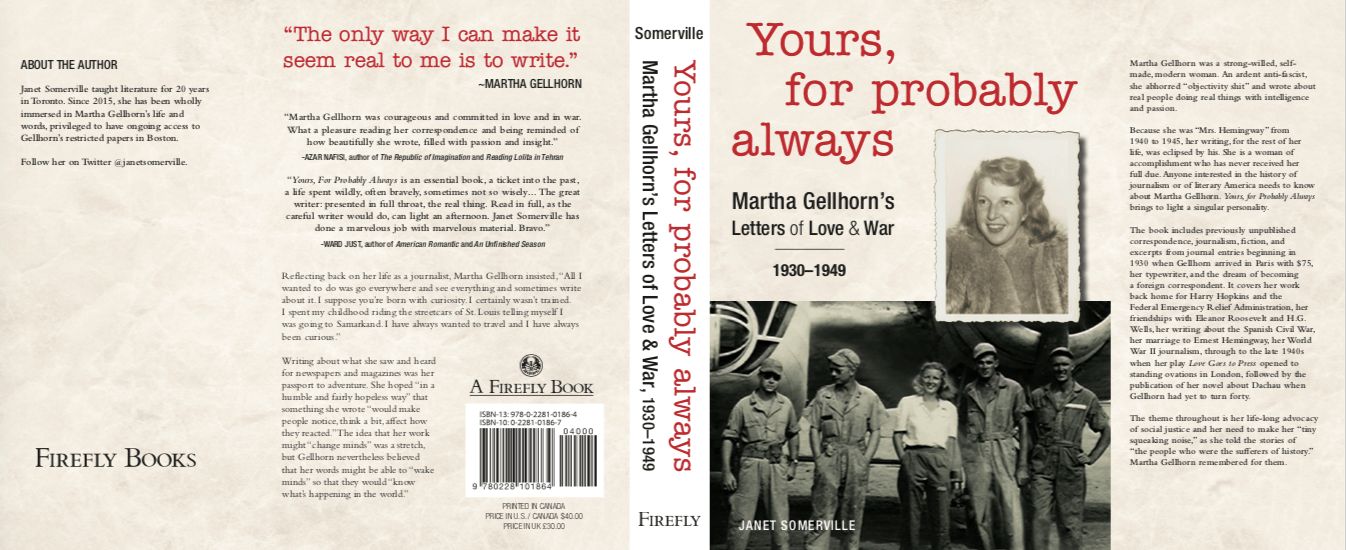
Sold to Penguin Random House Audio: Yours, for Probably Always: Martha Gellhorn’s Letters of Love & War, 1930-1949   by Janet Somerville

I’m excited to announce a deal I’ve made for a major new audiobook to be published on May 18 2021 by Penguin Random House Audio for Toronto writer Janet Somerville’s widely praised book Yours, for Probably Always: Martha Gellhorn’s Letters of Love & War, 1930-1949 (Firefly Books, hardcover 2019). Tony Award-winning actress Ellen Barkin*, a Gellhorn enthusiast and admirer of Somerville’s book, will be the voice of the audio edition. You can pre-order the audiobook via this link.

As with photojournalist Ruth Gruber** (1911-2016), Gellhorn (1908-1998, b. St Louis), was a trailblazer in her field. From the pitch letter I sent to acquiring editor Megan Mills at Penguin Random House Audio:

Journalist. Pioneer. Feminist. Human rights advocate. 

Martha Gellhorn was all of these and more, leaving her role as wife of Ernest Hemingway a lesser light among many noteworthy milestones. Rendered sensitively here by Janet Somerville in a curated collection of letters braided together with a biographical narrative threaded through the correspondence, Yours, for Probably Always brings readers into Gellhorn’s life and career shaped by her combat reporting, all spanning the Depression, the Spanish Civil War, WWII, the refugee crisis following the aftermath of the war and the Holocaust, and the Cold War. Somerville also highlights Gellhorn’s friendships, her lovers, and a life lived intentionally. 

Gellhorn’s work speaks to our times; she was a champion of the poor and dispossessed, a vocal critic of war and brutality, and a warrior against oppression. Her weapons were her pen and her words. Her circle included Gary Cooper, Dorothy Parker, Sylvia Beach, Colette, John Dos Passos, Ingrid Bergman, Lauren Bacall, Adlai Stevenson, and Robert Capa, a dear friend. Among her regular correspondents reflected in this collection were Leonard Bernstein; Eleanor Roosevelt; H.G. Wells; Maxwell Perkins; Charles Scribner; US General James Gavin, a high-profile critic of America’s War in Vietnam, and a romantic partner to Gellhorn; French philosopher Bertrand de Jouvenel; and of course, Hemingway.

Along with the letters, the book includes examples of Gellhorn’s journalism, fiction, and excerpts from her journals. An ardent anti-fascist, Gellhorn was a life-long advocate of social justice and a strong-willed, self-made modern woman. Yours, for Probably Always shines a light on this intrepid reporter and fearless figure.

The reception for Yours, for Probably Always

When the hardcover edition was published it carried glowing endorsements from Ward Just and Azar Nafisi, seen on the book jacket above, receiving wide coverage and superb reviews, including a starred Kirkus; coverage in the Guardian, where it was their Book of the Day; the NY Review of Books; and some Twitter love from actor Alec Baldwin:

  • “Somerville makes an impressive book debut with a life of novelist, journalist, and intrepid war correspondent Martha Gellhorn, told through a captivating selection of her letters to friends, family, husbands, and lovers. The volume is enriched by Somerville’s biographical narrative and her decision to include responses of many recipients and, in some cases, letters between individuals who were especially significant in Gellhorn’s life… An engrossing collection that burnishes Gellhorn’s reputation as an astute observer, insightful writer, and uniquely brave woman.”—Kirkus Reviews, a starred review
  • “It’s history as it was lived, and shared in intimate emotional detail… Curated with valuable context by Janet Somerville… her own love letter of sorts to a woman she calls ‘a wonder.’”—Lyse Doucet, Guardian Books,
  • “Martha Gellhorn was many things, including a novelist and short story writer, but a ‘relator of Wars”’ is the most important of them. . . . As early as 1935, her regular correspondent Allen Grover wrote to Gellhorn that ‘I should one day publish your collected letters. They’re magnificent prose.’ They are—and they are also precious traces of the turbulent, passionate, relentless, self-examined inner life of a woman of honor whose indomitable character is beautifully summed up by her mother in Somerville’s invigorating collection: ‘She lacks everything that makes living easy, she possesses most things that make it worthwhile.’”—Fintan O’Toole, New York Review of Books
  • The CBC radio program Day 6 aired a feature on Somerville’s book which explained,
    “Though [Gellhorn’s] dispatches from Normandy and Spain, which documented a mother’s grief after her child was killed by a bomb, brought humanity to tragedy for years, it was a report on Dachau…that made her famous. ‘My personal war aim was to get into Dachau,’ Gellhorn [said] in a 1983 TV interview. ‘I did get there and I was there the day the war ended. I didn’t have to be objective, in the sense that what was there to be objective about? It was a total and absolute horror and all I did was report it as it was.'”

Janet Somerville and Ellen Barkin

Somerville learned of Barkin’s interest in Gellhorn in 2019 when she offered to send the actor a copy of the hardcover book. They continued exchanging correspondence, by letter, text, and Twitter. Barkin told Somerville that she loved reading a few pages every night before bed, with Gellhorn’s powerful words, and Somerville’s narrative about her, in her mind’s ear.

In summer 2020, the pair spoke voice-to-voice for the first time, and Janet planted a seed about Ellen becoming her book’s voice, should there be an audiobook. Ellen responded with [almost] unprintable alacrity: “It would be my fucking honor.”

Around this time, I became Janet’s agent and my pitch to Penguin Random House Audio came soon after.

We cannot imagine anyone more suited to give Martha Gellhorn’s words vibrant life than Ellen Barkin. Like Gellhorn, she is intelligent, funny, indefatigable, an outspoken champion of the most disenfranchised among us, and a true supporter of social justice, willing to give voice to important issues when a less brave person would turn away. We are delighted she is adding her singular luster to Yours, for Probably Always.

Hemingway on PBS

We’re excited to announce the audiobook this week featuring the voice of Ellen Barkin, ahead of Ken Burns’s new documentary “Hemingway,” which will air on PBS, April 5-7.

*  Ellen Barkin was awarded the Tony in 2011 for her role in “The Normal Heart,” her Broadway debut. She broke out as a film actress in 1982 with her performance in “Diner.” She’s also known for her performances in “Tender Mercies” (1983), “Big Easy” (1986), “Sea of Love” (1989), “This Boy’s Life” (1993), “Ocean’s Thirteen” (2007), and “The Immortal Life of Henrietta Lacks” (2017).

** Like Gellhorn, Ruth Gruber was a foreign correspondent. I’ve often wondered if Gellhorn and Gruber crossed paths, as their careers tracked closely. Along with reporting from abroad, both women served in the FDR administration—Gellhorn in the Federal Relief Emergency Administration (FERA), and Gruber as Interior Secretary Harold Ickes’ Special Representative to Alaska. I worked with Gruber for twenty years, publishing six of her eighteen books, including Haven: The Dramatic Story of 1,000 WWII Refugees and How They Came to America (Three Rivers Press, 2000, and a CBS mini-series with Natasha Richardson as Ruth Gruber) and Exodus 1947: The Ship that Launched a Nation (Union Square Press, 2008).


Sold to Broadleaf Books: “Living with Horror: Faith and Fright in an Anxious World”

Delighted to have sold biblical scholar Brandon Grafius’s book “Living with Horror: Faith and Fright in an Anxious World” to Broadleaf Books of Minneapolis. It will be a thought-provoking study that explores the parallels between horror and religion, and the common ground shared by fear and faith, offering insight into many of the provocative and surprising theological themes that lurk under the surface of favorite horror films, while also discussing many of the movies, alongside a catalog of biblical stories that evoke fear and trembling. The fears that horror movies force to the surface of consciousness can help us reflect on our own troubled times, and will help readers gain a sense of understanding into the nature of fear and associated emotions. Grafius’s book will also provide an outlet for people struggling to contextualize what they are seeing each day on the news. By examining the themes of hope and faith, and justice and perseverance, all found in horror movies, it will show the reader how horror can help us make sense of the world, and help us all navigate the anxieties that are part of modern life, especially in pandemic times.

Delighted that the author will be working with a very engaged editor at Broadleaf, Lil Copan, who has a vision for the book that really aligns with the author’s book idea. Broadleaf has an interesting list which I commend to readers’ attention.

And, kudos to my adult son and business partner, Ewan Turner, who championed Brandon’s book from the first day he queried us about it.

“Battle for Justice” Shines a Light on Joe Biden, from 1987 to Today

With Joe Biden’s recent inauguration as 46th President of the United States, I’ve recently been re-reading a terrific book that shines light on him as a politician and a person, on his inner character, from a lot of very interesting angles. Battle for Justice: How the Bork Nomination Shook America, was originally a Norton hardcover in ’89, written by then-Boston Globe reporter Ethan Bronner, later a NY Times reporter, and now an editor with Bloomberg News. I had the privilege of republishing the book in trade paperback in 2008 when I was Editorial Director of Union Square Press.

At the time Ronald Reagan nominated Bork in July 1987, Biden was Chair of the Senate Judiciary Committee, and had already declared himself a candidate for the 1988 Democratic presidential nomination. The Reagan administration wanted confirmation hearings to begin immediately, but as Chair of Judiciary, Biden was in control of the calendar, and the hearings didn’t begin them until late September. This was a smart move, because during the interval opposition to Bork began forming ahead of the hearings, which went very badly for the nominee, who was widely perceived to be too far right-wing for many senators. The vote in committee went against Bork 9-5. Many observers thought Bork would at that point withdraw his nomination, but he insisted on having a vote by the full senate, which also went against him decisively, 58-42, with six Republicans voting Nay. Bronner’s narrative of the nomination fight is engrossing, and filled with Senate figures from our recent past—Ted Kennedy, who led the opposition to Bork; Arlen Specter, who was among the Republicans to vote Nay; Paul Simon, the bow-tied Democrat from Illinois; Pat Leahy of Vermont, who just served as Judge of the Trump Impeachment trial; and the odious John Bolton, who working in the Reagan Justice Department, was nominally responsible for shepherding Bork through the process, where his usual lack of charm contributed to the demise of the Bork nomination, though the nominee’s truculent extremism was the primary factor.

As it happened, Biden’s candidacy for the Democratic nomination also went down in the Summer-Fall of 1987, even before the fate of Bork’s nomination was settled in October of that year. In campaign speeches, Biden had borrowed words from the British Labor politician Neil Kinnock, with attribution at the outset. However, on several occasions that August, and once at a Democratic event in Iowa, he borrowed Kinnock’s words and the British pol’s family story, without acknowledging the source. A Biden campaign aide, Pat Caddell, said he was responsible for inserting the phrases into the speech, but the damage was done.

Seeing Biden as president now, and the scandals the country has witnessed since 1987, it is quaint to see what knocked Biden out back then. I am glad that the quirks of history have unfolded in such a way that Joe Biden is our president in 2021. Bronner’s book is well worth reading again now, in light of all we know today.


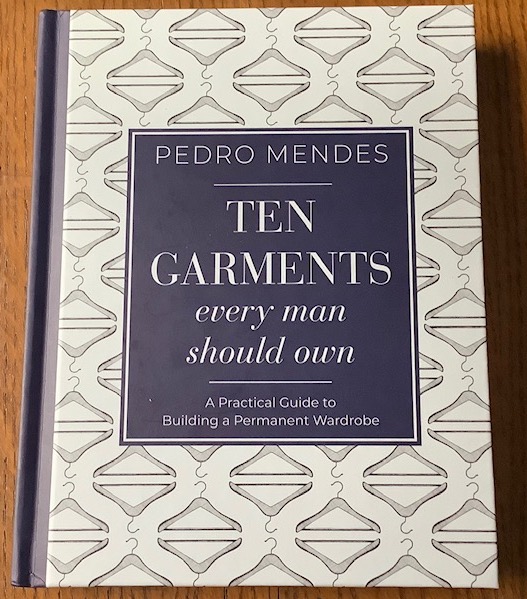
Soon to be Published: “Ten Garments Every Man Should Own” by Pedro Mendes

I am delighted to share word that a book I sold to Dundurn Press in October 2019, Ten Garments Every Man Should Own: A Practical Guide to Building a Permanent Wardrobe by Toronto mens’ style writer Pedro Mendes, is now a printed book and it will be published in North America next month, March 2021. I’m showing the handsome cover in this post and some of the interior pages.

It’s a practical guide to dressing better by building a classic, sustainable, and ethically minded wardrobe, focused on quality garments, rather than items that have to be replaced after barely a season of wear. Each chapter covers an essential piece: shirt, jacket, hat, leather shoes, and more, plus useful information on caring for a wardrobe. Mendes gives you the facts about what makes a garment worth investing in and owning—how it’s made, how it fits, and how it makes you look. The book is illustrated with precise line drawings, so you can really see the different elements of a garment.

Dundurn’s web page for the book includes this lovely blurb: “If the journey to a conscious closet begins with a single step, the first step is reading this book. Mendes has many lessons to impart about the difference between style and fad fashion, and to get there he asks both the practical and philosophical questions. Ten Garments Every Man Should Own ends up being more than sartorial advice to spruce up your wardrobe—it’s a guide to introspection.”—Nathalie Atkinson, arts and culture journalist and former fashion critic

I know most of us are lounging about in just about any old clothes these days amid the pandemic, but Pedro’s message of dressing with a higher degree of thoughtfulness is a valuable one. It’s an environmentally conscious menswear book, with a focus on sustainably-produced clothing, and owning clothes you keep for a long time, instead of discarding after just a season or two. The book is also handsomely designed, as you’ll see from the cover and shots of pages from it I’ve posted here. If you need to buy a birthday gift, or something for Father’s Day later this year, this could be just what you need.

I first met Pedro when I visited Toronto some years ago and toured the headquarters of the Canadian Broadcasting Corporation (CBC), where he then worked as a producer for CBC Radio 3, the national broadcaster’s outpost for Canadian rock n’ roll. Pedro led a number of indie music fans on a tour of the CBC building. He later left CBC and launched his career as a freelance writer on mens’ style. I’ve blogged often about CBC Radio 3, now shuttered, on my other blog Honourary Canadian. I am developing books with Canadian musicians, as well. We had a coffee that week and I soon after signed him to be a client of my literary agency. His Instagram handle is @pedro.mendes.hogtown, and he blogs on mens’ style at The Hogtown Rake.