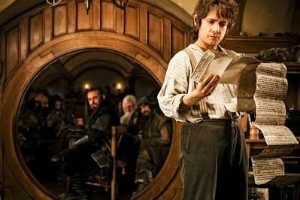
Update: One day after I published the post below about “The Hobbit,” the NY Times published this interesting piece today about the Tolkien archive, which is housed in the US, at Marquette University in Milwaukee, WI. Also, please note an earlier blog post of mine, J.R.R. Tolkien Renounced Racial Politics in 1938 Letter to a German Publisher.
—
 Some readers of this blog may recall that I happen to share a birthday with J.R.R. Tolkien’s hobbit protagonists Bilbo and Frodo Baggins, having written about that literary link in a piece on this site labeled Personal History. Since my teens I’ve been a fan of Tolkien’s work and then enjoyed Peter Jackson’s “Lord of the Rings” film trilogy. My wife and son and I already have tickets to see “The Hobbit: An Unexpected Journey” when it opens late next week. I’ve seen a trailer or two for the film but have steered clear of reading much about it, not wanting to have the element of surprise hijacked by reading details I don’t need to know yet. Still, I crossed paths today with a very encouraging Hobbit teaser on Nerdist.com, the website of Chris Hardwick, ebullient host of “The Talking Dead” fan show that is boradcast on AMC TV after the zombie-apocalypse program “The Walking Dead.”
What’s good for the book is also good for the film–a sense of humor. Though some of LOTR‘s self-importance is being retroactively returned to the tale, Bilbo is simply a much more fun reluctant-hero than Frodo, whose dewy-eyed earnestness was way too goody-goody at times. Martin Freeman [cast as Bilbo] also played Arthur Dent in The Hitchhiker’s Guide to the Galaxy, and that character–quite correctly–shares spiritual DNA with this Hobbit, who wants to live out the simplest pleasures of the countryside, but gets whisked into something bigger, and complains all the time. It also feels like the themes here are more tangible for kids to relate to than abstract ultimate-good versus ultimate-evil, such as the benefits of going outside and making friends instead of sitting around the house (granted, LOTR had a team of friends too, but it broke up rather quickly. This group stays together).
I greatly enjoyed the 2005 film version of Douglas Adams’ modern SF classic The Hitchhiker’s Guide to the Galaxy, directed by Garth Jennings, which featured not only the aforementioned Martin Freeman, but also Mos Def, Zooey Deschanel, Sam Rockwell, and the voice of Alan Rickman. So, if Peter Jackson’s new Hobbit film can conjure up some of that cinematic pleasure, then we’re in for a treat.

 #FridayReads, Jan. 18–God Save the Mark, a wise-cracking mystery novel by the peerless Donald E. Westlake, featuring a naive young man who inherits a fortune from an uncle he never even knew of, and then tries to keep his hands on it, and away from the lurking no-goodniks who want to fleece him of his windfall. Westlake’s dialogue is street-wise, funny, and real.