For Halloween, “Reader Faustus: A Novella in Verse” by M. G. Turner

My dad and I share an affinity for the legendary literary character Faust, who in various retellings over the centuries has been depicted as selling his soul to the devil in exchange for a number of enticing rewards, including immortal life, admiration from the public, endless amounts of money, and much more. For Philip, this interest goes back to his student days, when with a professor named Donald Sheehan he took a course at Franconia College called “Faust,” and wrote a paper on the topic. Then a few years ago, I undertook the writing of what I call a “novella in verse” which retells the Faust legend for our modern times. With these materials in hand we decided to publish another in the series of chapbooks I’ve brought out this year under our Riverside Press imprint (preceded by Dreams of the Romantics and Roman Visions), using my pen name M. G. Turner. Collected with the narrative poem are two other devilish tales I’ve written, “The Tale of Hanns Drumpf” and “Johann Fust: Patron of Gutenberg,” plus Philip’s essay from 1974, “Faust: Man and Myth.” We believe all this writing goes well together and are now happy to announce publication of Reader Faustus: A Novella in Verse for Halloween. For those who would like to buy a copy from us directly before we begin distributing it online, we are selling them for 13 dollars plus 5 dollars shipping.

To learn a little more about our new title, here is the back cover copy:

The “Faust” legend is as old as time, as is the proverbial “deal with the devil.” In M. G. Turner’s Reader Faustus this idea is brought into a modern context, as a young poet chooses to sell his soul in exchange for the power to read every book ever written. While Turner’s “novella in verse” hearkens back to Marlowe’s The Tragical History of Doctor Faustus (1601), Goethe’s Faust (1808), and Mann’s Doctor Faustus (1947)—Reader Faustus zeroes in on today’s zeitgeist, in which people feel burdened to consume endless content, and who see Faustian bargains all around them, in politics, technology, science, and the arts. Readers of the macabre will surely enjoy this new offering, a veritable museum of Faust, from the author of Dreams of the Romantics.

I’m honored to have received two endorsements in advance of publication:

“The Faust legend is ever regenerative and ever redefined, as seen in M. G. Turner’s beguiling new verse tale Reader Faustus. In elegant, Augustan rhyming couplets, Turner tells the story of the devil’s bargain anew, but with a focus on the wages of modernity, when those who create are cursed by having to consume ever more content. Clever, thoughtful, and fun, Reader Faustus uses classical language to speak to very contemporary problems.”—Ed Simon, author of Devil’s Contract: The History of the Faustian Bargain, Public Humanities Special Faculty in the English Department of Carnegie Mellon University, and Editor of Belt Magazine

“M. G. Turner’s richly imaginative Reader Faustus offers a new twist on the devil’s bargain. In verse both erudite and playful, Turner asks us to reflect on what we might offer in exchange for our pursuit of both knowledge and enjoyment. While Turner takes glee in the use of antique language and form, the poem is also uncannily modern, as it proposes a complex relationship between the ability to consume content and the ability to create content—a relationship that is always under negotiation, and which has become particularly fraught in our digital age. As Turner’s work recognizes, the stakes for this bargain have never been higher.”—Brandon Grafius, author of Scared by the Bible: The Roots of Horror in Scripture 

We hope you find the Faust legend as compelling as we do, and will be interested in visiting, and reading, our “veritable museum of Faust.” Please let us know!

[gallery columns="4" link="file" ids="19012,19013,19014,19011"]

M. G. Turner: “‘False Memories & Eldritch Interludes’ is a spooky delight”

A review by Ewan “M. G.” Turner of a new horror-inflected book:

False Memories & Eldritch Interludes is a spooky delight! Part-memoir, part tall tale, author Joseph Citro takes a novel approach by making himself known to readers in among a series of stories, narratives, and as he calls them, “eldritch” interludes. If that word is familiar it’s because it was popularized by fellow New England writer H.P. Lovecraft, whom Citro acknowledges as a major influence, as he was on so many, acting as a model for all who preserve local history in that most gothic region. Citro’s writing itself is excellent—personal and touching, and as a fellow horror writer/enthusiast myself, it is special to meet him in these ingenious pages. Along the way you feel less like you’re reading a book and more like you’re in the presence of a great storyteller who is weaving narratives that at first seem opposed to each other but surprise you with their profound resonance.

It is also a joy to read stories and then have them commented upon by the omniscient writer’s voice in welcome “Behind the Scenes” sections which provide an excellent dichotomy between fright and fable, and give you an even deeper view into the author—something Lovecraft himself was never able to do, but Citro does remarkably well and without it feeling contrived or too self-referential. Also, I should add that it is very refreshing to read work like this, though I hesitate to describe it as “no-nonsense.” Instead what I mean is that you have the feeling of being given a chance to see the inner workings of a seasoned writer’s mind and with him as a guide we’ll live to tell the tale! (Also, it’s just nice to read something unpretentious in style and yet extremely deep in terms of content, a nearly impossible feat to pull off.)

Favorite pieces in the collection include: “Them Bald-Headed Snays”; “Soul-Keeper”; “Kirby”; and “The Last Fortune Cookie.” “False Memories” is a must-read for all horror enthusiasts and for people who enjoy the work of highly skilled writers who tell stories connected to their local communities and expand upon and ultimately craft their own urban legends. Last, evocative illustrations by Corey Forman round out the package nicely.  It’s available on Amazon.

The Vermonter publication has described Joe Citro as “Vermont’s most recognized authority on ghosts, haunting, and the state’s mysterious past. He’s written many fascinating books on the subject, including his bestselling work, Passing Strange: True Tales of New England Hauntings and Horrors.” Citro really is a New England treasure, as is clear in this 2020 profile in Seven Days magazine.

Stellar Reviews of “Dreams of the Romantics,” a Story Cycle by M. G. Turner

September 9, 2025, latest update re: Dreams of the Romantics

Dreams of the Romantics by M. G. Turner is available through online booksellers, such as Amazon.com, BN.com, and Bookshop.org, whose sales support independent bookstores.

A very keen reader, the horror writer Joseph Citro, author of such novels as The Gore—who is described on Wikipedia as a “Vermont author and folklorist who has extensively researched and documented the folklore, hauntings, ghost stories, paranormal activity and occult happenings of New England”—loved Dreams of the Romantics and posted a very favorable review of it on the book’s Amazon page and on his own Facebook page. His full comment is below, and he concludes with this:

“The prose is poetic, the themes philosophical, and the tales range from contemplative to supernatural. (See especially Dr. Polidori’s installment!) Just when you’re feeling comfortably immersed in early 19th-century prose, the author inserts an anachronistic word or turn of phrase that reminds you the issues explored are as relevant today as they were during that unforgettable Year Without a Summer. Overall, this is an original, thought-provoking, and fascinating read, something [Lord] Byron might have called a “ripping yarn!”
Two thumbs up; three if I had an extra!👍👍+👍


May 15, 2025, an update regarding Dreams of the Romantics:

The prominent editor of weird fiction, and critic, S. T. Joshi (known for American Supernatural Tales, Penguin Classics, and The Theory of the Weird Tale, Sarnath Press) reviewed the book and recommended it to his audience, writing:

“The occasion for this story cycle is the most famous literary contest in the history of weird fiction….Turner engages in the fantasy of being himself a member of the literary circle at the Villa Diodati, recounting his own Gothic tale….The final story in the book, “The Last Voyage,” is a gripping modern recreation of the fateful boat trip that led to Shelley’s drowning in the Bay of Spezia in 1822….Dreams of the Romantics is a vivid and engrossing little book….well worth reading by those many devotees of the weird who find themselves drawn back to that day, more than two centuries ago, when several towering literary figures sought to enshrine the weird into the corpus of English literature.”—S. T. Joshi, Spectral Realms No. 23 (Summer 2025)

Post originally published April 8, 2025

Among the fortunate discoveries I made during COVID was that of a book reviewer in New Brunswick, Canada, James Fisher, who edits a book review journal called The Seaboard Review of Books, which can be found on Substack. Having long been interested in Canadian literature, and the curator of a blog I call Honourary Canadian, I appreciated that he and his team of critics focus on Canadian authors and small presses, and noticed that they also cover “international” titles. With that in mind, I contacted James and asked if he’d be interested in receiving a copy of Dreams of the Romantics, the chapbook inspired by the Romantic poets that Ewan Turner, my adult son and business partner, recently published under his pen name M. G. Turner. James was intrigued, so we shipped him a copy.

Yesterday, he published a lovely, thoughtful review of the book which I’m pleased to share here. Below are the closing paragraphs:

Dreams of the Romantics  was a beautiful read. Turner’s use of language reflects the period, and I read through the book several times, picking up on different metaphors from the lives of all those in attendance at Lord Byron’s dinner party. I also found it educational, as I had only a passing knowledge of the Shelleys, little of Byron and none of Doctor John Polidori. Invariably, I was sent scrambling to the Internet for answers to my questions, as well as the biographies of the participants.

I certainly anticipate hearing more from the pen of M. G. Turner, as Dreams of the Romantics certainly demonstrated his potential as a writer.”

I invite you to read it in full by clicking on this link, or by opening the screenshots below.

Dreams of the Romantics is now available on Bookshop.org, Barnes and Noble, and Amazon.


On Sale Now: “Dreams of the Romantics,” a Story Cycle about the British Romantic Poets, by M. G. Turner

As mentioned in the annual letter for Philip Turner Book Productions that we sent out a few weeks ago, Ewan will soon be publishing his first book, under his pen name M. G. Turner.  Titled Dreams of the Romantics , it’s a gothic story cycle about Lord Byron, Mary Shelley and Percy Bysshe Shelley, Samuel Taylor Coleridge, and Dr. John William Polidori, who served as Byron’s physician.

The poetic circle gathered at Villa Diodati on the shore of Lake Geneva in Switzerland; it was June-July 1816, during the fateful Year Without a Summer, following the eruption of Mt Tambora near Bali which cast a pall over the earth. Mary Shelley, eighteen that year, later described “incessant rain” and “wet, ungenial” weather. Over one three-day stretch stuck indoors during inclement weather, Byron—who that same month would write his lacerating, apocalyptic poem “Darkness”—dared each of his friends to devise a gothic tale. His challenge resulted in Mary Shelley’s Frankenstein, or Prometheus Reborn, and John Polidori’s The Vampyre, the first popular vampire story. Dreams of the Romantics will appeal to readers who have a yen for spooky stories, and an interest in or curiosity about the lives of these immortal writers.

The publisher, Riverside Press, is bringing out belles lettres titles. If you’d like to have a copy of Dreams of the Romantics, details are below.

  • The 96-page trade paperback, with seven stories imagining the lives of the British Romantic poets, sells for $15 + $5 shipping (maybe more for international destinations). If you want to buy a copy, please contact us at ptbookproductions[@]gmail[.]com and we will give you electronic payment information or our address
  • The painting on the front cover is “Wanderer Above the Sea of Fog,” Caspar David Friedrich, 1818
  • The painting on the back cover is “The Funeral of Shelley,” Louis Edouard Fournier, 1889
  • The Jenman symbol, seen on the back cover, traditionally symbolizes good fortune and wards off evil, as adopted by W. Somerset Maugham on his books.
  • In descending order the figures in the frontispiece shown here—opposite the titles of the stories—are Mary Shelley, Percy Bysshe Shelley, George Gordon Lord Byron, Dr. John William Polidori, and Samuel Taylor Coleridge.

The Tragedy of Bruno Schulz, A Mysterious and Captivating Writer by M. G. Turner

Reading the Polish-Jewish writer Bruno Schulz is an experience like no other: scholars have compared him favorably to both Franz Kafka and Marcel Proust. However, each of these authors provides only a partial analogy, despite Schulz’s work exhibiting the absurdity of the former and the nostalgia of the latter. But even with these similarities to existing storytellers, he is his own man, a wild, surreal magician of the written word who could conjure whole worlds right in his hometown of Drohobycz—then Poland, today Ukraine. In addition to being a linguistic marvel, he was also an accomplished illustrator of his own work, drawing bizarre phantasmagorical images which often featured a distorted version of himself.

Schulz is one of the few deceased writers I have ever felt creatively jealous of, for he achieved something on the page which is extremely elusive and usually relegated only to the medium of cinema: the ability to transmit surrealism into fiction. There are some technical reasons why fiction does not lend itself well to this style; in film, directors can move from image to image at will, while with words we must always be building and rounding out our world, as well as shoring up our grammar, and at the same time constantly keeping in mind the reader who may at any moment put the book down. However inexplicably, Schulz does both of these things—that is to say, building a world and transmitting surrealism—to powerful effect. He crafts confounding fables of a family in turmoil, of a son bewildered by his father, of a city where the rules of reality are supplanted by a magical dream logic that sweeps the characters and the reader into rollicking journeys of remarkable and sublime poignancy. And despite the inherent darkness of this world, in which it always seems to be night, it is truly a delight to go with him. Another literary feat he manages to accomplish is making the harsh realities of Jewish life in pre-war, and then war-torn Poland seem beautiful and in, its own way, holy. For there are no laments or complaints in his prose, or even dirges on suffering; rather, his work, in its own roundabout way, appears to be a celebration of the human imagination and its ability to influence and effect our lives in a palpable and entertaining fashion. Not to mention the fact that, like Kafka, his characters are not recognizably Jewish.

Still, the fact Schulz was Jewish—and later murdered by a jealous S.S. officer who resented his artistic endeavors, while walking home with a loaf of bread—does lend the work a feeling of impending doom. Like Kakfa, he is perpetually aware of his own perceived inadequacy and manages to fight this psychological oppression by saying in effect, “Okay, you’re right, I am hideous and inferior. But so are you, and more so—you are agents of darkness while I am only an agent of the strange.” This is my own rendering of what I take to be Schulz’s overarching idea and modus operandi. The world he permeates with strangers and drifters and birds and hats with a will of their own has no hue or whiff of evil to it; instead, confusion seems to be its main characteristic and echoes what he and his family must have been feeling at the height of the war when they’d been forced into the Drohobycz ghetto by the Nazis and their Ukrainian collaborators.

The confusion present in his two story collections—the only ones that survive, as the rest of his literary output, including a novel called The Messiah, is lost to history—has a logical conclusion, and that is madness. A sense of madness was what Schulz must have been feeling as his family members were taken away, a sense of the vicious absurdity of trying to be an artist in a world that was crumbling around him. If it was driving the author mad, it made sense that the characters themselves are occupying a mad world where the laws of physics are suspended, or else don’t even apply. But in fiction, unlike in life, this kind of societal collapse can be rendered beautiful and even, to the reader, pleasurable to read—and all for its dream-like qualities which are born of the author’s escapist fancy and aesthetic brilliance. We enter a trance when reading Schulz, a healing type of meditative state, that even in the English translation by Celina Wieniewska (Schulz wrote in Polish) is distinct from the kind acquired from reading Kafka or Proust. This is due to the writer’s fusion of linguistic excellence with unbridled imagination that reveled in knowing no bounds—especially as his external world became increasingly cramped, closed-in, and imprisoning.

Schulz’s best story, I believe, is “Sanatorium Under the Sign of the Hourglass,” a must-read for anyone interested in dream logic pushed to its most extreme. In this story the narrator’s father has died; yet he remains alive in only one location, a mysterious sanatorium where the rules of life and death go unenforced. Time is the key element here: in the sanatorium his father’s death simply has yet to occur, and it is here the narrator finds himself visiting the man whose antics have plagued him for many consecutive stories. Some scholars have pointed out the similarity of this theme to those of Franz Kafka whose issues with his own father were often on display in pieces like The Judgment, and of course The Metamorphosis. But instead of making us feel, as Kafka does, that the author is finding comparable metaphors in fiction for the most intense emotions in his own life, Schulz takes a more nebulous and, in many ways, more nuanced approach. There is simply no resolution in “Sanatorium Under the Sign of the Hourglass,” or really in any of his work. This mirrors the writer’s own death. As stated earlier, Schulz was shot down in the street at the age of fifty by an S.S. officer who did not appreciate Schulz’s artistic efforts—efforts he was lending to a rival Nazi commander who’d contracted his services to paint a mural of fairy tales on his children’s bedroom wall, in exchange for money and some degree of protection, which in the end did not save him. (This mural is now restored and on display in Israel’s Yad Vashem World Holocaust Remembrance Center.)

Perhaps Isaac Bashevis Singer said it best, when he lent a blurb to the publication of Schulz’s work, that had he “…been allowed to live out his life, he might have given us untold treasures, but what he did in his short life was enough to make him one of the most remarkable writers who ever lived.” I could not agree more. I highly recommend delving into this mysterious and tragic author if dream logic, surrealism, and magical realism appeal to you—though he is so much more than any label, name, or genre, can stick to him. In life he defied convention, and in death he did the same; thus, his immortality as a mid-century European literary master, albeit one who died before their time, is unquestionably assured.

M. G. Turner

January 2025

“The Shakespeare Authorship Conundrum Society” by M. G. Turner

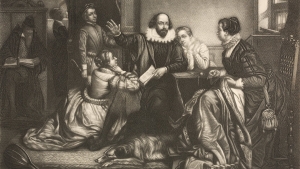
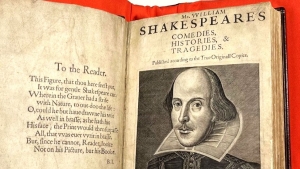
The Shakespeare Authorship Conundrum Society met Thursdays at the public mansion on Riverside Drive and 107th street. It was there that Theodore Gurney, Teddy for short, had found his confidantes—a ragtag gang of young and old aesthetes united over the dubious though benign conspiracy theory that the Bard of Avon was not the author of the greatest plays ever written. And in a culture plagued by misinformation of a more destructive sort, their little club wasn’t doing much harm. In fact, it was a delight to meet each week especially on those often rainy April afternoons and discuss, argue, and interpret. Everyone there was well-educated and a lover of the Bard’s work—that is, whoever the Bard actually was.

For some it was Edward de Vere, Earl of Oxford. Several of his close family members had, according to Bennet Leach, a forty-three-year-old professional fact checker, been the supposed Shakespeare’s patrons. He, as well as several others in the group, adhered to the idea that Old Will was indeed a real person, but more of a steward, a frontman for the work of someone else who for reasons of political impropriety could not go public with their quill. How, this particular faction argued, could an uneducated man of humble background, whose father was a mere tanner, have written so penetratingly about kings, queens, and other members of the royal elite? How could he have always had the inside scoop on court intrigue? He couldn’t, they claimed—hence the existence of a secret that, if confirmed, threatened to unseat nearly five hundred years of orthodoxy surrounding the Bard’s majestic output.

But Teddy didn’t fall into this category. Nor did he fall in with the others, some of whom claimed Shakespeare was a Sicilian by the name of Collolanza who’d supposedly been puttering around England at this time, or that he was in fact Christopher Marlowe himself, who’d inexplicably succeeded at faking his infamous barroom death. Nor did Teddy believe he was one of the kings and queens who graced the English, French, or Spanish thrones, whose names over the course of centuries had been tossed into the hat for consideration by amateur critics and armchair scholars.

It is important to note that Teddy’s own belief about the veracity of Shakespeare’s genius lay in a more considered, accurate, though certainly less exciting realm. His own postulation which had come to him after several weeks of attending the Thursday meetings and taking in all the diverse opinions—as well as doing frenzied research of his own—was that Shakespeare was indeed Shakespeare, but that, seeing as he was part of the consummate Elizabethan repertory company at the renowned Globe Theater, many of the plays, including some of the most famous might have been written, or edited, or looked over by actors, namely Richard Burbage, who some scholars had even gone so far as to posit as the unacknowledged co-author of Hamlet.

But amid all the wild theories that dove inside his ears each week Teddy felt reluctant to lay bare this, by comparison, banal theory. To him the very fact of its subdued suggestiveness made it more stirring than say, the unsubstantiated idea that Shakespeare was really Sir Francis Drake, composing plays and sonnets while circling “the whole globe.” Thusly, it wasn’t until the sixth week of his involvement with the Society as he was now thinking of it, that his courage became plucked up enough to share his hypothesis. He decided to begin by validating all the other theories he had heard that day and in subsequent weeks before pouring the proverbial cold water on the wildest of them. “Never in my life,” he began, “have I had occasion to enjoy such compelling and consequential talk. But there is another theory which has gone neglected that I would like to share with you today.”

The faces of his co-conspirators glimmered under the resplendent lights of the Library Room. Several of them smiled, while some looked demonically expectant, as if daring him to outdo their spirited reveries.

“Go ahead, please,” said Margaret Crawley—a sixty-four-year-old librarian who was on the verge of retirement and was herself planning a “truth-seeking trip” to Stratford-upon-Avon, aka “The Birthplace” in the fall. “You have not spoken much in our meetings and we’d all be glad to hear from you.”

“Well,” Teddy cleared his throat. “As I see it, none of us will soon get the validation from academia required for a public acceptance of our theories, but there is one suggestion made by some scholars whose names I can share that seems to me almost indisputable.”

After a shared gasp there was a round of excited voices—some angry and some mortally pleased. Teddy went on:

“It is that, seeing as the Globe was a place of collaboration and collective creativity, portions of the plays—maybe even large portions of them—could have been contributed by the actors. It has even been suggested that the renowned thespian Richard Burbage—and in some ways the Bard’s right hand man—took a leading role in not only the production but in the writing of Hamlet. Who knows how many times an actor would flub a line, but in the process of this divine accident make it sound even better than it had been written on the page and Old Will watching from the back of the theater might have called out: ‘Forsooth, that is better than what I had quilled! Leave as is.’

“And though this line of thinking cannot be expressly proved it cannot be expressly refuted either, which I think lends it a great deal of credence and intellectual power. I would love to know your thoughts.”

As Teddy stopped speaking a great silence filled the Library Room, which was only broken several seconds later by Lloyd Hanger, a fifty-seven-year-old linguistics professor who was the unofficial “heavy” of the group, “THAT IS TREASON!”

“Yes! How absurd!” came another voice, which was met by a second chorus, some in defense, some in derision:

“I think Teddy has a point!”

“What does he know, he hasn’t even spoken until today!”

“But of all the theories his makes the most sense!”

“Don’t forget about Edward de Vere—you can’t explain him away!”

“I think this young man just did.”

“Oh, poppycock.”

“Care to take it outside?”

“I’d like to.”

“SILENCE!” This one word, from the instigator of the unexpected skirmish, quieted the rabble. Especially as Lloyd added: “Do we want to get kicked out of here?”

“He’s right.” Margaret let out a deep, feeling sigh. “This idea you have presented to us, Teddy, has certainly raised the temperature. How curious too, considering it is one of the most moderate we have heard. However, so as not jeopardize our position here, I suggest we move on to other business.”

With that mild word the war had been put down and Teddy sat in silence, unsure if another contribution of his was apt to be considered. But truthfully he didn’t have one and when he walked out that April day, after saying goodbye to his co-conspirators he made a silent vow to not return. For as the rain pattered down upon the earth and misted the Westside in its dew he felt as if he could, like Schrodinger, see all the possible identities of Shakespeare both having existed and not. He was simultaneously a great naval-man, a great earl, a great king, and a great scholar. He was a Sicilian wanderer and Miguel de Cervantes. But something all these theories seemed to reject, and something all the theorists seemed allergic to was that someone of so humble a background could be imbued with genius. Like most conspiracy theories, it neglected to consider a bare, and perhaps humdrum truth—in this case, that the embers of creativity can spark anywhere resulting in a blaze so tall and great we remain in awe for hundreds of literarily blessed years after.

And some five hundred years prior, in a green corner of jolly old England a bard was brought into the world—though in the minds of the most benignly credulous, who he truly was we’ll never know.

M. G. Turner
New York City
December 2023