Publishers Lunch Spring 2023 Book Buzz Panel—Including Dava Sobel, on Madame Curie and the Women Scientists She Hired and Inspired

The Book Buzz panel put on by Publishers Lunch last night was terrific. Four great new novels and one science biography, with the authors appearing one after the other in conversation with their editors. The picture to the left shows the lone nonfiction author, Dava Sobel whose upcoming book is The Elements of Marie Curie: How the Glow of Radium Lit a Path for Women in Science. She discussed it with her editor George Gibson of Grove Atlantic. The narrative focuses on the Polish-born two-time Nobel Prize-winner (in Physics and Chemistry) Madame Curie (1867-1934) and the forty-five women scientists whom she mentored and did pioneering research with in her laboratory in Paris.

For the record, the four novels presented were Penitence by Kristin Koval (with editor Deb Futter, Celadon Books); Sky Full of Elephants by Cebo Campbell (with editor Olivia Taylor Smith, Simon & Schuster; City of Night Birds by Juhae Kim (with Helen Atsma, Ecco Books); and The Ancients by John Larison (with editor Emily Wunderlich, Viking Press).

Back to Dava Sobel, in 1995 I was at the book launch for what became her international bestseller Longitude: The True Story of a Lone Genius Who Solved the Greatest Scientific Problem of His Time in a book talk at the South St Seaport Museum bookshop in lower Manhattan. That event was also hosted by George Gibson, then her editor at Walker & Co. I am reminded by the inscription in the copy of the book I bought that night that it was September 22, 1995. That happened to be my 41st birthday, though I don’t recall going that night to celebrate, particularly. 

What a fateful night it was, birthday or not, because I also had the good fortune then to meet Dava Sobel’s aunt, who like me, had come to celebrate the publication of Longitude. This was Ruth Gruber (b. Brooklyn 1911-d. Manhattan 2016), a humanitarian, photojournalist, and foremost chronicler of the DPs (displaced persons) after WWII. With her I would ultimately publish six books, titles like Ahead of My Time: My Early Years as a Foreign Correspondent (Carroll & Graf Publishers, 2000) and Exodus 1947: The Ship that Launched a Nation (Times Books, 1997; Union Square Press, 2008; Ruth’s spot reporting in the postwar period on the real-life Exodus ship was the basis of Otto Preminger’s movie “Exodus”).

Dava’s mother was Ruth’s sister, and had long known of her aunt’s exploits and inspiring work. I commissioned her to write a new Introduction to the first trade paperback edition of Ruth’s 1983 book Haven: The Dramatic Story of 1,000 World War II Refugees and How They Came to America (Carroll & Graf Publishers, 2001). It came out around the time CBS broadcast a two-night miniseries based on the book, with Natasha Richardson playing Ruth’s part. The rest of the cast included Martin Landau, Anne Bancroft, and Hal Holbrooke. The backstory to the book and miniseries was that from 1940-46 Ruth had been a staffer in the FDR administration, and throughout that whole span she served as an official of the Interior Department under President Roosevelt’s longest-tenured cabinet secretary, Harold Ickes. In 1944 Ickes assigned her to undertake a dangerous mission. After first being made a temporary general—so if she was captured, she’d benefit from the rights of the Geneva Convention—she was flown on military aircraft to war-torn southern Italy and then met and screened and escorted one thousand (mostly, but not all, Jewish) refugees on a ship called the USS Henry Gibbins across the Atlantic. They were bound for a safe haven in Oswego, NY, a former army base called Fort Ontario, where they were when WWII ended some months later in ’45.

For readers who want to know more about Ruth Gruber, this link will take you to the approximately half-dozen posts I have published about her on this blog.

I am so glad I met Dava that night in 1995, and her aunt Ruth Gruber, through the always stellar ministrations of George Gibson, a friend in bookselling and publishing for many years.

In Conversation w/Canadian Author Ken McGoogan at The Explorer’s Club in NYC

In the early 2000s, when I was an editorial executive with Carroll & Graf Publishers, I had the good fortune to acquire the US publishing rights to a book first published in Canada, Fatal Passage: The Story of John Rae, the Arctic Hero Who Time Forgot and Ancient Mariner: The Amazing Adventures of Samuel Hearne, the Sailor Who Walked to the Arctic Ocean, what would prove to be only the first two books on polar exploration by Ken McGoogan, who has continued to immerse himself in the subject over the past twenty years, now having published a total of six Arctic books. A key development in that immersion has been his role as a resource historian for many sailings with Adventure Canada, a travel company that takes visitors on voyages to Canada’s northern reaches and in to the Arctic itself.

Fatal Passage chronicled the mystery of the ships HMS Terror and Erebus, which under the command of Royal Navy captain John Franklin, set off with more than 125 officers and crew on board in search of the Northwest Passage, but then disappeared never to be heard from again, at least not among Euro-centric people. Many search parties sought to learn the fate of Franklin and his men, including one helmed by John Rae, from Orkney in northern Scotland. He was the first European-based explorer to value highly the local knowledge of Inuit guides, hunters, and interpreters, who led him to eyewitnesses who’d seen hungry white seamen trekking across their lands in dire straits. They reported to Rae their understanding that to them these desperate men had engaged in cannibalism, feeding on the dead to try and save themselves. Rae’s discovery, though vetted by him with careful cross-questioning of the native witnesses, earned him a vituperative rebuke once back in England from Franklin’s wife, Jane Lady Franklin, who even enlisted Charles Dickens to editorialize against Rae. Fatal Passage effectively rehabilitated the reputation of John Rae, more than a century after it had been trashed by poobahs in Victorian England.

When it was published in the US, in 2002, the book won a Christopher Award, given to authors who produce works that “affirm the highest values of the human spirit.” McGoogan traveled from his home in Toronto to New York for the ceremony, and we began to get better acquainted as author and publisher, and as friends. Later, I made a road trip with my wife and son to Toronto and we enjoyed a dinner at Ken’s home with him and his artist wife Sheena. Another guest that night was Ken’s literary agent Beverley Slopen, from whom I’d acquired the rights to Ken’s books, and from whom I would later acquire rights to books by other Canadian authors, such as the mystery master Howard Engel, creator of the Benny Cooperman detective series.

Last December, Ken got in touch with me to extend an invitation. His latest book, Searching for Franklin: New Answers to the Great Arctic Mystery, was published in Canada last fall, and he explained to me it would be coming out in the US in the Spring of 2024. He would be coming down to New York to make a presentation on March 22 at the NY Public Library, in connection with a new exhibit, “The Awe of the Arctic” in the historic main library from March 15-July 13. A day prior to that, Ken said, he would be giving a talk at another public venue. He asked, in so many words, “Would you be interested in reading the new book, preparing some questions, and interviewing me at the first event?” After learning a few more details, including the fact there would be an honorarium to cover my preparation and for serving as his interlocutor, I readily accepted the exciting invitation.

In January, I was even more excited to learn from Ken that the venue for our joint event would be The Explorer’s Club, a venerable institution on the east side of Manhattan established in 1904. On Honourary Canadian, the sister website to this one, I put up a post promoting our talk, chronicling my longtime association with Canada and Canadian authors, and drafted what I dubbed my Canadian-adjacent bio, touching on my longtime immersion in #CANLit and in reading and publishing tales of polar exploration.

From Ken’s publisher—Douglas & McIntyre of Madeira Park, British Columbia, Canada—I received a copy of Searching for Franklin, and dove right into it. Rather than immediately noting possible questions for Ken while reading the book, I instead read it with a pencil in hand, scratching out asterisks in the margins next to passages that intrigued me, which I anticipated going back to once I’d finished the whole book, to mine them for the most resonant themes and to form the most stimulating questions I could think of for our discussion.

I found the book quite engrossing, and appreciated that it was written in multiple, contrasting styles of narrative nonfiction, though it’s all done without becoming jarring or off-putting. While most of is written in past tense, the norm for this sort of book prose, there are occasional passages in present tense, as when Ken and his fellow adventurers were actually touring the Arctic on an Adventure Canada cruise, and when they disembarked from the ship to traverse the ground where Franklin, his officers and crew, and their Inuit hunters, interpreters, and guides had trekked almost two centuries ago. Ken also presents some fascinating counter-factual possibilities that contrast with the known historical record, as he offers his best theory about what led to the tragic demise of Franklin and his two ships and the entire crew. Note with no spoiler: this new theory of his, appearing for the first time in Searching for Franklin is supported by medical reporting and highly informed speculation.

Last Thursday, the night of our discussion finally arrived. I was glad to be joined by my wife, artist Kyle Gallup, and my adult son Ewan Turner, who operates Philip Turner Book Productions with me; he is a creative writer publishing under the pen name M.G. Turner. After a friendly reception in the historic rooms of The Explorer’s Club, Ken McGoogan pulled on the rope that sounds the Club’s bell, calling the meeting to order, and an audience of what looked to be about seventy-five people took seats in the main hall. Following an introduction by Cedar Swan, the CEO of Adventure Canada, Ken gave a talk outlining his long association with the Franklin saga, going all the way back to the writing of Fatal Passage. Using slides, he described how Margaret Atwood had introduced him to Swan’s father Matthew, the founder of Adventure Canada; the many voyages he’s made with them over the past twenty years; how Franklin’s candidacy to lead the search for the Northwest Passage had been championed to the Royal Navy by Lady Franklin, even though his earlier expeditions had produced less than stellar results; John Rae’s discovery of Franklin’s fate; and the medical and dietary travails that he now believes led to the demise of so many of Franklin’s men. When he finished his presentation, it was time for our discussion.

I began, asking such questions as these (with appendices from my research in parentheses):

  • Why did the idea of the Northwest Passage become so central to British myth-making about itself, and later to Canada’s own self-image? (In a discussion a day earlier when we met for a convivial dinner and to discuss the following night’s program, I referred Ken to such evidence of the rousing example from pop culture of Stan Rogers’ song “Northwest Passage,” a veritable Canadian national anthem, sung lustily by the barrel-chested musician (1949-83) on his debut album in 1981. So as to not lengthen the duration of our discussion unduly, I refrained from mentioning it then, but do so now for the sake of sharing more of my research.)
  • How was it that young boys went to sea so young, including Franklin himself, at age twelve? (In another example from cultural history cited in camera to Ken, but not at the Club is the haunting folk song “The Captain’s Apprentice,” collected in 1905 by my favorite English composer Ralph Vaughan Williams, whose lyrics tell the sad tale of a boy treated roughly.)
  • Can you contrast the leadership styles of John Rae and Franklin, with Rae seeming to show special regard for the well-being of his fellow expeditioneers, more so than Franklin?
  • It’s amazing to me, as you write, that ships had libraries—1700 volumes on Franklin’s ship, which would have taken up a lot of room on board. Aboard ship, where living and sleeping quarters were notoriously tight, how did they accommodate so many books? (And, was there such a thing as a ship librarian? That would be the job for me.)
  • You write that Charles Dickens at least allowed John Rae to publish a rebuttal to Lady Franklin’s accusations about him, but I wonder: Why did Dickens believe Lady Franklin’s slanders about Rae, at all?
  • Can you explain why when Erebus and Terror were found in 2014 and 2016, they were forty miles apart in the Arctic Ocean?
  • The caloric demand for portagers and voyageurs while doing all the enormously strenuous work on the trail must have been very high for them—while they carried 80-pound packs, in contrast to the sailors who carried a fourth of that weight—yet they often didn’t get the food they needed. How did they manage?

The discussion between the two of us transitioned into questions from members of the audience, with me calling on seven or eight people to stand and ask their questions, which were good ones. I enjoyed this part of the program very much, taking me back to my days when I moderated the community meeting of my college, Franconia College. After about an hour and twenty minutes, we concluded what had been a very enjoyable and stimulating program. The Explorer’s Club has posted it on their youtube page, so if of interest, you may view it via the link below.

I will conclude this post by making one more observation that I didn’t take the time to say last Thursday night. As my author Ruth Gruber (1911-2016)—about whom I’ve written often on this website—who I’ve observed with her spot reporting during and after WWII, and in such books as Exodus 1947: The Ship that Launched a Nation, became, in my opinion, the most prominent chronicler of DPs (displaced persons) following the war, Ken McGoogan has over the course of his six books on the Arctic become our foremost chronicler of the explorers who sailed across the Atlantic seeking navigable waterways spanning northern seas that would take them all the way to “Cathay”—a Pierre Berton for the twenty-first century. I’m glad I’ve been in a position to carry on a dialogue with Ken these past many years.

https://www.youtube.com/live/450ZwrJor5U?si=QOE_hO59YB89Z2Xf

And here is a gallery of photos from the whole night, from the reception through Ken’s talk, and then from our discussion. All photos taken by Kyle Gallup.

[gallery link="file" ids="18452,18453,18454,18455,18456,18457,18458,18459,18460,18461,18462,18463,18464,18465,18466,18467"]


A Dispatch From the End of January

I established my company, Philip Turner Book Productions, in January 2009, fifteen years ago this month. It was the nadir of the Great Recession, only weeks after I’d been laid off in a big publisher’s downsizing; it turned out to be the last corporate house I would work for, an experience I wrote about in 2012. With that founding period in mind, I like to use the first month of each new year to take stock of the annum just ended, and try to set a course for the new one. In 2020, my adult son Ewan Turner began working in the business with me, and we had lots of new activity, so I had occasion to write full-length summaries of 2021 and 2022 which I published on this website and shared in my social networks.

This year, however, I’ve reached the end of  January without having prepared a similar summary. I just haven’t been inclined to go through the strenuous effort of a full-form look-back at 2023, not with the future rushing in. And the new year in business has gotten off a flying start, so I’ve had little time to blog. In addition to new work quickly cropping up, I’ve undertaken an interesting assignment. I’m serving as a juror for the 2024 J. Anthony Lukas Prize Project Awards, sponsored by the Columbia Graduate Journalism School. Our shortlists will be announced in late February, and a public event for finalists and awardees will be held later, in the spring. At the moment, I’m reading intensively back and forth among approximately 100 projects that are candidates for recognition. The Lukas Prize has three categories, all in nonfiction, as you can see on their website. It’s a very rewarding experience so far, and I’m enjoying working with some new colleagues.

I’ll close this post by sharing the covers of current books by authors we represent in the literary agency portion of our business, either recently published, or soon to be out in 2024. Ewan and I are hoping to do more good work this year.

Excited about “Deep Inside the Blues: Photographs and Interviews” by Margo Cooper

As readers of this blog may recall, I’ve been a fan of blues music since my teens in Cleveland, when I began listening to the local legend Mr Stress, whose eponymous band played at area venues for many years. I contributed an essay about him to the Cleveland Anthology from Belt Publishing in 2011, “Remembering Mr Stress, Live at the Euclid Tavern.”  I was excited recently to hear about the new book, Deep Inside the Blues: Photographs and Interviews by Margo Cooper, a historian and photographer who’s contributed to the NY Times Lens blog, and to receive a copy of her new book from the University Press of Mississippi.  

In a lengthy Foreword, William Ferris, former chair of the National Endowment for the Humanities, writes “These interviews deftly unlock and reveal the soul of a people and their music. These voices have hypnotic powers as they speak. Cooper focused on their rich language in her interviews and tried to capture “not only the exact content of what the musicians had to say, but the way they said it, their emotions, the rhythm of their speech, which was its own music. I began to see the possibilities of a deeper kind of blues story.”

I’ve only just begun to dig into this exceptional book, and know I’ll get a lot of enjoyment it in the weeks and months to come. Below is a gallery of some more shots of the book, the back cover, and interior shots of Earnest Roy, Jr. and Anthony Sherrod; Billy Boy Arnold; Bo Diddley, Arnold’s mentor; and Pinetop Perkins, who played with Muddy Waters; and the author/photographer, Margo Cooper.

[gallery link="file" ids="18297,18298,18299,18300,18301,18302"]


“The Shakespeare Authorship Conundrum Society” by M. G. Turner

The Shakespeare Authorship Conundrum Society met Thursdays at the public mansion on Riverside Drive and 107th street. It was there that Theodore Gurney, Teddy for short, had found his confidantes—a ragtag gang of young and old aesthetes united over the dubious though benign conspiracy theory that the Bard of Avon was not the author of the greatest plays ever written. And in a culture plagued by misinformation of a more destructive sort, their little club wasn’t doing much harm. In fact, it was a delight to meet each week especially on those often rainy April afternoons and discuss, argue, and interpret. Everyone there was well-educated and a lover of the Bard’s work—that is, whoever the Bard actually was.

For some it was Edward de Vere, Earl of Oxford. Several of his close family members had, according to Bennet Leach, a forty-three-year-old professional fact checker, been the supposed Shakespeare’s patrons. He, as well as several others in the group, adhered to the idea that Old Will was indeed a real person, but more of a steward, a frontman for the work of someone else who for reasons of political impropriety could not go public with their quill. How, this particular faction argued, could an uneducated man of humble background, whose father was a mere tanner, have written so penetratingly about kings, queens, and other members of the royal elite? How could he have always had the inside scoop on court intrigue? He couldn’t, they claimed—hence the existence of a secret that, if confirmed, threatened to unseat nearly five hundred years of orthodoxy surrounding the Bard’s majestic output.

But Teddy didn’t fall into this category. Nor did he fall in with the others, some of whom claimed Shakespeare was a Sicilian by the name of Collolanza who’d supposedly been puttering around England at this time, or that he was in fact Christopher Marlowe himself, who’d inexplicably succeeded at faking his infamous barroom death. Nor did Teddy believe he was one of the kings and queens who graced the English, French, or Spanish thrones, whose names over the course of centuries had been tossed into the hat for consideration by amateur critics and armchair scholars.

It is important to note that Teddy’s own belief about the veracity of Shakespeare’s genius lay in a more considered, accurate, though certainly less exciting realm. His own postulation which had come to him after several weeks of attending the Thursday meetings and taking in all the diverse opinions—as well as doing frenzied research of his own—was that Shakespeare was indeed Shakespeare, but that, seeing as he was part of the consummate Elizabethan repertory company at the renowned Globe Theater, many of the plays, including some of the most famous might have been written, or edited, or looked over by actors, namely Richard Burbage, who some scholars had even gone so far as to posit as the unacknowledged co-author of Hamlet.

But amid all the wild theories that dove inside his ears each week Teddy felt reluctant to lay bare this, by comparison, banal theory. To him the very fact of its subdued suggestiveness made it more stirring than say, the unsubstantiated idea that Shakespeare was really Sir Francis Drake, composing plays and sonnets while circling “the whole globe.” Thusly, it wasn’t until the sixth week of his involvement with the Society as he was now thinking of it, that his courage became plucked up enough to share his hypothesis. He decided to begin by validating all the other theories he had heard that day and in subsequent weeks before pouring the proverbial cold water on the wildest of them. “Never in my life,” he began, “have I had occasion to enjoy such compelling and consequential talk. But there is another theory which has gone neglected that I would like to share with you today.”

The faces of his co-conspirators glimmered under the resplendent lights of the Library Room. Several of them smiled, while some looked demonically expectant, as if daring him to outdo their spirited reveries.

“Go ahead, please,” said Margaret Crawley—a sixty-four-year-old librarian who was on the verge of retirement and was herself planning a “truth-seeking trip” to Stratford-upon-Avon, aka “The Birthplace” in the fall. “You have not spoken much in our meetings and we’d all be glad to hear from you.”

“Well,” Teddy cleared his throat. “As I see it, none of us will soon get the validation from academia required for a public acceptance of our theories, but there is one suggestion made by some scholars whose names I can share that seems to me almost indisputable.”

After a shared gasp there was a round of excited voices—some angry and some mortally pleased. Teddy went on:

“It is that, seeing as the Globe was a place of collaboration and collective creativity, portions of the plays—maybe even large portions of them—could have been contributed by the actors. It has even been suggested that the renowned thespian Richard Burbage—and in some ways the Bard’s right hand man—took a leading role in not only the production but in the writing of Hamlet. Who knows how many times an actor would flub a line, but in the process of this divine accident make it sound even better than it had been written on the page and Old Will watching from the back of the theater might have called out: ‘Forsooth, that is better than what I had quilled! Leave as is.’

“And though this line of thinking cannot be expressly proved it cannot be expressly refuted either, which I think lends it a great deal of credence and intellectual power. I would love to know your thoughts.”

As Teddy stopped speaking a great silence filled the Library Room, which was only broken several seconds later by Lloyd Hanger, a fifty-seven-year-old linguistics professor who was the unofficial “heavy” of the group, “THAT IS TREASON!”

“Yes! How absurd!” came another voice, which was met by a second chorus, some in defense, some in derision:

“I think Teddy has a point!”

“What does he know, he hasn’t even spoken until today!”

“But of all the theories his makes the most sense!”

“Don’t forget about Edward de Vere—you can’t explain him away!”

“I think this young man just did.”

“Oh, poppycock.”

“Care to take it outside?”

“I’d like to.”

“SILENCE!” This one word, from the instigator of the unexpected skirmish, quieted the rabble. Especially as Lloyd added: “Do we want to get kicked out of here?”

“He’s right.” Margaret let out a deep, feeling sigh. “This idea you have presented to us, Teddy, has certainly raised the temperature. How curious too, considering it is one of the most moderate we have heard. However, so as not jeopardize our position here, I suggest we move on to other business.”

With that mild word the war had been put down and Teddy sat in silence, unsure if another contribution of his was apt to be considered. But truthfully he didn’t have one and when he walked out that April day, after saying goodbye to his co-conspirators he made a silent vow to not return. For as the rain pattered down upon the earth and misted the Westside in its dew he felt as if he could, like Schrodinger, see all the possible identities of Shakespeare both having existed and not. He was simultaneously a great naval-man, a great earl, a great king, and a great scholar. He was a Sicilian wanderer and Miguel de Cervantes. But something all these theories seemed to reject, and something all the theorists seemed allergic to was that someone of so humble a background could be imbued with genius. Like most conspiracy theories, it neglected to consider a bare, and perhaps humdrum truth—in this case, that the embers of creativity can spark anywhere resulting in a blaze so tall and great we remain in awe for hundreds of literarily blessed years after.

And some five hundred years prior, in a green corner of jolly old England a bard was brought into the world—though in the minds of the most benignly credulous, who he truly was we’ll never know.

M. G. Turner
New York City
December 2023

“Poe’s Farmhouse,” a story by M. G. Turner

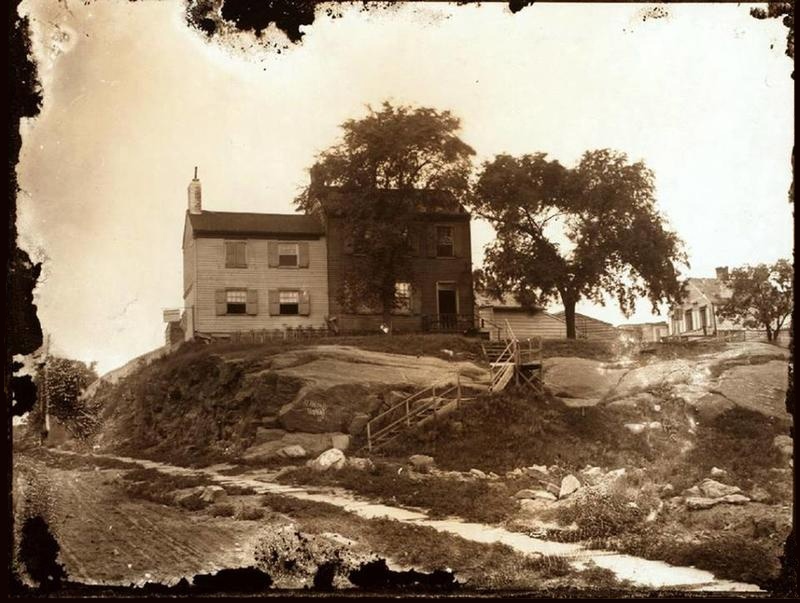
The house where Edgar Allan Poe lived in 1844, near the intersection of West 84th St and Broadway.

Peering through the pentagonal construction window the young writer gazed upon the barren wasteland that used to belong to one of his heroes. Poe’s farmhouse—or rather the apartment building that had once stood there—should have been designated an historical sight; yet the formerly empty structure had been flat-out demolished. There was nothing there now but rust-grey rubble and forgotten dreams—and of course a solemn-faced writer peering through the window and wondering what it must have been like for that giant of American fiction, that colossus of unhinged gothica, to have lived right on this spot.

The writer recalled his favorite stories. The Pit and the Pendulum. The Facts in the Case of M. Valdemar. The Masque of the Red Death. Then he thought of the single novel that sickly scion had scribed, The Narrative of Arthur Gordon Pym. Had all these grand, beautiful, and at times horrifying ideas gestated here? Was there something about this locale that helped engender frightening dramas to bewitch the mind and harry the senses? The air was cool and crisp; it was autumn. He peered even deeper into the mists of time, trying to discern what could not be immediately discerned. Where had the house stood? Was it there, by the empty wall, stained by rot and mold? What about the animals, if he had any? Where did they graze, where did they frolic? Where did Poe’s horrifyingly young wife find herself in the morning while her husband still slept off the inky dissolution of the night before? What about the visitors? What about his parentage? His friends? His longings? His lies? His life!

His life was here amid the stones, amid the acrid dust and shattered pebbles. His life was in the breath of the sky and in the soughing of the wind and the drizzle of the rain. A movie theater stood nearby, the equivalent of the three-penny opera of his day—the type his actress mother might have played in—easy entertainments, easy evenings, easy exigencies, as opposed to what he’d tried to compose in the dark of the night. Perhaps he had seen ravens floating up past his window or circling in the sky; perhaps birds of prey had perched upon the house in the depopulated twilight—evil portents of his young wife’s demise.

The writer thought on all of this; then his thoughts turned to himself and to his own stories which whispered to him at inopportune times. Had E. A. Poe faced the same daily struggle? Had he put off engagements, social calls, daytime explorations, nighttime ventures, all in the service of his craft? We are all in thrall to something—in some cases it is the noble work of helping our fellow man; in others it is the timeless pursuit of perfection, artistic or otherwise which makes our bones quake and our eyes water and our hearts yearn, but nevertheless answers the age-old question, the shifting, drifting dreary query the universe is always posing to, and imposing on, our six senses; the question of, what shall we do with our life?

The house was there as these thoughts and more fled through the writer’s mind. These thoughts and more consumed him, to the point where he could almost see it: a slightly dilapidated gabled home, modest in size and style, that once contained a dream. He thought of his own dreams, his own missions, his own eager anticipations. Life was moving too fast for him, the daily clip of days was maddening, he rarely took a moment to rest. But there’d be time enough to rest in the grave, time enough to contemplate the great mysteries when soil and dirt and grime had covered over the last of our remaining solidness and rendered us forgiven.