Restoring High Bridge, NYC’s Oldest Span, via Gothamist

A fascinating article with photos in Gothamist.com by Evan Bindelglass, covering the history and restoration of the bridge that connected the Bronx and Manhattan beginning in 1842, an interboro link across the Harlem River that was built to bring fresh water via the Croton Aqueduct in to Gotham. The span connects 170th Street in the Bronx to 173rd Street in Manhattan. In a deliciously arcane example of NYC geography, Bindelglass points out, that’s “West 173rd Street and not East,” though this is the east side of the island, “Because it is technically west of 5th Avenue,” the east-west midpoint of the island for road-naming purposes.

High Bridge has undergone numerous reconstructions over the decades. The current renovation–a joint project of NYC’s Parks Department and the NYC Department of Design and Construction–will allow the deck to reopen to pedestrians and cyclists upon its hoped-for completion in June 2014. In a suggestion that would delight many New Yorkers, Bindelglass reports,

“Some are already hailing the High Bridge as another High Line-like project.

 ‘Long linear spaces [are] en vogue in New York City,’ [said] Jennifer McCardle Hoppa,  Administrator for Northern Manhattan Parks for the Parks Department. 

As part of the project, the bridge deck will be restored and parts of it will be resurfaced. (An interesting thing to note is that the original stone arch portion of the bridge—and one stone arch remains on the Manhattan side—was surfaced in a herringbone pattern, but the steel portion was not.)”

My fondness for examples of New York City’s maritime and industrial past is probably well-known to readers of this blog, especially for landmarks like the Little Red Lighthouse, which I toured last weekend. That’s why I also appreciated this quote in Bindelglass’s story:

“‘Just the idea of that reconnection has tremendous symbolism, I think, for both communities,’ says David Burney, Commissioner of the Department of Design and Construction. ‘It’s this piece of industrial archeology, this huge pipe system that was carrying water across and into Manhattan that we’re preserving and keeping as a piece of history,’ Burney says, ‘We do a lot of bridge reconstruction. But this is very special.'”

I have ridden my bike in the neighborhood around High Bridge, and up to the High Bridge tower, which dominates the area around it on the Manhattan side. I look forward to seeing the renovation work completed next year. The work on High Bridge will give all of us access to another splendid city landmark. Meantime, I’m happy I can share this good piece of NY reporting, and one of Bindelglass’s photos from his gothamist.com piece. The image shows the old deck, surrounded by orange fencing. High Bridge tower is in the distance, on the Manhattan side.

High Bridge deck Bindelglass photo

Jan Yoors–Chronicler of the Romany & Tapestry Artist

Jan YoorsSaw this amazing wall-size tapestry at the Robert Miler Gallery’s “Suddenness + Certainty” exhibit, curated by artist Robert Greene. It’s by the late Jan Yoors (1922-77), a Belgian artist and author by whom I once nearly published a book. It was to have been his seminal study Gypsies, for the Kodansha Globe trade paperback series which I edited in the 1990s. As I recall, rights to publish a new edition of the book ended up with another publisher. According to a Wikipedia article about Yoors, at age 12 he ran away with a group off gypsies, living with them for some months until he went back to his parents. He returned to the gypsies periodically over the years. His book, originally published in 1969, was a rare study of the Romany, told from inside the group structure, with their customs and folkways portrayed with rare intimacy and authenticity.

I hadn’t thought of Yoors for years, until I saw his name on the tapestry last Thursday night. It’s a striking work–strong, graphic, and tactile, with a surprising cream-colored shape in the center of  the piece. The price on the list of works in the exhibit was $85,000. I took some pictures of it and asked at the desk if they knew whether it was the author, Jan Yoors, but they weren’t sure. I checked later and confirmed that he was both an author and artist. How nice to be reminded of his book, which I had enjoyed so much, and found so interesting almost twenty years ago. It was a fun night at the Robert Miller Gallery as Kyle and I also got to see paintings by our friend Stephen Lack, who introduced me to his friend Simon Hancock, of HarperCollins.

Another Brilliant Visitors’ Day at the Little Red Lighthouse

Ranger MastrianniReaders of this blog may recall when about a month ago I wrote a post after I discovered one day that the NYC Parks Dept opens the Little Red Lighthouse to visitors the second Saturday of each month from May-October. The LRL is the last lighthouse sited in Manhattan, and a unique urban landmark. It sits under the George Washington Bridge, aka known as the Great Gray Bridge, about even with 178th Street on one of the most westerly points in Manhattan. I had a fabulous time that day, exhilarated by the climb up the three steep steel stairways to the lighthouse’s cupola, where you stand out in the open air, viewing a 360-degree circuit from about 45 feet up in the air. That day I was able to take some great pictures: the shadows cast by the great gray bridge on the Hudson River; shoot south toward points in lower Manhattan; and point my camera in the upstate direction toward Yonkers and well past, fantasizing that the Catskills were just beyond a gradual dogleg in the river’s northward push. When I look that direction I imagine Hendrik Hudson in the Half Moon sailing up-river in the multiple voyages he made between 1709-1712.

I was eager to get back there and take more pictures, and excited that this time my wife Kyle Gallup would be riding up there with me. We set out just before 1 PM. It had been rainy much of the week, but that was finally past, and high barometric pressure had moved in–the air was scrubbed and freshened by the front of new weather. Our ride up the Cherry Walk was right in to 15 mph wind gusts but we pedaled through it.

As we pedaled past what we fondly call Hudson Beach, an exposed area of sand and shore about even with 165th Street, we rounded another bend and there was the lighthouse with its front door swung open for visitors, with a nearby tent staffed by a Coast Guard auxiliary officer. With a friendly demeanor, he had us sign in and added that next month–on October 12 for what will be the final open day of the year–there will be a fall festival in the park around the lighthouse. We left our bikes behind the tent and headed toward the open door of the lighthouse. A female ranger in a broad hat greeted us and showed us the chunky brass key that for many years was used to open the door.

From one’s first step inside, the interior of the lighthouse with its dense, plated steel walls, remindful of a ship or a submarine, makes a powerful physical impression. To learn more of the lighthouse’s colorful history–including details of the children’s book it inspired and the original siting of it at Sandy Hook, New Jersey, in 1880–I invite you to read the full post I wrote about it last month. Please click here to see all of this post’s photos. 

REPUBs: “Just Say ‘No’ to Science”

“Hono(u)rary Canadian”–My New Blog

Perce-Roche-tumbler6Along with The Great Gray Bridge, which is designed and built* upon a Wordpress theme, I maintain a blog–currently on tumblr–where I share briefly written posts with photos and quick hits. It’s often handy when I’m traveling or running around town, away from my desk.** That site was formerly named after this blog, but I’m officially refocusing it–its emphasis will now be on Canadian content and covering Canadian issues. I’m renaming it Hono(u)rary Canadian, in a bid for transnational wit. I make no singular claim to that title, for I know that Canada draws interest and affection from many in the US. I use it though, as kindly Canadians have said it about me, and because I do cherish a near-lifelong deep and personal connection with Canada. In fact, from the time I began The Great Gray in October 2011, Canada has played an important role in my coverage, constituting roughly 20-30% of my writing, links, and sharing. I’ve connected with many Canadian readers over the past two years, and have found there many Facebook friends and Twitter followers. I’m hoping to connect with even more Canadian readers with the newly named site, and more deeply.

Given my interest in Canadian literature, authors, indie music, geography, and politics–and the enjoyment I find in writing about them, this is a natural extension for me. I also plan to write about Canada’s next federal election, which will take place no later than 2015. I’ll also be sharing photos from my many years of travel in Canada, beginning with the image that I’ve chosen as the signature visual for the site. It shows the monumental Roche Percé or ‘pierced rock’ on the Gaspé Peninsula in the most eastern portion of Quebec. I visited the region on a solo vacation in the autumn of 1988. The mighty rock juts in to the Atlantic Ocean with its massive pointed prow facing toward shore. It is a wonder of the world, no kidding. A visitor can only get near it at low tide, as I did on one lucky occasion. I remember spending about 3 hours scampering in and out of the surf and trying to get as close as possible to the pierced opening, with the huge bulk of it towering at least a hundred feet above me. The image at the bottom of the post is a ‘selfie’ I took the same day, long before that term was in the vernacular. It’s a place I hope to see again someday, next time with my family.

I invite you to visit Hono(u)rary Canadian in the days, weeks, and months to come. I’ll post on both sites, share often between them, and do lots of cross-linking. My interest in reading, book culture, live music, city life, media, and current events, and my writing about them–covering New York City, the US, and Canada–is growing so that I need the two sites. Thanks for reading me at one or both of them.

PT & Perce Roche_0001

* My excellent designer, who adapted the Wordpress theme I chose for this site, is Harry Candelario, who when I first met him was known as the Mac Doctor, for his work on Apple products. I frequently suggest him to people when they ask me to recommend a web designer. I should add he also offers helpful advice about Wordpress, various Web platforms, SEO, and generally helps to increases one’s Web savvy.
** Though I may soon convert it from tumblr to Wordpress.

#FridayReads, Sept 6–Celebrating Robertson Davies’ 100th

#FridayReads, Sept. 6–The many books of Canadian novelist Robertson Davies, which I have had the pleasure of reading and enjoying over the past 30 years.

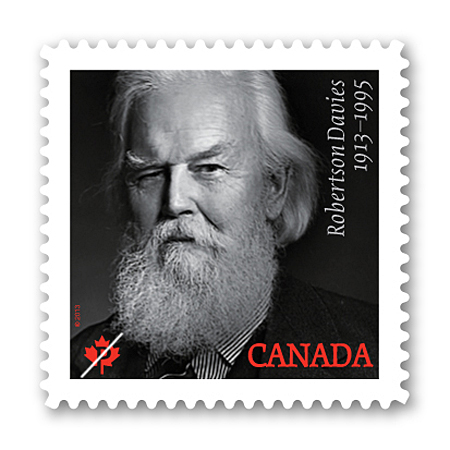
August 28, 2013, was the 100th anniversary of the birth of Robertson Davies, the great Canadian novelist and all around man of letters. The Canadian postal service is marking the anniversary by issuing the stamp below. When I ran Undercover Books in Cleveland, Ohio, which opened in 1978, we introduced thousands of U.S. readers to books by Canadian authors, particularly including Davies.* We were doing so much business in his books at one point in the early ’80s that I wrote Davies a letter c/o of his publisher Viking Penguin to let him know. He responded from ivied Massey College in Toronto, where he was a Don of Letters, and a pleasant correspondence between us ensued over a couple of years. Later, organizers of a writing conference at Case Western Reserve University asked me to invite Davies to a big meeting of theirs, but he declined, explaining he was averse to travel. The organizers asked me if I would instead speak on the combined experience of reading and selling Davies’ books, an invitation I accepted. In my files somewhere is a transcript of the talk I gave and the letters I exchanged with Davies. I will dig them out someday soon and scan them for this site and my newly renamed tumblr, Hono(u)rary Canadian, where I’ve also covered the new Davies stamp.

If you haven’t yet read Davies’ work, I still recommend his books highly. Most readers start with his Deptford Trilogy, and its opening book, Fifth Business, which was first published in 1970, followed in the trilogy by The Manticore and World of Wonders. Their motifs are indelible painted in my mind, though I haven’t re-read the books in more than 20 years: saints, snowballs, magicians, and freakish beauty. His earlier books–Tempest-Tost, Leaven of Malice, and A Mixture of Frailties–collectively known as the Salterton Trilogy, are also very enjoyable. His first break-out book, as a hardcover bestseller, was Rebel Angels, thanks in good part to the enlarged audience that my store, and other indie booksellers, brought to his books.

I’m really glad Robertson Davies is being remembered with this special stamp, which was announced at the Canada Post website and covered at Quill & Quire magazine. Below the stamp are photos of my copies of Davies’ books.  Please click here to see all photos.Robertson Davies stamp
* In a page on this website devoted to my career, Philip Turner–Professional Background, under the heading “Hono(u)rary Canadian” I present more info on Canadian authors I’ve worked with:
As a native of the Great Lakes region, I have a keen affinity for Canadian books and authors, seeing the book world of the U.S.’s upper Midwest and Canada’s southern tier (and one might argue, the whole of the Pacific Northwest) as contiguous literary cultures. As an Ohio bookseller, I introduced thousands of U.S. readers to such Canadian authors as Robertson Davies, Margaret Atwood, Mordecai Richler, Margaret Laurence, Timothy Findley Farley Mowat, and Pierre Berton. As an editor and publisher, I broadened that effort, publishing U.S. editions of books by Atwood, Richler, Mowat, Berton, and Dallaire, as well as Paul Quarrington, Antonine Maillet, Ken McGoogan, Julian Sher, William Marsden, Elaine Dewar, Bonnie Buxton, Howard Engel, Joan Barfoot, George Eliot Clarke, Steven Galloway, Stephen Strauss, Joel Hynes, Paul Anderson, Sheila Munro, and Jan Lars Jensen, among others.