 Since Hurricane Sandy hit New York City last Monday night, I had not ranged outside the Upper West Side of Manhattan, within 10-20 blocks of my home. My wife and son and I never lost power and aside from a tree that fell across our street, our neighborhood fortunately suffered little consequential damage. We’ve been able to buy fresh groceries and get cash from local ATMs. All week, I’d been very conscious that hundreds of thousands of fellow NYers had been plunged in to an unpleasant, partly pre-industrial existence, but with the subways out of commission and surface traffic horrible just on my own nearby streets, I was loathe to add to the difficulties and confusion below 34th Street, where power was out and so many parts of the city had been severely flooded. We made some donations–check out www. masbia.org, an outfit doing great work, and one which we’ll donate to again in the run-up to the holidays–and avidly followed all the news (thank you Brian Lehrer and John Hockenberry and all the correspondents on WNYC radio and NY1 TV). Finally, Thursday night I saw on Twitter that some Upper West Siders were organizing a trip downtown with supplies for an organization called Good Old Lower East Side, or GOLES. Once downtown, there would also be a chance for volunteers to connect with GOLES’s efforts, bringing provisions to seniors and others without power and elevators in their apartment buildings. I emailed Monica O’Malley and promised to meet her and her friends at noon on Friday.
When I got to the building on a west side block between Amsterdam and Columbus I found a group of young women already carrying flats of bottled water and bags of food from the lobby to a waiting cab. We met and quickly introduced ourselves and continued loading the cab, soon packing off several of us in what remained of the space in the taxi. With one of my co-volunteers, Melinda, we marched off together carrying bags of goods, planning to find a cab of our own, but first stopping off to buy many boxes of granola bars, portable, lightweight food that we knew would last a while. And with that, we hailed a livery cab and began our journey into the no-power zone. After crossing below 34th Street, I noticed the lack of operating traffic lights. Our driver stopped at every corner before proceeding through each intersection. Soon, we reached 169 Avenue B, between 10th and 11th Streets, brought our goods into the GOLES storefront, and found our friends from uptown. GOLES organizer Demaris was using a bullhorn to tell the eager volunteers, a mass of about 100 people at this point, what we could do to help. She was especially looking for any Spanish and Chinese speakers to ask residents of buildings what kind of help they might need, and if they had any urgent medical problems. While I couldn’t help with those languages, we did gather up provisions and were asked to bring them to needy residents of LaGuardia Houses, a public housing complex at the corner of Madison Street and Clinton Street, north of the Manhattan Bridge, close to the East River.
I sparked at the mention of the LaGuardia Houses, the site of a distressing report by WNYC correspondent Marianne McCune this week that chronicled the fortunes of a LaGuardia resident, 87-year old Margaret Maynard, who hadn’t been able to leave her apartment since before Sandy. She’d been subsisting on crackers and orange juice. McCune, whom I admire in her riveting audio report for the willingness she shows to get involved with and help out a person she’s covering, uses the waning battery in her cell phone to call a friend of Maynard’s, Doris George, who had been the maid-of-honor at Maynard’s wedding 60 years earlier. Though Maynard was reluctant to be the beneficiary of any special intervention, insisting that some folks were worse off than her, with the return of electricity to her building at that point still unknown, we learn that Maynard has since been evacuated to a nephew in the Bronx.
Walking south and east, I saw an astonishing amount of damage in parks and all over the neighborhood. I tried to capture it n my pictures, but am sure I haven’t. Everything’s been pushed down, especially the plants. At LaGuardia, we used flashlights we’d been given at GOLES to navigate hallways with floors wet from condensation due to the flooding to reach pitch-dark stairways and then up to floors in the building, where we began knocking on the doors of residents. The buildings were up to 18 stories. I walked up five floors at the most, for my knees. We were instructed to not be too aggressive in our knocking, lest we alarm residents. We found some who were doing okay, not in need of assistance; we asked them if they knew of any neighbors in distress. Even the people who didn’t need food and water were very glad to have been remembered and held in the thoughts of other New Yorkers. At one apartment, I found a three-generation Chinese household. The older ladies who answered the door were instantly grateful for the bottles of water, the boxes of raisins they said the children would love, a can of pineapple chunks, and several self-heating meals. At none of the apartments I visited did I find anyone in distress, like Ms. Maynard had been, but I did see some people who weren’t doing well at all.
I also saw instances of spontaneous resilience, like a pop-up coffee & oatmeal stand in front of a low iron gate near 82 Rutgers Slip, the next address I went with a big bag of foodstuff. Two gay friends, two guys, were running it, and had no dish put out for people to put money in. It was conspicuously free, not even asking for change. At that point on my own for a few minutes, I encountered a community meeting on the 2nd floor where a discussion was underway in English and Chinese translation on how to deal with difficulties caused by the storm. There I met Victor Papa, a veteran of this community’s many organizations and a board member the Two Villages Neighborhood Council. It was heartening to find this level of community organizing going on so quickly, even amid all the new problems that are less than a week old. He was also grateful for the provisions I brought.
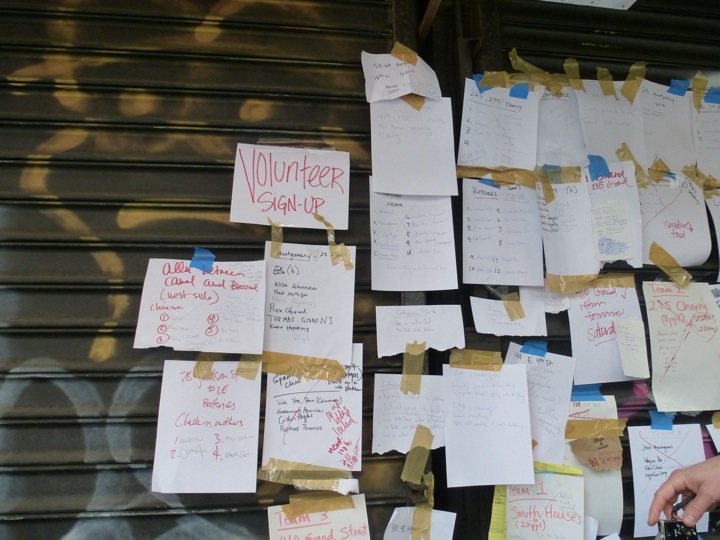
After this interlude, I met up again with two of the women from my original group, Melinda and Kim. We walked to 46 Hester Street, where CAAAV is located. This is a community group whose mission is to develop “power across diverse poor and working class Asian immigrant and refugee communities in New York City. Through an organizing model constituted by five core elements–basebuilding, leadership development, campaigns, alliances, and organizational development–CAAAV organizes communities to fight for institutional change and participates in a broader movement towards racial, gender, and economic justice.” In front of CAAAV’s storefront, dozens of notices had been posted. From across the street, these signs immediately reminded me of the weeks after 9/11, when people were putting up signs in search of missing loved ones. On closer inspection I found that these were notices of buildings and particular apartments where help was needed. CAAAV staff in orange vets were deploying teams to addresses where they knew help was needed.
Unfortunately, the notices posted on walls weren’t the only thing that reminded me of post-9/11 New York. There’s a fragility to the city right now that’s so reminiscent of then–a deep sadness at the realization that so many things have been lost, never to be regained. I met and spoke with one woman, Ellen, from Brooklyn, who had just come over the bridge to see what she could do to help. We were both taking pictures of the posted notices. She looked to be near tears much of our ten-minute conversation. We talked about 9/11 and I told her about my own experiences that day and afterward. Despite the lingering sadness, it was still extremely impressive to find such effective grassroots organizing. One thing I detected all afternoon was intensive and agile organizing like Occupy Wall Street. I know many of these organizations have been around for even longer than OWS, so it might be better to say that the LES and Chinatown have some very effective community organizations; maybe it’s OWS that’s borrowed and learned from them. The grassroots stake in the fortunes of the community was palpable.
It was now getting on past 3:00 and since I didn’t know how long it would take me to get back up to the Upper West Side, I said goodbye to Melinda and Kim and began heading uptown on foot. Kim said she was going to be cooking at home today, with the food to be donated to an organization she knew about. At the corner of Ludlow and Stanton, I saw a table set up on the sidewalk where coffee and food were being offered gratis to passersby. Spontaneous acts of generosity were sprouting all over town. Staffing the table were Ian and Savannah. She works at the shop on that corner, a hairstyling salon called Pimps and Pinups. With the shop closed, the two of them had set up their own food station on the sidewalk. I had a nice time sipping coffee and chatting with them and their patrons and taking a few pictures. Their corner was just down from the street from music clubs I often frequent–Arlene’s Grocery, Pianos, and the Living Room, which were all shut. So lively much of the time, this part of the Lower East Side had a ghost-town feel on a late Friday afternoon.
As I expected, public transportation was a major challenge, but using the M15 bus up First Avenue to 42nd Street, the M42 to Grand Central, the subway shuttle to Times Square (where I declined to try and get on the #1 train, since a ridiculous horde of passengers were already waiting for it), the M20 bus up Eighth Avenue to Lincoln Center and the M5 bus along Riverside Drive I got home just as darkness was falling. Riding the M5, I was enormously relieved to hear WNYC broadcast on my radio headset that Mayor Bloomberg had at last agreed to cancel the NYC Marathon and that power was just then returning to parts of lower Manhattan. It had been quite an afternoon, filled with generosity, moments of buoyant hope, and desperation.
Click here to see all photos.

 Readers of this blog will recall that I contributed an essay, “Remembering Mr. Stress, Live at The Euclid Tavern,” to Rust Belt Chic: A Cleveland Anthology. Co-editor Anne Trubek reports that the book is selling well, in its ebook and trade paperback editions, and is frequently being reordered by book retailers including Amazon.com. Anne posted news on Facebook tonight that the Nook, Apple, and Kindle ebook editions are right now being sold in the respective digital stores for the terrific price of $2.99 (Nook store, ITunes store, and Kindle store)