
Celebrating the Holidays with the Singing Roches
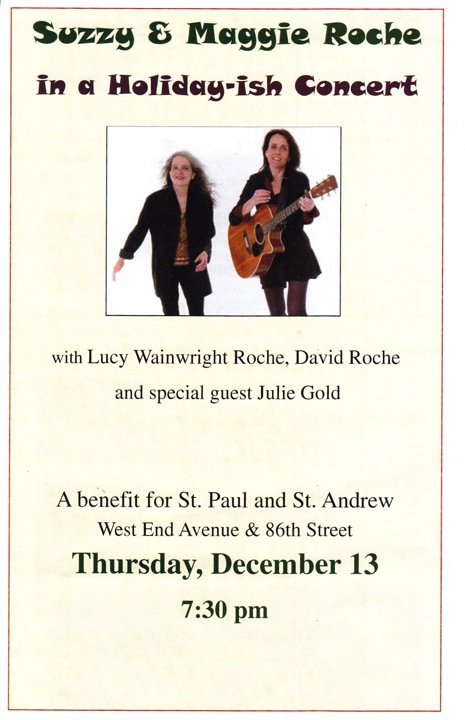
The night before the tragedy in Newtown, CT, I attended a special holiday concert put on by Suzzy and Maggie Roche with their extended musical family. It was a wonderful show, full of humor, uplifting sentiment, and infectious music. Sadly, the next morning as I downloaded photos from my camera and prepared to write a blog post about the show, news of the Newtown shootings began to emerge. I put the idea aside, my heart just wasn’t in it, especially after I learned that a former colleague’s 6-year old son was among the dead. Tonight, with Christmas Eve day ticking on toward midnight, even while another violent outburst of deadly gunfire was reported today, near Rochester, NY, I’ve decided to finally share my pictures and make this into a bit of a Christmas post.

I’ve written about the Roches a number of times over the past several months. First, Kyle and Ewan and I had fun at Terre Roche’s Sunset Singing Circle in Battery Park in June. This public sing-a-long was held at the tip of lower Manhattan, facing New York harbor and the Statue of Liberty. I also wrote about sister Suzzy’s splendid mother-daughter novel, Wayward Saints,  a tragi-comic tale of rock n’ roll, family, and second chances in life. I posted next when Terre published a NY Times Op-Ed on what she dubbed the new busking in the music biz, with emerging mechanisms to seek funding for support of recording such as Kickstarter and Indiegogo. Finally, last summer Suzzy led a Bryant Park reading room discussion on Edith Wharton’s House of Mirth, which Kyle and I greatly enjoyed, and which I wrote about, as well.

They are clearly a very talented family, and I’m a fan. What’s more, they don’t just rest on their laurels for things they did back in the day (with Maggie) as The Roches, with such great compositions as “Hammond Song,” with its theremin-like lead instrument and great harmonizing of all three voices. It’s still a beautiful song, and deserves a fresh listen, if you haven’t heard it recently, or ever. That’s why I was eager to attend Suzzy and Maggie’s Dec. 13 program, what they called a “holiday-ish concert,” which was also going to include their brother, David, with his daughter, Oona; Suzzy’s daughter, Lucy Wainwright Roche (whose father is Loudon Wainwright III, composer of the the classic, “Dead Skunk in the Middle of the Road”); and singer songwriter, Julie Gold, best known for her song “From a Distance,” which Bette Midler recorded and made famous as a Grammy Song of the Year in 1991. It promised to be quite a program, and the event didn’t disappoint, at all.

I had never heard Maggie before this occasion, and it was interesting to hear her voice mix with that of Suzzy, with it a bit lower in register by comparison. They did “Hammond Song,” with Lucy taking the part that would’ve earlier been sung by Terre. Lucy also sang the title song from her latest album, “There’s a Last Time for Everything.” That wordplay is found in much of the Roches’ writing, with humor in their lyrics and a kind of plain-spoken matter-of-factness that I found refreshing. It doesn’t at first seem artistic, and the lack of artifice is welcome; what it is, is real. Scan the first verse of their song, “We,” their opening number on this program, credited to all three of the sisters, which they wrote in 1979:

We are Maggie and Terre and Suzzy/Maggie and Terre and Suzzy Roche/we don’t give out our ages/and we don’t give out our phone numbers/give out our phone numbers/sometimes our voices give out/but not our ages and our phone numbers

The night ended with them inviting anyone in the audience who wanted to sing in the last few carols to join them at the front of the church. A lively group assembled around them and the evening ended with a great, joyous sing-a-long. I’m glad I could be there, and finally post this little essay on the concert, notwithstanding the terrible tragedies that have intervened. I hope the photographs below give you a full sense of this special program. Please click here to see all photos.

My Saturday Antidote to NRA Toxicity–Great Canadian Folk-Rock

Fun Night of Live Music with Mona’s Hot Four

This past Tuesday night I had a great time at the Rockwood Music Hall for a combined launch of a new documentary and CD. The film is called “Tuesday at Mona’s” as is the new CD, a live recording, and they feature a jazz quartet called Mona’s Hot Four, who have a long-running weekly gig on Manhattan’s Lower East Side at Mona’s Bar on Avenue B between 13th and 14th streets. The basic outfit is clarinet, piano, stand-up bass, and guitar, and is regularly supplemented by additional players on various instruments.

This launch had originally been planned for the week Superstorm Sandy hit NYC, but was of course canceled. Mona’s frontman, clarinetist Dennis Lichtman reported that Rockwood was forced to cancel 81 shows because of Sandy. They were able to reschedule, and the boisterous crowd did not seem at all diminished by the change. Just after 8 PM a film screen was unrolled on stage, and a projector was clicked on to screen the new documentary. About 30 minutes long, the film tells the feel-good story of how an  eclectic tribe of jazz players ended up finding at Mona’s the ideal venue and audience for their passionate enthusiasms for tunes of the halcyon pre-bop era. There are several extended songs and a number of interviews with musicians, fans, bartenders, and Wall St. Journal jazz critic Will Friedwald, who touted Mona’s Hot Four and the scene at the bar in an 2011 diary-like piece, “After Midnight at Mona’s”:

11:30 p.m. Within a few numbers (“Margie,” “Blues My Naughty Sweetie Gives to Me”), it’s abundantly clear that this group is immersed in the early New Orleans jazz idiom…. 1 a.m. The room is packed with young men sporting beards and slender women with Bettie Page bangs and abundant tattoos. There must be 100 people crammed inside this tiny bar, with seats for maybe 15, and only a fraction of those either sitting or standing can actually see the band. The room is dense with young musicians carrying instrument cases, or wearing their saxes around their neck, waiting to be called. “I think it’s amazing that we’ve become a mecca for those who love this music,” Mr. Lichtman says….2:30 a.m. The band is starting to thin out, and plays two numbers just to delight the record collectors in the crowd, “Dardanella” and “Hang Out the Stars in Indiana,” the latter fetchingly sung by Ms. [Molly] Ryan.

Once the film ended, Mona’s Hot Four took the stage, with clarinetist Lichtman introducing his band mates: Gordon Webster (piano), Jared Engel (bass), and Nick Russo (guitar). Their playing is a joy to hear with clear melodic lines on standards like “My Blue Heaven,” tasty licks on “Sugar Blues,” and fluent ensemble work on “Up a Lazy River.” Though Rockwood is not the Hot Four’s usual venue, many additional players showed up to supplement the quartet. In the set that followed the documentary, they were joined on stage by a caravan of players on trombone, trumpet, banjo, snare drum, and a number of talented vocalists. Among this retinue was singer the aforementioned Molly Ryan and banjo player and vocalist Jerron Paxton.

Lichtman fronts another group, Brain Cloud, which I had enjoyed and posted about during the Brooklyn Folk Festival last May. I hope I have another chance to hear them sometime, as they have a semi-regular gig at the Rodeo Bar in Manhattan. That group also plays some jazz, though with a different flavor than Mona’s Hot Four, as well as Western swing, klezmer, and songs from Tin Pan Alley, with vocalist Tamar Korn (who also sang with Mona’s Hot Four this week). After the documentary and an abbreviated set of music, Lichtman announced that Mona’s Hot Four would later that night they’d be camped out at Mona’s Bar for their usual late Tuesday night set. I wasn’t able to migrate to Mona’s on this night, but I do hope to hear them there some other week. If you’d like to buy the DVD/CD which includes the documentary and live album in one package, you can order it via this link, and listen to some of the Monas’ hot stuff.

Here’s a 2010 video of Mona’s Hot Four I just found online:

On my way back uptown, I stopped in at another great spot, the 11th Street Bar, to hear what live music they might have on in their back room. I was delighted to discover a band there led by guitarist Teddy Kumpel, whose band of drums, bass, and another lead guitar, was having fun playing an infectious melange of funk and blues. You can hear a sample of his groove at this page on his websitePlease click through on this link to see all photos I took during this fun night of live music.

“A Few Genuine Songs . . . All But Drowned out by the Loud Siren of Ambition”

In “Censoring Myself for Success,” a strikingly candid Op-Ed published yesterday in the NY Times, Somali-Canadian  poet, rapper, singer, and songwriter K’naan laments the influence of his label A&M/Octone on his latest album “Country, God and the Girl.” Coming after the worldwide fame that attached to him when his first hit song “Wavin’ Flag” became the anthem of the 2010 World Cup, K’naan writes that his early songs drew directly from his childhood experiences of a country trapped in continuous conflict, but then:

“A few days before I was to record [my third album], which was released in October, I received a phone call saying my record label wanted a little talk—before the songs were written. (I like to write in the moment.) For the first two albums, there were no such talks. But that was before my name was familiar. So let me start my story there.

In 2005 I found cheap recording space and sang about the killing ground of Somalia:

‘We begin our day by the way of the gun… you don’t pay at the roadblock you get your throat shot I walk with three kids who can’t wait to meet God lately, Bucktooth, Mohamed and Crybaby.’

In 2008, with a recording budget, I went on my own to Jamaica, to Bob Marley’s old studio, and sang of a lovely, doomed young friend:

‘Fatima Fatima, I’m in America, I make rhymes and I make ’em delicate, you woulda liked the parks in Connecticut… Damn you shooter, damn you the building, whose walls hid the blood she was spilling, damn you country so good at killing, damn you feeling, for persevering.’ …

Over breakfast in SoHo, we talked about how to keep my new American audience growing. My lyrics should change, my label’s executives said; radio programmers avoid subjects too far from fun and self-absorption.

And for the first time, I felt the affliction of success. When I walked away from the table, there were bruises on the unheard lyrics of my yet-to-be-born songs. A question had raised its hand in the quiet of my soul: What do you do after success? What must you do to keep it?

If this was censorship, I thought, it was a new kind—one I had to do to myself. The label wasn’t telling me what to do. No, it was just giving me choices and information, about my audience . . . who knew little of Somalia. How much better to sing them songs about Americans. . .

And there I was, trembling between doubt and self-awareness. I had started . . . striving to make (and please allow room for grandiosity here) my own ‘Natty Dread’ or my own ‘The Times They Are a-Changin’.’ But now, after breakfast, another voice was there, whispering how narrow the window of opportunity was. . . 

So I had not made my Marley or my Dylan, or even my K’naan; I had made an album in which a few genuine songs are all but drowned out by the loud siren of ambition. Fatima had become Mary, and Mohamed, Adam.

I now suspect that packaging me as an idolized star to the pop market in America cannot work; while one can dumb down his lyrics, what one cannot do without being found out is hide his historical baggage. His sense of self. His walk.”

Later, I found this posted by K’naaan on his Facebook page:

“After your overwhelming response, I’m inclined to write you all a quick note. Starting with the question: WHERE DID YOU PEOPLE COME FROM?!!! What an amazing and articulate bunch you are. You should know, I’ve read every single word in every single post underneath my essay, and, I am deeply moved. Have no fear, whatever you hear coming from me next, good or bad, will only be born from the intention to express. No other voice shall ever trespass into the sovereign continent of my words. I really do, from the bottom of my heart, thank you all. For gathering around me, like you did. I feel energized. Let it be a wondrous journey, thank you for riding along.

So much love to you guys,
K’naan”

In K’naan’s Op-Ed, I was struck as much by his self-criticism as by his critique of the execs who suggested he change his artistic approach. I suggest you read his whole Op-Ed for yourself, and note that the NY Times web page also includes a nice spoken word by K’naan, talking about Somalia and poetry. Finally, if you haven’t heard K’naan here is a video of his performance of “Wavin’ Flag on the CBC program “Q”: 

Woody Guthrie, New Yorker

Wonderful to think of Woody Guthrie playing music on NYC’s subways. H/t @grescoe on Twitter and Hajimero on tumblr for sharing this image that appeared in LIFE magazine in 1943.

How a Community Makes a Book

I first met writer and literary journalist Robert Gray when I was Editor-in-Chief of Carroll & Graf Publishers and he worked at the splendid Northshire Bookstore in Manchester Center, Vermont. I loved that his email address at the time incorporated the phrase “marbleman,” as a personal homage to Vermont’s marble quarrying. We both later moved on but kept in touch, especially after he became a regular contributor to the daily book world read Shelf Awareness, and I started curating and writing The Great Gray Bridge. Robert’s pieces for Shelf Awareness are published under the rubric, “Deeper Understanding.”

Recently, I let Robert know about Rust Belt Chic: A Cleveland Anthology to which I’d contributed an essay, hoping the DIY energy that produced the book would appeal to him, and that he might want to cover it in his column. He took the opportunity to heart and today published a great piece, “Self-Pub, Sense of Place & Concentric Circles,” with passages like this:

“When you want to know about a place, ask the people who live there. When you want to read about a place, read the writers whose words reveal more than just the surface of a region’s past and present. What does that have to do with self-publishing? This: For a bookseller considering the possibility of stocking a self-published book, one reliable sign of a winner is a title with a tangible sense of place. Whether or not such a book eventually finds readers beyond the region, it must begin at the center–a pebble dropped in a local pond–before concentric retail sales circles can spread. In their introduction . . . editors Richey Piiparinen and Anne Trubek describe the project as “a community effort to tell the story of a city.” And that’s just what it is.” 

Later, Robert generously mentions my essay, “Remembering Mr. Stress, Live at The Euclid Tavern,” linking to an expanded version of it on this blog. I invite you to read Robert’s entire piece at this Shelf Awareness link, and my piece if you haven’t yet. Robert’s past columns can also be found at his website, Fresh Eyes Now.

I should add that the Nook, Apple, and Kindle ebook editions of Rust Belt Chic are currently being sold in their respective digital stores for the terrific price of $2.99 (link for Nook storeITunes store, and Kindle store). Finally, I’m also happy to report that the first Rust Belt Chic event in the NYC area is coming up, Thursday, January 3 in Brooklyn at Public Assembly. I’ll be there to read, as will other northern Ohio transplants in the NYC area. It would be great to see you there!