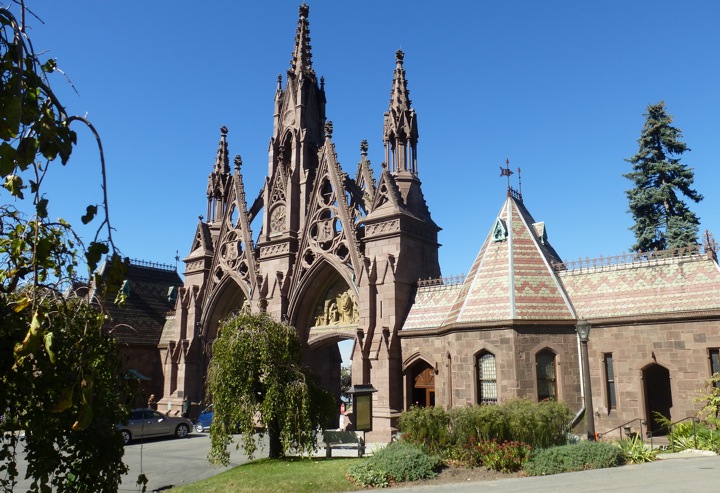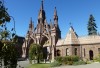
 Green-wood Cemetery is a NYC landmark I’ve been keen to visit for years and last weekend an ideal opportunity arrived for my wife and son and myself to finally get there. The complex, 478 acres of rolling hills (making it more than half the size of Manhattan’s Central Park), big hardwood trees, and sparkling views of Manhattan and NY Harbor, was founded in 1838 as a non-denominational burial ground that also offered what was described then as a “rural” location. To the urbanites who conceived Green-wood*, it was important to create a pastoral, soothing place for mourners to say goodbye to their loved ones. The three of us discovered on Saturday that it is still pastoral and still a balm to the daily cares of city-dwellers.
Among its more than “560,000 permanent residents”–as Green-wood’s literature refers to those interred there–is Louis Moreau Gottschalk (1829-69), a New Orleans composer and pianist whose kinetic and tuneful music provided our nation’s first examples of such styles as ragtime and stride piano, amid a fusion of African, Haitian, and Cuban rhythms joined with Western music. I get periodic emails from Green-wood and had learned from one message that in the 1970s, a memorial figure then gracing Gottschalk’s burial plot had been vandalized and destroyed. Saturday had been announced as the unveiling of a new figure at his gravesite. Not satisfied to merely place it there, Green-wood planned a program of live piano music in the bright autumn air, played and presented by John Davis; a talk by Frederick Starr, former president of Oberlin College and author of the Gottschalk biography, Bamboula!; an introduction of the sculptors who made the new figure; and finally, the unveiling of “The Angel of Music.” All this was offered to the public free of admission charge.
We emerged from the ‘R’ subway stop at 25th Street and 4th Avenue in Brooklyn, walking a block east toward 5th Avenue and Green-wood. Even before reaching the cemetery, we spotted a cool-looking complex of low buildings. Fenced around on all sides, this establishment was topped with a sign reading “McGovern Weir.” We wondered if it had been a business selling gravestones and monuments, though have since learned from the blog “Lost New York City” that it was for many years a florist. This handsome old wreck of a place was constructed in 1880, and was bought for $1.6M by Green-wood in April.
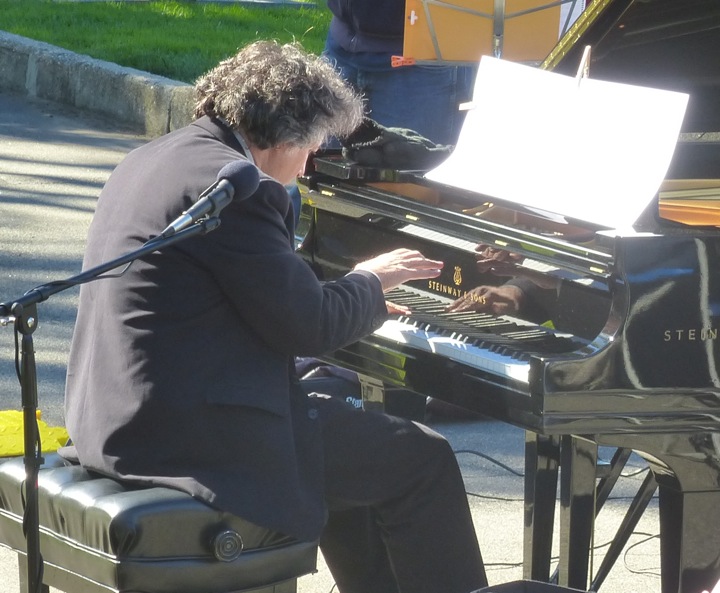
Walking past the Green-wood gatehouse we were met by a friendly young woman whom we’d later see again selling books from an outdoor kiosk. Here, she was handing out programs for the Gottschalk event. Ewan and I made it up the hill first where we saw the crowd gathered, with Kyle a bit behind taking pictures. Soon the three of us were settled comfortably on a grassy slope just a few yards from where a shiny black Steinway piano–lent by the Steinway company, whose forebears are buried at Green-wood–sat gleaming in the sun. Just the novelty of seeing a grand piano outdoors was exciting.
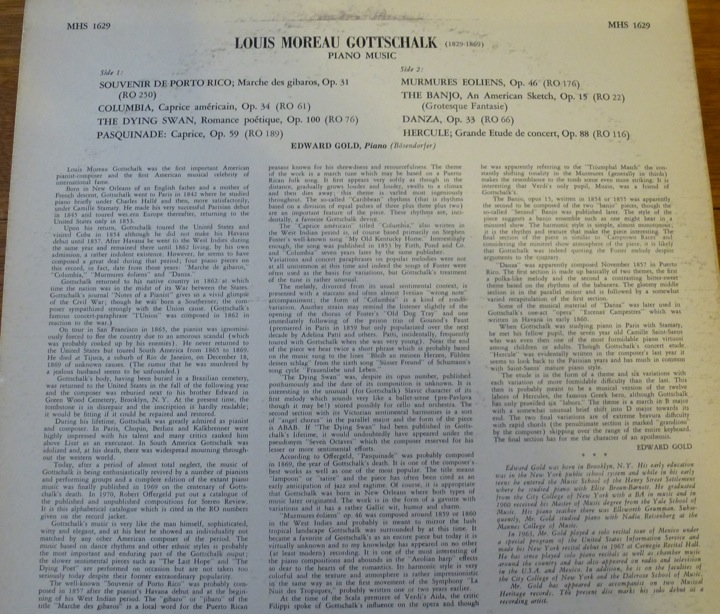
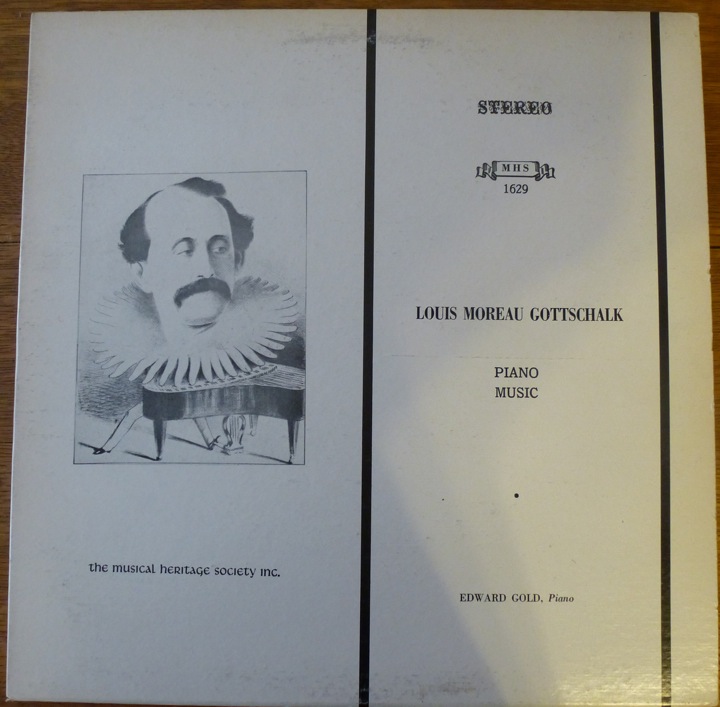
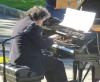
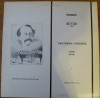
Green-wood President Richard J. Moylan quickly introduced John Davis, who, as he removed his gloves against the chill said he hoped we wouldn’t think he was pulling a pre-performance trick as Gottschalk was wont to do–carefully pulling off his white gloves one finger at a time as he sought to draw the attention of his audience to the very hands that were about to strike the piano keys. Davis launched in to his first Gottschalk selection, “Bamboula,” a sprightly piece based on a Creole song that warmed up the audience. One could hear shades of Chopin, as well as an anticipation of melodies that we’d later identify with Stephen Foster. Introducing “Danse Cubane,” he described Gottschalk as the “father of world music” and the first classical composer in America to break away from an exclusively European model. All this reminded me of what a relatively enlightened and open urban culture New Orleans was in the first half of the 19th century, with free people of color landing up there from the Caribbean and South America. Gottschalk, with a German-Jewish father and a Haitian mother, tapped into and reflected influences from the New World and the Old. Davis also amazed us when he described that in 1938–around 80 years after the peak of Gottschalk’s influence–Jelly Roll Morton wrote of “the Latin tinge” that pervaded his music, in a thread of influence that began with Gottschalk. Davis closed this part of the performance by evoking Mark Twain’s partiality toward the banjo and then playing one of Gottschalk’s signature compositions for solo piano, “The Banjo,” which thoroughly commingled African, Caribbean and European motifs. Here I’m glad to insert the front and back cover of an LP I acquired in the 1980s, with the music of Gottschalk played by Edward Gold. It still sounds great!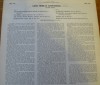
With these sounds still echoing in our ears, the program moved through Frederick Starr’s biographical presentation and the introduction of sculptors, Giancarlo Biagi and Jill Burkee. They bid us to walk a few yards along the slope to Gottschalk’s gravesite, ringed with a black wrought iron fence. As Mr. Moylan assured us even he had not yet seen the finished cast of “The Angel of Music,” we saw a pedestal in the middle of the grassy square topped with a figure enshrouded in a green tarpaulin. As we stood expectantly, hands reached out to shuck off the tarp, exposing an elegant bronze figure that looked as if it had set there for much longer than just this day. Applause and shouts of congratulations to the sculptors were heard as we all admired the delicate figure.
With that, we went back to our earlier spots as John Davis sat again at the piano, joined by clarinetist Jeffrey Lederer and vocalist April Matthis. The trio performed “Slumber on, Baby Dear,” a lullaby composed by Gottschalk. As a final round of clapping rang out, Richard Moylan invited everyone to Green-wood’s nearby chapel where refreshments and coffee would be served. We walked down the hill and around the property to the chapel. Along the way, we stopped at the book kiosk where maps of Green-wood are also available. There we asked the same young woman who’d greeted us earlier if she could possibly help us determine where we’d find the grave of one’s of Green-wood’s “permanent residents,” Thomas C. Durant, who was instrumental in building the trans-continental railroad in the years immediately after the Civil War, and through his corruption became embroiled in the infamous Credit Mobilier scandal of the post-Civil War years. We’d learned about the real-life Durant from the TV series, “Hell on Wheels,” a fictional treatment of the building of the railroad, in which the Irish actor Colm Meaney plays the striving rail baron. One plot thread in the TV series–which is actually true to history, as far as I can tell–is that Durant had corruptly enriched himself at the expense of the US government and investors in the railroad, and very possibly ended his life in some disrepute. In the program, he runs his enterprise with a great deal of secrecy and intrigue, and again, this seems to conform with what I’ve read about the real Durant. Colm Meaney’s Durant is a scheming, self-interested, angry figure who, I daresay, most TV viewers come to distrust and even loathe. The friendly greeter-bookseller helped us locate Durant’s burial plot number and we made a note on our map, indicating where we ought to be able to find Durant’s memorial.
Following some coffee and a snack in the chapel, a vaulted space where mourners at Green-wood gather for indoor memorial services, we thanked our hosts and walked toward Section H, Lot 10400, in search of Durant. After passing some beautiful Civil War-era memorials, we hunted around for quite a while, to no avail. Growing frustrated, but no less determined, and refusing to leave disappointed, the three of kept walking and looking until I finally found a mausoleum bearing the legend, “T.C. Durant.” The form of the memorial was entirely in keeping with the Durant we’ve come to know from the program and our research. Sealed up tight behind a gated door flashing spear points, a stolid and impregnable edifice squats in the brow of a low hill, with trees looming protectively over it. Like the man interred there, it gives off no secrets and yields virtually no information. It doesn’t even use his full first or middle names, no year or birthplace is etched in the stone, and likewise no death date, though we’d read it was 1871. In the dappled light of mid-afternoon, we found it was even difficult to photograph the letters of his name mounted above the gate, and had to take many pictures before we got images that decently bear the legend of Durant’s initials and last name. The successful outcome to our searching left us with more questions than answers about the real Thomas Durant, and we will continue trying to learn about him what we can.
With that, we walked back toward the gatehouse and out on to the ordinary streets of a quiet Saturday in Brooklyn, grateful for the fine program celebrating Gottschalk put on this special day, and struck by the charm and splendor of Green-wood Cemetery, a bucolic urban retreat we hope to return to soon. I hope these photos, most of them taken by my wife Kyle Gallup, will give you some sense of the occasion. And, if you can, check out the music of Louis Moreau Gottschalk, a worldly musical pleasure.
*Green-wood shares the hyphen in its name with the New-York Historical Society, a particularly 19th century sort of spelling.
Please click through to see all photos.