
Eager to Participate in the Adirondack Center for Writing’s Publishing Conference, June 6-7
I’m looking forward to being part of the Adirondack Center for Writing’s Publishing Conference on Sunday June 7. I will be evaluating the work of about a dozen writers during the workshop. It should be fun to encounter all this new work and talk about writing and publishing with all the participants. The conference will be held near Lake Placid, NY. If you know any writers who live in that region of upstate NY, please let them know about the event. Thanks to Michael Coffey and Nathalie Costa for the invitation. Click here for more details and see the screenshot below. 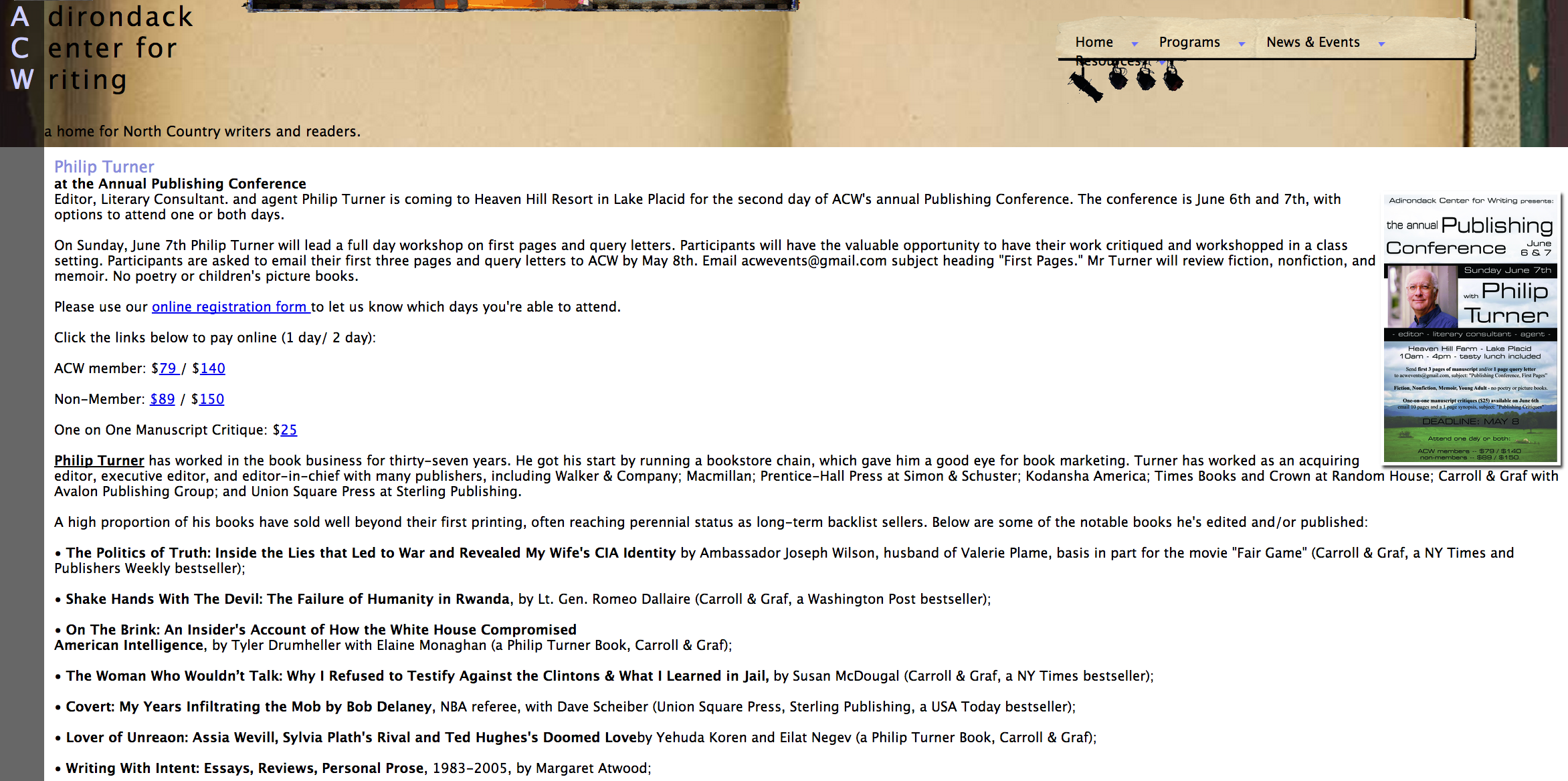
Inspired Readings by the 2014 NBCC Award Finalists
 From the opening night of the National Book Critics Circle‘s annual two-night literary extravaganza, here are pictures I took of some of the finalists who read excerpts from their nominated books. They gave inspired renderings of their work. The awards will be given tonight, in six categories—Poetry, Criticism, Biography, Autobiography, Nonfiction, Fiction—at the New School’s Tishman Auditorium on W. 11th Street at 6pm, free admission. I hope to sit even closer to the stage tonight, for the best possible pictures.
NYC & Hudson River Views, March 5-6, 2015
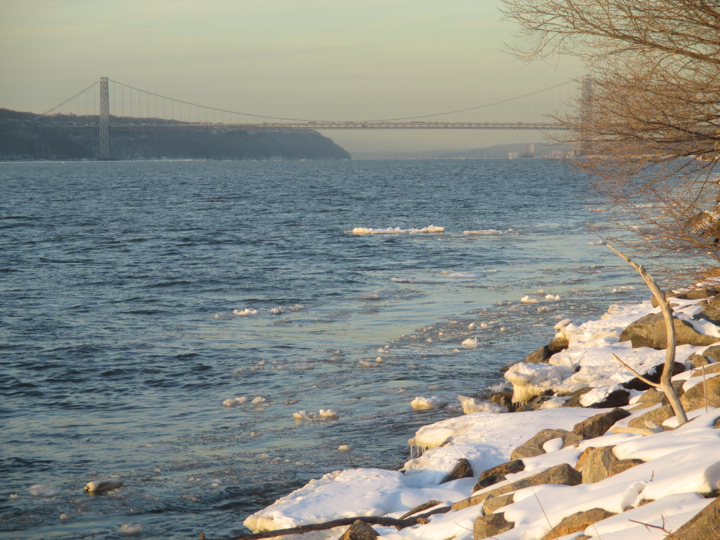 Pictures taken on walks in my Manhattan neighborhood March 5-6, 2015. On Thursday, there was wind-driven snow from midnight till evening with about 7 inches accumulation, when I took the first two pictures posted here. Today, Friday, was bright and sunny, a good day for a walk along the Hudson. All pictures here.
PEN’s Annual Meeting a Reminder of the Organization’s Mission

Post by Philip Turner.
PEN’s annual meeting last night was the third or fourth such gathering I’ve attended, and it was enriched by the fact that a programmatic element was included in the event, a panel on a recent PEN visit to China, when the delegation met with Ai Weiwei, among other artists and writers. While in other years the meeting was mostly minutes and committee reports, last night’s reminded us of PEN’s mission as an advocate of free expression. Quoting Aung San Suu Kyi from her years as a political prisoner in Myanmar, incoming PEN president Andrew Solomon reminded us of PEN’s mission: “Please use your liberty to defend ours.”
Tracking Malaria, its Calamitous History and Worrying Future
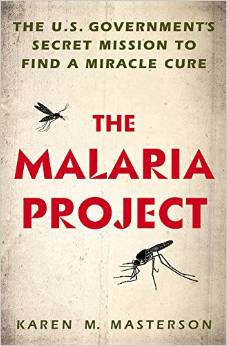 Fascinating Q&A on C-Span BookTV w/narrative science writer Karen Masterson, author of The Malaria Project: The US Government’s Secret Mission to Find a Miracle Cure, which chronicles the efforts of the US military which had for long been worried about the disease’s potential to infect American troops serving in far-flung locales. There was a move to find a cure for the mosquito-borne disease. Interesting to me, the book, which looks to be fairly serious science, is published by NAL. They brought out it in 2014, apparently first in hardcover. By my reckoning, NAL is a house long known more for mass-market paperback fiction than narrative nonfiction in hardcover. [It looks like they’ve now brought it out now in trade paperback.] Good for NAL, a nice piece of publishing. More on Masterson and her book via this link. You can view the video via this link on BookTV’s website.
One thing Masterson said amazed me. The effectiveness of bed nets—which have been a useful tool in combating malaria, preventing mosquitoes from biting people while they sleep—is being eroded because mosquitoes, hungry for what scientists call their “blood meal,” are adapting their behavior and learning to bite people earlier in the day when they are still out and about. In watching her talk about this global affliction that still sickens and weakens millions worldwide every year—and kills a considerable percentage of those stricken—I was reminded of a book that I began discussing in 2006 with Paul R. Epstein—a doctor and scientist, and at the time, associate director of Harvard’s Center for Health and the Global Environment. Epstein was a trailblazer in studying the effects of climate change on human health. I first heard his distinctive New York accent when he was a guest that year on an episode of “Fresh Air” with Terry Gross. You can still hear it, via this link. Listening to their conversation in a rental car, in a classic ‘driveway moment,’ I learned that due to the planet’s warming temperatures, mosquitoes that transmit malaria have over the past several decades begun doing so at more northern latitudes and higher elevations than they have ever been known to do before. Epstein also discussed the finding that the tick-borne illness dengue fever is also occurring at latitudes and elevations where it was before not seen. Epstein discussed how these diseases are infecting a much greater number of people worldwide due to the warming of our planet.
These are only a couple of the scientific discoveries chronicled in Epstein’s book, Changing Planet, Changing Health: How the Climate Crisis Threatens Our Health and What We Can Do about It, co-written with Dan Ferber, which ultimately came out in 2011. I actually commissioned it in 2007, shortly after I became Editorial Director of Union Square Press at Sterling Publishing, a job that ended two years later when Sterling, a division of Barnes & Noble, shuttered the imprint, a milestone I’ve also written about on this blog. When I left the company, my old bosses quickly canceled Dr. Epstein’s book, although I had nearly completed editing the manuscript. Fortunately, that decision, though very shortsighted, while preventing the book from being published as soon as it might have, it was later picked up by the University of California Press, to be published alongside other important environmental titles. This is a link to the book on U Cal’s website. Sadly, Dr. Epstein, died in November 2011, at age 67, of cancer. Here’s a Washington Post obit on him. Though we fell out of touch after Union Square Press closed, I recall we did speak a couple more times, and he sent me a finished copy of the book, which he inscribed to me with a very generous message, “April 25, 2011 To Phil Turner—The motivating force for this book. Warm wishes, Paul,” pictured below. I didn’t know he was ill, and was stunned by news of his death.


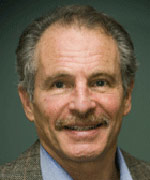 Before Dr. Epstein became a teacher and researcher at Harvard, he had worked as a doctor in places like Mozambique and Angola, devoting himself to the study of tropical diseases and improving public health in developing countries. It was a privilege to meet and work with him. I was really sorry he wasn’t able to make personal appearances in front of audiences, on TV, and on radio, like I first heard him. As I listened to Karen Masterson on C-Span tonight, I found myself wondering if she knows about Paul’s research on the growing incidence of malaria and other illnesses worldwide due to climate change, and if she has perhaps read Dr. Epstein’s book. I see she teaches science writing at Johns Hopkins, so perhaps I’ll have a chance to send her this post and find out. [I did correspond with Ms Masterson and she was interested to learn about Dr Epstein and his book.]