Celebrating the Holidays with the Singing Roches
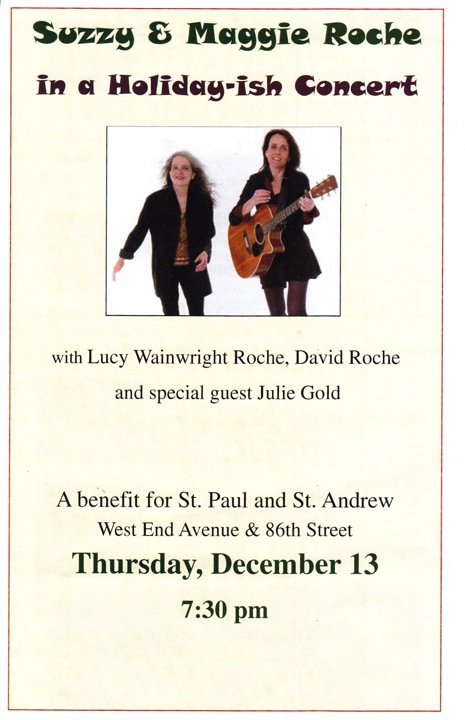
The night before the tragedy in Newtown, CT, I attended a special holiday concert put on by Suzzy and Maggie Roche with their extended musical family. It was a wonderful show, full of humor, uplifting sentiment, and infectious music. Sadly, the next morning as I downloaded photos from my camera and prepared to write a blog post about the show, news of the Newtown shootings began to emerge. I put the idea aside, my heart just wasn’t in it, especially after I learned that a former colleague’s 6-year old son was among the dead. Tonight, with Christmas Eve day ticking on toward midnight, even while another violent outburst of deadly gunfire was reported today, near Rochester, NY, I’ve decided to finally share my pictures and make this into a bit of a Christmas post.

I’ve written about the Roches a number of times over the past several months. First, Kyle and Ewan and I had fun at Terre Roche’s Sunset Singing Circle in Battery Park in June. This public sing-a-long was held at the tip of lower Manhattan, facing New York harbor and the Statue of Liberty. I also wrote about sister Suzzy’s splendid mother-daughter novel, Wayward Saints,  a tragi-comic tale of rock n’ roll, family, and second chances in life. I posted next when Terre published a NY Times Op-Ed on what she dubbed the new busking in the music biz, with emerging mechanisms to seek funding for support of recording such as Kickstarter and Indiegogo. Finally, last summer Suzzy led a Bryant Park reading room discussion on Edith Wharton’s House of Mirth, which Kyle and I greatly enjoyed, and which I wrote about, as well.

They are clearly a very talented family, and I’m a fan. What’s more, they don’t just rest on their laurels for things they did back in the day (with Maggie) as The Roches, with such great compositions as “Hammond Song,” with its theremin-like lead instrument and great harmonizing of all three voices. It’s still a beautiful song, and deserves a fresh listen, if you haven’t heard it recently, or ever. That’s why I was eager to attend Suzzy and Maggie’s Dec. 13 program, what they called a “holiday-ish concert,” which was also going to include their brother, David, with his daughter, Oona; Suzzy’s daughter, Lucy Wainwright Roche (whose father is Loudon Wainwright III, composer of the the classic, “Dead Skunk in the Middle of the Road”); and singer songwriter, Julie Gold, best known for her song “From a Distance,” which Bette Midler recorded and made famous as a Grammy Song of the Year in 1991. It promised to be quite a program, and the event didn’t disappoint, at all.

I had never heard Maggie before this occasion, and it was interesting to hear her voice mix with that of Suzzy, with it a bit lower in register by comparison. They did “Hammond Song,” with Lucy taking the part that would’ve earlier been sung by Terre. Lucy also sang the title song from her latest album, “There’s a Last Time for Everything.” That wordplay is found in much of the Roches’ writing, with humor in their lyrics and a kind of plain-spoken matter-of-factness that I found refreshing. It doesn’t at first seem artistic, and the lack of artifice is welcome; what it is, is real. Scan the first verse of their song, “We,” their opening number on this program, credited to all three of the sisters, which they wrote in 1979:

We are Maggie and Terre and Suzzy/Maggie and Terre and Suzzy Roche/we don’t give out our ages/and we don’t give out our phone numbers/give out our phone numbers/sometimes our voices give out/but not our ages and our phone numbers

The night ended with them inviting anyone in the audience who wanted to sing in the last few carols to join them at the front of the church. A lively group assembled around them and the evening ended with a great, joyous sing-a-long. I’m glad I could be there, and finally post this little essay on the concert, notwithstanding the terrible tragedies that have intervened. I hope the photographs below give you a full sense of this special program. Please click here to see all photos.

Windy Hudson River Bike Ride Photos

I shared a couple of these photos on Instagram earlier, but here are two others. They were all taken on a break during a very windy bike ride this past Saturday. Standing on a bluff above the Hudson River as as an intense, dramatic sunset glowed across the whole skyline, I am in upper Manhattan at about 165th Street, looking south down the river back toward the city. Though I’ve often ridden in strong wind along the Hudson, the gusts usually come from one direction. Saturday, they swirled and came from all points of the compass.

Alexander Moulton, 1920-2012, Innovative Bicycle Designer

Although Englishman Alexander Moulton (pictured here) was trained as an automotive engineer his most lasting professional contribution was as the designer of the first mini-bicycle, the forerunner of today’s folding bikes. The fascinating NY Times obituary details the moment when

“Moulton began toying with a small-wheel design for an adult bicycle in the late 1950s. His interest was partly spurred by gasoline rationing in Britain during the Suez crisis, which began when Egypt nationalized the Suez Canal, an act that threatened to halt oil shipments to Western Europe from the Persian Gulf.

But the design was also fostered by his own engineer’s determination to make things better: ‘The Moulton bicycle was born out of my resolve to challenge and improve upon the classic bicycle,’ he said.

His idea was to create a more efficient, all-purpose vehicle, suitable for errands and commuting at least as much as for recreation. He wanted it to have substantial carrying capacity, to be maneuverable in traffic, to roll smoothly and to be pedaled easily.

He came up with a bike with wheels 16 inches in diameter, high-pressure tires for minimum rolling resistance, front and rear rubber suspension systems for smooth riding on potholed or cobblestoned roads, and a step-through frame (that is, without the top tube of the traditional diamond-shaped frame) for easy dismounting (and more suitable for women wearing skirts). The small wheels left plenty of room for carrying briefcases, shopping bags or overnight luggage. The early bikes could easily be taken apart for convenient stowing, though they were not really foldable; still, the small-wheel collapsible bikes of today owe a debt to the original Moulton. ([The Moulton company] now makes foldable bikes itself.)”

I’ve owned mini- and collapsible bikes and didn’t know who’d invented them.  They are great city errand-running bikes. I also love the fact that they were invented as a response to a fuel crisis. Thank you, Alexander Moulton!

Young Adult and Homeless in U.S. Cities

As reported by Susan Saulny in Wednesday’s NY Times, more and more young people are suffering financially in the wake of the recession and lingering weak economy and are unable to keep themselves sheltered in homes of their own. Saluny traveled to Seattle, one of the few American cities that has outreach services specifically geared to helping people ages 18-25. She profiles young people like Duane Taylor, 24, who was,

“Studying the humanities in community college and living in his own place when he lost his job in a round of layoffs. Then he found, and lost, a second job. And a third.

Now, with what he calls ‘lowered standards’ and a tenuous new position at a Jack in the Box restaurant, Mr. Taylor, 24, does not make enough to rent an apartment or share one. He sleeps on a mat in a homeless shelter, except when his sister lets him crash on her couch.

‘At any time I could lose my job, my security,’ said Mr. Taylor, explaining how he was always the last hired and the first fired. ‘I’d like to be able to support myself. That’s my only goal.’

Across the country, tens of thousands of underemployed and jobless young people, many with college credits or work histories, are struggling to house themselves in the wake of the recession, which has left workers between the ages of 18 and 24 with the highest unemployment rate of all adults.”

Although data on this overlooked population is scarce, it’s clear that Taylor’s situation is part of a growing trend.  Saulny reports that the Obama administration has begun outreach with employment counseling and other services in a number of cities where this population has grown more visible. “New York, Houston, Los Angeles, Cleveland and Boston are among the cities included in the effort.”

She writes also about a 20-year old man named Roman Tano who’s recently been staying,

“At YouthCare’s James W. Ray Orion Center [in Seattle], another shelter for young adults that offers training programs. In October, its capacity grew to 20 beds from 15.

Two months ago, Mr. Tano gave up an apartment in his native Dallas after losing his job. He sold his Toyota and sought opportunities in the Pacific Northwest.

He rented a room and set out with his résumé (expertise: fund-raising). But when his $2,000 in savings withered to nothing, “I ended up sleeping on the street for the first time in my life,” he said. ‘I just kind of had to walk around and try to stay warm.’

Mr. Tano found the YouthCare shelter online, and has been staying there for a month. He has a new job as a canvasser for an environmental organization.

‘Coming into it, I was, like, completely out of my element,’ he said of YouthCare. ‘But in the time I’ve been here, it’s a pretty diverse group of people. There are a lot of people just trying to work to get out of this.’

‘After I get my paycheck,” he said brightly, “I should be on my way.’”

As readers of this blog may recall, I wrote a personal essay, Three Years Ago Today, on my own search for meaningful and remunerative work in the wake of a layoff amid the recession, and have linked to the site called Over 50 and Out of Work, which republished that essay as Warding Off the Demons of Disemployment, but I was unaware until tonight of young people being affected so dramatically by the economic crisis. I hope young Mr. Tano is soon on his way to a better situation, but I must add that it is crazy and misguided for Republican representatives and senators to be criticizing President Obama’s request for more economic stimulus, instead demanding deficit reduction and austerity even though we have so many people suffering with lack of work and career advancement. You may click on this link to see the video with interviews of Duane Taylor and Roman Tano accompanying Ms. Saulny’s well-reported article.

Fun Night of Live Music with Mona’s Hot Four

This past Tuesday night I had a great time at the Rockwood Music Hall for a combined launch of a new documentary and CD. The film is called “Tuesday at Mona’s” as is the new CD, a live recording, and they feature a jazz quartet called Mona’s Hot Four, who have a long-running weekly gig on Manhattan’s Lower East Side at Mona’s Bar on Avenue B between 13th and 14th streets. The basic outfit is clarinet, piano, stand-up bass, and guitar, and is regularly supplemented by additional players on various instruments.

This launch had originally been planned for the week Superstorm Sandy hit NYC, but was of course canceled. Mona’s frontman, clarinetist Dennis Lichtman reported that Rockwood was forced to cancel 81 shows because of Sandy. They were able to reschedule, and the boisterous crowd did not seem at all diminished by the change. Just after 8 PM a film screen was unrolled on stage, and a projector was clicked on to screen the new documentary. About 30 minutes long, the film tells the feel-good story of how an  eclectic tribe of jazz players ended up finding at Mona’s the ideal venue and audience for their passionate enthusiasms for tunes of the halcyon pre-bop era. There are several extended songs and a number of interviews with musicians, fans, bartenders, and Wall St. Journal jazz critic Will Friedwald, who touted Mona’s Hot Four and the scene at the bar in an 2011 diary-like piece, “After Midnight at Mona’s”:

11:30 p.m. Within a few numbers (“Margie,” “Blues My Naughty Sweetie Gives to Me”), it’s abundantly clear that this group is immersed in the early New Orleans jazz idiom…. 1 a.m. The room is packed with young men sporting beards and slender women with Bettie Page bangs and abundant tattoos. There must be 100 people crammed inside this tiny bar, with seats for maybe 15, and only a fraction of those either sitting or standing can actually see the band. The room is dense with young musicians carrying instrument cases, or wearing their saxes around their neck, waiting to be called. “I think it’s amazing that we’ve become a mecca for those who love this music,” Mr. Lichtman says….2:30 a.m. The band is starting to thin out, and plays two numbers just to delight the record collectors in the crowd, “Dardanella” and “Hang Out the Stars in Indiana,” the latter fetchingly sung by Ms. [Molly] Ryan.

Once the film ended, Mona’s Hot Four took the stage, with clarinetist Lichtman introducing his band mates: Gordon Webster (piano), Jared Engel (bass), and Nick Russo (guitar). Their playing is a joy to hear with clear melodic lines on standards like “My Blue Heaven,” tasty licks on “Sugar Blues,” and fluent ensemble work on “Up a Lazy River.” Though Rockwood is not the Hot Four’s usual venue, many additional players showed up to supplement the quartet. In the set that followed the documentary, they were joined on stage by a caravan of players on trombone, trumpet, banjo, snare drum, and a number of talented vocalists. Among this retinue was singer the aforementioned Molly Ryan and banjo player and vocalist Jerron Paxton.

Lichtman fronts another group, Brain Cloud, which I had enjoyed and posted about during the Brooklyn Folk Festival last May. I hope I have another chance to hear them sometime, as they have a semi-regular gig at the Rodeo Bar in Manhattan. That group also plays some jazz, though with a different flavor than Mona’s Hot Four, as well as Western swing, klezmer, and songs from Tin Pan Alley, with vocalist Tamar Korn (who also sang with Mona’s Hot Four this week). After the documentary and an abbreviated set of music, Lichtman announced that Mona’s Hot Four would later that night they’d be camped out at Mona’s Bar for their usual late Tuesday night set. I wasn’t able to migrate to Mona’s on this night, but I do hope to hear them there some other week. If you’d like to buy the DVD/CD which includes the documentary and live album in one package, you can order it via this link, and listen to some of the Monas’ hot stuff.

Here’s a 2010 video of Mona’s Hot Four I just found online:

On my way back uptown, I stopped in at another great spot, the 11th Street Bar, to hear what live music they might have on in their back room. I was delighted to discover a band there led by guitarist Teddy Kumpel, whose band of drums, bass, and another lead guitar, was having fun playing an infectious melange of funk and blues. You can hear a sample of his groove at this page on his websitePlease click through on this link to see all photos I took during this fun night of live music.

Carrying On the Tradition of a Brave Human Rights Rabbi

Dec. 6 Update: As of noon today, a NY Times article about the expression of support for the UN’s endorsement of Palestinian statehood by the rabbis and board at B’Nai Jeshurun was the most emailed story on the Times website. Also, for any readers of this blog who would like to discover more about the late Marshall Meyer (1930-93), my friend and longtime BJ member Jane Isay reminds me of Marshall’s posthumous book You Shall Be My Witness, which she edited with Marshall’s widow, Naomi.

Dec. 4, 2012
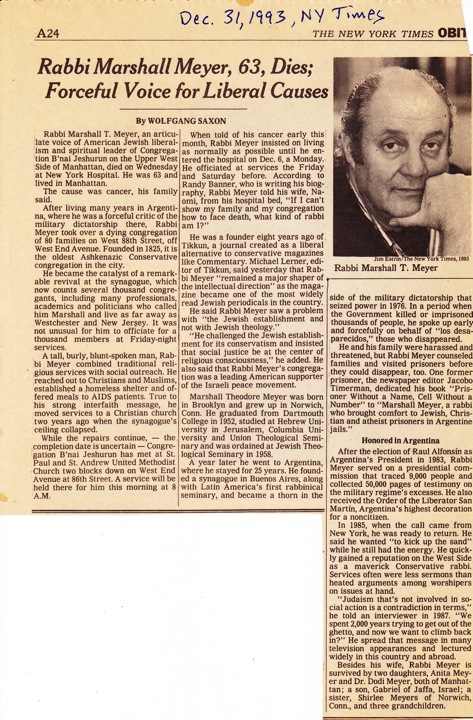
Though I have not officially been a congregant for the past several years, I was for more than a decade (1985-97) an active member of Congregation B’Nai Jeshurun, a Manhattan synagogue. Its lead rabbi during the years I was active, until his untimely death in 1993, was Marshall T. Meyer. I met Marshall in 1985, shortly after he returned to the United States from Argentina following a lengthy sojourn as a rabbi there, during which time he became an outspoken critic of the military junta that imprisoned, tortured, and ‘disappeared’ thousands of people they deemed opponents in the country’s “dirty war.” The dedication of the searing 1981 book, Prisoner Without a Name, Cell Without a Number, by Argentine activist and former prisoner Jacobo Timerman, reads,

To Marshall Meyer

A rabbi who brought comfort

to Jewish, Christian, and atheist prisoners in

Argentine jails.

After the murderous generals fell from power, Marshall served on the national commission that investigated and chronicled the full range of crimes and abuses they had committed, the only non-Argentine to do so. He told me in sadness that after his service on that body he found he could no longer be an honest pastoral counselor to victims’ families, having learned disturbing details of the torture prisoners endured; he felt torn between sharing what he knew when grieving survivors asked him about their relatives’ last days, and the desire to spare them more agony. However, they sensed he knew more than he could say. Marshall—who as a rabbinical student worked with spiritual giant Abraham Joshua Heschel, typing several of his book manuscripts prior to publication—had a big personality and was unflinchingly vulnerable. He gave and received a lot of hugs. When he returned to the States from Argentina, he soon became rabbi of B’Nai Jeshurun, then a somewhat moribund Manhattan congregation, and within a short time had made it one of the most vital synagogues in New York City. It even gained a nickname, ‘BJ.’ During his tenure, Marshall recruited two younger rabbis to serve alongside him there, Roly Matalon and Marcelo Bronstein–from Argentina and Chile, respectively–who fully took the helm after his wrenching death, at only age 63. Though I’m not much involved with the congregation these days, I still consider myself a sort of lay disciple of Marshall’s, and a friend to Roly and Marcelo and to the congregation.

As a reading of Marshall’s NY Times obituary will attest, provided here in a link and below as a scan of my original clipping, Roly and Marcelo carry on Marshall’s committed rabbinate. The NY Times reports tonight that the two rabbis, along with BJ’s longtime musical director, Cantor Ari Priven, and rabbinical colleague Felicia Sol, and the institution’s board, have made public an open letter they wrote, seconding the UN’s vote last week that endorsed Palestinian statehood. The Times article reprints the entire letter, as I will do too.

Dear Friends,

Yesterday’s vote at the UN on Palestinian membership was a day which will go down in history, although what history will write about it only time will tell.

In this week’s Parashat Vayishlach, Jacob battles with the angel and earns the name Israel. It is the first time we are recognized as the people of Israel. Our own struggles were rewarded exactly 65 years ago on 29 November 1947 with the UN partition plan that acknowledged the right of the Jewish people to an independent state.

The Parasha also tells us how Jacob prepares to meet his brother Esau again, 20 years after fleeing from him. The risks are real — Esau has threatened to kill him. This meeting is the biblical prototype of confrontation between Israel and the nations. Before the meeting with Esau, Jacob prepares in three ways: he divides his camp in two, he prays to God, and he sends Esau gifts and conciliatory messages. These three tactics mirror the basic strategies that Israel has at its disposal: preparation for battle, prayer, and diplomacy.

We as a nation have had to rely on all three at different times. Today we feel it is critical that we remember the crucial role that diplomacy played in achieving independence for the State of Israel.

The vote at the UN yesterday is a great moment for us as citizens of the world. This is an opportunity to celebrate the process that allows a nation to come forward and ask for recognition. Having gained independence ourselves in this way, we are especially conscious of this. Every people has the right of recognition, every person has the right of recognition.

As Jews deeply committed to the security and democracy of Israel, and in light of the violence this past month in Gaza and Israel, we hope that November 29, 2012 will mark the moment that brought about a needed sense of dignity and purpose to the Palestinian people, led to a cessation of violence and hastened the two state solution.

We continue to pray for a lasting peace between Israel and her neighbors.

As soon as I read about what they’d done at BJ, I tweeted this out with the link to the Times piece:

Philip Turner ‏@philipsturner
Proud of NYC’s Cong B’Nai Jeshurun, its rabbis&board for boldly voicing support of UN vote for Palestinian statehood. http://nyti.ms/UEwkGK

Now I’m happy to share the news even more widely, here on this blog. For the record, I will state that I believe in co-existence and a two-state solution as the best hope for resolving the decades-long conflict between Israelis and Palestinians. I’m grateful to have known and shared a deep friendship with Marshall, and appreciative of the legacy that his successors faithfully carry on at BJ.